TL;DR. A Notion habit tracker is a free, fully customizable template inside a workspace you may already use, but it has no real native reminders, takes manual upkeep, and tends to fall apart the first time you miss a day or change your routine. Loggd is a dedicated tracker with reminders, cross-device sync, and a forgiving contribution grid that treats a missed day as one lighter square, not a reset. Use Notion if you live in Notion and want full control. Use Loggd if you want something that nudges you and survives a missed day.
If you searched "notion habit tracker," you are almost certainly choosing between two very different things: a do-it-yourself template inside Notion, or a dedicated habit app. They look similar in a screenshot. They feel completely different after two weeks.
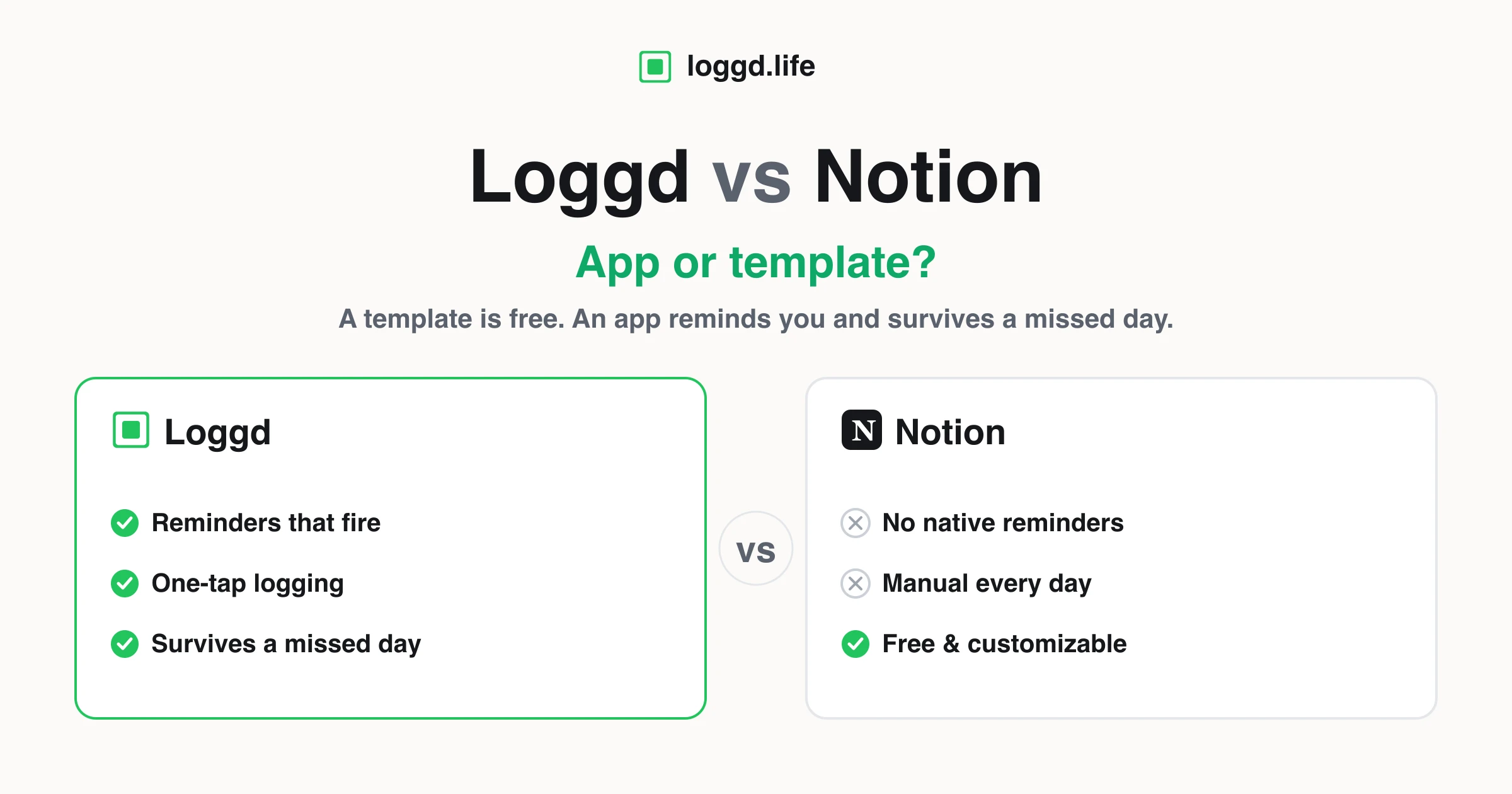
A Notion habit tracker is free and endlessly customizable, but it has no native reminders and tends to break when you miss a day. A dedicated app like Loggd adds reminders, one-tap logging, cross-device sync built for daily use, and a forgiving contribution grid. Here is the honest comparison, including where Notion genuinely wins.

Loggd vs Notion habit tracker at a glance
| Loggd | Notion habit template | |
|---|---|---|
| What it is | Dedicated habit and life tracker | A template inside a general workspace |
| Price | Free tier; €7/mo or €48/yr; €89 lifetime | Free (Notion free plan covers it for one person) |
| Customization | Fixed, opinionated, fast | Almost unlimited (you build it) |
| Native habit reminders | Yes (push and email) | No (workarounds only) |
| Logging friction | One tap | Open Notion, find page, edit cell |
| Handles a missed day | Forgiving grid, no reset | Usually breaks or looks "failed" |
| Cross-device | Web and iOS, built for daily logging | Yes (Notion apps), but heavier to use |
| Setup time | Minutes, works out of the box | From minutes to hours, depending on template |
| Lives next to your notes/projects | No | Yes (its main advantage) |
| Gamification | Levels, XP, badges, streaks | None (unless you build it) |
The short read: Notion wins on price, customization, and integration with the rest of your workspace. Loggd wins on reminders, friction, and surviving real life. Pick by which of those you actually need.
Where Notion habit templates genuinely win
Let me be fair first, because the "Notion is bad at this" takes online are usually overstated. There are real reasons people love a Notion tracker.
It is free and you may already pay nothing. Notion's free plan is enough to run a personal habit tracker for one person. If you already use Notion, adding habit tracking costs you nothing.
It is infinitely customizable. This is the big one. You control every column, view, color, formula, and rollup. Want a habit tracker that also computes a weekly score, links habits to your goals database, and shows a custom progress bar? You can build exactly that. No dedicated app gives you that much control.
It lives next to everything else. Your habits sit beside your notes, your projects, your reading list. For a true Notion power user, that single-workspace consolidation is genuinely valuable and hard to replicate.
If you are already a Notion devotee who opens the app every day without being told to, a good template can absolutely be enough. Notion's own marketplace and creators offer dozens of solid free habit templates with daily, weekly, and monthly views.
So the honest concession is this: if Notion is already your home base, a template is free, integrated, and good enough. The rest of this article is about the people for whom it is not.
Where Notion habit trackers fall apart
Here is the pattern that sends people from a Notion template to a dedicated app. It is not that Notion is bad software. It is that a general workspace is the wrong tool for the specific job of keeping a daily habit.
Does Notion send habit reminders? Not really.
This is the single biggest gap. Notion has no reliable native daily habit reminder. It can surface a reminder on a specific dated item, and recurring databases can repeat, but there is no built-in push notification that taps you on the shoulder every evening and says "you have not checked off your habits yet."
The thing that makes habits stick is a timely nudge at the moment of action. A tracker that waits silently for you to remember to open it is leaning entirely on the willpower it was supposed to replace. People build workarounds with third-party automation tools, but that is a project you have to set up and maintain. Out of the box, your Notion tracker will never chase you.
Loggd sends habit reminders by design, push and email, at a time you choose.
Every check-in is manual friction
In Notion, logging a habit means: open Notion, navigate to the right page, find today's row, and edit a checkbox or property. That is four steps and a context switch, every single day, for a thing that should take one tap.
Friction is where habits die. The whole point of a dedicated tracker is to make logging so fast it does not compete with the rest of your day. One tap, done. Multiply the difference by 365 days and it is the difference between a habit that survives and one that quietly stops.
It breaks the moment you miss a day
This is the complaint you will see everywhere, and even ClickUp's own analysis of Notion habit templates makes the same point: they tend to break when you miss a day or change your routine.
Here is why. Most Notion trackers are rigid grids. Miss three days and the grid now shows empty cells that read as failure. Change your routine, drop a habit, add a new one, and the carefully built layout no longer matches your life. There is no forgiving logic, just a static table that now looks broken. So you stop opening it, and within a week the tracker is abandoned.
This is not a hypothetical. In our own aggregate data across thousands of trackers, the overwhelming majority of habits never make it past the first few days, and a model that visually punishes the first miss is a model optimized to make people quit. We wrote about that in detail in why a contribution grid beats a streak counter.
What a dedicated tracker adds
A purpose-built tracker is not "Notion but worse at customization." It is a different bet: give up control, get back consistency. Here is what that buys you.
- Reminders that actually fire. Push and email nudges at a chosen time, no setup project required.
- One-tap logging. Open the app, tap the habit, done. No navigation, no editing cells.
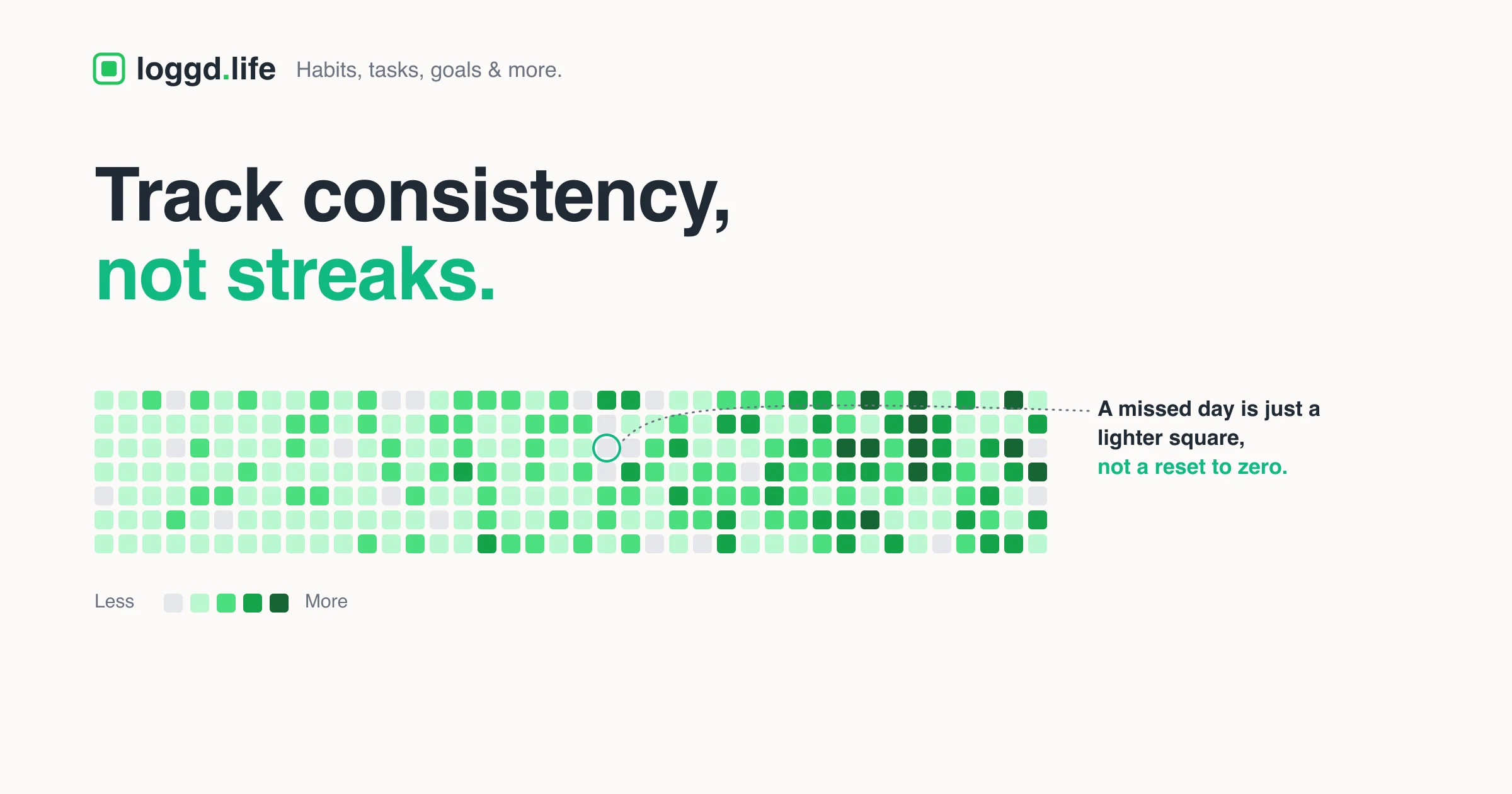
- A forgiving model. Loggd's default is a contribution grid: a missed day is a lighter square in a year of darker ones, not a reset to zero and not a row of red. It is built to survive a bad week.
- Cross-device sync built for daily use. Loggd runs on the web and on iOS with home-screen widgets, with an Android app in development. You can check off a habit from your phone's home screen or a work browser without opening a heavy workspace.
- A whole system, not just habits. Loggd also includes tasks with natural-language input, a built-in focus timer, goals, and a bucket list, all connected. It is closer to "Notion's all-in-one promise, but opinionated and fast" than to a single-purpose checkbox app.
- Gamification. Levels, XP, badges, and streaks give the boring middle of habit-building some visible progress. A blank Notion grid gives you nothing until you build it.
The trade is real and worth stating plainly: you lose Notion's unlimited customization and you lose having everything in one workspace. In exchange you get a tool whose entire job is making the habit stick.
Who should pick which
Pick a Notion habit template if:
- You already use Notion every day and open it without being reminded.
- Customization matters more to you than nudges. You want to build the exact dashboard in your head.
- You want your habits sitting next to your notes, projects, and databases.
- "Free" is the deciding factor and you are willing to do the upkeep.
- You are disciplined enough that you do not need the app to chase you.
Pick Loggd (or another dedicated tracker) if:
- You need reminders. If "I just forget" is why your last tracker failed, this is decisive.
- You want logging to take one tap, not four.
- Your past trackers fell apart after a missed day and you want a model that absorbs gaps.
- You want something that works out of the box, no template hunting, no formula building.
- You want one connected system for habits, tasks, focus, and goals, with a free tier to start.
There is a simple honest rule buried in all of this. If you already open Notion every single day without being reminded, a template can replace an app. If you do not, it cannot, because the missing daily-open habit is exactly the habit the tracker was supposed to help you build.
Frequently asked questions
Is a Notion habit tracker good?
Good if you already live in Notion and want full control of the layout. Weak as a habit-building tool, because it has no native reminders, every check-in is manual, and most templates break when you miss a day.
Does Notion send habit reminders?
Not natively in any reliable daily-nudge sense. You can hack reminders with recurring items or third-party automations, but out of the box Notion will not chase you to log a habit. A dedicated app like Loggd does.
Is a free Notion template better than an app?
The template wins on price, customization, and integration. The app wins on reminders, low-friction logging, and surviving a missed day. Pick by which you need more.
Why does my Notion habit tracker keep falling apart?
Because it is manual and rigid with no nudges. Miss a day or change your routine and the layout stops matching reality, so you abandon it. Even ClickUp's analysis notes Notion trackers tend to break on a missed day.
Can Notion replace a habit tracking app?
For disciplined Notion power users, yes. For most people, no, because habits stick on low friction and timely reminders, which is exactly where a DIY Notion setup is weakest.
What is the best Notion habit tracker template?
The simplest one you will actually open daily. If you are shopping for the perfect template instead of checking off habits, the tool has become the project, and a dedicated tracker would get you building habits faster.
About the author
I'm Eusebiu, the solo founder building Loggd. I have been a dev contractor for about five years and I am now going full time on Loggd, building it in public and sharing the journey with a growing audience on Threads. I genuinely like Notion and use it for notes and planning. I built Loggd because a workspace is the wrong tool for the one job of keeping a daily habit: it does not remind you, it makes logging slow, and it punishes a missed day. This comparison tries to be fair to a tool I actually use.
Last updated: June 2026.
Try Loggd free
If a Notion template fits your brain and your workflow, keep it, it is free and flexible. But if your trackers keep dying because nothing reminds you and one missed day makes the whole thing look broken, start with Loggd: reminders, one-tap logging, and a forgiving grid. Three habits free, no card.