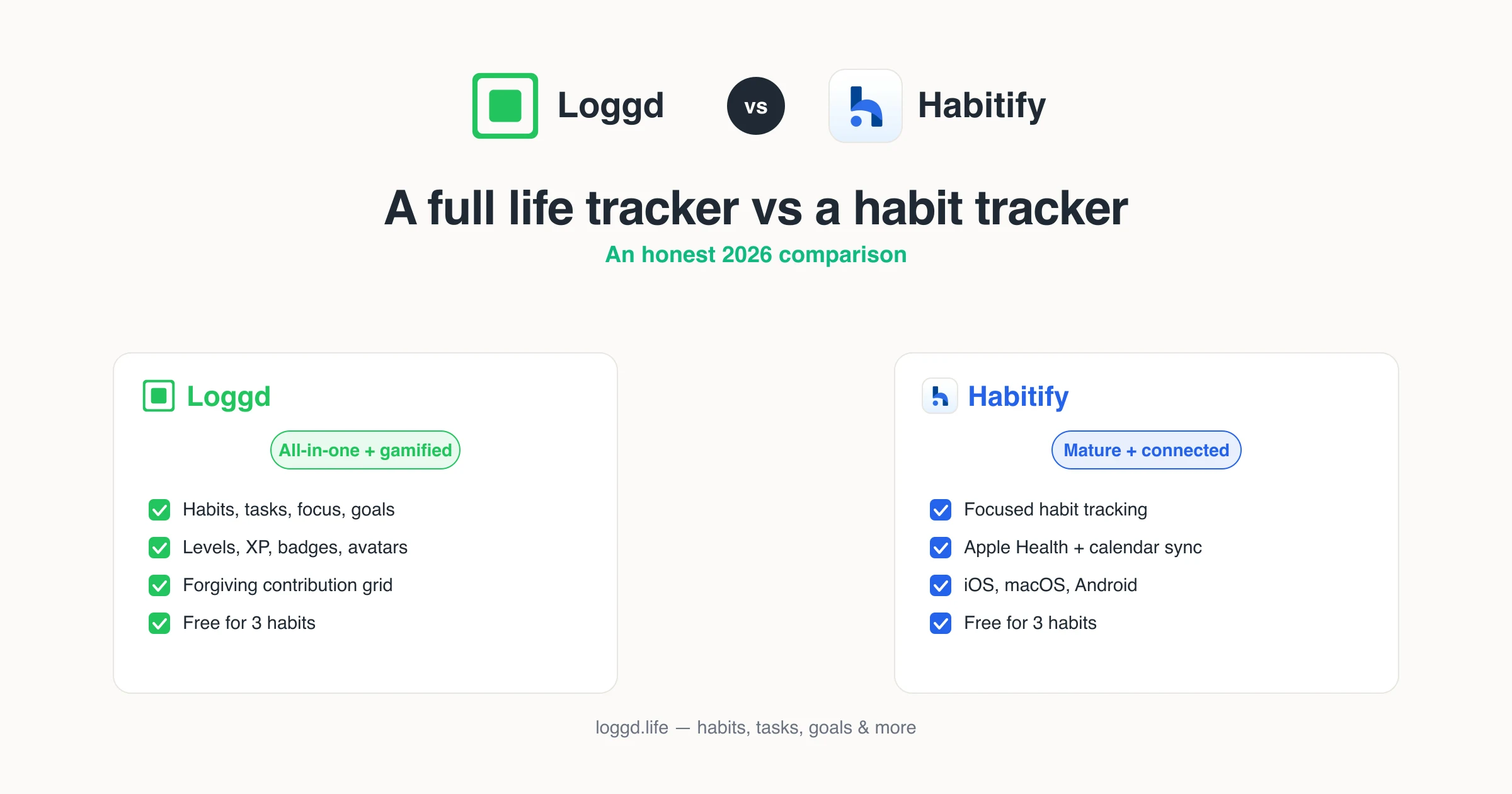
TL;DR. The biggest difference is scope. Habitify is a focused, polished habit tracker. Loggd is a full life-tracking platform: habits, tasks, a focus timer, goals, and a bucket list in one app, wrapped in light gamification (levels, XP, badges, avatars, leaderboards) and a forgiving GitHub-style contribution grid. Both are free for 3 habits, then priced similarly (Loggd €7/month or €48/year; Habitify about $2.49/month billed annually or $59.99 lifetime as of mid-2026). Pick Habitify if you want a single-purpose tracker with deep Apple Health and calendar integrations plus a native Android app. Pick Loggd if you want one app for your whole system, with progress that survives a missed day.
The real question is not "which app tracks habits better." Both track habits fine. The question is how much you want one app to do.
Habitify does one thing and does it well: habit tracking, with mature analytics and integrations. Loggd is built to replace the stack of apps most people juggle, a habit tracker, a to-do app, a focus timer, a goals tool, all in one place, and it makes the process stick with light gamification and a tracking view that forgives a bad day.
Here is the honest head-to-head, with live pricing, so you can decide in a couple of minutes.

Loggd vs Habitify at a glance
| Loggd | Habitify | |
|---|---|---|
| Free tier | 3 habits, 2 goals, 30 tasks, 4 tags | 3 habits |
| Monthly price | €7/mo | Not offered (annual only) |
| Annual price | €48/yr | |
| Lifetime | €89 (limited) | $59.99 |
| Platforms | Web, iOS (+ home-screen widgets); Android in development | iOS, macOS, Android |
| Main tracking model | Forgiving contribution grid (streaks available too) | Streaks + analytics |
| Scope | All-in-one: habits, tasks, focus timer, goals, bucket list | Habit tracking (focused) |
| Gamification | Levels, XP, badges, avatars, leaderboards | Minimal |
| Health/calendar integrations | API + webhooks (no Apple Health/calendar yet) | Apple Health, Apple/Google Calendar, Zapier, IFTTT |
The short version: Habitify is the more mature, better-connected single-purpose tracker. Loggd is a broader, gamified all-in-one platform with a more forgiving tracking model. Both genuinely give you 3 habits for free.
Pricing compared
Both apps cap their free tier at 3 habits, which makes this a fair fight. The difference is what you pay, and what you get, once you outgrow it.
Habitify (verified live on habitify.me/pricing, mid-2026):
- Free: 3 habits, cross-platform sync. No advanced reminders, calendar, Apple Health, or API.
- Premium: about $2.49/month billed annually (roughly $29.88/year). Unlimited habits, advanced and location-based reminders, calendar and Apple Health integration, API and automation.
- Lifetime: $59.99 one-time.
Habitify restructured its pricing in April 2026, so the exact figures can move. The numbers above are from the live pricing page.
Loggd:
- Free: 3 habits, 2 goals, 30 tasks, 4 tags, plus the focus timer, daily reflections, streaks, the contribution grid, and iOS home-screen widgets. No credit card.
- Pro: €7/month or €48/year. Removes the limits and adds advanced analytics, data export, and focus patterns.
- Lifetime: €89, limited availability.
On annual pricing, Habitify is cheaper (~$30/year vs €48). That is a real point in Habitify's favor if you only want habit tracking. Loggd's price covers a wider tool (tasks, focus, goals, bucket list), so you are paying for scope, not just habits.
Tracking philosophy: contribution grid vs streaks
This is the biggest difference between the two, and it is not about features, it is about how each app makes you feel when you slip.
Habitify is built around streaks and analytics. You get a running streak count, completion rates, and charts. It is clean and motivating, right up until you miss a day and the streak resets to zero. For a lot of people that reset is where the habit dies.
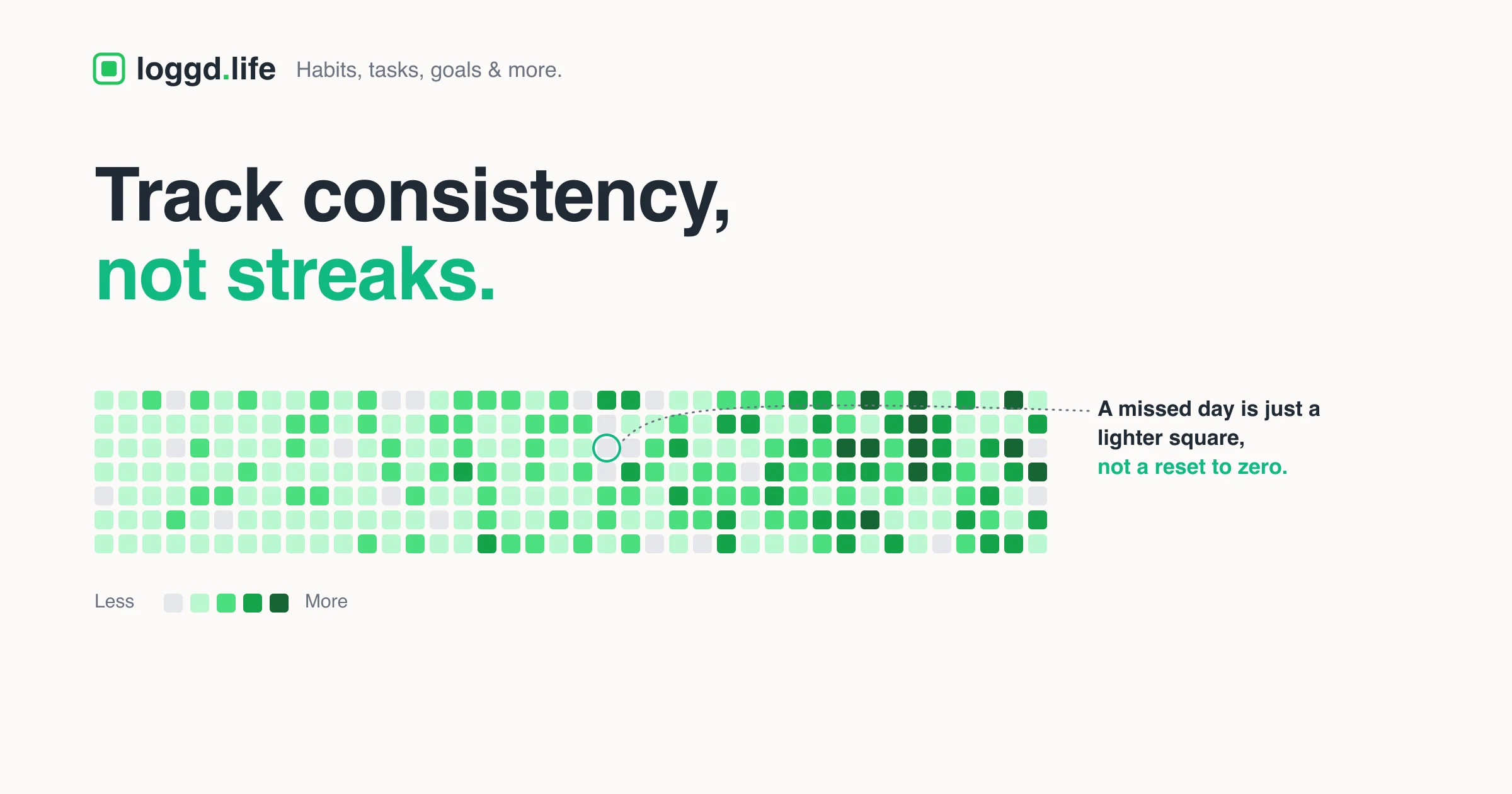
Loggd makes the contribution grid the main view instead. It is the GitHub-style heatmap: every day you log adds color, and a missed day is just a lighter square in a year of darker ones. Nothing resets. You can still see a streak if you want one, but it is not the headline.
So the honest framing is:
- Habitify suits you if streaks motivate you and you like detailed analytics.
- Loggd suits you if streak resets have made you quit before, and you want a view that rewards overall consistency instead of perfection.
Platforms and integrations: where Habitify wins
Credit where it is due. Habitify is the more mature, better-connected app, and it is not close in this category.
- Native apps everywhere. Habitify has iOS, macOS, and Android. Loggd has web and iOS today, with iOS home-screen widgets, and an Android app in development (no committed date). If you are on Android right now, Habitify is the practical choice.
- Health and calendar sync. Habitify connects to Apple Health, Apple and Google Calendar, and automation tools like Zapier and IFTTT. Loggd offers a REST API and webhooks for building your own integrations, but it does not sync with Apple Health or calendars out of the box yet.
If automatic syncing with your existing health and calendar stack is the thing you care about most, stop here and pick Habitify. Loggd is not trying to win that category yet.
Where Loggd wins: it is a whole system, not just habits
This is the heart of it. Habitify is a habit tracker. Loggd is a life-tracking platform that happens to include one of the best habit views around. On the same free tier, the same app also gives you:
- A task manager with natural-language input ("call dentist tomorrow at 3pm" just works).
- A built-in focus timer (Pomodoro-style) that feeds your progress instead of living in a separate app.
- Goals and a bucket list that connect to your daily habits, so a big ambition breaks down into something you actually track.
- The forgiving contribution grid as the default view, where a missed day is a lighter square, not a reset.
Habitify can track your habits. To match what Loggd does, you would also need a separate to-do app, a separate focus timer, and a separate goals tool, and none of them would talk to each other.
Gamification that makes it stick
Tracking is only useful if you keep doing it, and this is where Loggd pulls ahead. Loggd is gamified by design:
- Levels and XP. Every habit, task, focus session, and reflection earns points and levels you up, so progress is visible and rewarding from day one.
- Badges. Milestones and consistency unlock badges, turning the boring middle of a habit into something with checkpoints.
- Avatars. A library of avatars to make your profile yours.
- Leaderboards. Opt-in friendly competition, because doing it alongside other people works.
Habitify keeps things minimal and analytical, which some people prefer. Loggd treats motivation as a feature, not an afterthought, and the gamification is the engine that gets people past the first week.
Loggd is also built in public by a solo founder, so the roadmap and the reasoning behind every decision are out in the open. You are not buying into a faceless app; you can see exactly where it is going.
Who should pick which
Pick Habitify if:
- You need a native Android or macOS app today.
- Apple Health, calendar sync, or Zapier automation is essential.
- You want a focused, mature habit tracker and nothing more.
Pick Loggd if:
- You want one app for habits, tasks, focus, goals, and a bucket list instead of three or four separate ones.
- Gamification (levels, XP, badges, avatars, leaderboards) is what actually keeps you going.
- Breaking a streak has made you give up before, and you want a forgiving contribution grid.
- You are on iOS or the web and happy to wait on Android.
There is no universal winner here. If you want a focused, deeply-integrated habit tracker, Habitify is excellent. If you want one gamified app that runs your whole system and forgives a missed day, that is Loggd.
Frequently asked questions
Is Loggd or Habitify better?
They solve different problems. Habitify is a focused, mature habit tracker with deeper integrations and native Android/macOS apps. Loggd is a broader, gamified all-in-one platform (habits, tasks, focus, goals, bucket list) with levels, XP, badges, and avatars, plus a forgiving contribution grid. Pick Habitify for a focused tracker with integrations and Android; pick Loggd for one gamified app that runs your whole system.
How much does Habitify cost in 2026?
Free for 3 habits, Premium at about $2.49/month billed annually (~$29.88/year), or $59.99 lifetime. Premium unlocks unlimited habits, advanced reminders, calendar and Apple Health integration, and API access. Habitify changed its pricing in April 2026, so confirm the current numbers on habitify.me/pricing.
How much does Loggd cost?
Free for 3 habits, 2 goals, 30 tasks, and 4 tags. Pro is €7/month or €48/year, with a limited €89 lifetime. Pro removes the limits and adds analytics, data export, and focus patterns. The free tier is genuinely usable on its own.
Does Loggd have an Android app?
Not yet. Loggd is on web and iOS (with home-screen widgets); Android is in development with no committed date. Habitify has had native Android for years, so choose Habitify if Android is non-negotiable today.
What is the difference between a contribution grid and streaks?
A streak resets to zero when you miss a day. A contribution grid shows a missed day as a lighter square in a year of darker ones, so nothing resets. Habitify leans on streaks; Loggd makes the forgiving grid the main view while still offering a streak.
Is there a free version of each?
Yes, both cap the free tier at 3 habits. Habitify free includes cross-platform sync but holds back integrations. Loggd free adds 2 goals, 30 tasks, 4 tags, the focus timer, reflections, and widgets.
Which has better integrations?
Habitify. It connects to Apple Health, calendars, Zapier, and IFTTT, with native macOS and Android apps. Loggd has an API and webhooks but no built-in Apple Health or calendar sync yet.
About the author
I'm Eusebiu, the solo founder building Loggd. I've been a dev contractor for about five years and I'm now going full time on Loggd, building it in public and sharing the journey with a growing audience on Threads. I've used most of the habit trackers on the market, including Habitify, which is a genuinely good app. I built Loggd because I wanted forgiving tracking and one place for habits, tasks, focus, and goals. This comparison tries to be fair to a stronger, more mature competitor. Loggd is on web and iOS, with Android in development.
Last updated: May 2026.
Try Loggd free
Both apps give you 3 habits for free, so the cheapest way to decide is to try them. If forgiving tracking and an all-in-one app sound right, start with Loggd, 3 habits, no card. If you need Android or Apple Health today, Habitify is the honest pick.