TL;DR. The Wheel of Life is a self-assessment that rates satisfaction across life areas like health and career to reveal imbalance. You score each area 1 to 10, the scores draw a wheel, and the lopsided shape shows you where to focus. Loggd has a free Wheel of Life tool with 10 areas, a live radar chart, a balance score, and saved history so you can track it month to month. No signup. The real value comes from the next step: turning your lowest-scoring area into a goal you actually work on.
What is the Wheel of Life assessment?
The Wheel of Life is a self-assessment that rates your satisfaction across the major areas of your life so you can see, in one picture, where things are out of balance.
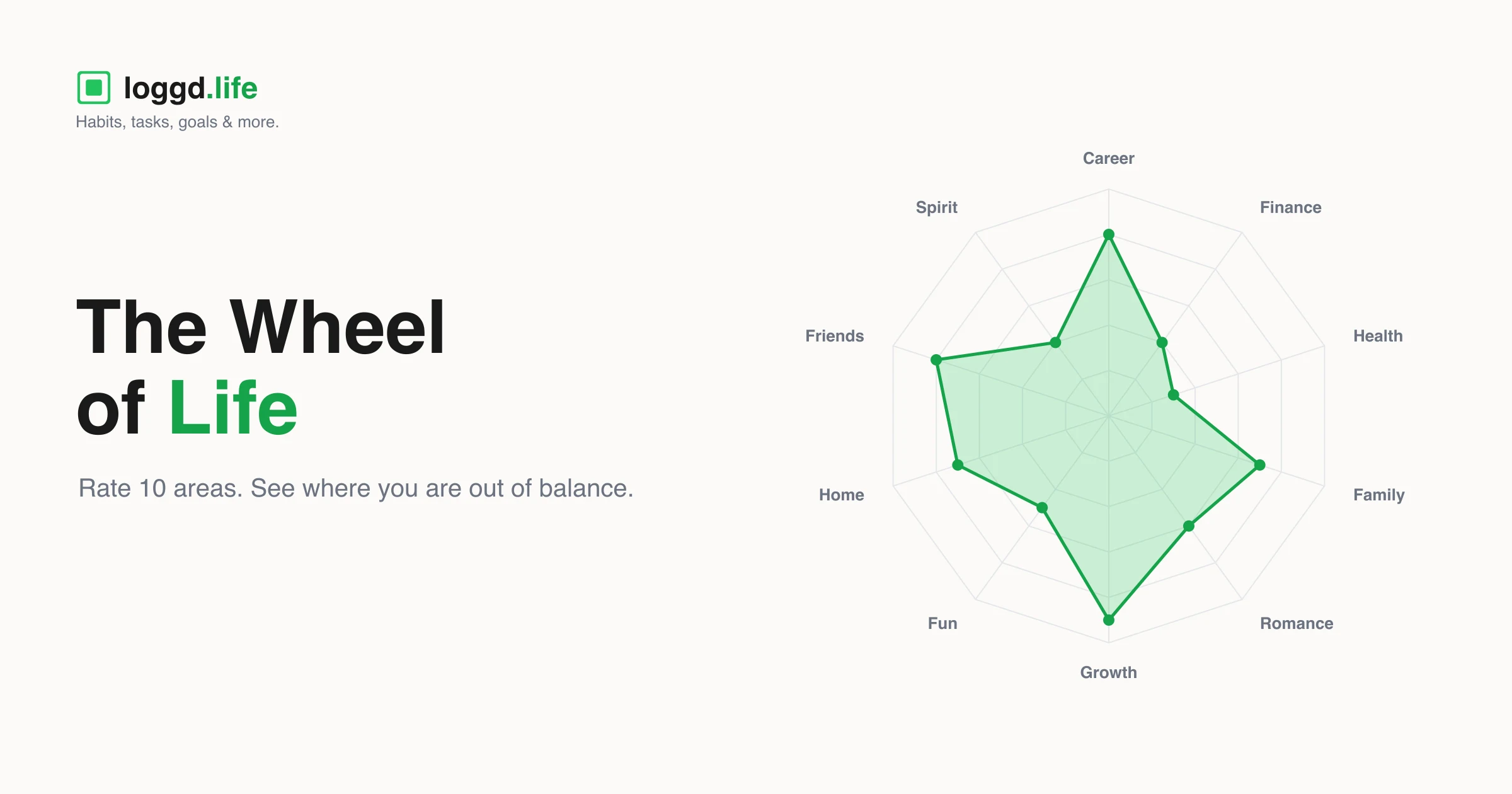
You rate each area on a scale of 1 to 10. Each area is a spoke on a wheel, and your scores draw a shape inside it. A balanced life produces a round, even wheel. A life that is all career and no rest, or all relationships and no health, produces a jagged, lopsided one. The shape is the insight. It takes a vague feeling that something is off and turns it into something you can point at.
The exercise was popularized by Paul J. Meyer, founder of the Success Motivation Institute, in the 1960s, and it has been a staple of life coaching ever since. The reason it has lasted is simple: most people never step back and look at their whole life at once. They optimize the one area that is loudest this week and let the quiet ones decay. The wheel forces the wide-angle view.
What are the 10 life areas?
Different versions use 6, 8, or 12 spokes. Loggd's wheel uses 10, which is enough to capture a real life without turning the assessment into homework:
| # | Life area | What it covers |
|---|---|---|
| 1 | Career and Work | Your job, direction, sense of progress |
| 2 | Finance and Money | Income, savings, financial security |
| 3 | Health and Fitness | Physical health, energy, wellness habits |
| 4 | Family and Relationships | Parents, siblings, children, close family |
| 5 | Romance and Partnership | Your relationship or dating life |
| 6 | Personal Growth | Learning, skills, becoming who you want to be |
| 7 | Fun and Recreation | Play, hobbies, genuine downtime |
| 8 | Physical Environment | Your home, workspace, surroundings |
| 9 | Friends and Social Life | Friendships and community |
| 10 | Spirituality and Purpose | Meaning, values, the bigger why |
You do not have to care equally about all ten. If spirituality is not your thing, a low score there might be fine. The wheel is a mirror, not a scorecard. What matters is whether the low spokes are areas you have chosen to deprioritize, or areas you have simply been neglecting.
How do you score the Wheel of Life?
Rate each area from 1 (very dissatisfied) to 10 (completely satisfied), based on how you feel about it right now, not where you wish it was or where you think it should be.
Three rules make the scores honest:
- Go with your gut. Your first-instinct number is usually truer than the one you negotiate yourself into. Do not overthink each spoke.
- Rate the present, not the plan. "I'm about to start going to the gym" does not move your health score. Rate where you actually are today.
- Compare to your own standard, not other people's. A 7 in finance means you are mostly satisfied with your money situation, full stop. It is not graded against anyone else.
As you rate, the radar chart redraws live, so the imbalance shows up the moment it exists. When you finish, the tool gives you a single balance score for the whole wheel, plus short insights calling out your highest and lowest areas. That one number is what you will track over time.
How to read your results
The mistake almost everyone makes is fixating on the average. The average hides the thing that matters most: the gaps.
Here is how to read the wheel properly:
- Find the lowest spoke first. This is your highest-leverage area. The lowest score, not the average, is usually what is dragging on everything else. A 3 in health quietly taxes your career, mood, and relationships at the same time.
- Look at the spread, not just the height. A wheel of all 6s is more livable than a wheel with three 9s and two 2s. Big gaps between neighboring areas are where you feel friction day to day.
- Check your highest spoke. Your strongest area is a resource. If your social life is a 9, that is energy and support you can lean on while you work on the weak ones.
- Notice the "fine but not great" middle. The 5s and 6s are easy to ignore because nothing is on fire. They are often where a small, deliberate push pays off fastest.
A round wheel that sits low everywhere (all 4s) is a different problem from a jagged wheel with a single deep dip. The first says "everything needs a little more," the second says "fix this one thing." The shape tells you which.
Turning a low score into an actual goal
This is where most Wheel of Life exercises die. You draw a beautiful, honest wheel, feel a jolt of clarity, and then nothing changes. A month later the wheel looks identical because a chart is not a plan.
The fix is to treat the wheel as a diagnosis and then go act on it. In Loggd, every goal belongs to a life area, and the set of areas (career, health, relationships, financial, growth, impact, and other) maps closely onto the wheel. So the handoff is natural:
- Run the wheel and find your lowest area. Say it comes back as Health and Fitness at a 3.
- Open Loggd and create one goal in that life area. Not five. One. "Walk 8,000 steps a day" or "strength train twice a week."
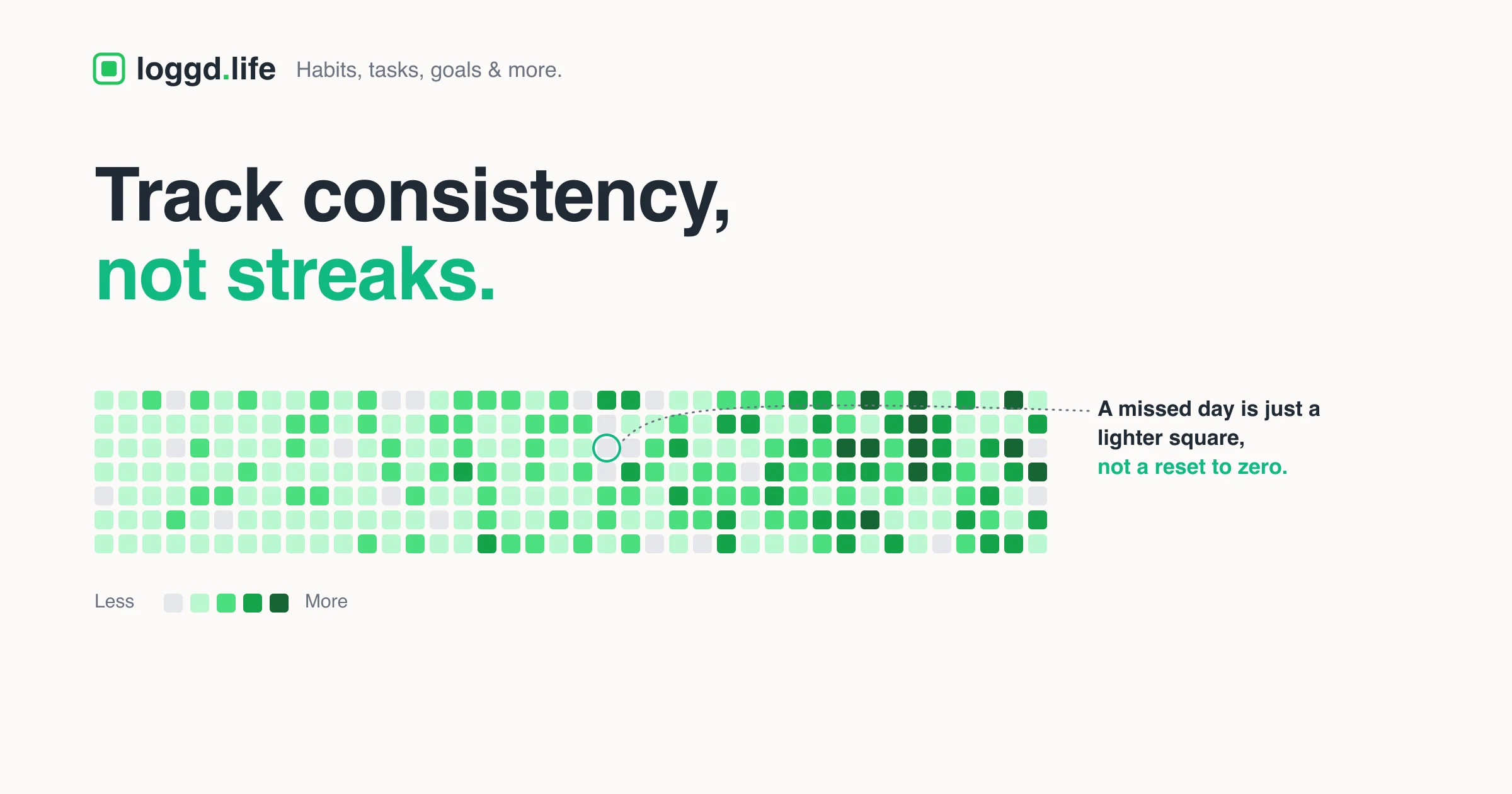
- Put a daily habit underneath it. The goal is the destination; the habit is the thing you actually do. Loggd's contribution grid shows the habit filling in over the month, which is the proof your wheel is about to move.
- Re-run the wheel next month. Watch that one spoke climb. Then pick the next lowest area and repeat.
To be clear about how this works: the standalone wheel tool does not push anything into your account automatically. It stores your assessment in your browser, and you create the goal yourself. The point is the loop. The wheel tells you where, the app is where you act, and re-running the wheel tells you whether it worked.
One area at a time is not a limitation, it is the whole strategy. Trying to lift all ten spokes at once is how people end up lifting none.
How to run the assessment in 5 minutes (step by step)
The free Wheel of Life tool takes about five minutes and needs no account.
- Open the tool. All 10 life areas are listed with a short description of what each one covers.
- Rate each area 1 to 10. Go fast. Trust your first number. The radar chart updates as you go.
- Read your balance score. One number for the whole wheel. This is what you will compare against next time.
- Read the insights. The tool flags your highest and lowest areas so you do not have to hunt for them.
- Save the assessment. It is stored in your browser, so you build a history and can compare this month against last month.
- Pick one low area to act on. Open Loggd, create a goal in that life area, and add a daily habit. Then re-run the wheel in a month.
That last step is the difference between a wheel you do once for the novelty and a wheel that actually changes your life over a year.
Frequently asked questions
What is the Wheel of Life assessment? A self-assessment that rates your satisfaction across the main areas of your life (1 to 10 each) and draws them as spokes on a wheel, so a lopsided shape shows you exactly where you are out of balance. It was popularized by Paul J. Meyer and is a staple of life coaching.
What are the 10 areas of the Wheel of Life? Career and Work, Finance and Money, Health and Fitness, Family and Relationships, Romance and Partnership, Personal Growth, Fun and Recreation, Physical Environment, Friends and Social Life, and Spirituality and Purpose.
How do I score the Wheel of Life? Rate each area 1 (very dissatisfied) to 10 (completely satisfied) based on how you feel today, not where you wish you were. Go with your gut and compare to your own standard, not other people's.
What is a good Wheel of Life score? There is no universal target, and chasing straight 10s misses the point. A wheel averaging 7 to 8 is healthy, but balance matters more than height: a consistent wheel beats a jagged one with a few highs and some deep dips.
How often should I do a Wheel of Life assessment? Monthly or quarterly. That is long enough to see real change and frequent enough to stay honest. Loggd saves your history so you can track whether the area you are working on is actually moving.
Does the Wheel of Life connect to my goals in Loggd? Not automatically. The tool is standalone and browser-based. But Loggd's goals each belong to a life area that lines up with the wheel, so the natural workflow is to run the wheel, find your lowest area, and create a goal in that life area yourself.
Last updated: June 2026.
Written by Eusebiu, the solo founder building Loggd in public. I have been tracking my own habits, goals, and life areas for over six months while building this, and the Wheel of Life is the exercise I come back to whenever I can feel I am over-indexing on work and letting the rest slide. I share the build and what the data shows on Threads.
Ready to find your weakest spoke? Run the free Wheel of Life assessment. No signup, saved in your browser, five minutes. Then turn your lowest area into a goal you actually work on.