TL;DR. Across 4,000+ people and 45,000+ habit check-ins, the data tells an uncomfortable story. Most tracked habits are abandoned within days. The habits that last are the low-effort or automatic ones, not the ambitious ones. And 60% of people who sign up to track a habit never log a single check. Measured behaviorally, self-improvement looks far less like steady upward progress and far more like a series of short-lived restarts. That sounds bleak. It is actually freeing, and it tells you exactly what to change.
Here is the most honest sentence I can write about habit tracking, backed by real data instead of a motivational poster: most tracked habits are abandoned within days, the longest-lasting ones are the low-effort or automatic ones, and 60% of people who sign up never log a single habit.
I run Loggd, a habit and life tracker. That gives me a view almost nobody writes about honestly, because it is not flattering: the aggregate behavior of thousands of real people trying to build habits, including all the ones who quit on day one. The self-improvement industry is worth somewhere around $54 to $57 billion a year (Grand View Research; The Business Research Company). The data from inside one tracker suggests most of that money is buying a feeling, not a result.
This is what 4,000+ habit trackers actually reveal.

Do habit trackers actually work?
The honest answer is: yes, but almost never for the reason the app store screenshots imply.
The biggest single predictor of a long streak in our data is not motivation, not premium features, not the perfect reminder time. It is automation. Habits that completed themselves from an outside signal held an average longest streak about nine times higher than habits a human had to remember to check off (more on this below). The tracker helps when it removes friction and shortens the gap between doing the thing and seeing the reward. It does almost nothing when it is just one more box you have to remember to tick.
The cleanest proof of that is the 60% of people who never tick the box at all.
The uncomfortable headline: most habits die in days
Here is the survival curve. We looked at the longest streak each of 5,251 habits ever reached. Not the current streak, the all-time best. The single best run that habit ever had.
| Best streak the habit ever reached | Share of all habits |
|---|---|
| Never checked once | 46.4% |
| Exactly 1 day | 28.8% |
| 2 days | 6.2% |
| 3 to 6 days | 10.5% |
| 7 to 13 days | 4.4% |
| 14 to 29 days | 2.2% |
| 30 to 65 days | 1.0% |
| 66+ days | 0.5% |
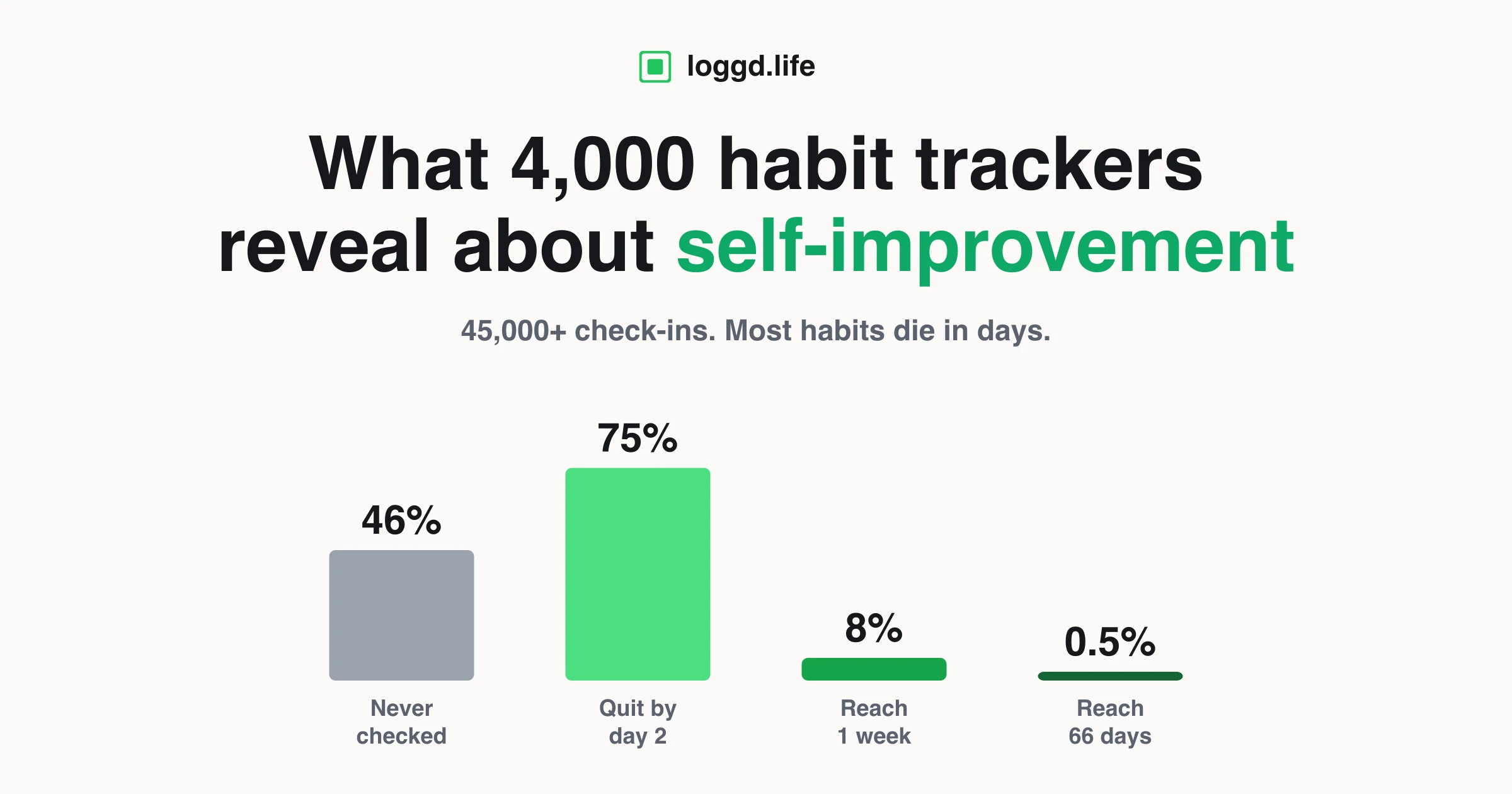
Read that top row again. Almost half of all habits people create never receive a single check-in. The habit is created in a hopeful moment and then never touched.
Stack the next rows and it gets starker. About three out of four habits never make it past a one-day streak. Roughly 90% never reach a single week. And the 66-day mark, the number popularized from Phillippa Lally's 2010 study on how long it takes a behavior to become automatic, is reached by about 0.5% of habits. Half of one percent.
Lally's study found it took a median of 66 days for a new behavior to reach automaticity, with a range from 18 days to 254 days depending on the person and the habit. Our data does not contradict that. It shows that almost nobody gets far enough into the curve to find out where they personally land.
The myth says "do it for 66 days and it sticks." The data says the overwhelming majority of attempts end in the first week, so the 66-day finish line is irrelevant to how habits actually fail. People do not fail at day 66. They fail at day 2.
What people try to build (and what they actually pick)
Before we look at why habits die, it is worth seeing what people reach for. Grouping habit names into rough themes:
| Theme | Approximate share of habits |
|---|---|
| Fitness (gym, exercise, running, steps, stretching) | ~27% |
| Mind and learning (reading, studying, coding, journaling) | ~15% |
| Health and body (water, sleep, vitamins, food, teeth) | ~14% |
| Mindfulness (meditation, gratitude, breathing) | ~3% |
| Digital and focus (less social media, fewer screens) | ~3% |
Methodology note, said plainly: many of these habit names come from onboarding templates the app suggests, like "Go to the gym" or "Drink 8 glasses of water." So this table reflects what people pick from a list at least as much as what they independently decide to track. The themes are real signal; the exact name counts are not. We will not pretend a templated "Exercise 30 minutes" appearing hundreds of times means hundreds of people independently typed that phrase.
The takeaway survives the caveat: people overwhelmingly try to build fitness and self-discipline habits, the most willpower-intensive category there is. That choice is part of why so many fail. We aim the hardest possible habits at the most fragile possible willpower and act surprised when it does not hold.
Where they fail: the willpower tax
Here is the most useful finding in the whole dataset, and it reframes everything else.
We split habits into two groups: ones a person had to manually check off, and ones that completed automatically by syncing from an external source (in our case, a developer's GitHub commit history, which auto-marks a "code today" habit when real commits show up).
| Manually checked habits | Automatically synced habits | |
|---|---|---|
| Average longest streak | ~2.2 days | ~20.5 days |
| Reached a 7-day streak | 6.7% | 59.6% |
The gap is not subtle. Automatic habits lasted roughly nine times longer on average, and were nearly nine times more likely to survive a full week. Same app, same humans, same notification system. The only thing that changed was whether the habit required an act of willpower to record.
Zoom out across every check-in and the same story repeats. Of the 45,000+ checks logged, about 47% came from automatic syncing rather than a person tapping a button. A tiny minority of habits (the automatic ones) produce nearly half of all the activity, precisely because they do not depend on a human remembering.
This is the willpower tax. Every habit that requires you to remember, decide, and act has a daily failure point built into it. Remove the human step and the habit stops dying. That is not a motivation problem you can solve with a better quote. It is a friction problem you solve with design.
The consistency patterns: when habits slip
Two more patterns, both small and both telling.
Habits slip on the weekend. Check-ins decline almost perfectly from the start of the week to Saturday:
| Day | Share of all check-ins |
|---|---|
| Monday | 16.2% |
| Tuesday | 15.7% |
| Wednesday | 15.2% |
| Thursday | 14.9% |
| Friday | 14.5% |
| Saturday | 11.5% |
| Sunday | 12.0% |
Monday is the high point of intention. By Saturday, check-ins drop by nearly a third. The "fresh start" energy is real and it is front-loaded into the work week. The honest design response is not to guilt people about weekends, it is to expect the dip and not punish it.
People who also track focus time hold longer streaks. Among users who completed at least one focus session, the average longest habit streak was about 5.2 days, versus about 1.6 days for people who never used the focus timer (based on 400+ focus users, comfortably above our reporting floor).
Be careful with that one. This is correlation, not causation. People who run focus sessions are probably more engaged and more deliberate to begin with, and that underlying trait likely drives both behaviors. Focus tracking is not a magic streak booster. But the association is consistent with the broader theme: people who build a system, more than a single isolated habit, stick around longer.
What it means (the part that is actually freeing)
Put the findings together and the standard self-improvement narrative falls apart:
- It is not a discipline problem. 60% never even start, and the ones who do mostly fail in the first two days. That is too fast to be about willpower running out. It is about the system never engaging.
- The winning habits are the easy and automatic ones, not the heroic ones. Ambition predicts failure. Friction predicts failure. Low friction predicts survival.
- Consistency is fragile and patterned. It dips on weekends, it leans on systems, and it collapses the moment a habit depends on you remembering.
Here is why that is freeing rather than depressing. If self-improvement were purely about willpower, the only fix would be to become a more disciplined person, which nobody knows how to do on demand. But the data says the levers are mostly structural:
- Make it automatic where you can. Pick habits that can be triggered or measured by something you already do. The closer a habit gets to "happens whether I think about it or not," the longer it survives.
- Start humiliatingly small. A two-minute version of a habit beats a one-hour version that you abandon in three days. The survival curve rewards the trivial.
- Stop treating a missed day as failure. This is the big one. A streak that resets to zero on the first miss is a design that manufactures quitting. After one bad weekend, the counter says "0" and people delete the app rather than face it.
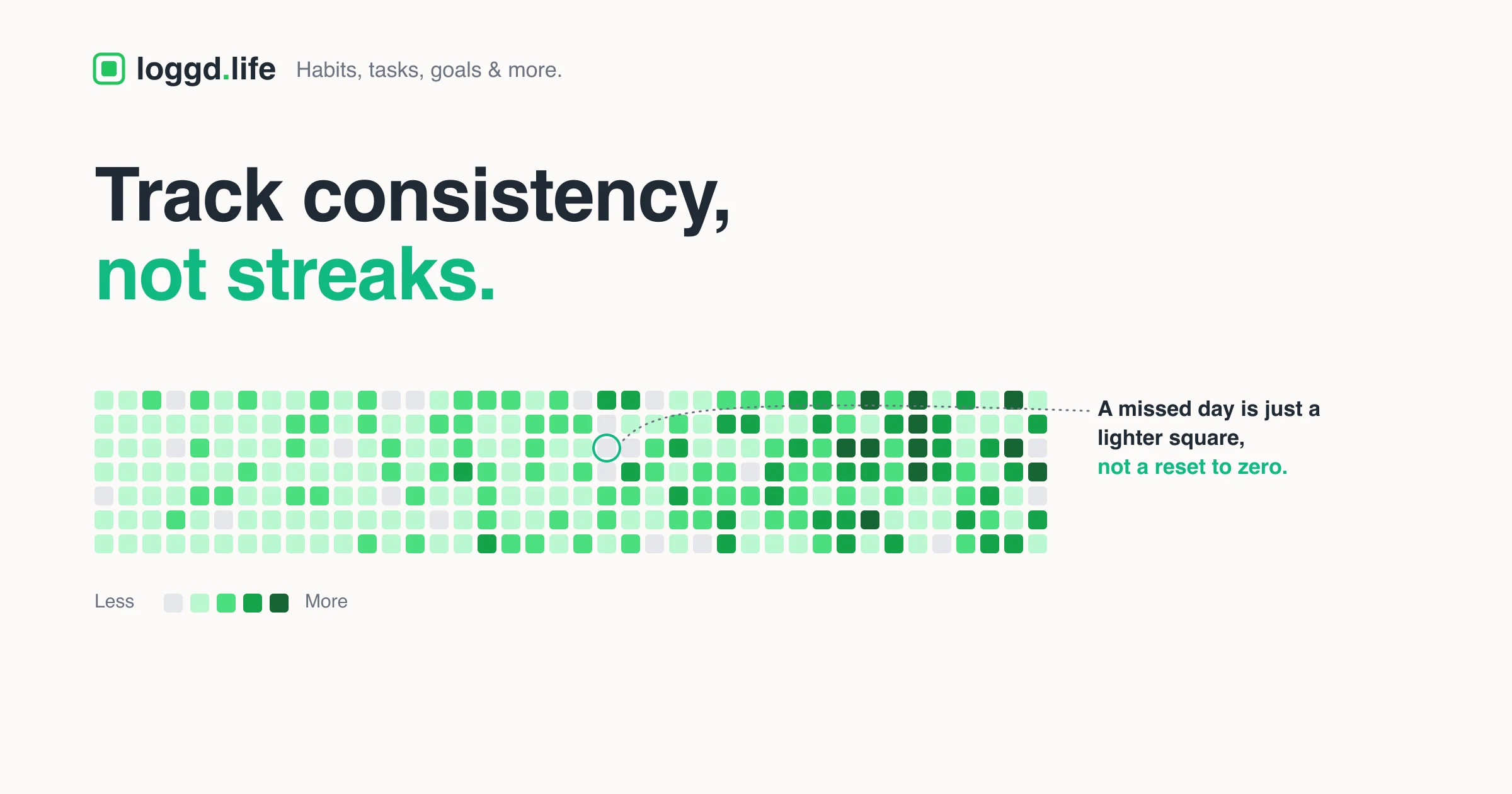
That last point is exactly why Loggd's default view is a contribution grid instead of a streak counter. A missed day becomes one lighter square in a year of darker ones, not a reset to zero. The data above is the argument for that design: when 75% of habits never pass a single day, a model that punishes the first miss is a model optimized to make people quit.
Methodology and what this data is not
This is a flagship claim, so it gets a real methodology section, including the parts that weaken it.
- Source and scale. Aggregate, anonymized data across 4,000+ registered Loggd users and 45,000+ habit check-ins, re-run June 2026. All figures are rounded aggregates. No individual data, no user-entered text, no identifying detail.
- Selection bias. Everyone here chose to use a habit tracker. That over-represents motivated, self-improvement-minded people and under-represents the general population. If anything, the real-world quit rates are likely worse than what a self-selected tracker audience shows.
- Tracked is not the same as done. A missing check-in does not prove the behavior did not happen. Someone may have gone to the gym and not logged it. We are measuring tracking behavior, which is a proxy for, not a perfect record of, actual behavior.
- Some quitting is healthy. Abandoning a habit can be a good decision. People drop habits that stopped serving them, or that they replaced with something better. "Quit" is not always "failed."
- Seeded templates. Many habit names come from onboarding suggestions, so name-frequency counts reflect menu design as much as personal choice. We report themes, not name-level rankings, for that reason.
- Automation sample is small but stark. The automatically synced habits are a small subset (developers syncing GitHub). The 9x effect is large and directionally clear, but it comes from a specific population. Two honest confounds: these are people whose day job already involves coding daily, so part of the consistency is the underlying behavior, not just the automation. And to be clear about how the number is built, it compares the all-time best streak (
longest_streak) of every GitHub habit against every manual habit, with no dormant accounts filtered out. When a syncing user goes inactive we pause their rewards and reset their current streak, but their historical best is preserved and still counted here, so this is not a survivorship artifact that quietly drops the quitters. Read the 9x as "removing friction dramatically helps," not as a precise universal multiplier.
None of these caveats overturn the headline. They sharpen it. Even among a motivated, self-selected audience, with tracking-not-doing working in their favor, most habits still die in days. That is not a measurement artifact. That is the reality the motivational version papers over.
Frequently asked questions
Do habit trackers actually work?
They work when they reduce friction and shorten feedback, not when they just add another box to remember. The strongest predictor of a long streak in our data was automation, not features or motivation. The 60% who never log a single check show that the tracker by itself does nothing.
How long do most habits last?
Most do not last. About 46% of habits never get a single check, roughly 75% never pass a one-day streak, and only about 0.5% reach 66 days.
What habits last the longest?
The low-friction and automatic ones. Automatically synced habits averaged a longest streak about nine times higher than manual ones. Easy beats ambitious.
Why do most people fail at self-improvement?
Two reasons, neither of them "laziness." Sixty percent never start (activation failure), and among those who do, the habits that demand daily willpower collapse fast while automatic or trivial ones survive.
Is tracking your habits worth it?
Yes, if you track to learn rather than to perform. The honest picture of what you actually do is the value. A forgiving view keeps you in the data long enough to learn from it; a punishing streak counter just makes people quit.
How was this data collected?
Aggregate, anonymized data across 4,000+ Loggd users and 45,000+ check-ins, re-run June 2026, all rounded, no individuals. The sample is self-selected and many habit names are seeded from templates, both of which are disclosed above.
About the author
I'm Eusebiu, the solo founder building Loggd. I have been a dev contractor for about five years and I am going full time on Loggd, building it in public and sharing the journey with a growing audience on Threads. I have tracked my own habits publicly for over six months, including the weeks I dropped off, so the patterns in this article are not abstract to me. I publish data like this partly because it is honest and partly because the honest version is more useful than the motivational one. If a tracker is going to be worth your time, it has to survive your worst week, not just your most inspired one.
Last updated: June 2026. Annual refresh.
See your own data honestly
The point of all this is not to feel bad about your quit rate. It is to build a system that survives a missed day instead of punishing it. Start with Loggd: track habits on a forgiving contribution grid, start with three habits free, no card. Track to learn, not to perform.