TL;DR. Research says it takes about 66 days on average to make a behavior automatic, not the popular "21 days," with a real range of 18 to 254 days (Lally et al., 2010). But Loggd data on 5,491 real habits shows almost nobody gets that far: only about 0.6% of habits ever reached a 66-day streak, and roughly 46% never reached even a one-day streak. Habit formation takes longer than most people think, and the hard part is not the finish line. It is surviving the first two weeks.
How long does it take to build a habit?
About 66 days on average, not 21. That is the headline finding from the most-cited study on the topic, and the "21 days" number you have heard everywhere is a myth (more on where it came from below).
But the average hides the real story, which is the spread. In the same research, individuals took anywhere from 18 days to 254 days to make a new behavior feel automatic. So the honest answer to "how long does it take to build a habit?" is: somewhere between three weeks and eight months, depending on you and on how hard the habit is.
And then there is what actually happens in the wild. We track habits for thousands of people, and when we look at how far real habits get, the picture is sobering: most never come close to 66 days, because most are abandoned in the first week. The timeline is not the problem. Lasting long enough to reach it is.
The 66-day study, explained (Lally 2010)
The number everyone cites traces back to one paper: Lally, van Jaarsveld, Potts and Wardle (2010), published in the European Journal of Social Psychology. Researchers at University College London asked 96 people to pick a new daily habit (something like "drink a glass of water after breakfast" or "go for a walk before dinner") and tracked them for 12 weeks. Each day, participants recorded whether they did the behavior and how automatic it felt.
By fitting a curve to the rising automaticity scores, the researchers found:
- The average time to reach peak automaticity was 66 days.
- The range ran from 18 days to 254 days.
- Missing a single day did not meaningfully hurt the process. One slip is not a reset.
- Some participants never fully automated their habit inside the 12-week window.
That last detail matters. The study's real message is not "it takes 66 days." It is "it varies enormously, and it is slower and more forgiving than you think." The 66 is just an average pulled from a wide, messy distribution.
A 2024 meta-analysis of health-behavior habit formation (PMC11641623) reinforced the same point: the time to form a habit clusters in a broad range rather than landing on any single magic number, and it depends heavily on the behavior and the person. Habit formation is a distribution, not a deadline.
Why "21 days" is a myth
The "21 days to form a habit" rule is one of the most repeated pieces of self-help advice, and it is based on a misreading.
It comes from Dr. Maxwell Maltz, a plastic surgeon who wrote in his 1960 book Psycho-Cybernetics that it took his patients "a minimum of about 21 days" to get used to a change, such as adjusting to a new face after surgery or a phantom limb sensation after an amputation. Read that carefully:
- He said "a minimum of about," describing a floor, not a fixed rule.
- He was describing adjusting to a change, not building a new behavior from nothing.
- It was a clinical observation, not an experiment.
Over the decades, "a minimum of about 21 days" got flattened into "21 days to form a habit," and a casual note became a fake law repeated in thousands of articles. The actual evidence puts the average at roughly three times that long.
Here is the practical danger of the myth: if you believe a habit takes 21 days, you expect to be "done" at three weeks. When it still feels like effort on day 22, you conclude it failed and quit, right around the point where the real work is just beginning.
| The number | Where it comes from | What it actually means |
|---|---|---|
| 21 days | Maltz, Psycho-Cybernetics (1960) | A surgeon's casual note that patients took "a minimum of about 21 days" to adjust to a change. Not a rule. |
| 66 days | Lally et al. (2010), UCL | Average time to automaticity across 96 people. A midpoint, not a guarantee. |
| 18 to 254 days | Lally et al. (2010), the full range | The real spread. This is the honest answer. |
What Loggd's real streak data shows (the gap)
Here is where original data beats another retelling of the same two studies. We looked at the all-time best streak of every habit on Loggd and counted how many ever reached each milestone. The sample: 5,491 habits across 2,983 users, re-run in June 2026.
The average longest streak across all habits was 2.8 days. Not 2.8 weeks. Days.
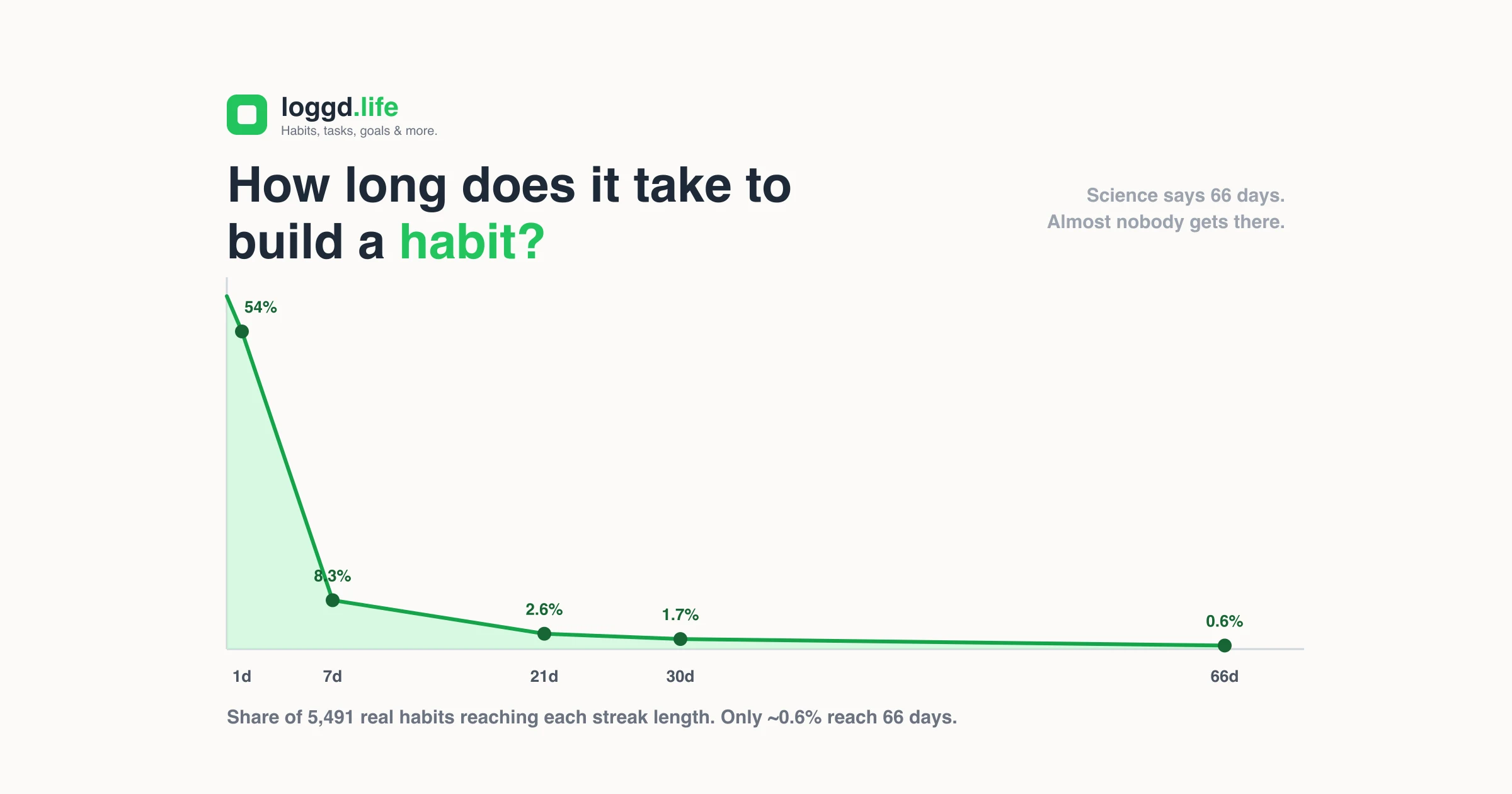
The survival curve, milestone by milestone:
| Milestone | Habits that reached it | Share of all habits |
|---|---|---|
| At least a 1-day streak | 2,973 | ~54% |
| 7-day streak | 457 | ~8.3% |
| 21-day streak ("the myth") | 141 | ~2.6% |
| 30-day streak | 91 | ~1.7% |
| 66-day streak (automaticity) | 31 | ~0.6% |
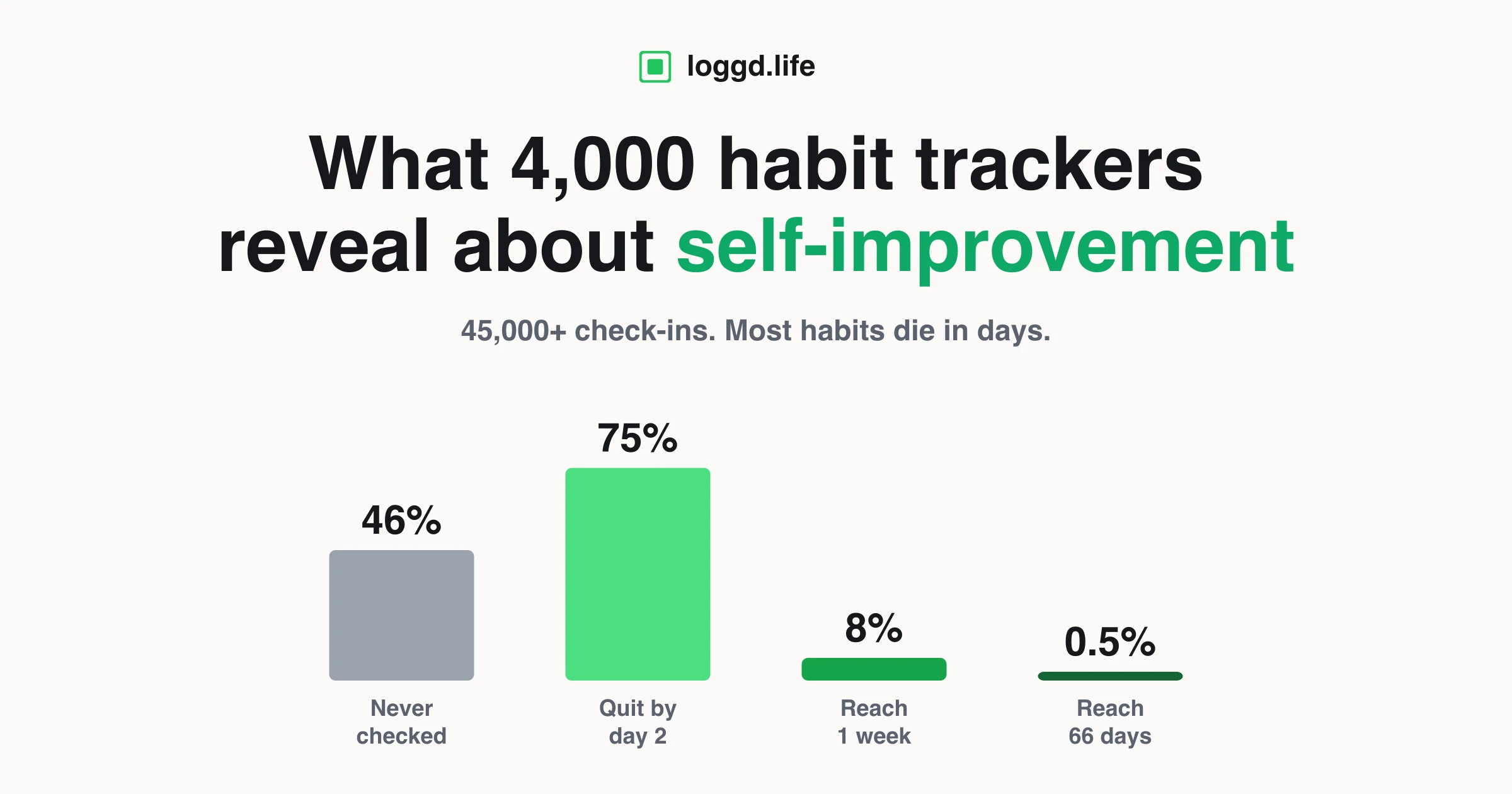
Read the top row again: about 46% of habits never reached even a one-day streak. People create the habit, fully intend to do it, and then never log a second consecutive day. By the 7-day mark, more than 90% of habits have dropped off. By 66 days, the research's average finish line, only about 1 in 175 habits is still standing.
This is the gap between the science and the reality. The 66-day study describes what happens if you keep going. The data describes how rarely people keep going at all. Both are true, and together they say something more useful than either alone: the timeline was never the hard part. The first two weeks are.
The one thing that beat the curve: removing friction
There is a striking exception in the data, and it points straight at the fix. Some Loggd habits are checked off automatically from an outside data source instead of by hand (for example, a "code every day" habit that completes itself from a GitHub commit log).
- Manually checked habits averaged a longest streak of about 2.3 days.
- Automatically synced habits averaged about 20 days, roughly nine times longer.
Automated habits are a small slice of the total (under 3% of all habits), so treat this as directional, not a precise universal multiplier, and note the obvious confound: someone syncing a coding habit already codes daily for work, so part of that consistency is the underlying behavior, not just the automation. But the direction is unmistakable. The habits that did not depend on remembering, on willpower, on opening an app, are the ones that survived to the timelines the research talks about. Friction is the thing that kills habits before they can form.
How to actually reach automaticity
If the science says 66 days and the data says almost nobody gets there, the practical question is: how do you become one of the few who does? The data points to a clear answer, and it is the opposite of "try harder."
- Plan for two months, not three weeks. Expect a habit to still feel like effort at day 22. That is normal, not failure. Knowing the real number (closer to 66 days) keeps you from quitting at the exact moment most people do.
- Start absurdly small. The automated habits won by removing effort. You can copy that manually by shrinking the habit until it is almost impossible to skip: two push-ups, one page, a single glass of water. A tiny habit you actually do beats an ambitious one you abandon in three days.
- Anchor it to something you already do. Attach the new behavior to an existing cue ("after I pour my morning coffee, I write one sentence"). A stable cue is what the 66-day research found drives automaticity. No cue, no habit.
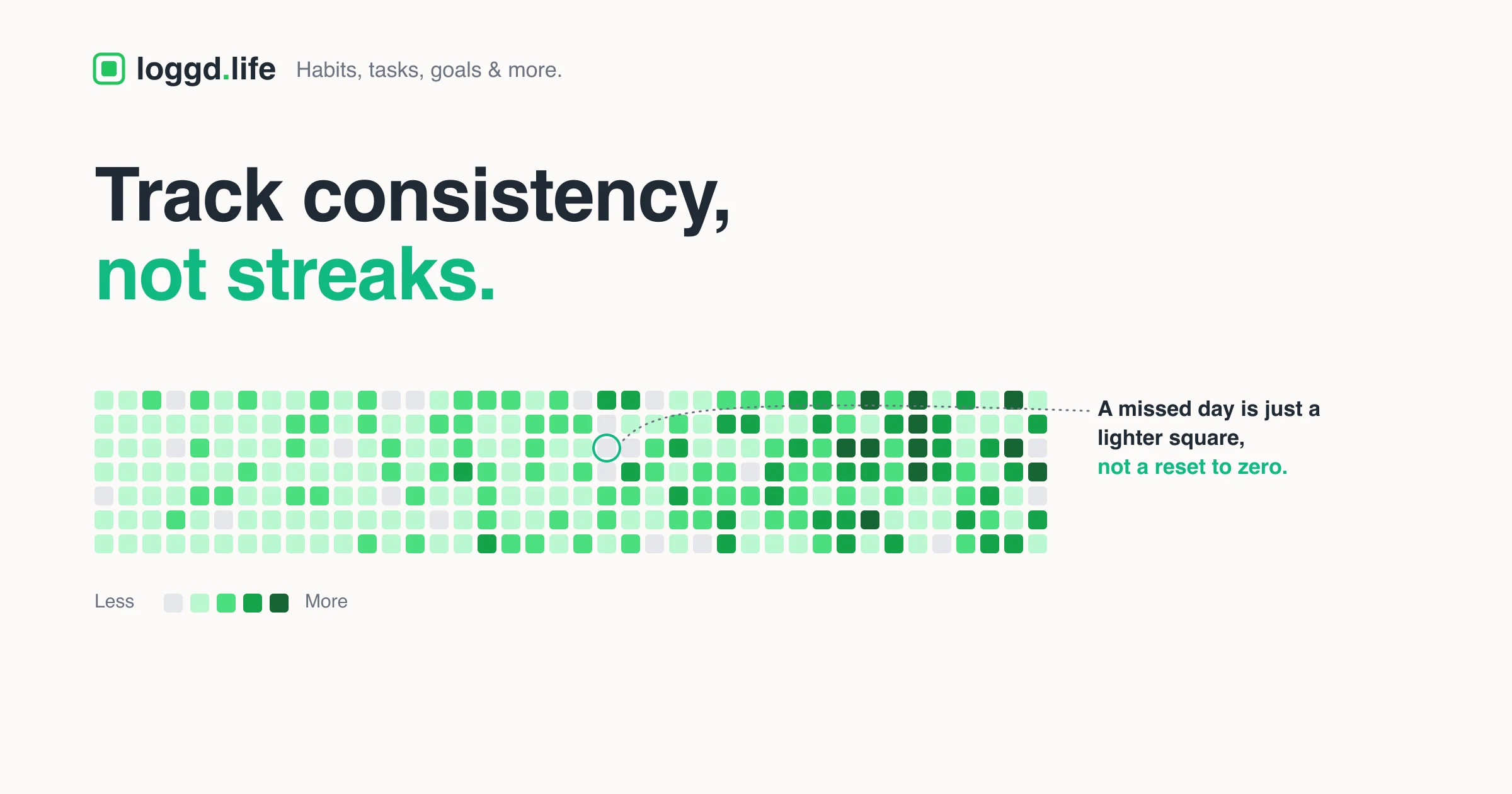
- Treat a missed day as a single light square, not a reset. The Lally study found that one missed day did not derail the process. The danger is the all-or-nothing reaction: miss once, feel like a failure, quit entirely. A model that resets your streak to zero on the first slip is a model that manufactures quitting.
That last point is exactly why Loggd's default view is a contribution grid instead of a streak counter. A missed day becomes one lighter square in a year of darker ones, not a zero that wipes out your progress. When the data shows that 46% of habits die before a single repeat and only 0.6% reach automaticity, a tracker that punishes the first miss is optimized for exactly the wrong outcome. For the fuller picture of what these patterns look like across thousands of people, see what 4,000 habit trackers reveal.
Methodology and caveats
Because this article makes a data claim, here is what the numbers are and are not:
- Source and scale. Aggregate, anonymized data across 5,491 habits and 2,983 registered Loggd users, re-run June 2026. All figures are rounded aggregates. No individual data, no user-entered text, no identifying detail.
- Milestones use all-time best streak. "Reached 66 days" means a habit's
longest_streakvalue hit 66 at some point, not that it is still active. This is the most generous possible reading, and even so only 0.6% qualify. - Selection bias. Everyone here chose to use a habit tracker, which over-represents motivated, self-improvement-minded people. Real-world quit rates are probably worse, not better, than what a self-selected tracker audience shows.
- Tracked is not the same as done. A missing check-in does not prove the behavior did not happen. We are measuring tracking behavior, a proxy for actual behavior.
- The automation effect comes from a small group. The 9x figure compares a small subset (developers syncing GitHub) against manual habits, with the day-job confound noted above. Read it as "removing friction helps a lot," not as an exact law.
None of these caveats overturn the headline. They sharpen it. Even among motivated people, with tracking-not-doing working in their favor, the overwhelming majority of habits never get within sight of 66 days.
Frequently asked questions
How long does it take to build a habit?
On average about 66 days (Lally et al., 2010), with a real range of 18 to 254 days. The "21 days" figure is a myth. In our data, only about 0.6% of habits ever reached a 66-day streak, because most are abandoned in week one.
Is the 21-day rule real?
No. It is a misreading of Maxwell Maltz, who in 1960 observed patients taking "a minimum of about 21 days" to adjust to a change. That floor became a fake rule. The research average is closer to 66 days.
What is the 66-day study?
Lally, van Jaarsveld, Potts and Wardle (2010), a UCL study of 96 people that found an average of 66 days to reach automaticity, with a range of 18 to 254 days and one missed day having little effect.
How many days to break a bad habit?
There is no clean number; the same 18-to-254-day range is the best guide. Breaking is harder than building, and replacing the routine with a small alternative works better than white-knuckling it.
Why do habits take so long?
Because a habit is a brain shortcut that only forms through repeated reps under a stable cue, and that rewiring is gradual. It also breaks easily early, which is why most habits die in the first two weeks.
Do habit trackers speed it up?
They can, by adding a feedback loop and a small reward and by making your real pattern visible. The biggest lever in our data was reducing friction: automated habits lasted roughly nine times longer than manual ones.
About the author
I'm Eusebiu, the solo founder building Loggd. I have been a dev contractor for about five years and I am going full time on Loggd, building it in public and sharing the journey with a growing audience on Threads. I have tracked my own habits publicly for over six months, including the weeks I dropped off, so the gap between the 66-day science and the messy reality is not abstract to me. I publish data like this because the honest version is more useful than the motivational one: knowing that the first two weeks are the real battle is what changes how you start.
Last updated: June 2026. Annual refresh.
Track a habit to automaticity
The point of all this is not to be intimidated by 66 days. It is to build a system that survives a missed day long enough to get there. Start with Loggd: track habits on a forgiving contribution grid, start small with three habits free, no card. Make the first two weeks survivable, and the timeline takes care of itself.