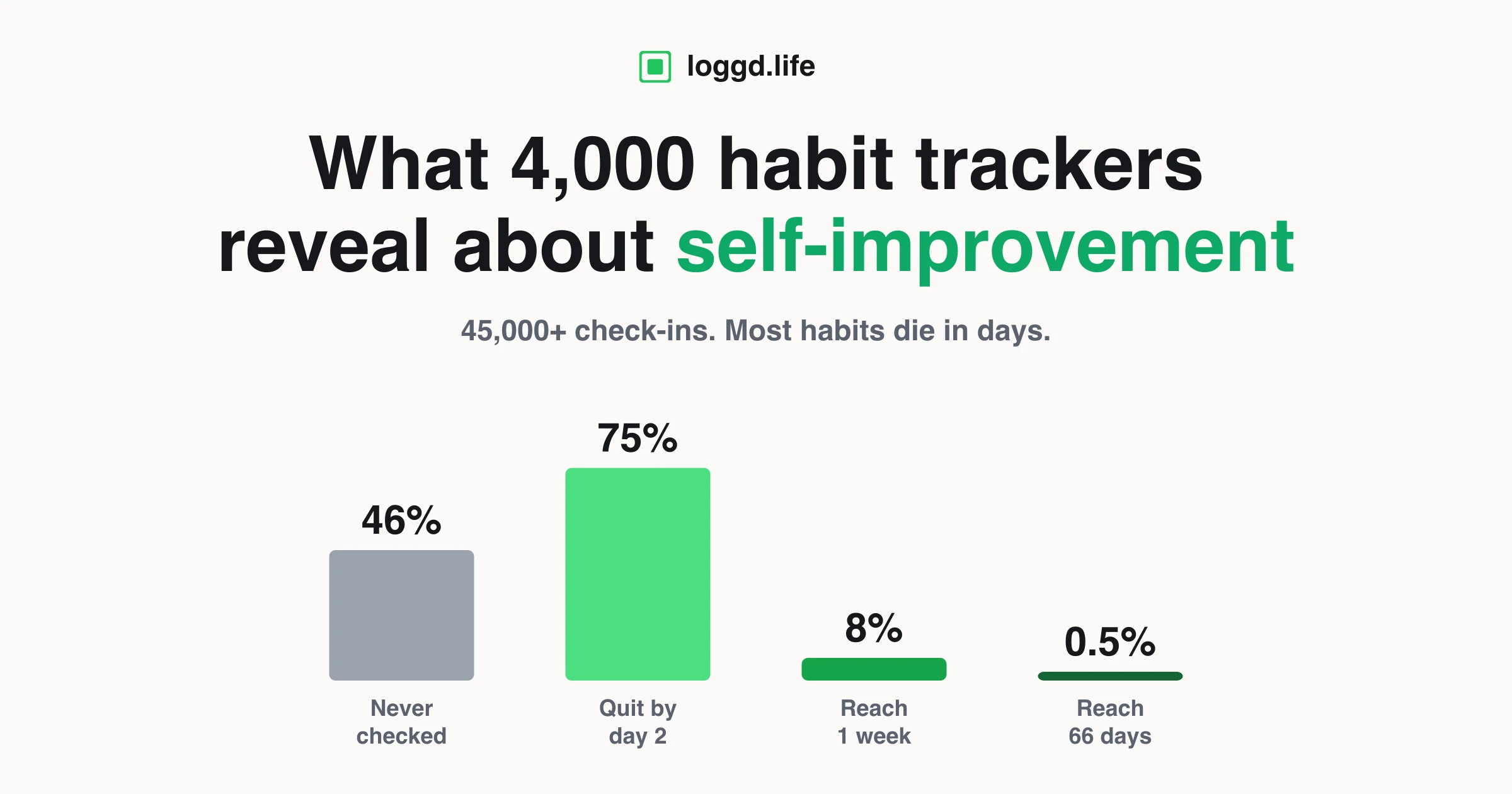
TL;DR. Based on 6,700+ habits tracked by 3,600+ Loggd users in 2026, the most-tracked habits are going to the gym, exercising for 30 minutes, walking 10,000 steps, and drinking more water, followed by reading, journaling, and meditation. But raw popularity is misleading. Several of the top entries are habits the app suggests during onboarding, and the gap between the habits people start and the ones they keep is large: most tracked habits never reach even a 2-day streak. The habits that actually survive are the ones that log themselves. Here is the full ranked list, plus the honest read of what it means.
Around 280 people on Loggd track "go to the gym" in some form. It is the single most-tracked habit on the platform. And it has one of the shortest average streaks on the entire list.
That contradiction is the real story here. This is not a prescriptive "here are good habits to track" listicle, every habit app publishes one of those. This is a descriptive look at what thousands of real people actually chose to track, which ones the app nudged them toward, and the large gap between starting a habit and keeping it.

What are the most-tracked habits right now?
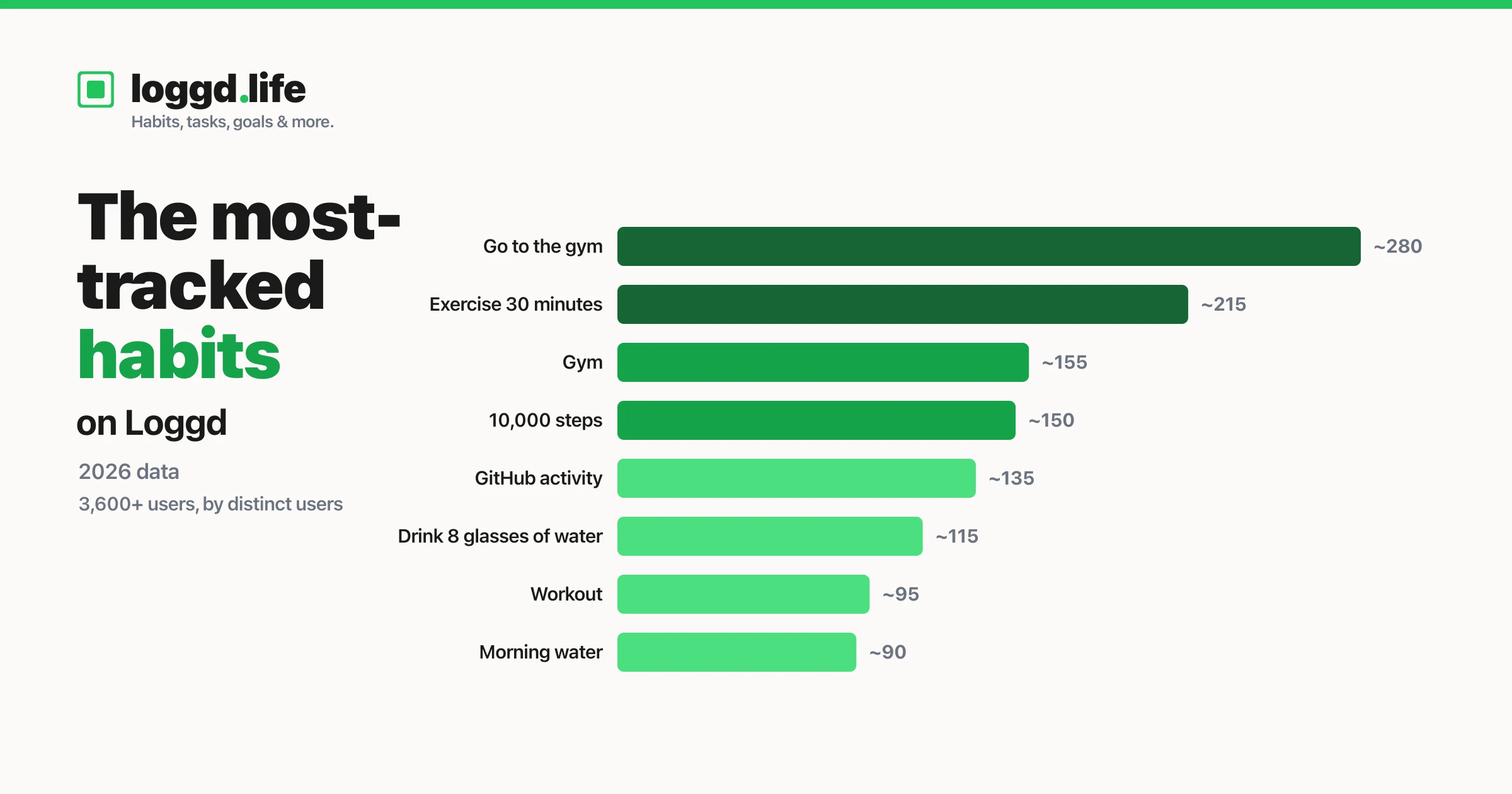
Here are the top 10 most-tracked habits on Loggd in 2026, by number of distinct users. Counts are rounded. The last column marks whether the habit is one Loggd offers as a one-tap suggestion during onboarding (more on why that matters below).
| Rank | Habit | Users (approx.) | In onboarding picker? |
|---|---|---|---|
| 1 | Go to the gym | 280 | Yes |
| 2 | Exercise 30 minutes | 215 | Yes |
| 3 | Gym | 155 | No (typed) |
| 4 | 10,000 steps | 150 | Yes |
| 5 | GitHub activity | 135 | Yes (auto-syncs) |
| 6 | Drink 8 glasses of water | 115 | Yes |
| 7 | Workout | 95 | No (typed) |
| 8 | Morning water | 90 | Yes |
| 9 | Morning stretch | 85 | Yes |
| 10 | Read 30 minutes | 80 | Yes |
Two things stand out immediately. First, fitness and hydration dominate. If you group the obvious synonyms ("go to the gym," "gym," "workout," "exercise," "exercise 30 minutes"), exercise is by far the most-tracked theme on the platform, ahead of everything else combined. Water is second. Reading is third.
Second, eight of the top ten are one-tap suggestions from Loggd's onboarding picker. Only "gym" and "workout" (the bare, user-typed variants) are not. That is the single most important thing to understand before you read any "most popular habits" list, including this one: popularity is heavily shaped by what the app puts on the menu. We come back to this below.
The one genuine outlier in the top 10 is GitHub activity (5th). It is on the menu, but it is not a manual habit at all, it auto-logs from a developer's commit activity. Hold that thought, because it turns out to be the most important habit on this entire list.
The full top-40 list
Past the top 10, the list broadens into the habits you would expect: sleep, vitamins, journaling, reading, coding, and the small daily anchors. Counts are rounded to the nearest five; every entry shown has at least 50 users behind it except where noted.
| Rank | Habit | Users (approx.) |
|---|---|---|
| 1 | Go to the gym | 280 |
| 2 | Exercise 30 minutes | 215 |
| 3 | Gym | 155 |
| 4 | 10,000 steps | 150 |
| 5 | GitHub activity | 135 |
| 6 | Drink 8 glasses of water | 115 |
| 7 | Workout | 95 |
| 8 | Morning water | 90 |
| 9 | Morning stretch | 85 |
| 10 | Read 30 minutes | 80 |
| 11 | Exercise | 80 |
| 12 | Run | 80 |
| 13 | Do pushups | 70 |
| 14 | Sleep 8 hours | 65 |
| 15 | Take vitamins | 60 |
| 16 | Journal | 55 |
| 17 | Read | 55 |
| 18 | Meditate | 50 |
| 19 | Read 10 pages | 50 |
| 20 | Post on threads | 50 |
| 21 | Brush teeth | 45 |
| 22 | Practice coding | 40 |
| 23 | No alcohol | 40 |
| 24 | No junk food | 35 |
| 25 | Reading | 35 |
| 26 | In bed by 10pm | 35 |
| 27 | Study | 30 |
| 28 | Drink water | 30 |
| 29 | Meditation | 30 |
| 30 | 10k steps | 25 |
| 31 | Deep work session | 25 |
| 32 | Plan tomorrow | 20 |
| 33 | No social media | 20 |
| 34 | Practice language | 20 |
| 35 | Skincare routine | 20 |
| 36 | Eat fruit | 20 |
| 37 | Sport | 20 |
| 38 | Morning routine | 20 |
| 39 | Take the stairs | 15 |
| 40 | Make bed | 15 |
A few things to read out of the long tail:
- The synonyms tell you what people mean, not what they typed. "Gym," "go to the gym," "workout," "exercise," and "sport" are the same intention typed five ways. The category, not the exact label, is the real signal.
- The bottom of the list is where it gets interesting. Below rank 40, the counts drop fast and the habits get genuinely personal: take creatine, track expenses, skincare, language practice, take the stairs. The long tail is enormously diverse, which is itself a finding. There is no "correct" set of habits. People track their own lives.
How many of these are app suggestions vs. choices people made?
This is the part most "popular habits" articles leave out, and it is the part that changes how you should read the table.
Most of the top entries are habits Loggd offers as a one-tap suggestion during onboarding. "Go to the gym," "exercise 30 minutes," "10,000 steps," "drink 8 glasses of water," "morning water," "morning stretch," "read 30 minutes," and others all sit in the starter picker a new user sees on day one. When someone is handed a tidy menu of starter habits, a lot of them tap a few without much commitment, then never check them again.
So the popularity ranking reflects menu design as much as personal motivation. A templated "Exercise 30 minutes" appearing 200+ times does not mean 200 people independently decided that was their habit. It partly means 200 people tapped a suggestion during setup. The clearest tell is in the synonyms: "go to the gym" (a picker option, ~280 users) towers over "gym" and "workout" (the typed-from-scratch versions, ~155 and ~95), even though they mean the same thing. The gap is the menu effect.
We are flagging this rather than hiding it, for one reason: a popularity stat that pretends every entry was a deliberate, organic choice is misleading, and a misleading stat is not worth citing. The themes are real signal (people genuinely want to exercise, drink more water, read more). The exact name-level rankings are softer than they look, because the app's own starter menu is sitting on the scale.
The honest version of the headline: the most suggested-and-accepted habits are gym, exercise, steps, and water. Whether people keep them is a separate question, and the answer is sobering.
Which popular habits do people actually keep?
Here is the gap. The most-tracked habits are not the most-kept habits. In fact, they are often the opposite.
Across all 6,700+ habits on Loggd:
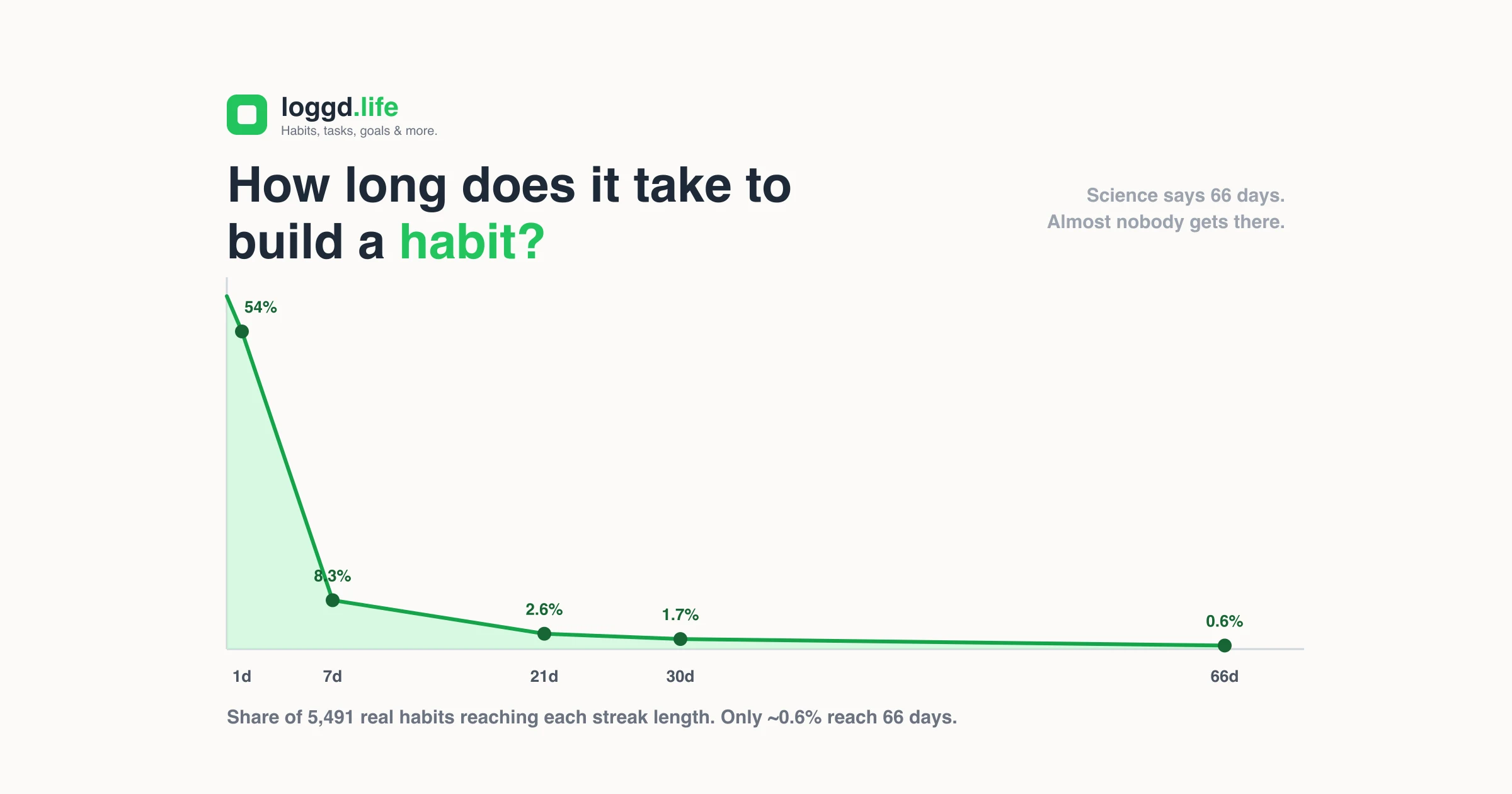
- About 45% never reach even a 1-day streak. They get created, sometimes from a suggestion, and never checked once.
- Most of the rest fade within a day or two. The median habit barely registers a streak at all.
- Only a small fraction ever reach a 7-day streak.
And when you sort the popular habits by how long people actually keep them, the most-wanted habits do worst:
| Habit | Avg. longest streak (days) | Note |
|---|---|---|
| GitHub activity | ~21 | Auto-synced |
| Post on threads | ~16 | Public, low-friction |
| Take vitamins | ~4.5 | Tiny, anchored |
| Workout | ~3.4 | Manual |
| Morning water | ~3.2 | Tiny, anchored |
| Brush teeth | ~3.0 | Already automatic |
| Go to the gym | ~1.5 | High friction |
| 10,000 steps | ~1.1 | High friction |
| Exercise 30 minutes | ~0.9 | High friction |
Two patterns jump out.
First, the two longest-surviving habits both log themselves. GitHub activity (auto-synced from commits) and posting on a public feed have streaks roughly 5 to 15 times longer than any manually-checked habit. The lesson is not about willpower. It is about friction. A habit you do not have to remember to log is a habit that survives. We wrote about this directly in what 4,000 habit trackers reveal: the single biggest driver of a long streak is whether the habit auto-completes.
Second, among manual habits, small beats big. "Take vitamins," "brush teeth," and "morning water" outlast "go to the gym" and "30-minute workout" by a wide margin. The big effortful habits are the ones people most want and abandon fastest. The tiny anchored ones quietly survive.
What this means if you are choosing habits to track
If you came here for a list of habits to copy, here is the more useful takeaway: how you track matters more than what you track.
- Start with 1 to 3 habits, not ten. The more habits people start at once, the lower the follow-through. A short list you actually check beats a long list you abandon.
- Pick small and anchored over big and effortful. "Drink a glass of water when I wake up" survives. "Go to the gym" does not, at least not as a checkbox. Shrink the habit until it is almost too easy.
- Reduce logging friction. The habits that last are the ones that log themselves or take one tap. If checking the box is a chore, the habit dies, regardless of how motivated you were on day one.
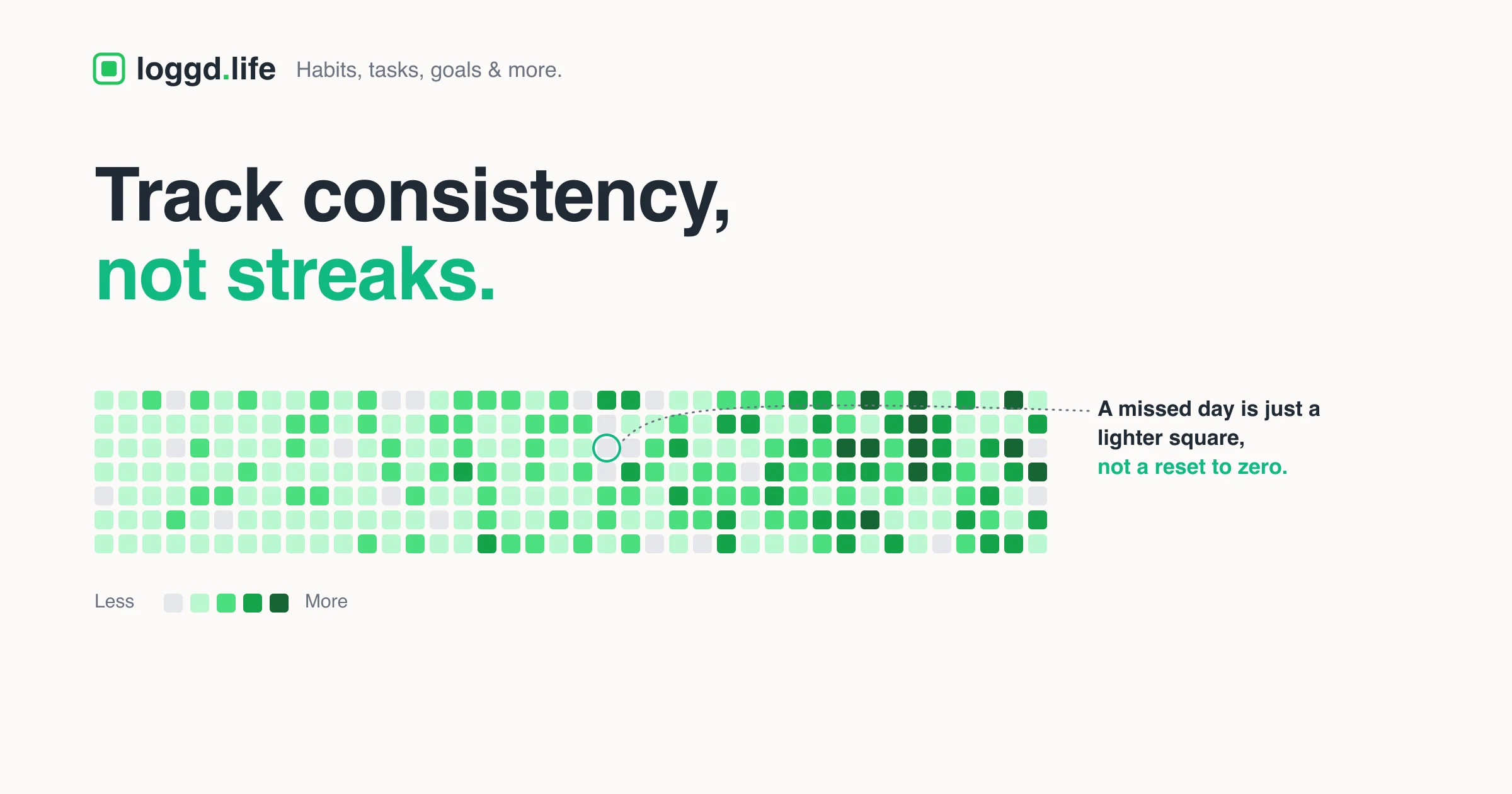
- Do not let a broken streak end the habit. Most people quit the first time they miss a day. That is exactly why Loggd's default view is a forgiving contribution grid instead of a streak counter that resets to zero. A missed day should be a lighter square in a good year, not a reason to give up.
The most-tracked habits on Loggd are the ones people aspire to. The most-kept habits are the ones people made easy. If you want to be in the second group, choose accordingly.
Methodology
These figures come from aggregate, anonymized data across 3,600+ registered Loggd users and 6,700+ habits, re-run in June 2026.
- What is counted. Habit names were normalized (lowercased, trimmed) and ranked by distinct users, so one power-user cannot skew a name. All published counts are rounded to the nearest five.
- Minimum sample. No named habit count is published with fewer than 50 users behind it. Streak averages shown are for habits with a large enough sample to be stable.
- Onboarding picker effect. Most of the top habit names are one-tap suggestions in Loggd's onboarding picker ("go to the gym," "drink 8 glasses of water," "morning water," "read 30 minutes," and so on), so name-frequency counts reflect menu design as much as personal choice. We report this openly because it changes how the ranking should be read. The themes are real; the exact name-level ordering is partly an artifact of the menu.
- Selection bias. The sample is self-selected: people who chose to use a habit tracker. It over-represents the motivated and under-represents the general population.
- Privacy. No individual user data, no user-entered free text beyond generic habit labels (which are generic by nature, "gym," "read"), and no usernames or demographics.
On the "which survive" framing: habit automaticity averages around 66 days per Lally et al. (2010), with a wide range (18 to 254 days), and a 2024 meta-analysis found health-habit formation can vary even more widely. So "survives" here means "kept checking," not "became automatic." Most habits on Loggd fade long before either.
Frequently asked questions
What is the most popular habit to track?
Gym and exercise variants dominate, followed by 10,000 steps and drinking water, then reading, journaling, and meditation. Note that several of these are onboarding suggestions, so popularity reflects the menu as much as personal choice.
How many habits should I track at once?
One to three. The more you start at once, the lower the follow-through. Get a couple sticking before adding more.
Are app-suggested habits worse than ones you pick yourself?
Mixed. Suggested habits inflate the popularity numbers because many get added and ignored. But the bigger predictor of survival is logging friction, not who chose the habit.
What habits are easiest to keep?
The ones that log themselves (auto-synced habits have by far the longest streaks) and, among manual habits, small anchored ones like a vitamin or morning water.
What habits do people quit fastest?
High-friction physical habits: 30-minute workouts, 10,000 steps, the gym, running. The most-wanted habits are also the fastest abandoned.
Is tracking habits actually effective?
It helps as a feedback loop, but it is not magic. Most started habits still fade fast, and real automaticity averages around 66 days.
How was this data collected?
Aggregate, anonymized data across 3,600+ users and 6,700+ habits, re-run June 2026, all rounded, 50-user minimum per named stat, no individuals. Most top habit names are one-tap suggestions from Loggd's onboarding picker, which is disclosed above.
About the author
I'm Eusebiu, the solo founder building Loggd, a habit and life tracker. I have been a dev contractor for about five years and I am now going full time on Loggd, building it in public with a growing audience on Threads. I have tracked my own habits on Loggd for over six months, including all the ones I quit. This kind of data is not flattering, most started habits fade fast, but I would rather publish the honest picture than a tidy list that pretends everyone keeps everything.
Last updated: June 2026.
Track your own habits on Loggd
If you want to see which of your habits actually stick, start tracking on Loggd, 3 habits free, no card. Pick one or two small ones, make them easy to log, and let the forgiving grid show you a year of progress instead of punishing one missed day.