TL;DR. A Sunday reset is a routine, not a productivity system. The version that survives is about 90 minutes in three blocks of roughly 30: house and admin, food and body, then the week ahead. The last block is the one that pays, because closing last week's open loops is what makes Monday quiet. Write down your 30-minute fallback version now, while you are calm, so a bad Sunday produces a short reset instead of no reset at all.
Sunday at my house is not aesthetic. There is a small person who needs feeding at unpredictable intervals, contract work waiting for Monday, and a laptop with my own app on it that I would rather be building. The reset I run is 90 minutes with a toddler somewhere in the middle of it, and it looks nothing like the videos.
The videos are the problem. The genre has one fixed shape: fresh linen, a matcha, a beige room, six hours of work compressed into 40 seconds. As content it is pleasant. As a plan it is unusable, because what you are watching is a performance of a reset rather than a reset.
Here is the version that survives an ordinary week.
What a Sunday reset actually is
It is a fixed block of time where you handle the house, the food, and the week ahead in one go, instead of in fragments spread across seven days. That is all it is. No official list, no required order, nothing to buy.
And it will not make you more productive. I want to say that early, because most writing on this topic makes claims it cannot support. A reset does not add hours or remove anything from your plate. What it does is narrower: it moves a batch of small decisions and chores into one slot where they are cheaper, and it means Monday starts with information rather than archaeology.
That is worth 90 minutes. It is not worth five hours, and it is not worth the guilt of having skipped it.
The 90-minute shape
Three blocks, roughly half an hour each.
| Block | Roughly | What it covers |
|---|---|---|
| House and admin | 30 min | Laundry, surfaces, bins, the paper pile, one nagging admin job |
| Food and body | 30 min | Meals decided, shop list, training in the calendar, sleep target |
| The week ahead | 30 min | Head emptied, last week closed, next week's real shape named |
Ninety minutes is not a magic number. It is roughly the longest block most people can hold every week for a year, which is the only test that matters for a routine.
For contrast: the reset checklist tool on this site ships with six categories of default tasks, and every minute estimate in those defaults adds up to 150 minutes. That is a fine menu and a terrible weekly commitment. Treat the long list as the menu and the 90 minutes as the plan.
Block 1: house and admin (30 minutes)
The goal is a house that does not generate decisions on Tuesday. Not a deep clean.
- Laundry on first. It is the only item that keeps running while you do everything else. Starting it at minute two rather than minute twenty is the cheapest improvement to this block.
- One surface per room. Kitchen counter, coffee table, desk, the chair. Not the whole room. The surfaces are what make a space read as chaotic.
- Dishwasher emptied, bins out. Both are ten-second decisions that become all-week friction if they are still pending on Monday.
- The paper pile. Open everything. Act on anything under two minutes. The rest becomes a written-down task, not a pile you look at again next Sunday.
- One nagging admin job. Exactly one. The renewal, the form, the appointment you have postponed twice. One per week means fifty two a year.
That last item is where most of the relief comes from. The dentist appointment you have not booked is on no list, but it runs in the background all week, and booking it takes four minutes. For the annual sweep of that category rather than one item a week, the life admin checklist covers the once-a-year jobs that never reach a to-do list at all.
Block 2: food and body (30 minutes)
The word to hold on to here is decide, not cook.
- Decide the week's meals. Five dinners, written down. Not a menu plan, just names.
- Write the shop list from those meals. In that order. A list written before the meals are decided is a list of ingredients that become nothing.
- Do the shop, or place the order. Usually the bulk of the block.
- Prep only the one thing that removes the most weeknight friction. For me that is a pot of something for Monday. For you it may be nothing.
- Put training in the calendar at times you will keep. Three sessions you do beats five you do not.
- Set the alarm for the wind-down, not the sleep. The alarm that matters is the one telling you to stop, not the one telling you to lie down.
Meal prep is where these routines usually die. Cooking five identical containers on a Sunday afternoon is a hobby, and if it is not your hobby, skipping it costs almost nothing. Deciding is most of the value.
One caveat on the training slot: scheduling a session does not tell you whether you will have anything left for it. If your Wednesday evening is reliably empty of energy rather than empty of time, that is a different problem, and energy management is the more useful lens.
Block 3: the week ahead (30 minutes)
This is the block people cut first. It is the one that pays.
Split it in half: close last week, then open next week.
Close last week (about 15 minutes).
- Empty your head onto one page. Everything loose, unsorted, no editing. The brain dump tool gives you a blank page, prompts if you are stuck, an optional timer, and a copy button at the end.
- Go through last week's list and mark what got done, what did not, and what quietly died without being decided.
- Write three lines on what actually happened. Not what you finished, what happened. Most of a working week disappears into conversations and small fires that no task list recorded, which is the argument for keeping a done list.
- Note anything in last week's calendar that generated a task you never wrote down. That is where the invisible follow-ups live.
Open next week (about 15 minutes).
- Calendar first. Fixed commitments only. That is the shape you are working inside, and planning does not change it.
- Name the two or three things that have to be true by Friday. Not a list. Two or three.
- Put the biggest one somewhere specific. A day, ideally a time. An unscheduled priority is a wish.
- Look for the collision you can already see: the deadline the day after the trip, the deep work block on the day with three meetings.
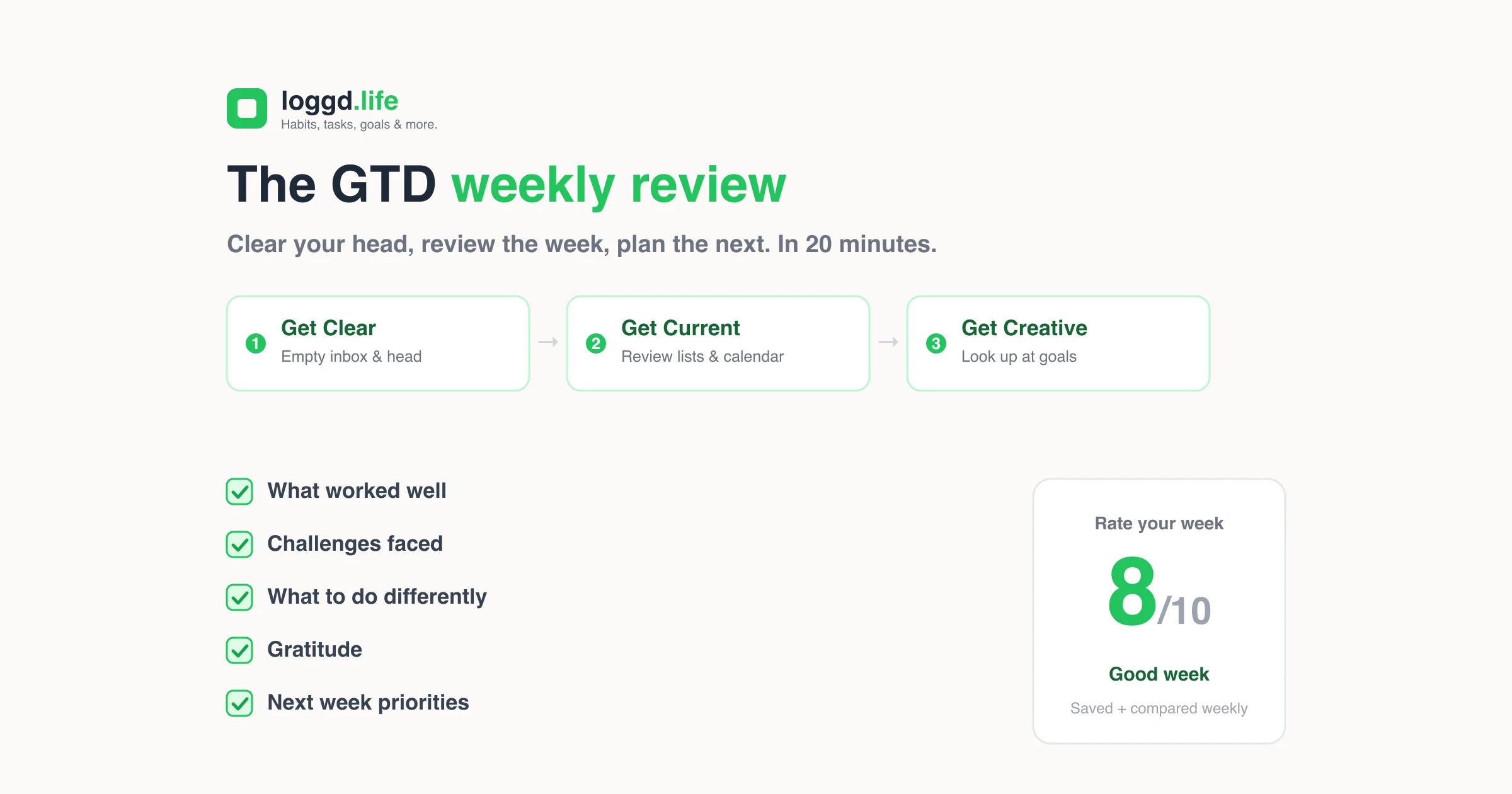
The fuller version of this half is the GTD weekly review, a 20 to 30 minute ritual aimed at getting the whole system back to a state you trust.
The reason this block matters most is simple. Monday rarely feels bad because of the work. It feels bad because you spend the first hour reconstructing where everything stood on Friday, and every one of those reconstructions is an open loop that has been running all weekend.
The rule that keeps it alive
Here is the actual mechanism, and it is not motivation.
Your reset is the minimum viable version you can do on a bad Sunday, not the aspirational version from a video.
Write that version down now, while you are calm. Mine:
- Laundry on
- Kitchen surfaces clear
- Meals decided
- Ten minutes on the week ahead
About 30 minutes. That is the reset. Everything else here is what I do when there is more time.
Decide it in advance because on the bad Sunday you will not negotiate honestly with yourself. At 8pm with a sick kid and a full inbox, the choice presents itself as "the full reset or nothing", and nothing wins. A pre-agreed 30-minute version is a different choice, and it is easy to say yes to.
What to cut when you have 30 minutes
| Keep | Cut |
|---|---|
| Laundry started | Deep cleaning anything |
| Kitchen surfaces | Every room beyond the surfaces |
| Meals decided | Meals cooked in advance |
| Ten minutes on next week | Reviewing last week in detail |
| The two or three things that must be true by Friday | The nagging admin job |
| Bins | Digital tidying of any kind |
The digital category goes first every time. Inbox zero, unsubscribing, organising files: all of it feels like a reset and none of it changes your week.
One quirk if you use the checklist tool: its weekly streak only counts a week where every task in every category is checked. Running the short version, delete the tasks you are not doing rather than leaving them unchecked, or the streak never fires and you feel like you failed a reset you deliberately shortened.
What a Sunday reset will not do
Four things, plainly.
It will not fix an overloaded week. If the work does not fit, no amount of Sunday preparation makes it fit. You just meet the overload having already noticed it.
It will not survive as a two-hour ceremony. The failure mode is not skipping it. It is building a version so long that skipping becomes the only sane option.
It is not a system. No output, nothing compounds, no metric. It is housekeeping plus fifteen minutes of thinking, and it is fine for it to be exactly that.
It is not free. If Sunday evening is the only unclaimed block you get all week, spending all of it resetting is a bad trade. Take the short version and go do something you like.
Running it
Paper is fine for all of this.
If you would rather have the list in front of you, the reset checklist tool walks the six categories with a minute estimate on every task, a running total, the option to add or delete tasks so the list becomes yours, a copy button for the whole checklist, and a weekly streak. The checkboxes clear themselves when the calendar week rolls over, and everything stays in your browser with no account.
Then close the laptop and go and have the last few hours of your Sunday.
Last updated: November 2026.
Written by Eusebiu, the solo founder building Loggd in public. I build the app in the evenings around contract work and a small daughter, so the 30-minute version of this routine is the one I run most weeks. I share what the aggregate data keeps showing on Threads.
Keep the routine visible without the all-or-nothing pressure. Loggd records a weekly ritual as a forgiving contribution grid, so the Sunday you skipped stays one lighter square instead of resetting you to zero. Start free.