TL;DR. A done list is what you actually did, written at the end of the day instead of the start. It works because visible progress is what keeps people going, and because most of a real working day disappears into decisions, conversations and small fires that no task list ever recorded. Three lines a night, deliberately including the invisible work. Compile weekly. The compile is what you reach for at review time, at invoice time, and on the Friday when the week felt like nothing happened.
My to-do list has never once been empty.
Not in ten years. Not on a good day, not on holiday. Every item I finish makes room for two more, and the list I look at on Friday evening is always longer than the one I opened on Monday morning. On paper that is a healthy system doing its job. In practice it is a document that greets me every morning with a tidy summary of everything I have failed to do.
I build a habit tracker in the evenings, around contract work and a small daughter who fights bedtime. My days end tired. On the tired days that list is actively bad for me, because it is the only artifact I have and it is written entirely in the language of arrears.
The done list is the same day, inverted.
What a done list is
At the end of the day, you write down what you did. Not what you planned. Not what you should have done. What happened.
Three lines. Plain, specific, past tense. Then you stop.
That is the whole format. There is no scoring, no ranking, no reflection paragraph. If it takes longer than two minutes you have built something else, and the something else will be the first thing you drop in a busy week.
Why the to-do list reads as failure
This is structural, not psychological.
A to-do list is a list of open obligations. That is its definition. Completing an item does not add anything to the page, it removes something from it, so the best possible outcome of a productive day is a slightly shorter list of things you still owe. The document has no way to represent a good day. It can only represent a smaller gap.
Worse, the list is written by the optimistic morning version of you and read by the tired evening version. The morning version thinks four deep tasks fit in a day. The evening version, who spent two hours on a problem nobody planned for, gets to look at the gap between them and draw conclusions.
Those conclusions are usually about character. They should be about estimation.
The progress principle, without the numbers
Teresa Amabile and Steven Kramer ran what is probably the largest diary study of its kind: thousands of daily entries from people working on creative projects inside real companies, day after day, over months. Then they went looking for what separated the good days from the bad ones.
The answer was progress. Of everything that lifted what they called inner work life, the mood, motivation and perception people brought to their work, making progress in meaningful work was the strongest positive driver. And the progress did not have to be large. Small steps forward showed up in the diaries as clearly as milestones did.
I am not going to quote a percentage at you, because the number is not the useful part. The direction of the arrow is. Progress feeds motivation at least as much as motivation feeds progress, which means the thing you look at when you close the day is not neutral. It is the evidence you use to decide whether the day was worth anything.
A to-do list is evidence of the gap. A done list is evidence of the progress. Same day. Two different verdicts.
Run it in three lines
Pin it to something that already happens. Closing the laptop, the last cup of tea, the walk to put the kid to bed. A done list with no trigger becomes a done list you keep meaning to start.
Write three lines, past tense, specific. "Fixed the sync bug" is worth less in three weeks than "found why habit checks duplicated on timezone change". Specific lines survive. Vague lines rot.
Do not edit them into achievements. The line is a record, not a performance. If you catch yourself writing only the impressive things, you have started keeping a highlight reel, and a highlight reel is useless for the two jobs this list is actually good at.
Include the invisible work, on purpose
This is the part most people skip, and it is the part that makes the difference.
Most of a working day is not tasks. It is decisions, interruptions, judgement calls and things that quietly did not go wrong. None of that was ever on a task list, so none of it gets recorded, and then you sit down at 9pm convinced you did nothing.
| What the day actually contained | What the task list recorded |
|---|---|
| Killed a feature that was going to cost two weeks | Nothing |
| Talked a colleague out of a bad migration | Nothing |
| Answered 40 messages, four of which mattered | Nothing |
| Noticed a billing bug before a customer did | Nothing |
| Wrote 20 lines of the thing on the list | One item, unfinished |
Five categories worth deliberately including:
- Decisions made, especially the ones where you chose not to do something.
- Conversations had, if they changed anything.
- Things you prevented, which is the single most invisible category of work there is.
- Things you unblocked for someone else.
- Things you learned the hard way, including the mistakes.
Prevention work is the reason experienced people so often feel unproductive. The better you get, the more of your day is spent stopping problems that therefore never happen, and an absence leaves no trace anywhere except in a record you write yourself.
The weekly compile, which is where it pays
Once a week, read the seven entries and pull the eight or ten lines that still matter. That compile is the actual product. Three places it earns its keep:
Performance reviews. Nobody remembers March in November. The person who kept a compile writes their review from a document. Everyone else writes it from vibes and recency, and recency is not kind to the quarter where you did the unglamorous plumbing.
Invoices and client updates. I do contract work. A weekly compile is the difference between a line item I can defend and a number I guessed. It also stops the specific failure mode of undercharging for the week that felt slow but was not.
The week that felt like nothing. This is the one that changed my mind about the practice. Roughly one week in five feels empty to me while it is happening. When I read the compile, it is almost never empty. Occasionally it genuinely is, and that is worth knowing too, but the feeling and the record disagree far more often than I expected.
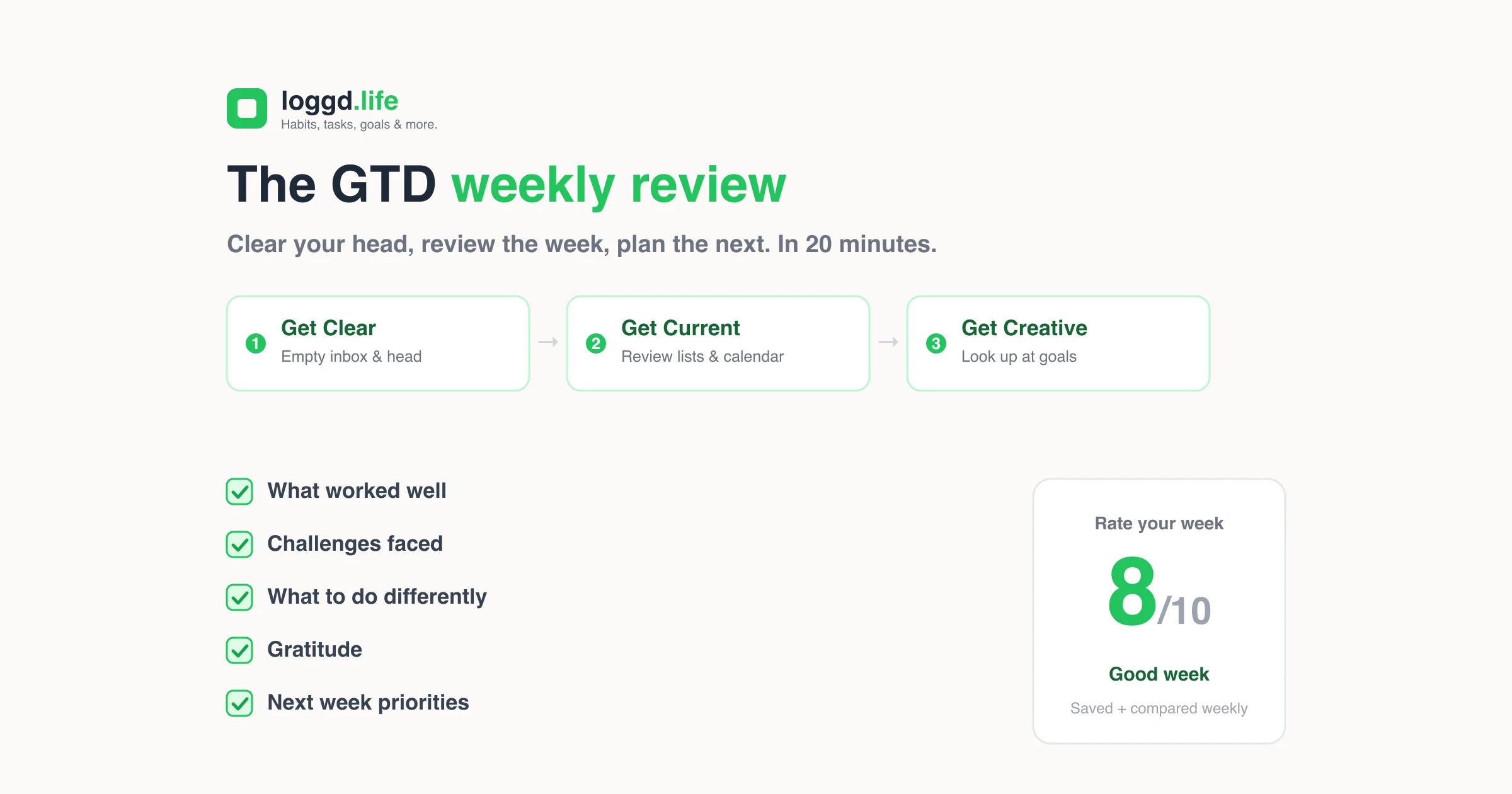
If you already run a weekly review, the compile slots straight into it. The weekly review guide covers the wider ritual, and the weekly review tool will walk you through it if you would rather not build the ceremony yourself.
Who this does not help
A done list is a record, not a plan. It cannot tell you whether the things you did were the right things, and it will happily document a busy year spent on the wrong work in beautiful detail.
If your problem is that you are busy in a way you are not happy about, the done list is the wrong tool and it may even be a comfortable place to hide. Two better starting points: the 1-3-5 rule for forcing a decision about what the day is actually for, and a time audit for finding out where the hours went before you decide anything at all.
It also does not help if you turn it into a scoring system. The moment there is a target number of wins per day, you will start writing lines to hit the target, and the record stops being true.
The version I built
The daily wins journal is the done list as a tool. Three slots for the day, each tagged to one of six categories: personal, professional, health, relationships, learning and creative. If a slot is blank and you are stuck, there is a prompt button that offers a question from that category.
Entries are dated. It keeps a current streak and a best streak, shows the last 30 days as a calendar of logged and empty days, groups your history by week for the compile, and copies or downloads the whole journal as plain text so you can paste it into a review document. Everything is stored in your browser and kept for 90 days, which is the honest limit: it is not a permanent archive, and if you want the compile to survive the year, export it.
One thing it does not do, despite the name: the "Win of the Week" panel simply picks the longest entry from the last seven days. It is a rough proxy for the most detailed one, not a judgement about which win mattered.
Three lines, past tense, including the things nobody could see. That is it. The point is not to feel better about the day, although you often will. The point is to have an honest record of it, because the alternative record, the one written in unfinished tasks, was never honest to begin with.
Last updated: November 2026.
Written by Eusebiu, the solo founder building Loggd in public. I build it in the evenings around contract work and a small daughter, so most of my done list is three lines long and half of it is invisible work. I share what the aggregate data keeps showing on Threads.
Keep the record without keeping a spreadsheet. Loggd shows what you actually did as a forgiving contribution grid, so a quiet Tuesday stays one lighter square instead of a zero. Start free.