TL;DR. A time audit is three to seven honest days logged in 30-minute blocks, with no editing and no flattering rounding. Log the scrolling too. Two numbers usually land hard: what commuting plus phone time costs you over a year, and how few genuinely deep hours fit into a week that felt completely full. Then change one thing, not nine. The interactive time audit tool does the summing, the leak detection and the yearly projections so the only work left is telling the truth.
I used to describe my week to people in a way that was completely false, and I was not lying.
Ask me and I would say something like: contract work most of the day, two or three hours on Loggd in the evening, gym three times a week, plenty of time with my daughter. That is a nice week. It is also a week assembled out of the parts I remember, which are the parts I chose. The twenty minutes between tasks, the reflexive phone check that becomes eleven minutes, the drive, the second email pass at 21:40, none of those made the summary. They never do.
A time audit is the boring instrument that closes that gap. You log where the hours went, you look at the total, and you stop being able to have the argument.
What a time audit actually is
It is a retrospective. That is the whole distinction.
Time tracking is ongoing. It is what freelancers do to bill clients, and it fails for the reason most tracking fails: the effort is permanent and the insight arrives once.
An audit is a short investigation with an end date. Three to seven days, then you stop, then you act. You are not building a habit here. You are collecting evidence.
That distinction is why audits get abandoned. Treat one as a lifestyle change and you quit on day two, which is exactly the pattern I keep seeing in the habit data on this site. Set the end date first.
The three-day protocol
Seven days is the ideal audit. Three days is the audit you will actually finish. Start with three, and add a weekend day if you can, because weekdays and weekends have completely different shapes and only one of them is scheduled by someone else.
Three rules make the difference between a useful audit and a flattering one.
Log in 30-minute blocks. Not to the minute, not by the hour. Minute-level logging turns into a second job and dies by lunchtime. Hour-level logging is too coarse to catch the actual problem, because the fragmented half hours are the whole finding. Thirty minutes is the resolution where the picture appears without the logging becoming the thing you are auditing.
Do not edit. This is the rule everyone breaks. You will finish a day, look at the number next to entertainment, and feel a strong urge to reclassify some of it as research. Do not. An audit you have quietly corrected is a mirror you have drawn on. If the number embarrasses you, that is the number doing its job.
Include the scrolling. Most audits fail here rather than at the logging. People log the meeting and the commute and the gym, and then treat forty minutes of standing in the kitchen looking at a phone as an interstitial nothing that does not belong in any category. It is not nothing. It is often the single largest recoverable block in the week, and it is invisible precisely because it never feels like an activity you started.
Practically: three checkpoints a day. After lunch, at the end of the workday, and before bed. Each one covers a stretch you can still remember honestly, which is the part that matters.
The categories that matter
Keep the list short enough that assigning an hour takes under two seconds. The time audit tool ships with deep work, shallow work, meetings, admin, commute, chores, self-care, social, entertainment and sleep, plus custom categories for anything those miss.
One split does most of the work: deep work versus shallow work.
If both land in a single bucket called work, the audit will tell you that you worked 46 hours and you will learn nothing, because you already knew that. Split them and the real number appears. Deep work is the cognitively demanding stuff that only you can do and that actually moves anything: writing the thing, building the thing, solving the hard problem. Shallow work is everything else that is still legitimately work: replying, scheduling, formatting, chasing, the fourth pass over an inbox.
Both are necessary. They are not interchangeable, and only one of them tends to produce the results you are judged on.
The second split worth making is inside your leisure: passive entertainment versus anything you would describe afterwards as restorative. They occupy the same hours and they do not return the same thing.
You do not need more categories than that. Every extra one is a decision you have to make forty times a day, and decisions are what kills logging.
The two numbers people find shocking
Every audit produces its own results, so I will not tell you what yours will say. But two findings come up so often that they are worth bracing for.
One: commute plus phone, projected over a year.
Take the arithmetic yourself. A 25-minute commute each way is 50 minutes a day. Across five days that is about 4 hours and 10 minutes a week, and across roughly 46 working weeks it lands near 190 hours. Add a phone habit of an hour and a half a day and you are somewhere near 550 hours a year, which is more than 22 full 24-hour days.
Nothing in that calculation is a claim about you. Those are your numbers run forward, and that is exactly why it lands. The daily version feels trivial and the annual version does not, and both describe the same behaviour. The screen time calculator runs the phone half of that projection over a lifetime if you want the more uncomfortable version, and the time audit does the yearly projection automatically for every category you flag as low value.
Two: how little deep work fits into a full week.
This is the one that stings. People routinely log a 50-hour work week and discover that the genuinely focused portion of it, the part where the hard thing actually moved, is a single-digit number of hours.
That is not usually a discipline failure. It is what a calendar of 30-minute gaps produces. Deep work needs runway, and a day chopped into fragments by meetings and interruptions has no stretch long enough for anything to reach altitude. You did not waste the week. The week was shaped so that focus had nowhere to happen.
Which is the useful reframe, because you can change the shape of a week. You cannot change a personality flaw by Monday.
What to change afterwards
Here is where most audits die. You get the results, you feel a burst of clarity, you plan a total redesign of your life, and by Wednesday you are back to the same week with a lingering sense of guilt.
Change one thing.
1. Cut the largest leak in half. Not to zero. The audit flags categories you rated low value that still consume real hours, so pick the biggest one and halve it. Halving is achievable and survives a bad week. Elimination is a promise you break, and then you abandon the whole project because you broke it.
2. Put the recovered hours somewhere specific. Time you free up without a destination gets reabsorbed within about a week, usually by the exact category you just cut. Give it a slot. The time blocking planner is the fastest way to do that: place the block, label it, and let the summary panel show you the hours per category so the plan and the audit speak the same language.
3. Re-run the audit in a month. One week of data tells you where you are. Two weeks a month apart tell you whether anything actually changed, which is the only question that matters. Your entries are saved in your browser between visits, so the second run is mostly confirming numbers rather than typing them.
If a full week of logging is more than you can commit to right now, the daily time pie is the five-minute version: you build one typical 24-hour day as a pie chart, compare it against your ideal day, and get the same category-level gaps without the week of logging. It is a snapshot rather than a record. It is also considerably better than continuing to guess.
What a time audit will not do
I should be honest about the limits, because time audits get sold as a life fix and they are not one.
An audit tells you where the hours went. It does not tell you which hours deserve to be there. That is a values question, and no amount of logging answers it. If you finish the audit and your reaction is that everything on the list matters, the audit worked correctly and your actual problem is that you have taken on more than a week holds. The wheel of life assessment is a better instrument for that question than any timer.
The three-day log is also more commitment than some people will ever give this. If you know you will not keep it, the honest downgrade is drawing your 24 hours from memory and checking one real day against it. It is a weaker instrument and the gap between the two pictures is the whole lesson, but a five-minute exercise you actually do beats a protocol you abandon on day two.
An audit also cannot fix a week that is not yours to shape. If your hours are set by shift work, caring responsibilities or a job with no discretion in it, the audit will mostly confirm what you already suspected. That is still worth knowing, and the honest conclusion may be that the recoverable time is small and sits entirely in the evening. Small and real beats large and imaginary.
And an audit is a snapshot. One unusual week can mislead you badly in either direction, which is why the re-run matters more than the first pass.
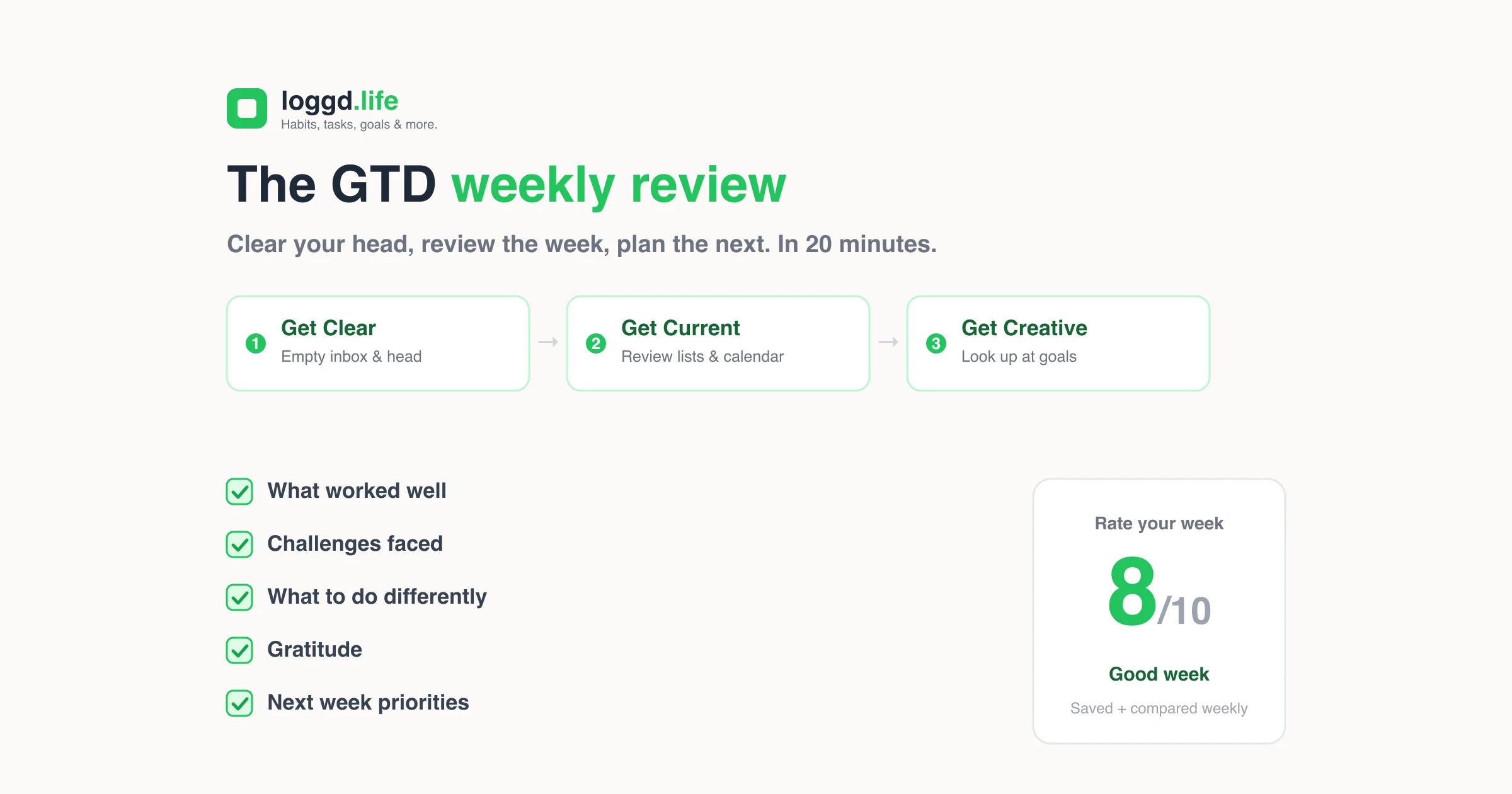
The strongest follow-on is not another audit at all. It is a standing weekly review, where the audit stops being a one-off shock and becomes fifteen minutes on a Friday that keeps the week from drifting back to its old shape.
Start tonight, not Monday
The audit you start on a Monday in some cleaner future month is not real. The one you start tonight, in the middle of an ordinary unremarkable week, is the one that produces usable data, precisely because the week is ordinary.
Open the time audit, log today in 30-minute blocks, and do not tidy the numbers. Everything stays in your browser, there is no account, and the tool does the summing so the only difficult part is the part no software can do for you.
Three days. No editing. Include the scrolling.
Last updated: September 2026.
Written by Eusebiu, the solo founder building Loggd in public. I build the app in the evenings around contract work and a small daughter, which means my own week has roughly four discretionary hours in it and I have audited every one of them. I share what the aggregate data keeps showing on Threads.
Turn one honest week into a habit that holds. Loggd tracks your habits, tasks and focus sessions on a forgiving contribution grid, so the block you protected after the audit is visible six weeks later. Start free.