TL;DR. You quit habits after a few days because you started too big and because one missed day reads as total failure. The fix is not more discipline. Shrink the habit until repeating it tomorrow is trivial, anchor it to something you already do every day, and use a tracker that treats a miss as one lighter square instead of a reset to zero. And the target is earlier than you think: across 7,800+ real tracked habits, most die before the second check-in, so the goal for week one is simply to check it twice.

If you have started the same habit four times this year, this is not a motivation article. You clearly have motivation. You have started four times.
What you have is a design problem, and it is measurable.
Why do you quit habits after a few days?
I build Loggd, a habit tracker, which means I can see what happens to habits in aggregate. The numbers are blunter than most advice admits.
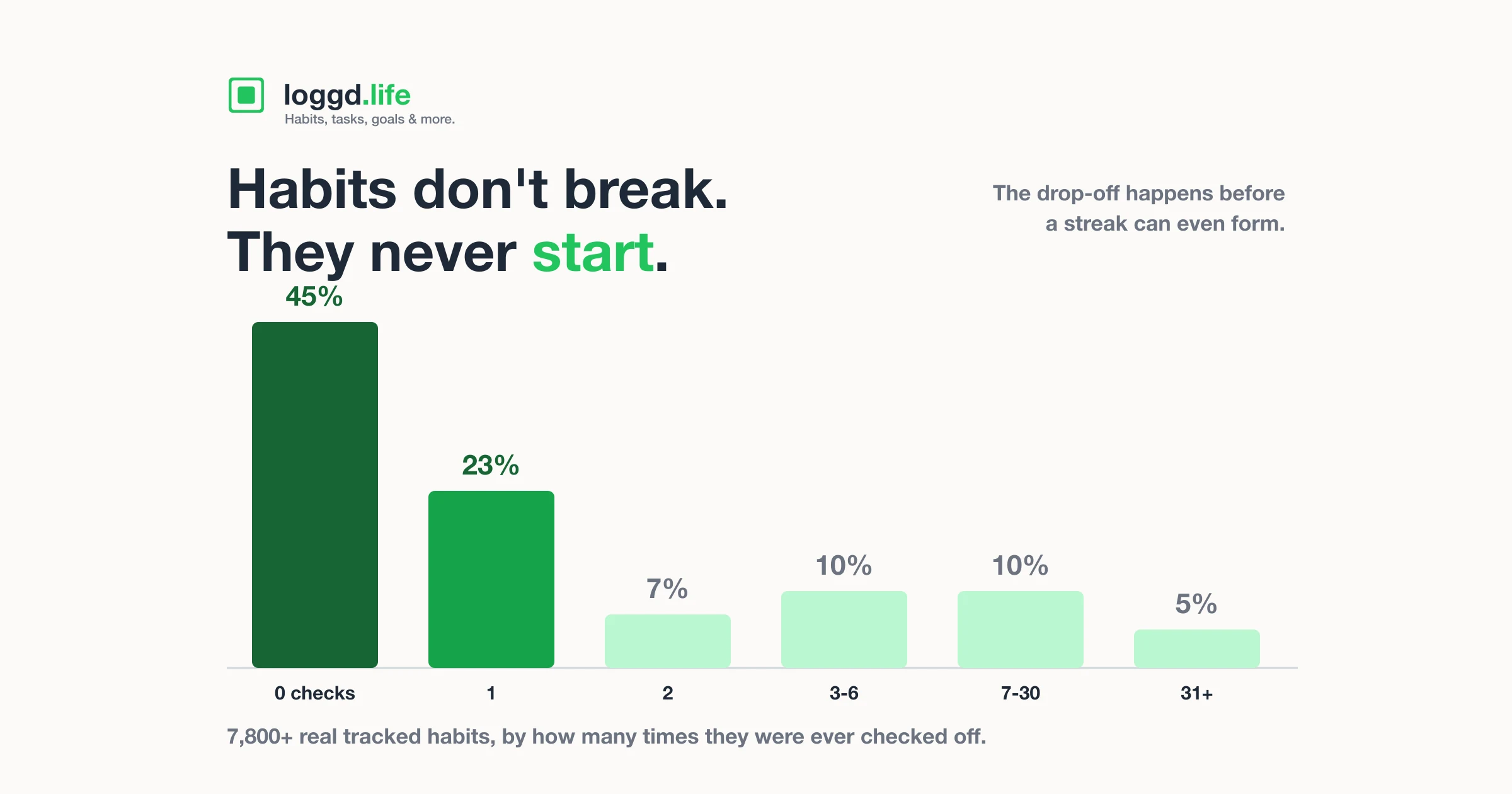
Across 7,800+ habits from 4,200+ users:
- About 45% are never checked off a single time.
- Another 23% are checked exactly once, then never again.
- Only around 26% ever reach three check-ins.
- Only around 5% reach 31 or more.
The full breakdown is in habits people quit fastest, but the important part is what it does to the "I quit after 3 days" story.
Day three is not where habits die. Most habits never get near day three. They are created in a burst of intent, checked once, and abandoned. The wall is check number two.
That matters because it changes what you should be optimizing. Advice built around "push through the tough second week" is aimed at a stage that two thirds of habits never reach. If you have been trying to build stamina for a marathon, and the actual failure happens in the first hundred metres, no amount of stamina training helps.
So here are four fixes, each aimed at the place habits actually break.
Fix 1: Shrink it until the second check is trivial
The habit you chose was designed by an optimistic version of you. The habit you have to do tomorrow gets done by a tired version of you. Those are different people, and the tired one has the deciding vote.
Look at what the data does to ambitious habits. "Exercise 30 minutes" is one of the most popular habits on Loggd, tracked by 245 people, and its average longest streak is 0.9 days. Thirty minutes is not a hard workout. It is a hard scheduling commitment, every single day, forever.
The test, borrowed from BJ Fogg's Tiny Habits work: shrink the habit until doing it takes under 30 seconds and needs no preparation.
| The habit you wrote | The habit that survives |
|---|---|
| Exercise 30 minutes | 10 pushups |
| Read 30 minutes | Read one page |
| Meditate 20 minutes | Three slow breaths, sitting on the bed |
| Run 5k | Put on shoes, walk to the end of the street |
| Journal every night | Write one line |
The objection is always the same: one page is not enough to matter. Correct. One page does not matter. Two hundred consecutive days of one page matters enormously, and it is the only version of this that reaches day two hundred. You are not optimizing today's output. You are optimizing the probability of tomorrow.
You can always do more on a good day. Doing more never breaks anything. Setting the bar at "more" is what breaks it.
Fix 2: Anchor it to something you already do
The second failure is memory. On day one you are thinking about the habit constantly. On day two it is competing with everything else in your life, and it loses silently. Nobody decides to quit. They just do not remember at 9pm.
Anchoring solves this by stealing the reliability of a routine you already have. The format is: after [existing habit], I will [new habit].
- After I pour my morning coffee, I drink a glass of water.
- After I brush my teeth at night, I write one line in my journal.
- After I close my laptop for the day, I do 10 pushups.
The mechanism here is what researchers call an implementation intention, and Peter Gollwitzer's work found that specifying when and where a behavior will happen substantially increases follow-through compared with intention alone. The existing routine acts as the reminder, so you are not spending willpower on remembering.
Pick an anchor that already happens every single day without you thinking about it. Coffee, teeth, shoes off at the door, closing the laptop. A weekly anchor cannot support a daily habit.
Fix 3: Stop chasing a perfect streak
This is the one place where the standard habit tracker actively works against its user, and it is the reason Loggd is built the way it is.
A streak counter is a number that says 14, then you miss one day, and it says 0. Nothing about your actual behavior justifies that. You did the thing 14 times out of 15, which is excellent. The number tells you that you have nothing.
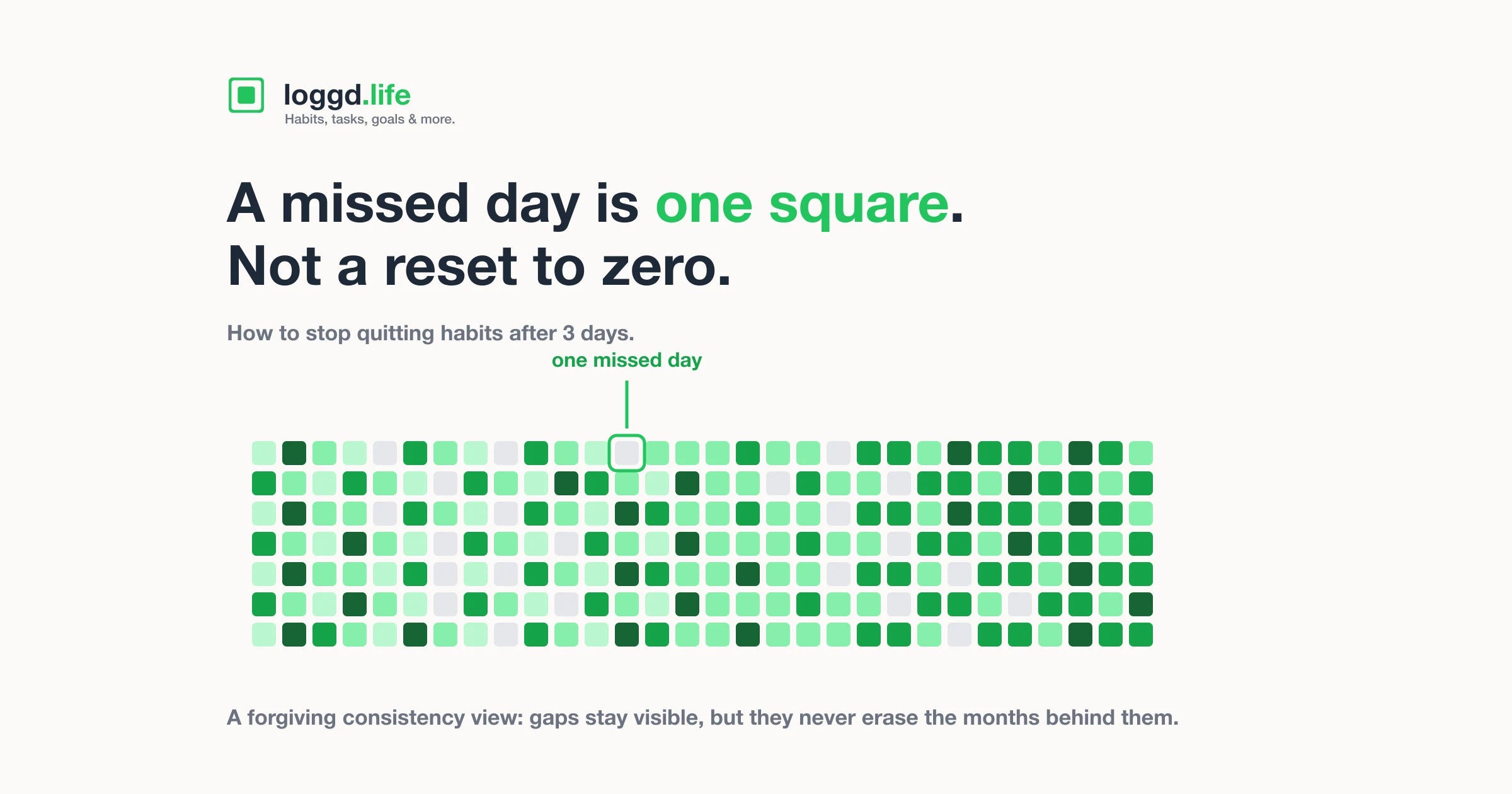
Psychologists call the resulting spiral the abstinence-violation effect: once a rule is broken, the broken rule itself becomes the reason to abandon the whole project. One missed day becomes "I ruined it," which becomes "I will restart Monday," which becomes nothing.
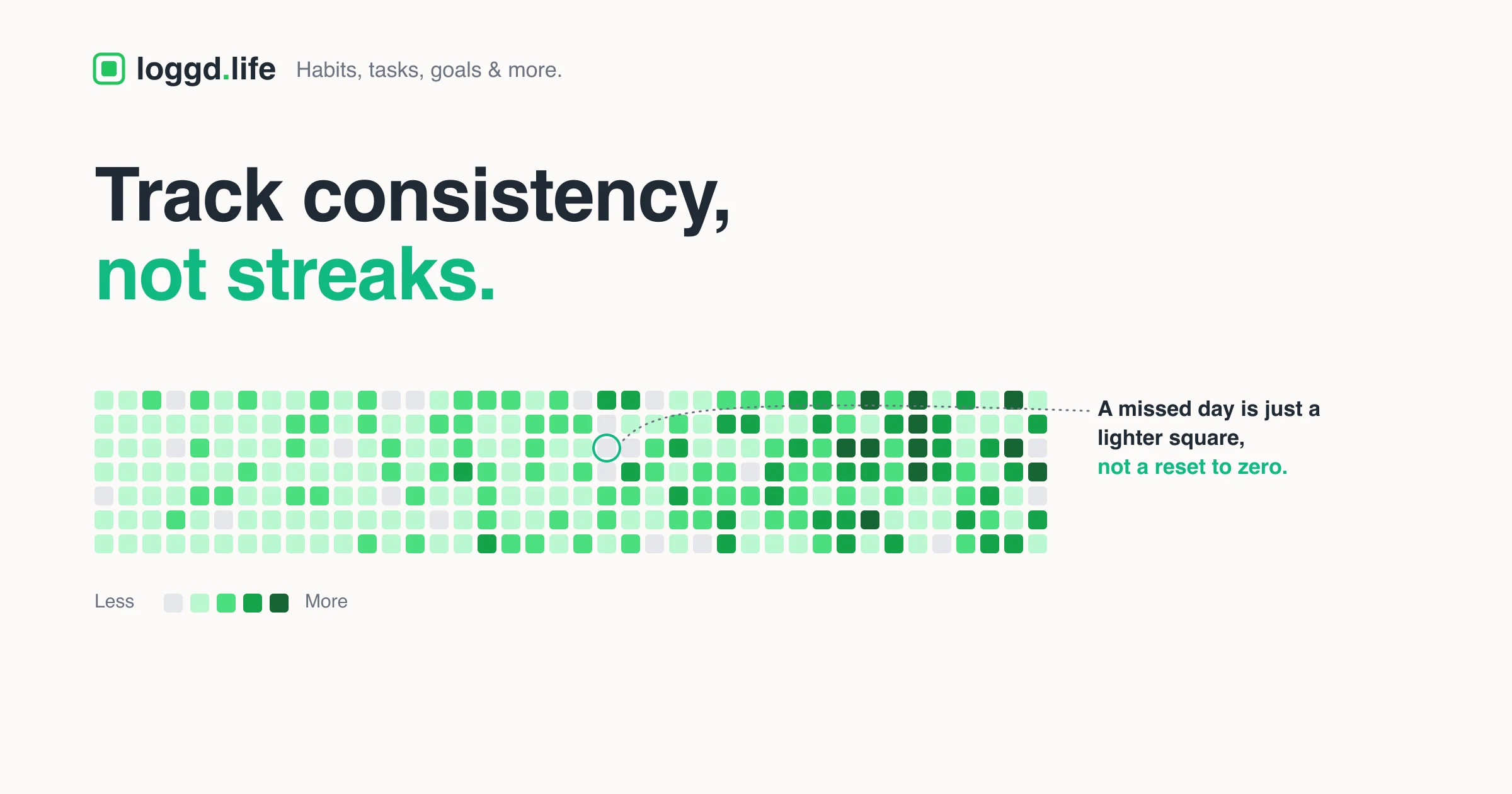
This is why Loggd shows a contribution grid instead of a streak counter. A missed day is one lighter square in a grid of hundreds. You can look at a month with two gaps and see what it plainly is: a good month. A streak counter shows the same month as a failure and a restart.
If your tracker only offers streaks, the workaround is to stop reading the number and start looking at the calendar view. Count days done this month, not days in a row.
Fix 4: Never miss twice
One missed day is noise. Two in a row is the beginning of a new pattern, which is your brain doing exactly what it is supposed to do, just with the wrong behavior.
So the only rule you need after a miss is: do it the next day. Not double. Not a make-up session. Not a fresh start on Monday. The next day, at the normal size.
Our own tracker data backs the shape of this rule, though not the folklore around it. Measuring what happens after a missed day shows the sharpest single drop in the whole curve falls between the first missed day and the second, which is exactly what the rule claims. What the data does not show is a cliff at two. Every further day costs you, steadily, which makes coming back today worth more than any restart date you are eyeing.
Two things this rules out, both of them common and both of them fatal:
- Compensating. Missing a run and then doing two tomorrow turns the habit into a debt you owe yourself. Debts get avoided.
- Waiting for a clean restart. Monday, the first of the month, and January are the three most expensive dates in habit building. Restarting on Thursday works exactly as well and costs you three fewer days.
Your first week, concretely
If you want the whole thing as a sequence:
- Pick one habit. Not three, not a morning routine. One. Tracking a long list is the most reliable way to track nothing.
- Shrink it until the tired version of you would do it without negotiating.
- Attach it to a daily anchor and say the sentence out loud: after I ___, I will ___.
- Do it once today. This part is easy and it is not the point.
- Do it again tomorrow. This is the whole game. Two thirds of habits never get here.
- When you miss, do it the next day at the normal size, with no compensation.
- Review after two weeks, counting total days done rather than consecutive days. Only add a second habit once the first one runs without you thinking about it.
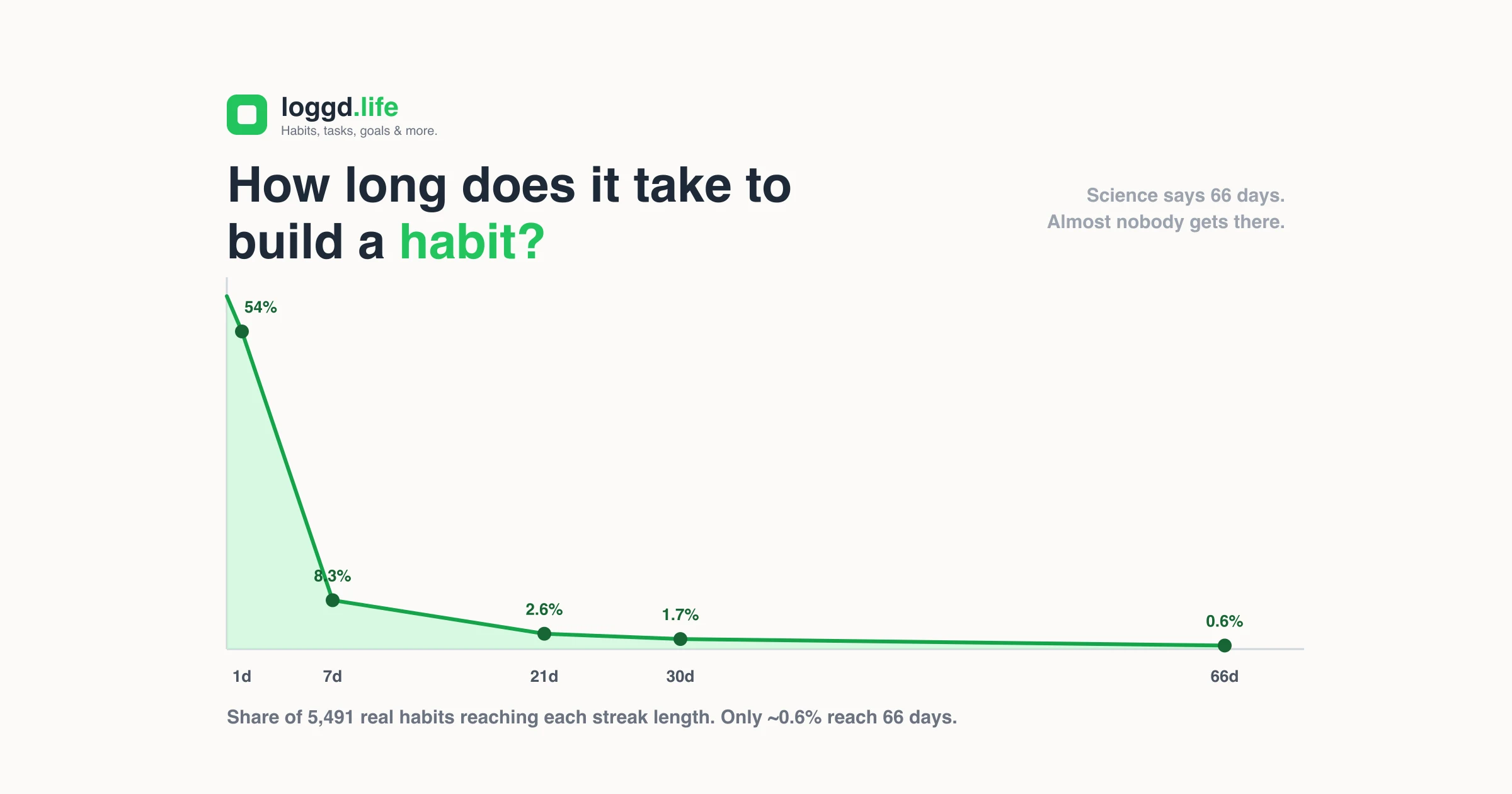
Set expectations correctly on the timeline. The Lally 2010 study at University College London put median automaticity at around 66 days, ranging from 18 to 254. The Loggd data on how long habits take shows well under 1% of tracked habits reach the 66-day mark. You are aiming at a months-long process, and quitting at day three means quitting before the process starts.
When quitting is actually the right call
Not every abandoned habit is a failure, and pretending otherwise is how people end up dragging around a list of obligations they never chose.
Some habits are worth dropping on purpose:
- Habits you picked because you thought you should want them.
- Habits that belong to a life you are not living right now, like a 6am gym slot during a season with a newborn in the house.
- Habits you are tracking to please someone else.
The distinction is between quitting deliberately and quitting by neglect. Deciding a habit is not for you right now, and removing it, is a clean decision. Leaving it in your tracker unchecked for six weeks is just a daily reminder that you are failing at something you never committed to. Delete it. The remaining habits get easier immediately.
FAQ
Why do I quit habits after a few days? Because the habit was too big to repeat and one missed day reads as failure. The data shows most tracked habits die before the second check-in, so the issue is the design of the habit, not your discipline.
How do I get past the first week? Target the second check-in, not the week. Shrink the habit, anchor it to an existing daily routine, and decide your minimum version in advance for bad days.
How small should a new habit be? Under 30 seconds, no preparation needed. One page, three breaths, 10 pushups. You can always do more.
What do I do after missing a day? Do it the next day at the normal size. Never miss twice. Do not compensate and do not wait for Monday.
Is it normal to quit after 3 days? Yes, and reaching day three actually beats about three quarters of tracked habits.
How long until a habit sticks? Median around 66 days per the Lally 2010 research, with a range of 18 to 254. The 21-day rule is a myth traceable to a 1960 misreading.
Last updated: August 2026.
Written by Eusebiu, the solo founder building Loggd in public. I have been tracking my own habits for over six months, mostly in the gaps after my daughter is asleep, and I build the app around what the aggregate data keeps proving about follow-through. I share the numbers as I find them on Threads.
Build the habit without the all-or-nothing pressure. Loggd shows your consistency as a forgiving contribution grid, so a missed day stays one lighter square instead of resetting you to zero. Start free.