TL;DR. About 45% of tracked habits are never checked off once, and another 23% are checked exactly one time and never again. That is the pattern across 7,800+ real habits and 4,200+ people, and it looks the same in every habit tracker; this one just publishes it. Roughly two in three habits die at or before the second check-in. The habits abandoned fastest are the high-effort physical ones: running, morning stretch, pushups, 30-minute workouts, 10,000 steps, and reading 10 pages, all averaging streaks of a day or less. The popular story is that people quit at day three, or that a broken streak kills a habit. The data says something less flattering and more useful: most habits never get far enough to break a streak. They are created, checked once, and quietly abandoned.

If you have ever set up a habit tracker with real intent and then found it untouched two weeks later, you are looking at the single most common outcome in the data. Not the exception. The default.
I run Loggd, a habit and task tracker, so I can see the aggregate shape of this across thousands of people. Here is what actually happens to a habit after someone creates it.
One thing to say up front, because it matters for how you read every number below. This is not a Loggd problem, it is the shape of habit formation itself. Every habit tracker on the market has numbers like these, and the published research points the same way: the Lally study at University College London found automaticity takes a median of 66 days, which almost nobody reaches in any system. The difference is that most apps only ever show you the success stories in their marketing. I would rather publish the real curve, because knowing where habits actually break is the only way to design around it, both for you and for the app.
Which habits do people quit fastest?
Sorting habits by their average longest streak, and only counting habit names that at least 50 different people track, the bottom of the list looks like this.
| Habit | People tracking it | Avg. longest streak (days) |
|---|---|---|
| Run | 90 | 0.7 |
| Morning stretch | 100 | 0.7 |
| Do pushups | 85 | 0.9 |
| Exercise 30 minutes | 245 | 0.9 |
| 10,000 steps | 180 | 1.0 |
| Read 10 pages | 50 | 1.1 |
An average longest streak of 0.7 days means that across everyone tracking "run," the typical best-ever run of consecutive days did not reach a single day. Most of those habits were never checked at all.
Two things stand out. First, every entry is a physical or scheduling habit that demands a real block of time or a real change to your evening. Second, "read 10 pages" is on this list despite being the kind of habit that usually gets recommended as an easy win. Ten pages is not small when you are starting from zero pages.
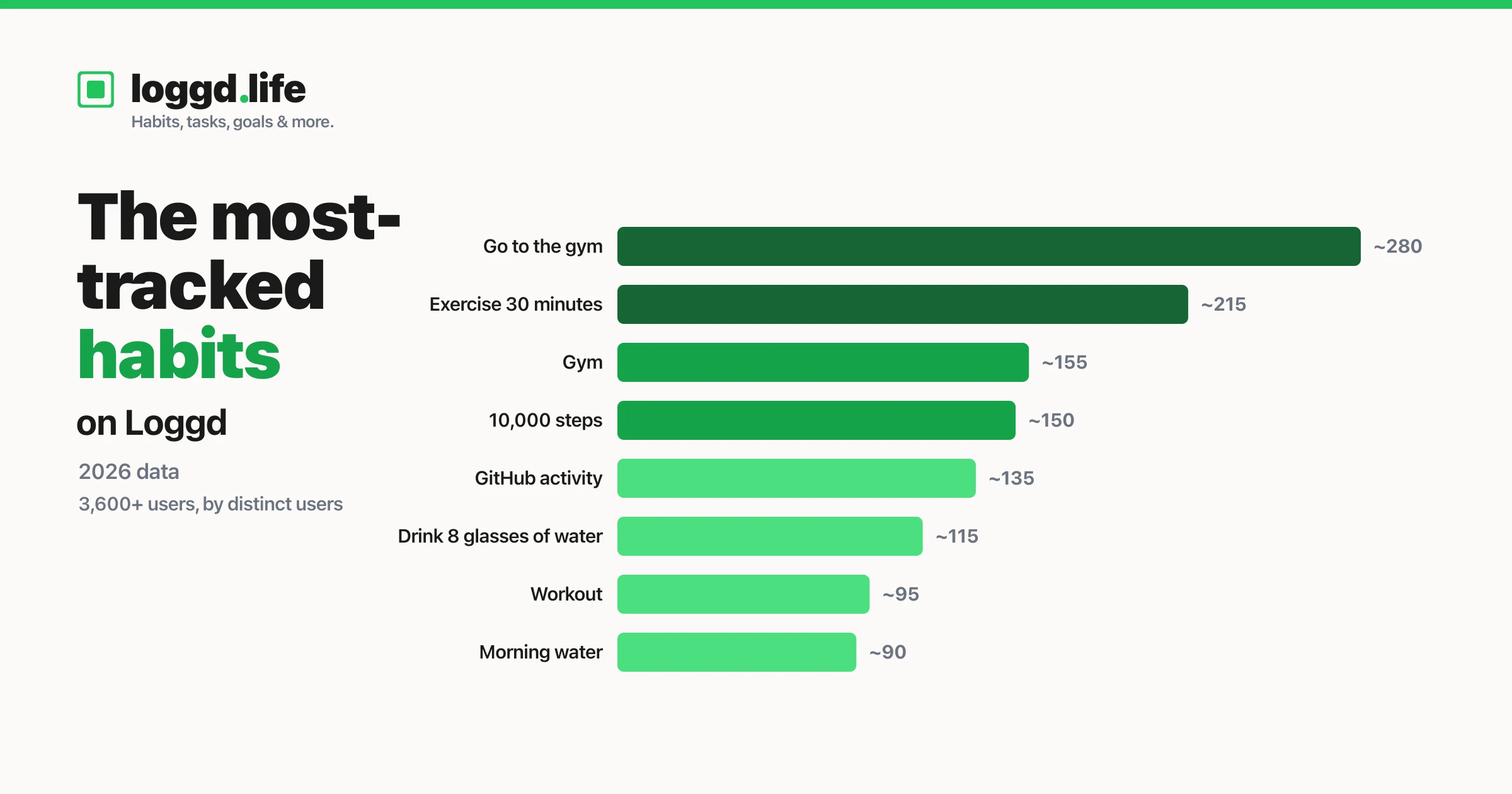
We covered the flip side of this list in the 50 most-tracked habits on Loggd: the habits with the longest streaks are the ones that log themselves, like GitHub activity syncing automatically. The friction of logging predicts survival better than the ambition behind the habit.
But the habit names are the least interesting part of this data, because sorting by name hides the real finding.
Most habits are never checked twice
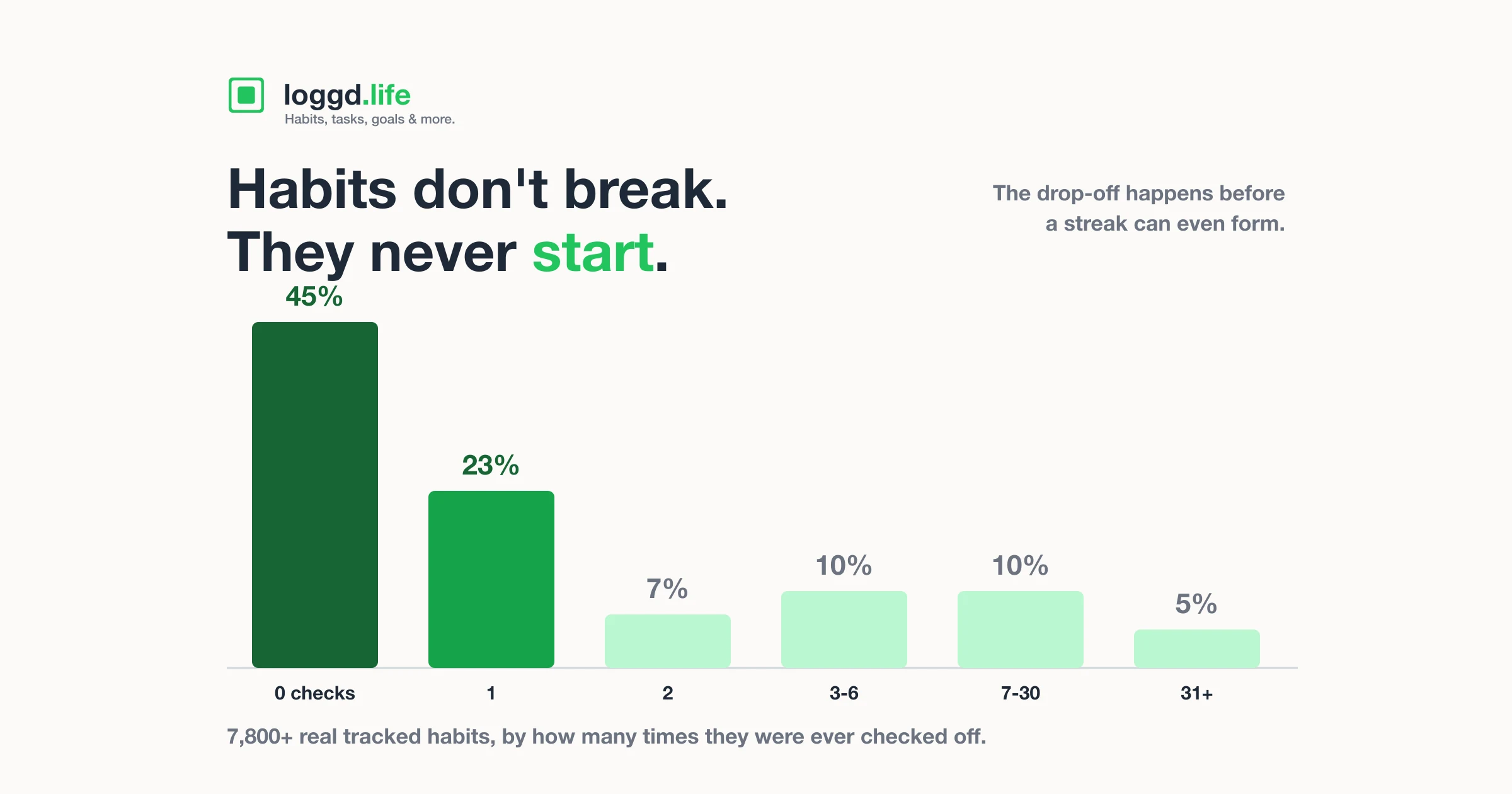
Instead of streaks, count raw check-ins. How many times was each habit ever marked complete?
| Total check-ins | Share of all habits |
|---|---|
| 0 | ~45% |
| Exactly 1 | ~23% |
| Exactly 2 | ~7% |
| 3 to 6 | ~10% |
| 7 to 30 | ~10% |
| 31 or more | ~5% |
Read the top two rows together. About 68% of habits accumulate one check-in or fewer. Nearly half never get a single one.
Put differently: of the habits that do get checked off at least once, about 41% never receive a second check. The person set it up, did the thing once, felt the small hit of satisfaction, and never came back.
This reframes the whole conversation about quitting. The popular narrative, the one every motivation blog runs on, is that people build momentum for a few days and then lose it. That story assumes a stretch of consecutive days that eventually breaks. For two thirds of habits, that stretch never exists. There is no streak to break.
The wall is not day three. The wall is check two.
How long does a habit actually live?
For habits that got at least one check-in, measure the days between the day the habit was created and its final check-in. That is the habit's lifespan.
| Lifespan | Share of habits that were checked at least once |
|---|---|
| Last check on the day it was created | ~33% |
| 1 to 2 days | ~13% |
| 3 to 6 days | ~10% |
| 7 to 29 days | ~18% |
| 30+ days | ~26% |
A third of all habits that ever get checked are checked only on the day they were created and never again. Setup and first check-in are the same event, and it is also the last event.
One honest caveat on that bottom row: the 30+ day group includes habits that are still running right now, so it mixes long survivors with people who are simply mid-habit. It is not a clean "these lasted a month and then stopped" figure. The top rows are unambiguous, though, because a habit last checked on its creation day two months ago is genuinely finished.
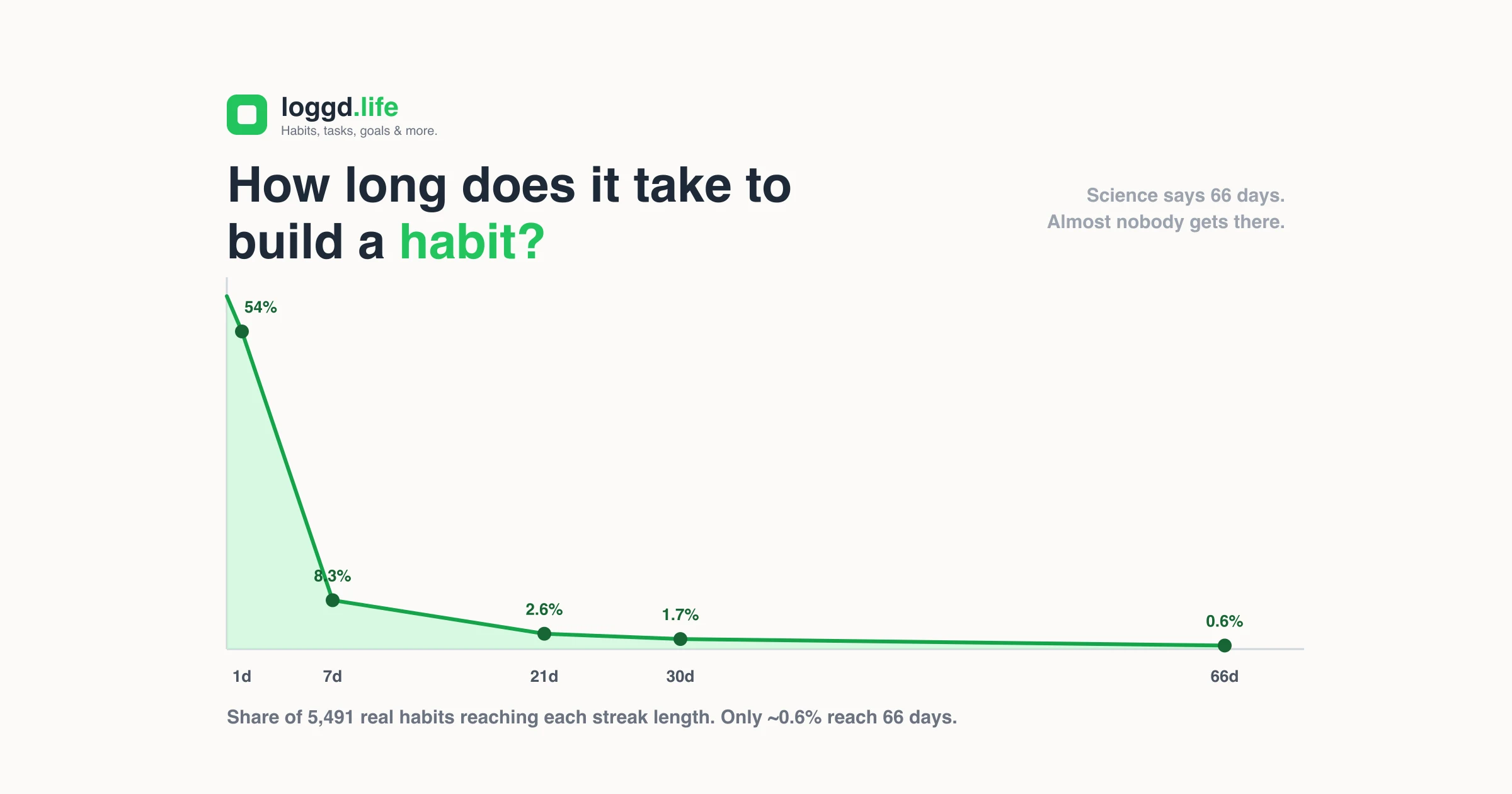
Set against the streak data from how long it takes to build a habit, where reaching the 66-day mark that the Lally research associates with automaticity is a sub-1% event, the picture is consistent. Almost nobody gets near the point where a behavior becomes automatic, because almost nobody gets past week one.
Are app-suggested habits abandoned more often?
Yes, and it is worth measuring rather than assuming, because almost every tracker offers a starter menu.
Loggd, like almost every tracker, shows new users a list of suggested habits: go to the gym, drink 8 glasses of water, morning stretch, read 30 minutes. Tapping one takes a second and carries no real commitment, so some of those habits were never genuinely chosen. That should show up in the data, and it does:
- Habits picked from a suggestion menu: never checked 52% of the time.
- Habits people typed themselves: never checked 43% of the time.
A nine point gap. Choosing your own habit measurably beats picking one off a list, which is a useful finding if you are setting up any tracker: type your own, in your own words, even if the menu has something close.
What the gap does not do is explain the pattern. Habits that someone thought about, typed out, and named themselves are still abandoned before the first check-in more than four times in ten. Remove suggestion menus entirely and the headline finding barely moves. People create habits they do not repeat, whether or not an app proposed them.
Why the second check is the real wall
Three things separate a habit that gets a second check from one that does not, and none of them are motivation.
The first check is free, the second one is not. Creating a habit and checking it once happens in a burst of intent, usually in one sitting. The second check requires a completely different thing: remembering, on a different day, in a different mood, with the novelty gone. Most habit advice optimizes for the burst. The burst is not the problem.
Size is decided at creation, and it is usually wrong. "Exercise 30 minutes" at 245 people tracked and a 0.9-day average streak is the clearest example in the dataset. Thirty minutes is a decision made by an optimistic version of you who is not the person who has to show up tomorrow. The habits that survive tend to be small enough that a bad day does not disqualify them.
Friction compounds daily, ambition does not. Auto-synced habits on Loggd, like GitHub activity, run streaks many times longer than manual ones, as we broke down in what 4,000 habit trackers reveal. Those users are not more disciplined. Their habit costs nothing to log. Every unit of friction you remove is paid back every single day; every unit of ambition you add is charged every single day.
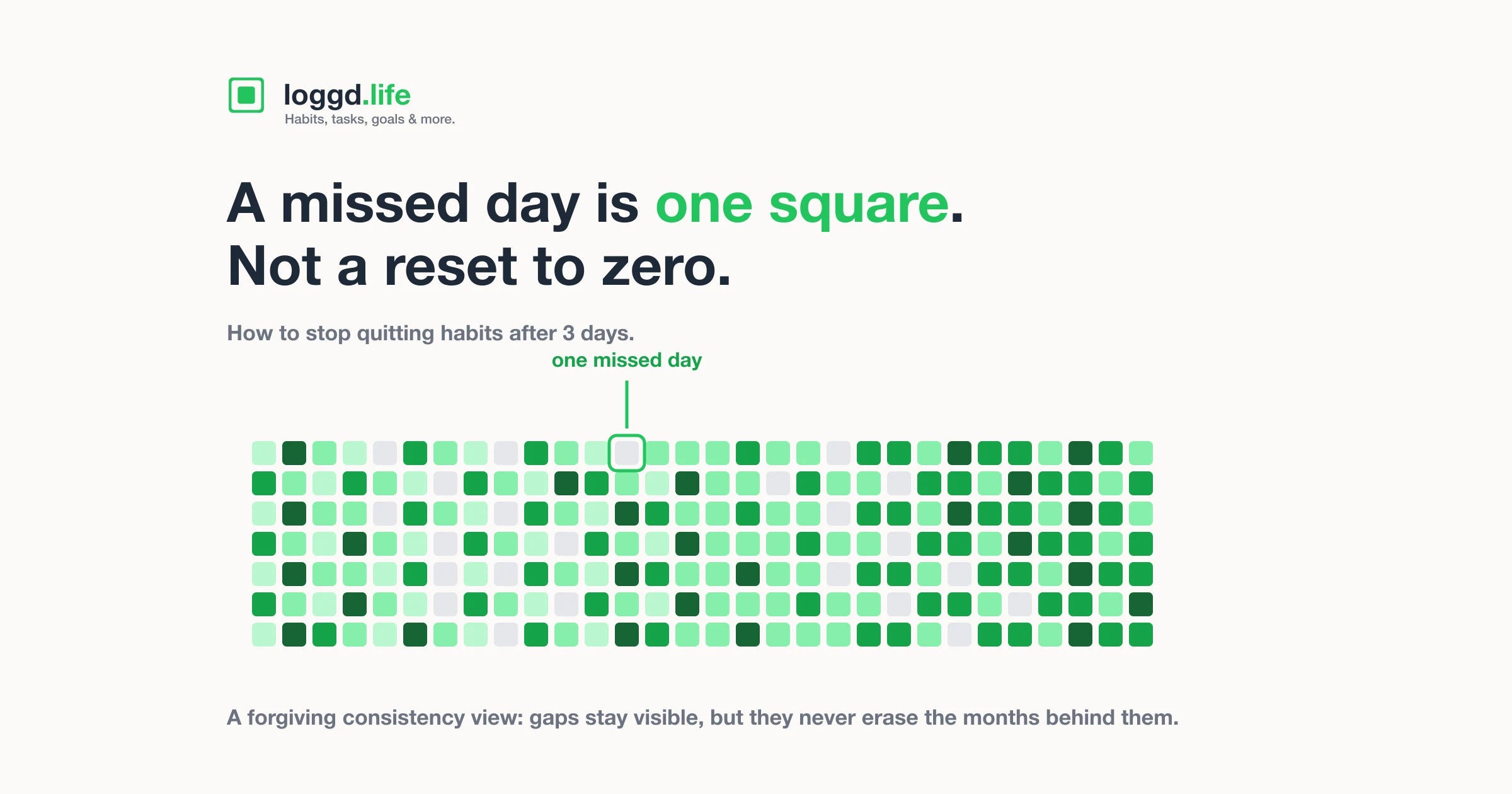
There is also a structural reason streak-based tracking makes this worse. If your tracker shows a streak counter, a missed day resets it to zero, and the visible zero reads as failure. That is the abstinence-violation effect in software form. It is exactly why Loggd's default view is a forgiving contribution grid rather than a streak counter: a missed day should be one lighter square in a year of squares, not a reset.
How to pick habits you will not quit
Short version, based on what the surviving habits have in common:
- Make the second check trivial, not the first. Ask what version of this you could do tomorrow on your worst day, then make that the habit.
- Anchor it to something you already do daily. After I pour my coffee, after I brush my teeth, after I close my laptop. An existing routine carries the remembering for you.
- Track one to three habits, not ten. A long list is the fastest way to check none of them.
- Remove logging friction. One tap, a widget, or an integration that checks itself. If logging is a chore, the habit dies regardless of how much you wanted it.
- Treat a missed day as a lighter square. Never miss twice is a rule you can keep. A perfect streak is not.
The full playbook, with the specific fixes for each failure point, is here: how to stop quitting habits after 3 days.
FAQ
Why do I quit habits so fast? Because the habit was almost certainly too big to repeat the next day. In this dataset, about 45% of tracked habits are never checked once and another 23% are checked exactly once, so roughly two in three die at or before the second check-in. This is the normal outcome, not a character flaw.
What habits do people abandon fastest? High-friction physical habits: running, morning stretch, pushups, 30-minute workouts, 10,000 steps, and reading 10 pages, all averaging streaks of around a day or less.
Is it normal to quit a habit after 3 days? Reaching day three puts you ahead of most tracked habits. Only about 26% ever get three or more check-ins.
Does habit tracking make quitting more likely? Streak-based tracking can, because one missed day resets a visible counter to zero and triggers an all-or-nothing response. A forgiving grid view avoids that failure state.
Is the 21-day rule real? No. It traces back to a misreading of Maxwell Maltz's 1960 observations about patients adjusting to surgery, not to habit research. The Lally 2010 study at UCL found a median closer to 66 days, with a range from 18 to 254 days depending on the behavior.
How do I stop quitting habits? Optimize for the second check-in: shrink the habit, anchor it to an existing routine, and use a tracker that does not punish a missed day.
Methodology
Figures come from aggregate, anonymized data across 7,800+ habits and 4,200+ registered Loggd users, re-run in August 2026.
- What is counted. Completed check-ins per habit, and the number of days between a habit's creation date and its final completed check-in. Habit names were lowercased and trimmed before grouping.
- Minimum sample. No named-habit statistic is published with fewer than 50 people behind it, counted as distinct users. All figures are rounded.
- Onboarding picker effect. Many habit names come from Loggd's onboarding suggestion menu. We measured that effect directly and report it above rather than burying it.
- Survivorship. The 30+ day lifespan bucket includes habits that are still active, so it is not a pure "quit after a month" figure.
- Selection bias. This sample is people who chose to install a habit tracker. It over-represents the motivated.
- Privacy. No individual user data, no user-entered free text beyond generic habit labels, no demographics.
Last updated: August 2026.
Written by Eusebiu, the solo founder building Loggd in public. I have been tracking my own habits for over six months and building this app around what the data keeps telling me, including the parts that are unflattering to my own onboarding flow. I post the numbers as I find them on Threads.
Track habits without the all-or-nothing pressure. Loggd shows your consistency as a forgiving contribution grid instead of a streak that resets to zero, so a missed day stays a single lighter square. Start free.