
A goal setting plan turns something you want into actions you can schedule and review. Start with one meaningful goal, define a monthly milestone and a weekly target, then put the next action on your calendar.
The useful output is a short chain of decisions: what finished means, what happens this week, when the work starts, and what changes if the week goes wrong. We’ll use one example throughout: publishing three portfolio case studies within 12 weeks while keeping a full-time job. The plan should fit around the life you already have, not an imaginary empty week. Keep a calendar and a place for tasks nearby. You can use paper or an app; what matters is that the next action and its time are easy to find.
Choose a Meaningful Goal With a Clear Finish Line
Before choosing a deadline, ask what this goal would change in your ordinary life and why it deserves time now. Goal setting gives daily choices a direction. When two reasonable options compete, a clear reason helps you decide which one moves the goal forward and which can wait.
Separate the result you want from the work you control. An outcome goal might be receiving an interview invitation. That depends partly on another person’s decision. A performance goal could be publishing three portfolio case studies, while a process goal might be working on the portfolio twice a week. You can schedule the work even though you cannot guarantee the invitation.
For our example, define the finish line as three completed case studies available to share. Three drafts sitting in a folder do not meet it. Then check the goal against SMART criteria: the deliverable is specific, completion is measurable, the scope is achievable alongside current commitments, the reason is relevant, and the finish has a deadline. Achievable is a capacity check, not a promise that nothing will go wrong.
Make the plan concrete by identifying who, what, when, where, and why. Here, you are the person doing the work; the work is producing three shareable case studies; the deadline is 12 weeks from now; the work will happen in scheduled blocks at your desk; and the reason might be having a portfolio ready to share with potential employers. If your own finish line is still vague, use the SMART goal worksheet to turn the intention into a concrete statement.
Connect the Goal to This Week’s Next Action
Work backward from the finished result. This gives you a goal hierarchy: each smaller level shows what to do next without confusing a long-term aim with today’s task.
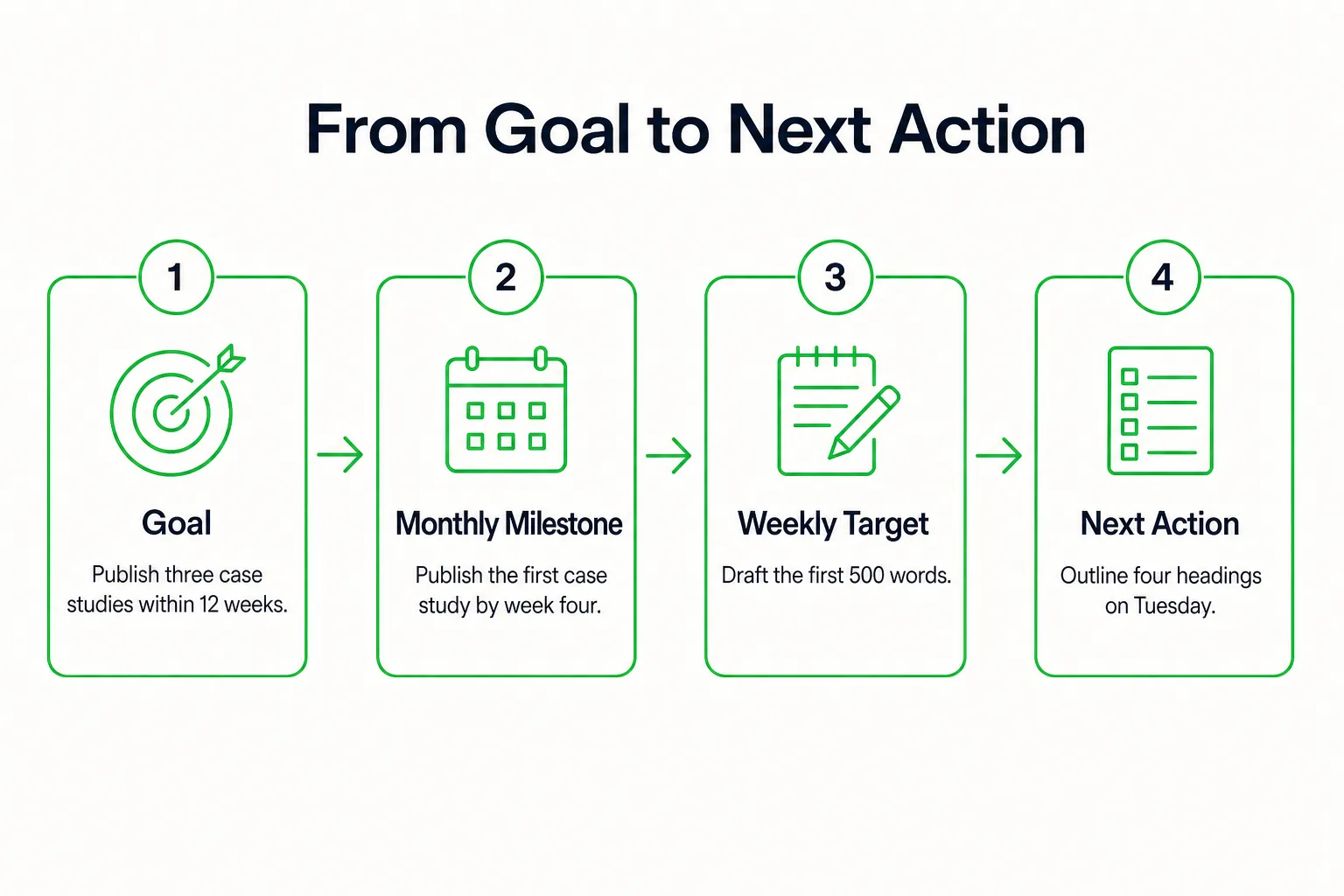
- Define the finished result. Publish three portfolio case studies within 12 weeks.
- Choose the first monthly milestone. Publish the first case study by the end of week four.
- Set this week’s deliverable. Draft the first 500 words of that case study.
- Name the next physical action. On Tuesday, outline four headings: problem, approach, result, and lesson.
The goal is the destination. A milestone is a meaningful checkpoint on the way there. A task has a clear completion condition, such as finishing the four-heading outline. A habit repeats on a schedule, such as setting aside portfolio time twice a week.
A useful next action starts with a verb and names an object. “Work on portfolio” leaves you deciding what to do when the time arrives. “Outline the problem, approach, result, and lesson from the first project” is clear enough to start. Estimate 20 minutes for that outline, then put it in Tuesday’s calendar.
Breaking a long-term goal into small, attainable steps creates opportunities to experience success. That makes progress visible along the way; it does not guarantee how quickly the whole goal will be completed. If you want to map weekly targets across the full 12-week window, use the 12 Week Year planner.
Choose What Fits Before You Schedule the Week
A commitment needs a behavior, room for missed days, and a place in an ordinary week. Before adding goal work, put work hours, care responsibilities, meals, and existing appointments on your calendar. Then look at the time that is genuinely available, not the time you hope will appear.

For the next planning cycle, choose one primary growth goal and keep essential maintenance habits running. Add another active goal only when its next actions have actual time slots. If two goals compete, compare the cost of delaying each one, any approaching deadlines, and the capacity you have this week. Choose which goal moves forward and which waits. Give the paused goal a review date and a clear condition for restarting it.
Use this weekly planning routine:
- Mark fixed commitments and appointments.
- Find the work periods you can realistically use.
- Choose one deliverable for the week.
- List its tasks and estimate how long each will take.
- Reserve focus time for the highest-priority next action.
For the portfolio goal, reserve 30 minutes on Tuesday and 30 minutes on Thursday. Put the 20-minute outline inside Tuesday’s block, leaving the remaining time to start the draft. Keep some available time unassigned for spillover. If the work does not fit, reduce its scope, move the deadline, or pause another commitment before taking on more.
Use the ideal week planner to find recurring openings around your existing responsibilities. Then put specific tasks into those openings with the time blocking planner.
Give Daily Actions a Cue and a Completion Rule
Keep one-off tasks separate from recurring habits. “Choose screenshots for the first case study” is a task with a finish line. “Start portfolio work after dinner on Tuesday and Thursday” is a habit schedule. Both can support the same weekly target, but they do different jobs.
Tie each daily goal to the deliverable you chose for the week. Pick the action that moves it forward instead of adding unrelated tasks just to make the day look productive. A useful cue makes it easier to start: an implementation intention specifies an action and the situation in which it will happen.
For example: “If I finish dinner on Tuesday, then I will sit at my desk and outline the first case study before opening messages.” A review found that implementation intentions had a medium-to-large effect on goal attainment. That supports making a concrete if-then plan; it does not remove the need to protect time and do the work.
Before each session, decide what completion means. For example, work on the named task during the reserved block, then record what you finished and the next action. Keep that rule stable so your progress tracking reflects what actually happened. For help choosing the day’s task, use the ten-minute daily planning routine. Keep the daily check-in brief: what moved, what blocked it, and what comes next.
Decide What Happens After a Missed Day
Plan for interruptions before they happen. A useful goal plan should anticipate setbacks and decide how to get back on track. Keep the recovery decision beside the habit schedule or next task so you can use it after a missed session.
After a miss, follow this checklist:
- Identify what prevented the action. Was the time unavailable, the task unclear, or the task too large?
- Check whether another real opening exists this week.
- Choose what to do next: restart, reschedule, reduce, or stop.
Restart at the next planned opportunity if the interruption was temporary. Reschedule a one-off task if its deliverable still matters and you can name an available slot. If the original scope repeatedly exceeds your time, reduce it. For the portfolio example, make the next session a 10-minute outline revision instead of expecting yourself to finish a section.
Reconsider or abandon the goal if its reason has changed or its cost now displaces a more important commitment. Remove upcoming tasks from your schedule, then make an explicit decision about any obligations that remain. Do not move every missed task to tomorrow. Choose the next useful action and adjust the weekly target if needed.
Treat a streak as a record of consistency, not the reason to continue. Decide how to recover based on the goal’s value and the time you actually have.
Review Effort and Results Together
Compare the weekly target with what actually happened. Once a month, look again at the milestone, deadline, and reason for pursuing the goal. Change the plan when the evidence from your own week points to a mismatch.
| Measure | What to record | Decision it informs |
|---|---|---|
| Completed actions | Finished deliverables and any task that was unclear or blocked | Clarify the task or remove the blocker |
| Time invested | Focus minutes spent on the goal | Reconsider your capacity or task estimates |
| Habit consistency | Completed sessions compared with scheduled opportunities | Change the schedule or the size of each session |
| Milestone results | Whether the defined milestone is complete, such as a published case study | Keep the target, adjust it, or set the next milestone |
Read the measures together. If you spent time but did not finish a draft, inspect the work itself: perhaps the task was too broad or its completion condition was unclear. If you missed sessions, change the schedule or scope. If you completed a milestone, you have a reason to choose the next target.
A filled progress grid records participation; the finished deliverable shows the result. For an exercise goal, tracking progress and noting improvements can support motivation. Keep that advice tied to exercise rather than assuming the same effect for every kind of goal.
Use the goal countdown timer if seeing the time left to a milestone would help you make a scheduling decision. Mark a specific small win, such as finishing the first draft. If accountability would help, send someone you trust the next deliverable and check-in date, then report what happened.
Put Your Goal Setting Plan Into Loggd
Loggd can keep the portfolio goal’s tasks, habits, and focus sessions together. Use the app to record the work you have chosen, while keeping your milestone dates and weekly decisions in your planning notes.
Add the goal you are pursuing, such as publishing three case studies in 12 weeks. Put the first case study’s next deliverable on the task list, set its priority, and use tags to group related tasks. Tasks can connect with goals, so you can see how a specific piece of work relates to the result you are pursuing.
Set a flexible habit schedule for portfolio work on Tuesday and Thursday. When each reserved session begins, use the focus timer for the work block. Focus sessions can connect with goals, too. Keep the scheduled time realistic for your week, and record the next action when you finish.
Use the daily check-in to review what moved, what got in the way, and what comes next. Keep the milestone deadline and your weekly review decisions in your planning notes, then consider them alongside the app’s task and habit records. Daily checkoffs fill a grid of your last 365 days, giving you a year-at-a-glance record to look at beside completed milestones. The grid shows activity; the published case study shows the result.
Points, streaks, and badges can add encouragement if you enjoy gamification. Let them support the routine, not decide whether the goal is worth pursuing. The useful question remains: what is the next action, and when will you do it?
Loggd is free on iPhone, Android, and the web, with no credit card needed. Start with the goal, the next deliverable, and the work sessions you can actually fit.
Goal Setting Plan Questions
What are strategic goals?
Strategic goals are longer-range priorities that guide which smaller goals and actions deserve attention. For a person, that might mean building a stronger professional portfolio, then choosing milestones and weekly tasks that support it. The term is also used by organizations for goals that shape their broader direction.
Can I make a goal-setting plan without an app?
Yes. Write down the goal, its finish line, the next milestone, this week’s deliverable, and the next action. Use a calendar to reserve work time and a paper list or notes page to track completed actions and review what needs to change.
What if achieving my goal depends on someone else’s decision?
Separate the outcome you hope for from the actions you control. You can schedule steps such as preparing an application, sharing your work, or asking for a conversation, but you cannot schedule another person’s decision. Track your own actions and set a date to review the outcome and decide what to do next.
Sources
- SMART Framework | Youth Advisory Councils
- Healthy and fit on the go: Goal setting
- Implementation Intentions | Division of Cancer Control and Population Sciences (DCCPS)
- Keep it going! How to stick with a fitness routine