Personal goal setting examples include saving a specific amount in 12 weeks, finishing a course in four weeks, or making time for a weekly conversation. To use one, give it a finish line, choose the actions that fit your week, and track what you actually do.
Personal goals can be about work, money, health, relationships, learning, or the practical details of home life. The 10 examples ahead are starting points you can adapt to your time, income, responsibilities, and interests. Pick one that would make an ordinary week better. You do not need to start a goal in every area of life at once.
What Makes a Personal Goal Clear Enough to Act On?
A personal goal is a result or behavior you choose, with a way to recognize progress. Its purpose is practical: it helps you decide what gets time this week and what can wait.
Long-term goals describe a direction that takes time. Short-term goals give you a nearer step toward it. For example, you might want to build a career skill over a year, then set a short-term goal to complete an introductory course this month.
SMART goals use five qualities: specific, measurable, achievable, relevant, and time-bound. You can use them to sharpen a goal's wording, without turning goal setting into a separate planning exercise. “Read more” becomes “Read 120 pages in 30 days, starting with four pages after breakfast.” That names the target, a measure, and a time frame. If the book is dense or breakfast is rushed, adjust the daily pace or choose another cue so the plan fits your week.
Separate the outcome you want from the action you control. Getting a job offer depends on another person's decision. Completing an application or practicing an interview answer is within your control, so you can put it on this week's calendar. A clear goal connects the hoped-for result to actions you can actually take.
How to Choose Your Top Three Without Starting Everything
When several life areas matter, start with a short candidate list rather than trying to change everything at once. For each goal, ask: Does this matter to me? Is there a real reason to act now? Can I give it time during an ordinary week?
Then choose in this order:
- Identify the most pressing need, such as preparing for an upcoming application deadline.
- Choose a meaningful improvement that can fit alongside it, such as setting up a small savings transfer.
- Put a third worthwhile goal, like learning an instrument, on a later list with a date to reconsider it.
Ranking three priorities is different from running three active plans. Utah State University Extension recommends focusing on one or two goals at a time to avoid feeling overwhelmed. You can still care about all three; you are deciding which ones receive time now.
If you are choosing goals mainly because other people expect them, first write what you want more room for in your life. Use the personal mission statement builder to put your priorities into words before choosing a goal.
Assign time to the active goals, even if the first step is brief. Give the parked goal a specific review date, so you can decide later with your actual schedule in view.
Personal Goal Examples for Work and Learning
1. Complete Four Career-Training Lessons in Four Weeks
Choose this if a skill could help you in your current role or prepare you for a different one. CareerOneStop lists increasing professional knowledge and training as a career goal. Make the goal small enough to fit around your existing work.

- Goal: Complete four lessons from one career-training course in four weeks.
- Repeatable action: Complete one lesson each week.
- Setup task: Choose the course and identify its first lesson.
- Focus time: Reserve two 25-minute learning blocks each week.
- Evidence: Record lessons completed and one short note about how you could use what you learned.
The two blocks give you a chance to continue the lesson or review your notes if one session is not enough. Keep the lesson count as your outcome measure and the blocks as evidence of the work that supports it.
2. Make Ten Job-Search Follow-Up Calls in Two Weeks
This goal can help when you want to follow up on existing job-search contacts rather than leave networking as a vague intention. CareerOneStop illustrates specificity with ten job-search follow-up calls, rather than an unspecific plan to make connections.
- Goal: Make ten appropriate follow-up calls in two weeks.
- Repeatable action: Schedule and make five calls each week.
- Setup task: Prepare a contact list and choose the next person to call.
- Focus time: Reserve a short block to prepare before each calling period.
- Evidence: Log completed calls and the next step for each contact.
Count making contact as your action. A response is up to the other person, so record it separately rather than making it the measure of whether you followed through.
3. Read 120 Pages in 30 Days
A page target works well if you have a particular book you want to finish. It makes “read more” into a result you can check and gives you a modest daily starting point.
- Goal: Read 120 pages in 30 days.
- Repeatable action: Read four pages after breakfast.
- Setup task: Choose the book and keep it within reach of your breakfast spot.
- Focus time: Use an optional longer reading block when you have time to make up for a busy day.
- Evidence: Record the pages read.
Use the reading goal calculator to turn your book's remaining pages and your deadline into a daily target. If four pages after breakfast no longer fits, change the cue or the pace, then check that the revised plan still gets you through the book by your chosen date.
Personal Goal Examples for Money, Movement, and Screen Time
4. Save $300 in 12 Weeks
A named savings target gives each transfer a purpose. Set aside a consistent amount each week for 12 weeks, and check that the amount and date leave your essential expenses covered.
- Goal: Save a specific amount in 12 weeks.
- Repeatable action: Transfer a set amount each week.
- Setup task: Choose the destination account and set the transfer date.
- Focus time: Schedule a brief weekly balance check.
- Evidence: Record the amount actually transferred.
The CFPB identifies recurring automatic transfers as an effective way to build savings. Use the sinking fund planner to calculate the contribution for your own amount and deadline. If a transfer would put essential bills at risk, choose a smaller amount or a different date.
5. Walk for 15 Minutes Three Times a Week
Choose this if you want movement to have a defined place in your week. Try it for four weeks, using three days and a route that work with your schedule.
- Goal: Walk for 15 minutes three times a week for four weeks.
- Repeatable action: Attach each walk to an existing part of your day, such as the end of lunch.
- Setup task: Choose your three days and a suitable route.
- Focus time: Set aside 15 minutes for each walk.
- Evidence: Record completed walks and minutes walked.
A short walk that fits your actual week is easier to plan than an open-ended intention to exercise more. If one of your chosen days gets crowded, move the walk to another workable time and keep the weekly target clear.
6. Keep Social Media to Two Planned Daily Sessions
This goal suits someone who wants clearer boundaries around scrolling. Utah State University Extension gives two 15-minute social-media sessions per day as an example of a digital-wellness goal.
- Goal: Keep social media to two planned sessions a day for a two-week trial.
- Repeatable action: Use one 15-minute morning window and one 15-minute evening window.
- Setup task: Choose the windows and set a timer for each session.
- Focus time: No separate work block is needed; the timer marks the end of each scrolling session.
- Evidence: Record whether each session stayed within its planned window.
At the end of two weeks, review whether those windows fit your day. Adjust them if needed, while keeping the aim specific: decide when you will scroll, then notice whether the plan is working.
Personal Goal Examples for Relationships and Everyday Life
7. Make Time for One Weekly Conversation
Choose this if you want to make regular room for someone you care about. For four weeks, set aside 20 uninterrupted minutes with a willing friend or family member.
- Goal: Have one 20-minute conversation each week for four weeks.
- Repeatable action: Meet or talk once a week without another task competing for your attention.
- Setup task: Send an invitation and agree on a time.
- Focus time: Protect the agreed 20 minutes.
- Evidence: Record conversations held.
The measure is making time together, not scoring another person's attention or feelings. If the first time does not work for both of you, agree on another time and keep the invitation as the step you control.
8. Prepare a Three-Minute Talk in Four Weeks
A short presentation is a useful personal development goal when you want to practice speaking and finish with something you can deliver. Pick a topic that gives you a clear starting point.
- Goal: Prepare and give a three-minute talk in four weeks.
- Repeatable action: Practice for 10 minutes three times a week.
- Setup task: Choose the topic and draft the main points.
- Focus time: Reserve one weekly rehearsal block to practice the talk from beginning to end.
- Evidence: Track rehearsals and write one change to make next time.
Focus on one speaking skill at a time, such as pausing between points or speaking clearly. Use these deliberate practice examples to choose a specific skill to work on.
9. Clear One Drawer Each Week
A four-week home goal can make a neglected corner of your routine feel manageable. Choose four drawers, then work on one each week.
- Goal: Clear four drawers in four weeks.
- Repeatable action: Work on one drawer each week.
- Setup task: Choose the four drawers and decide which one comes first.
- Focus time: Reserve a 20-minute weekly block.
- Evidence: Record finished drawers.
Count a drawer as finished when you have removed unwanted items and returned what belongs. A defined space has a visible finish, so track completed drawers rather than minutes alone.
10. Arrange a Volunteer Shift Within 30 Days
“Get involved locally” is hard to schedule. Arranging one shift gives the intention a concrete next step and a clear finish line.
- Goal: Agree on a volunteer shift within 30 days.
- Repeatable action: Follow up on the next step until a shift is arranged.
- Setup task: Identify suitable opportunities, check requirements and availability, then contact an organizer.
- Focus time: Reserve a short research block to compare options and make contact.
- Evidence: Record the milestone of an agreed shift.
These examples need different kinds of tracking. A conversation is a recurring action; a talk has a finished deliverable; arranging a volunteer shift is a short project. Choose the measure that shows what moved forward for that particular goal.
Turn Your Chosen Goal Into a Weekly Plan
Turn the goal you chose into a plan for the next seven days. Start with one result you can check at the end of the week, then decide what actions and time will support it.
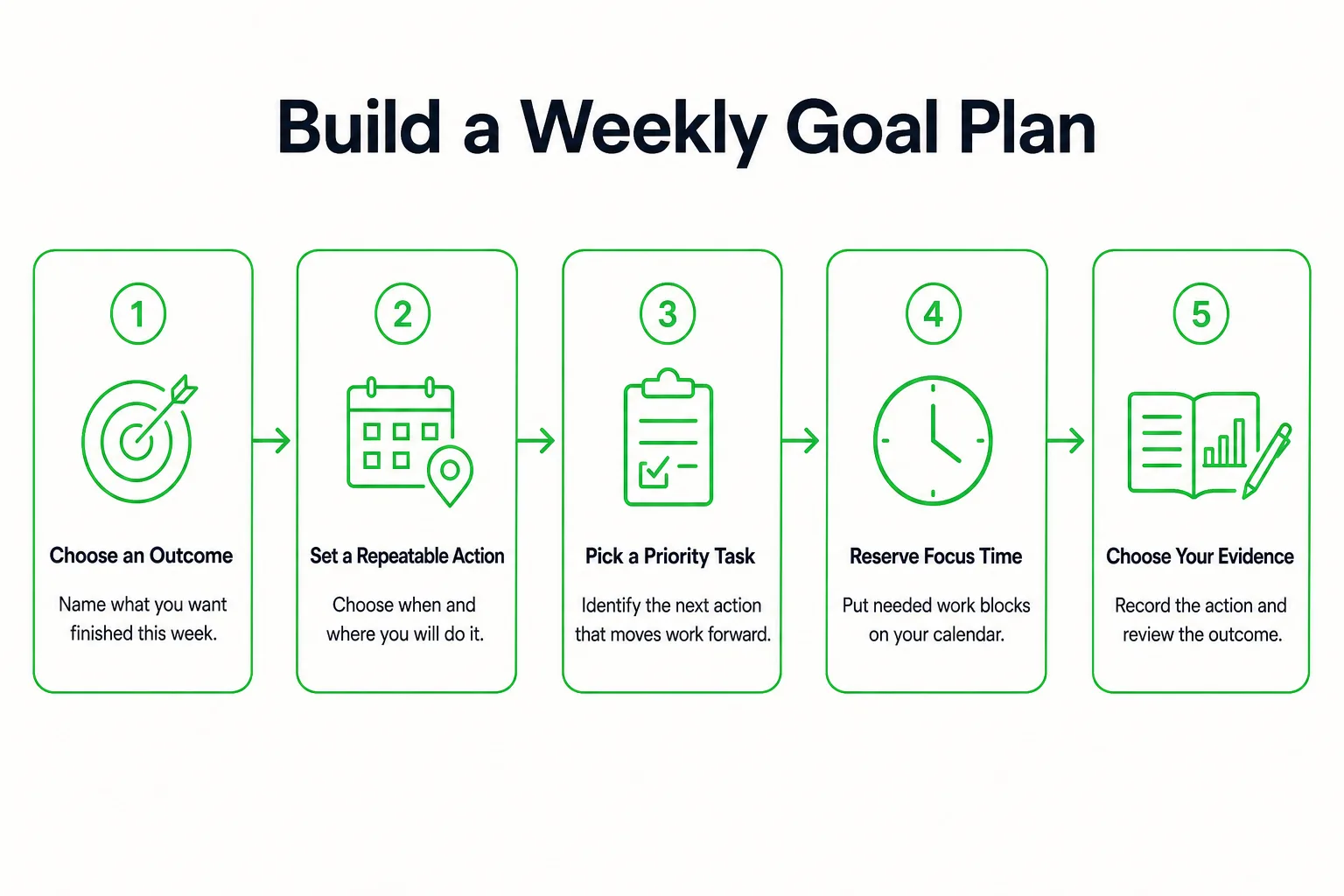
Copy this template and fill it in:
- Goal:
- This week’s outcome:
- Repeatable action and cue:
- Priority task:
- Scheduled focus time:
- Daily evidence:
- Review date:
Set it up in this order: name the weekly outcome, choose a repeatable action and a cue for starting, then identify the next setup task or deliverable. Reserve focused work time if the action needs it. Finally, choose what evidence you will record and when you will review it.
A goal can use several types of tracking, but give each entry a distinct job. Finishing a setup task, for example, does not count as completing a repeated behavior.
| Track As | Use It For | Example | Evidence |
|---|---|---|---|
| Habit | A repeated behavior | Walking on planned days | Walks completed |
| One-off task | A finite action | Selecting a course | Course selected |
| Project milestone | A checkpoint toward a larger result | Finishing a draft | Draft finished |
| Focus session | Protected work time | Practicing a skill | Minutes practiced |
Choose evidence that fits the goal: pages read, minutes practiced, walks completed, dollars transferred, calls made, or conversations held. Pick one primary outcome measure and one action measure, so you can see both what changed and what you did. If several tasks compete for the same block, use these Eisenhower Matrix examples to decide what needs attention first.
Review the First Week and Return After a Missed Day
A useful goal includes an action that fits your normal week and a clear way to return after a missed day. Here is what that can look like with Jordan’s four-week training goal: complete four lessons, one each week, with two 25-minute practice sessions each week.
In the first week, Jordan completes one 25-minute session and misses the second. The lesson is still unfinished. At review, Jordan records one of two sessions completed, 25 minutes spent, and no completed lesson. That record shows what happened without treating the week as a success or failure in the abstract.
The missed session was scheduled for an evening already occupied by another commitment. Jordan moves it to an available lunch break next week. The next outcome is to finish the first lesson, while keeping two 25-minute sessions on the plan. There is no need to double the workload to make the calendar look caught up.
After a miss, record what happened, name the obstacle, schedule the next action, and reassess the deadline after seeing what fits. Streaks can mark consistency, while the action and outcome records show what needs changing. If getting started is the recurring obstacle, use these habit stacking examples to attach practice to something you already do.
Put Your Personal Goal Plan Into Loggd
You can put this plan into Loggd by creating the training goal, then adding a habit with a schedule that matches your planned practice days. Put course selection or lesson preparation in the task list. Priorities and tags can help organize the next tasks, while the focus timer can hold your planned practice blocks. Tasks and focus sessions can connect with the goal.
Use the daily check-in to review the day’s actions. Each checked-off day fills the grid of your last 365 days, giving you a way to look back at consistency over time. Points, levels, streaks, and badges offer optional motivation, but keep lesson completion and practice records at the center of your progress tracking.
Loggd is free on iPhone, Android, and the web, with no credit card needed. Set up one chosen goal and schedule its next work session.
Sources
- SMART Goals for the New Year
- Set Career Goals
- Get money smart. 25 tips to improve your financial well-being