TL;DR. Habit stacking is one sentence: after I [current habit], I will [new habit]. It works because a finished action is a reliable cue and a clock time is not. It is James Clear's packaging of implementation intentions, an idea studied for about two decades before Atomic Habits. Below are 30 stacks grouped by when they actually happen, the three reasons stacks break, and how to shorten a broken one instead of throwing it away.
For about six weeks I ran a stack that read: after I put my daughter to bed, I will write for 30 minutes.
Then it died, and it took me another month to understand why. The anchor was wrong. Bedtime is not an action that ends at a predictable point, it is a negotiation that finishes somewhere between 19:40 and 21:15, and occasionally does not finish at all. Some nights the cue fired and I wrote. Most nights it arrived when I had nothing left.
The formula is trivial. Choosing the anchor is the entire skill.
The formula
After I [current habit], I will [new habit].
That is it. Everything else is judgement about what goes in the two slots.
The anchor has to be a completed action. This is the rule people break first. "At 7am I will meditate" is not a stack, it is an appointment. A clock time passes whether you notice it or not, so it cannot trigger anything by itself. A finished action has an edge you can point at: the kettle clicks off, the mug lands in the sink, the laptop lid shuts, the front door closes behind you, the seatbelt clicks. Those are cues. 7am is a fact.
The anchor has to be genuinely automatic already. If your morning coffee sometimes happens and sometimes does not, it is not an anchor, it is a second habit you are building at the same time.
The new habit has to fit in the gap the anchor leaves. After you brush your teeth there is maybe two minutes before the next thing pulls you. Ten squats fit. A 20-minute mobility routine does not, and that stack loses to your schedule every time.
Where this actually comes from
Clear named it and wrote the sentence that made it spread, and I use his phrasing throughout. It is worth being straight about the lineage, though, because a lot of habit content presents stacking as a discovery.
The mechanism underneath is implementation intentions: if-then plans studied by Peter Gollwitzer and colleagues since the 1990s. The finding that keeps replicating across health and behaviour research is unglamorous and useful: people who commit in advance to a specific when and where act on their intentions more often than people holding the same goal in their head. Naming the moment does most of the work.
Stacking is the version where the "when" is another behaviour rather than a clock time. It adds one thing: the trigger is something you already do reliably, so you are not also building the trigger.
30 habit stacks that survive a real week
Steal these directly or use them as shapes. Each one names a finished action, then something small enough to fit behind it.
Mornings
- After I turn off my alarm, I will put both feet on the floor and stand up.
- After I fill the kettle, I will drink a full glass of water.
- After I pour my coffee, I will write down the one thing today has to produce.
- After I brush my teeth, I will do ten squats.
- After I put my shoes on, I will check what time my first meeting starts.
Work blocks
- After I sit down at my desk, I will close every tab that is not for the first task.
- After I open my laptop, I will start a 25-minute timer before I open email.
- After I send the last message of a meeting, I will write down the one action it created.
- After I mark a task done, I will read the next line instead of opening a browser.
- After I stand up for a break, I will refill my water glass on the way back.
Evenings
- After I put my plate in the sink, I will set out tomorrow's clothes.
- After I close the laptop for the day, I will write three lines about what happened.
- After I plug my phone in on the far side of the room, I will pick up the book on the nightstand.
- After I turn off the TV, I will stretch for two minutes before I stand up.
- After I get into bed, I will name one thing that went right.
When your attention is unreliable
The clock-time rule has one exception worth knowing if you have ADHD or anything that looks like it: an alarm someone else made ring is an event, not a time. External interrupts work as anchors precisely because they do not depend on you noticing anything.
- After I put my keys in the bowl, I will put my wallet and phone in the same bowl.
- After I take my medication, I will check off the one habit I actually care about.
- After I open the fridge, I will drink water before I decide what to eat.
- After my timer goes off, I will say out loud what I am about to do next.
- After I notice I have picked up my phone for no reason, I will put it face down and take one breath.
Parents
- After I strap my child into the car seat, I will put on the podcast instead of the news.
- After the last bedtime story, I will leave my phone on the charger in the hallway.
- After I load the dishwasher, I will tidy for five minutes and stop when the timer ends.
- After nap time starts, I will do the task that needs quiet before the one that needs energy.
- After I pack the school bag, I will pack my own gym bag.
Remote work
- After I close my last call of the morning, I will stand up and leave the room.
- After I make lunch, I will eat it somewhere that is not my desk.
- After I shut the laptop, I will walk once around the block.
- After I log out of chat, I will write tomorrow's first task on paper.
- After I sit down in the morning, I will open the document before the inbox.
Why stacks break
Three reasons, ordered by how often they have wrecked my own week.
1. The anchor is not stable. My bedtime example. The test is blunt: does this happen every single day, at a predictable point, whether or not I am in a good mood? If your honest answer contains the word "usually", the anchor is a wish.
2. The stack got long. The same counting question applies to your habit list as a whole, and our data has an uncomfortable answer to it: see how many habits you should track at once. Five links is a single point of failure repeated five times. Miss link two on a Tuesday and links three through five disappear with it, and because the whole thing feels like one unit, the failure reads as total. Two links is a stack. Five is a routine, and routines need different maintenance.
3. The anchor happens where the new habit cannot. "After I get into bed, I will do ten pushups." You cannot do pushups in a bed, or rather you can do them exactly once, for the anecdote. Same for anything needing a laptop anchored to something you do in the car.
There is a quieter fourth reason. The new habit was too big from the start, and cue design cannot save it. The Loggd data on this is not flattering: across more than 7,800 tracked habits, about 45% were never checked off even once, and another 23% were checked exactly once and never again. The full breakdown is in habits people quit fastest. Almost all of that is a sizing problem. No anchor rescues a habit you cannot repeat tomorrow.
How to shorten a stack instead of abandoning it
The default response to a dead stack is to declare it a failure and design a fresh one. Almost always the better move is to cut the existing one down.
Keep the anchor, shrink the habit. Thirty minutes of writing becomes one paragraph. Ten squats becomes two. If you cannot see the smaller version yourself, the micro habit generator asks what goal area you are working on and how much time you actually have, and suggests two-minute versions with trigger moments attached.
Keep the habit, change the anchor. Move it to an earlier, harder edge in the day. My writing stack now hangs off closing the laptop at the end of contract work, which happens whether or not bedtime went well.
Cut the chain to one link. Whatever survived the bad days is the real stack. Keep that, drop the rest.
Write it down again in full. Stacks decay in memory into "in the evening, sometime". Rewriting the sentence with both slots filled is often the entire repair.
If you want the list somewhere other than your head, the habit stacking generator walks through it in three steps: add up to seven anchor habits sorted into morning, afternoon and evening, add up to ten new habits from a library of about forty suggestions across six goal areas, then click an anchor and click a habit to pair them. It builds the chain in time order, and you can copy it or download it as a plain text file. Everything is saved in your browser, no account needed.
What habit stacking will not do
- It will not create time. A stack relocates a behaviour, it does not conjure a spare 20 minutes.
- It will not work on a day with no shape. Shift work, a newborn, travel. If nothing repeats, there is nothing to attach to. Anchor to the few things that survive anyway: eating, showering, plugging your phone in.
- It will not make you want the habit. Cue design fixes forgetting. If you keep remembering and then not doing it, the problem is size or reward, which is a different repair and one I went through in how to stop quitting habits.
- It will not survive a schedule change. New job, new school run, new season. Expect to rebuild your stacks deliberately every time the week changes shape.
Pick one anchor you would bet money on. Write one sentence. Keep the new habit small enough that a bad Tuesday cannot beat it. The reason it works is almost boring: you stopped relying on remembering.
Last updated: November 2026.
Written by Eusebiu, the solo founder building Loggd in public. I build the app in the evenings around contract work and a small daughter, which is where most of my opinions about unstable anchors come from. I share what the aggregate data keeps showing on Threads.
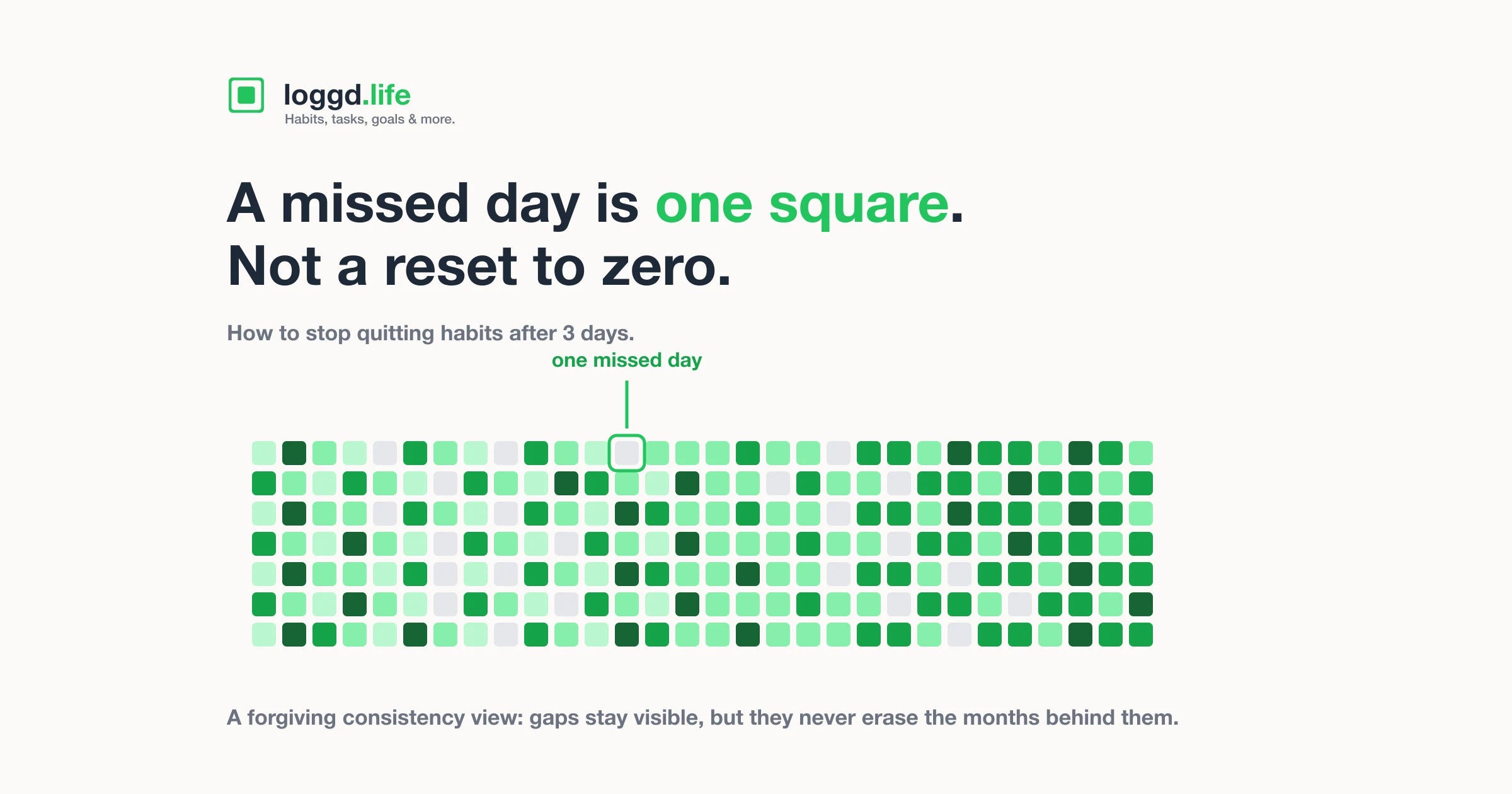
Track the stack, not just the intention. Loggd shows your consistency as a forgiving contribution grid, so a missed link stays one lighter square instead of resetting you to zero. Start free.