TL;DR. The standard advice is to start with one habit and add more later. Across 7,877 habits belonging to 4,219 people, the accounts tracking a single habit have the shortest streaks and the lowest survival rates, and the numbers get better at two habits and better again at three, all inside the free tier. That is correlation, not causation: anyone who went back and added a second habit was already more engaged than someone who did not. So the data cannot confirm the one-habit rule, and it is not a licence to pile more on. The count was never the interesting variable. What separates a habit that survives from one that dies is whether check number two ever happens.
Every habit guide gives the same instruction. Start with one habit. Master it. Then add another. I have repeated that advice myself, including inside this app.
Then I counted.
I build Loggd, so every few months I run queries that I half expect to confirm the things I say in public. This one did not. Grouped by how many habits a person tracks, the single-habit accounts come out worst on every streak measure I can compute, and the numbers improve at two and again at three.
I am not going to finish this post by telling you to add habits. By the end I hope you will agree the count was the wrong thing to argue about. But I am not going to sit on a result because it disagrees with the advice everybody repeats, mine included.
What is actually on people's lists
The median Loggd user tracks 1 habit. The mean is 1.87. The 90th percentile is 3, which is also exactly where the free tier stops. So the typical account here is one habit, and the busy end of normal is three.
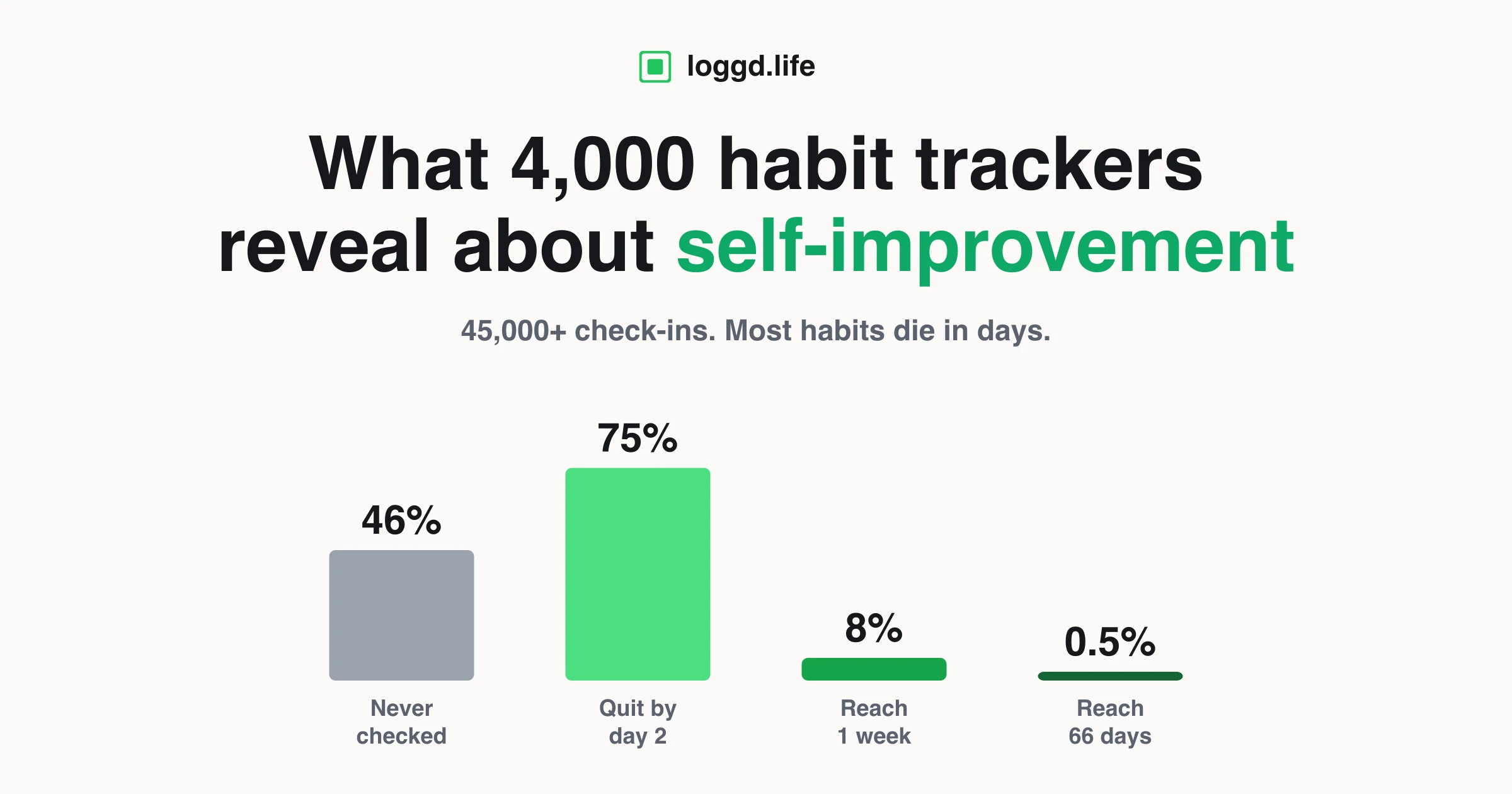
One exclusion before any outcomes, because it changes the whole table. Of those 7,877 habits, 7,691 are checked by hand, 147 sync automatically from GitHub, and 39 sync from Threads. Every figure below counts manual habits only. Habits fed by an integration tick themselves off, which inflates their streaks enormously, and that effect is the most-cited number in what 4,000 habit trackers reveal. Leaving them in would have handed the result to whichever bucket happened to contain the developers.
Per habit: how each habit on a list performs
Take every manual habit and group it by how many habits its owner tracks.
| User tracks | Users | Manual habits | Never checked once | Reached a 7-day streak | Reached 21 days | Avg longest streak |
|---|---|---|---|---|---|---|
| 1 habit | 2,337 | 2,271 | 40.9% | 2.2% | 0.6% | 1.06 days |
| 2 habits | 621 | 1,204 | 37.8% | 5.9% | 1.7% | 2.23 days |
| 3 habits | 1,133 | 3,338 | 41.7% | 7.5% | 2.0% | 2.44 days |
| 4 or more | 128 | 878 | 27.8% | 21.8% | 7.5% | 5.80 days |
Start with the column that does not move. "Never checked once" sits at 40.9%, then 37.8%, then 41.7% across the first three rows. Adding a second or third habit does not visibly dilute attention: the dead-on-arrival rate is the same whether your list has one line or three.
Everything else moves. A habit belonging to a three-habit user reached a seven-day streak 7.5% of the time against 2.2% for a one-habit user, and the average best streak climbs from 1.06 days to 2.44 days. The 21-day column says the same thing at a smaller scale.
That is the opposite of what the advice predicts. If focus were the scarce resource, spreading it across three habits should make each one weaker.
Per person: does anybody keep something alive
Per-habit rates can mislead. If you track three habits you hold three lottery tickets, so of course you are likelier to hold a winner. The fairer question is asked per person: does this human have any habit at all that survived?
| User tracks | Users | Has a habit reaching 7 days | Has one reaching 21 days |
|---|---|---|---|
| 1 habit | 2,337 | 2.1% | 0.6% |
| 2 habits | 621 | 8.7% | 2.6% |
| 3 habits | 1,133 | 12.4% | 3.6% |
| 4 or more | 128 | 40.6% | 20.3% |
The lottery-ticket objection turns out not to rescue the one-habit group. Counted per person, 2.1% of single-habit users ever got a habit to a week, against 12.4% of three-habit users. The gap widens rather than closing.
So both framings agree. Within the free tier, more habits on the list goes together with better outcomes.
Why this is not a licence to add habits
Four things, all of which I would want stated plainly if somebody else published that table at me.
This is correlation, not causation. Creating a second habit is itself a signal. It means you came back, opened the app on a different day, and decided this was worth more attention. That is engagement, and engagement is the far more plausible cause of both the longer list and the longer streaks. Nothing here says adding a habit will make you more consistent. Add a third line tonight hoping the count does the work and you will get a longer list and the same behaviour.
The bottom row is a different species. Loggd's free plan caps you at three active habits. Every single one of those 128 users therefore pays for the app. That is self-selection on top of self-selection: people who chose a habit tracker, and then chose to spend money on it. With 128 people in the group, one unusual cohort moves the number. Read that row as suggestive and nothing more. It tells you about paying customers, not about habit counts.
Some single-habit accounts were never really accounts. Loggd's onboarding suggests template habits, and tapping one takes a second. Somebody who tapped a suggestion, never returned, and left one untouched habit behind lands in the top row and pushes its "never checked" rate up. I measured that suggestion effect directly in habits people quit fastest, and it is real. It is the first thing I would attack if I were trying to knock this analysis down.
The interesting part is the part that is free. The one, two and three-habit rows all sit inside the free tier: every one of those lists is reachable without paying a cent. So the differences between them are not a paywall artifact the way the bottom row is. That is what makes the trend worth publishing at all. Strip the bottom row out entirely and the direction still holds.
What actually predicts a habit surviving
Here is the reason I think the whole "how many" question is a distraction.
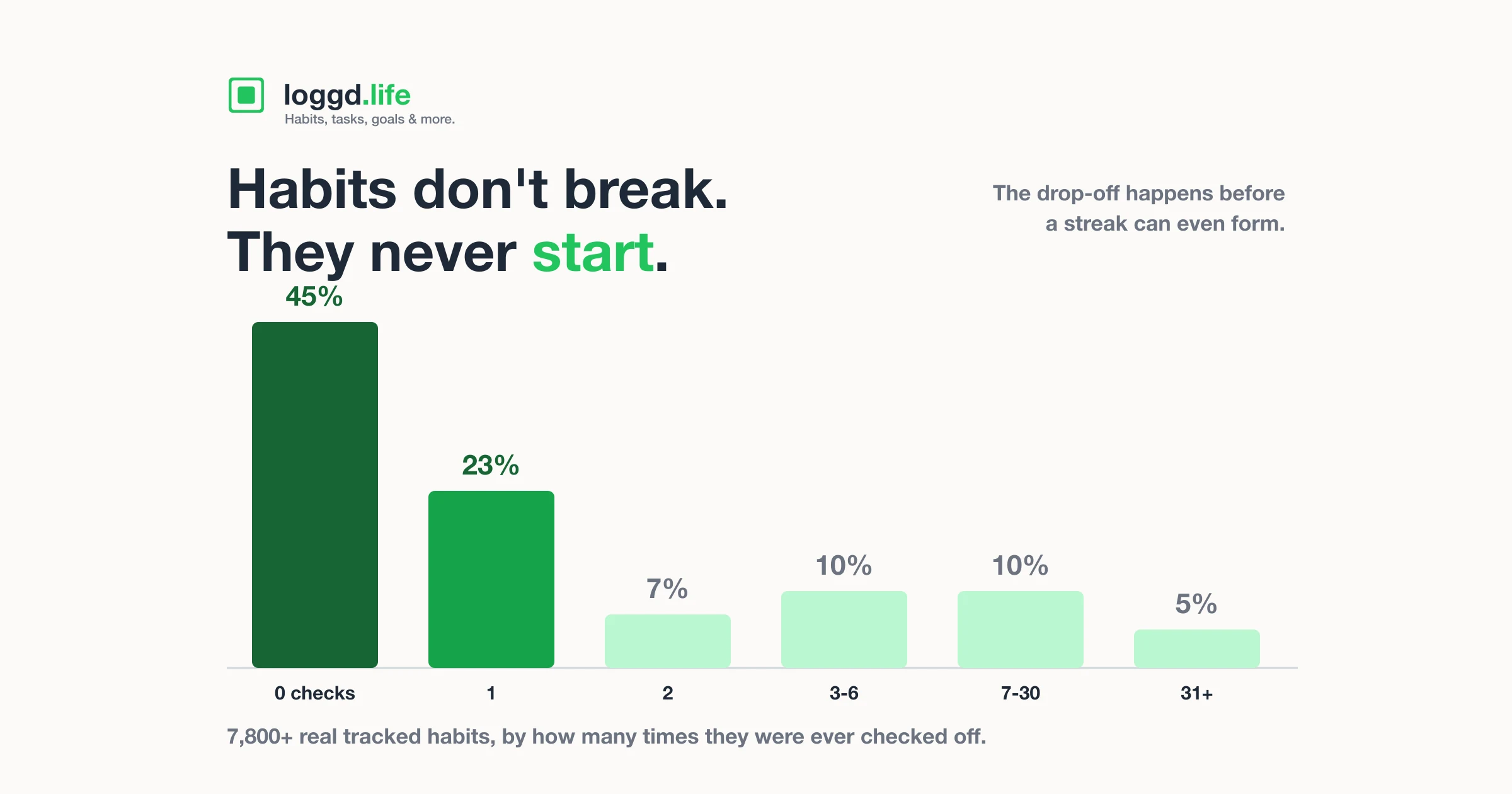
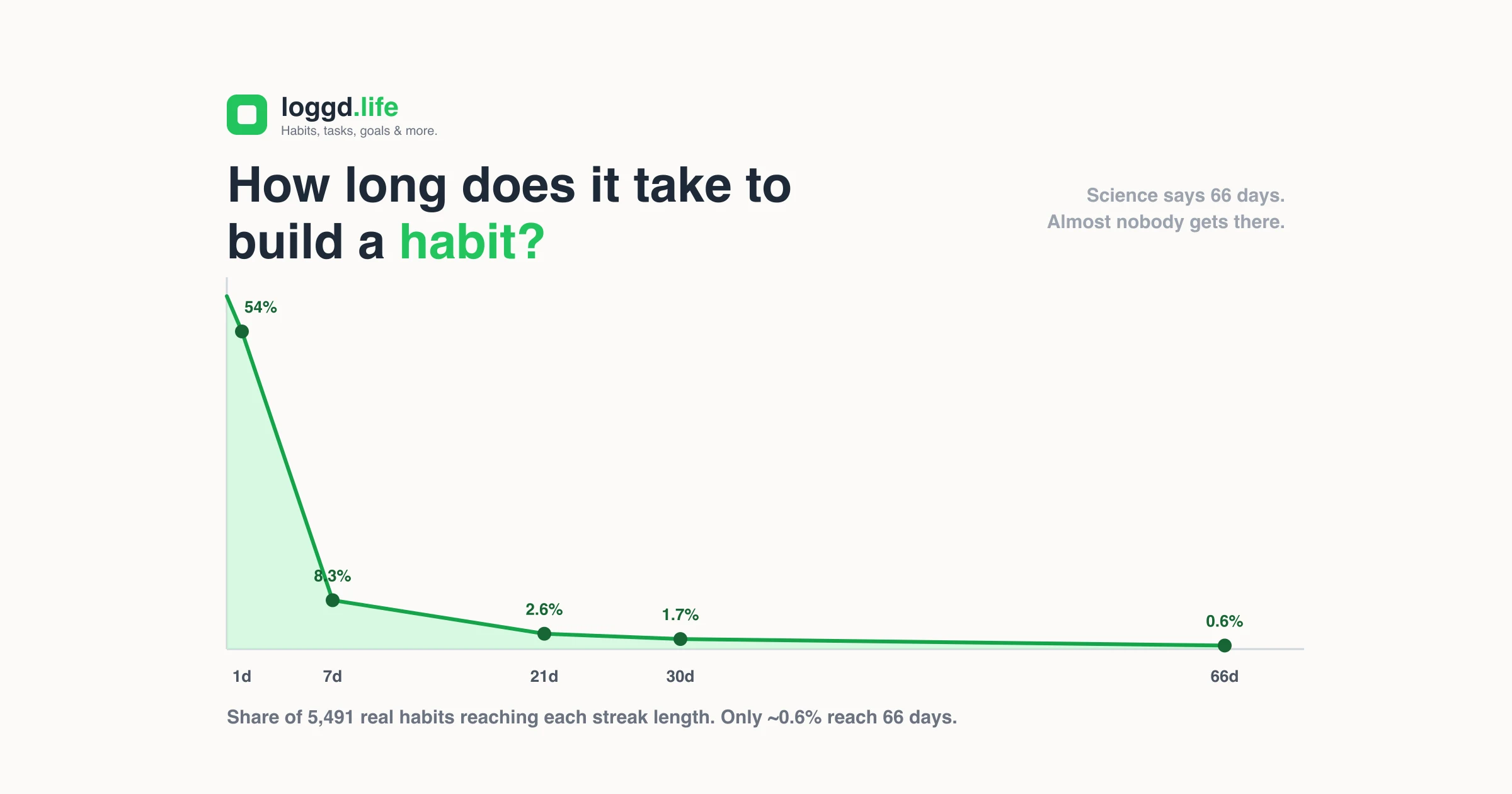
The thing that kills habits in this dataset is not competition between them. It is the second check-in. Habits do not usually build a run of days and then break; most never get a second mark at all, and that wall arrives long before any argument about focus becomes relevant. The full distribution behind that is in habits people quit fastest, and it sits alongside the formation timelines in how long it takes to build a habit.
A person with one habit and a person with three both face that same wall, once per habit. Nothing about owning fewer habits makes the second check-in easier.
How to actually choose your number
Two tests, neither of them arithmetic.
Does each habit have its own cue? Two habits anchored to different moments, one after your morning coffee and one when you close your laptop, do not compete. Two habits that both want the same slot at 7pm are one habit with an argument attached. When people say three habits is too many, they usually mean three habits stacked on the same fragile evening window. Different cues, different moments, no conflict. The habit scorecard tool is built for exactly this pass: you list what you already do each day, rate each line as positive, negative or neutral, and then use its stacking tab to write "after I [existing habit], I will [new habit]" so each new thing gets its own anchor. Everything stays in your browser.
Could you do all of them on your worst day? Not a good day. A representative bad one: short sleep, late finish, someone else's emergency. If the honest answer is that two of the three would go, then on a bad week you own one habit and two sources of guilt. Shrink them until the answer is yes, or drop one. The micro habit generator helps with the shrinking side: you pick a life area and how much time you actually have, and it lists small habits that fit inside that window, each with a suggested trigger moment, so you can assemble a starter kit of three to five and copy or print it.
For what small actually looks like, the micro habits list is the companion read.
Methodology
One aggregate query, run on 2026-08-10 against the production database, covering activity through 2026-08-05.
- Population. 7,877 habits across 4,219 users, demo account excluded. Users grouped by their total habit count.
- What is counted. Outcome columns count manual habits only: 7,691 of the total, with 147 GitHub-synced and 39 Threads-synced habits excluded because they check themselves off.
- Milestones use all-time best streak, not the current one. That is the most generous available reading, and the numbers are still small.
- Small group warning. The four-or-more group is 128 users. It is reported because omitting it would be its own kind of dishonesty, not because it is solid.
- Selection bias. Everyone here chose to install a habit tracker, which over-represents the motivated.
- Privacy. Aggregates only. No individual user data, no user-entered text, no demographics.
The honest conclusion
The advice says start with one. Our data cannot confirm that, and inside the free tier it mildly points the other way, while being genuinely unable to separate cause from effect. If you have been holding yourself to a single habit because a book told you that focus is the whole game, the evidence for that rule is weaker than its confidence suggests.
But do not read this as permission to open your tracker and add four things tonight. The number on your list has never been the variable that decides anything. Whether you check the second box is.
Pick habits with separate cues, small enough to survive your worst Tuesday, and then go and do the boring part twice.
Last updated: December 2026.
Written by Eusebiu, the solo founder building Loggd in public. I build it in the evenings around contract work and a small daughter, so my own list is short by necessity rather than by discipline. I publish the queries that contradict me as well as the ones that flatter me, and post them as I find them on Threads.
Track one habit or three, without the all-or-nothing pressure. Loggd shows your consistency as a forgiving contribution grid, so a missed day stays one lighter square instead of a reset to zero. Three habits free, no card. Start free.