TL;DR. A micro habit is a behaviour shrunk until it takes under two minutes and almost no decision. Fifty examples are below, grouped by area. The two-minute rule does not claim that two minutes produces the result you want. It claims that two minutes is short enough that you cannot argue with it, and showing up is the thing being trained. To pick yours, take the habit you already failed at and cut it until it feels embarrassing. Then leave it there longer than you want to, because scaling too early is how people lose it.
I have a list of habits I have failed at, and it is not short. Meditation, three times. Stretching, more times than that. Reading before bed, which I have restarted so often it has become a genre of evening rather than a habit.
The pattern was always the same. I picked a version that a rested, unhurried version of me could do, and then real life arrived: a deadline, a toddler who decided 3am was interesting, an evening that got eaten. The habit was not too hard. It was too big to survive a bad Tuesday.
Micro habits are the correction. Not a motivational trick, a size change.
What actually makes a habit "micro"
Two things, and the second one matters more.
It fits in under two minutes. Not "about two minutes if things go well". Genuinely under, on your worst day.
It needs no decision. A habit that takes ninety seconds but requires you to find something, unlock something or decide something is not micro. It has a two-minute body and a five-minute activation cost, and the activation cost is what you skip.
The two-minute framing comes from James Clear's Atomic Habits, where the rule is to scale a new habit down until it takes two minutes or less. Its status is worth being straight about: that is a heuristic Clear arrived at from practice, not a research finding, and there is nothing established about the number two. What holds up is the principle underneath. Make the entry cost so small that you cannot build a case for skipping it.
Because the honest reason micro habits work is unflattering. They do not make you disciplined. They remove the argument.
50 micro habit examples
Every one fits inside two minutes. Take three at most. They are grouped by area, because that is how people pick.
Body
- Drink a glass of water before your first coffee.
- Do five squats while the kettle boils.
- Stand up and roll your shoulders once an hour.
- Take one flight of stairs instead of the lift.
- Put your trainers by the door tonight.
- Stretch your hamstrings for sixty seconds after brushing your teeth.
- Step outside for two minutes of daylight before opening a laptop.
- Chop one vegetable when you get home.
Mind
- Three slow breaths before you unlock your phone.
- Say one thing that went well, out loud, while the coffee brews.
- Write one sentence about how the day felt before you close the laptop.
- Feel your feet on the floor for three breaths when you sit down to work.
- Write the worry down with one next step beside it.
- Read one paragraph of a real book.
- Look out of a window at something far away for a minute.
Home
- Make the bed.
- Clear one surface back to empty.
- Carry one thing back where it lives every time you leave a room.
- Start the dishwasher before bed.
- Wipe the sink after brushing your teeth.
- Put one item in a donation bag.
- Set out tomorrow's clothes.
Money
- Look at your bank balance. Just look, no judgement.
- Log the purchase in a note the moment you pay.
- Move one unit of currency into savings.
- Unsubscribe from one marketing email.
- Add it to a wishlist instead of the basket.
- Check one subscription: do you still use it?
- Decide tomorrow's lunch tonight.
Relationships
- Send one appreciative message.
- Greet the people at home before you check your phone.
- Ask one follow-up question instead of changing the subject.
- Say thank you for one specific thing someone did.
- Phone face down and out of reach at shared meals.
- Reply to one message you have been avoiding.
- Listen for two minutes before offering advice.
Work and focus
- Write tomorrow's most important task before you shut down.
- Put your phone out of arm's reach before you start.
- Close every tab you are not using.
- Capture the commitment the moment you say yes.
- Set a one-minute timer and start the thing you are avoiding.
- Write a one-line record of what you finished.
- Glance at tomorrow's calendar while you set your alarm.
Digital
- Charge your phone outside the bedroom.
- Delete one app you opened out of boredom yesterday.
- Turn off one notification the moment it annoys you.
- Move the worst offender off your home screen.
- Switch the screen to greyscale after dinner.
- Log out of one site on the browser you work in.
- Leave the phone in another room for the first two minutes of a conversation.
None of these are clever. A micro habit that impresses you is too big.
How to pick yours: shrink the one you already failed at
Do not start from this list. Start from your own failures, which are better data than anything I can suggest. Write down the habit you have abandoned most often, then cut it until it feels embarrassing to say out loud.
| What you keep trying | The version that survives |
|---|---|
| Read 30 minutes before bed | Read one paragraph |
| Meditate for 10 minutes | Three slow breaths before the phone |
| Work out every morning | Five squats while the kettle boils |
| Journal every evening | One sentence about the day |
| Track my spending | Log one purchase as you pay |
If the cut version does not feel a bit silly, you have not cut far enough. The embarrassment is the signal that you have landed on something a bad day cannot take from you.
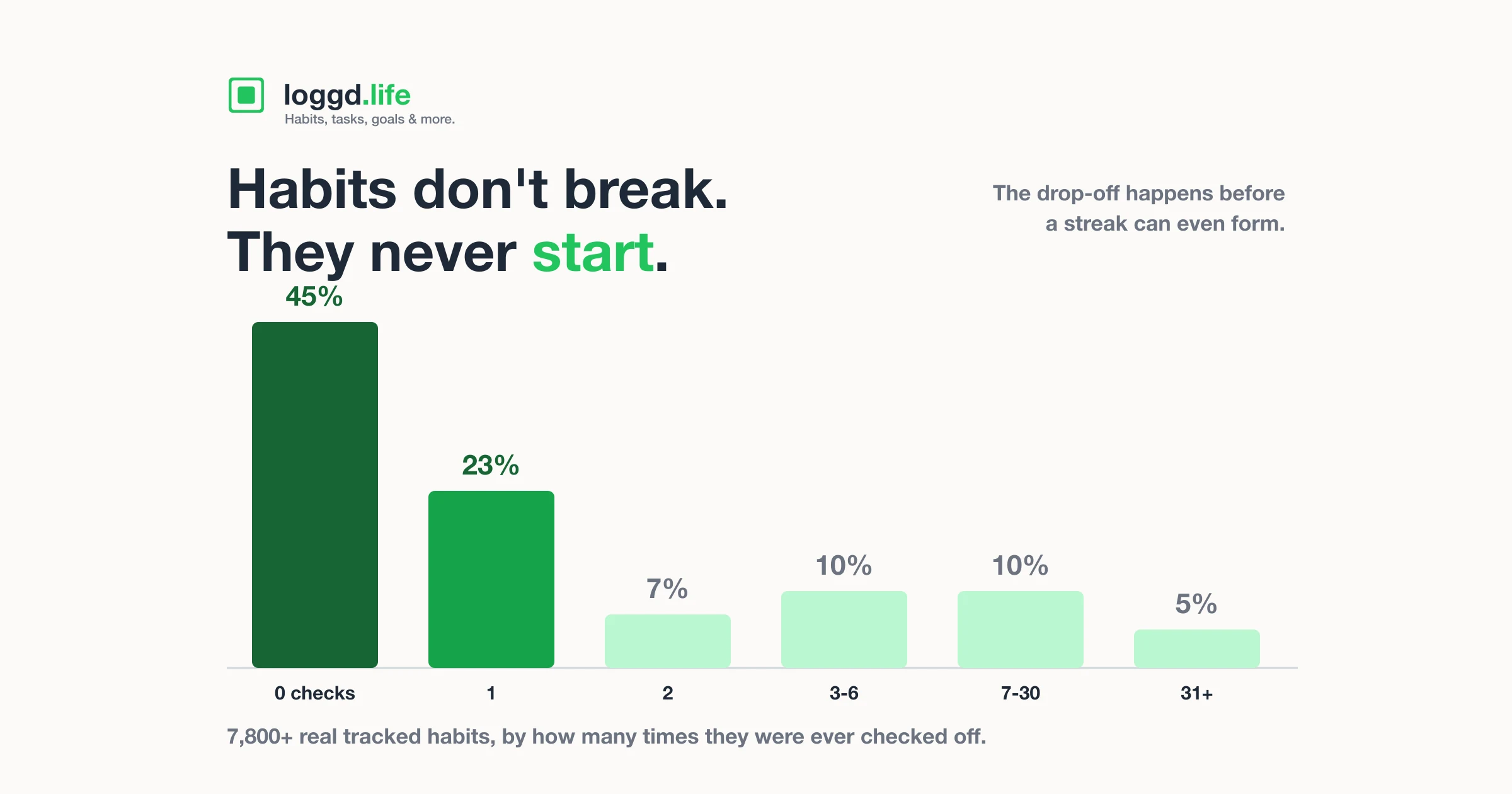
Our own numbers back the direction, and they are worse than most people expect. Across 7,800 tracked habits, about 45% were never checked off once and another 23% were checked exactly one time and never again, which we broke down in habits people quit fastest. "Read 10 pages" sits in that post's list of the fastest-abandoned habits, next to running and thirty-minute workouts. Ten pages is not small when you start from zero pages. One paragraph is.
If you want the shrinking done for you, the micro habit generator holds a curated library across six areas: health, productivity, mindfulness, learning, relationships and money. Pick an area and how much time you actually have, thirty seconds, one minute or two, and it filters to what fits. Each habit carries a trigger moment, a note on why it works, and a scale-up path for week one and week four. Up to five go into a starter kit you can reorder, copy or print, all of it in your browser.
Give it a moment, not a slot
A two-minute habit with no fixed moment is still a memory test, and memory is what failed last time.
So attach each one to something you already do without thinking. After I pour my coffee. After I put my keys down. The full method is in the habit stacking guide, and the habit stacking generator builds the pairs for you: list the anchors you actually have, up to seven, list the habits you want, then pair them into "After I X, I will Y" lines laid out from morning to evening.
One caution from repeated failure: do not attach a habit to a moment that is already chaotic. My mornings involve a small person with strong opinions about socks, so anything pinned to "after breakfast" died. The same habit attached to "after I close the laptop" is still running.
The scaling trap
Here is the part standard advice gets wrong, and I got wrong for a year.
You will be told to grow the habit. Two minutes becomes five, five becomes fifteen, and the ladder is presented as the point. The problem is timing. Almost everyone starts climbing in week one, because the habit feels easy, and it feels easy because it is new.
Novelty is doing the work at that stage, not the habit. When novelty runs out you are no longer defending a two-minute habit you cannot argue with. You are defending a fifteen-minute one, which loses to a late meeting immediately.
The same instinct shows up in how many habits people run at once, and there the answer is less obvious than the advice suggests. I went through our own numbers in how many habits you should track at once, and the single-habit accounts do worst, which is not what anyone tells you.
Grow it when it gets boring, not when it feels good. Boredom means the behaviour has stopped needing a decision, which is the thing you were actually building. Enthusiasm means the novelty has not worn off yet.
Two rules I follow now:
- Keep the floor. If you raise the habit to ten minutes, two minutes still counts as a kept day.
- Grow one at a time. Scaling three at once restarts all three at a size that already failed.
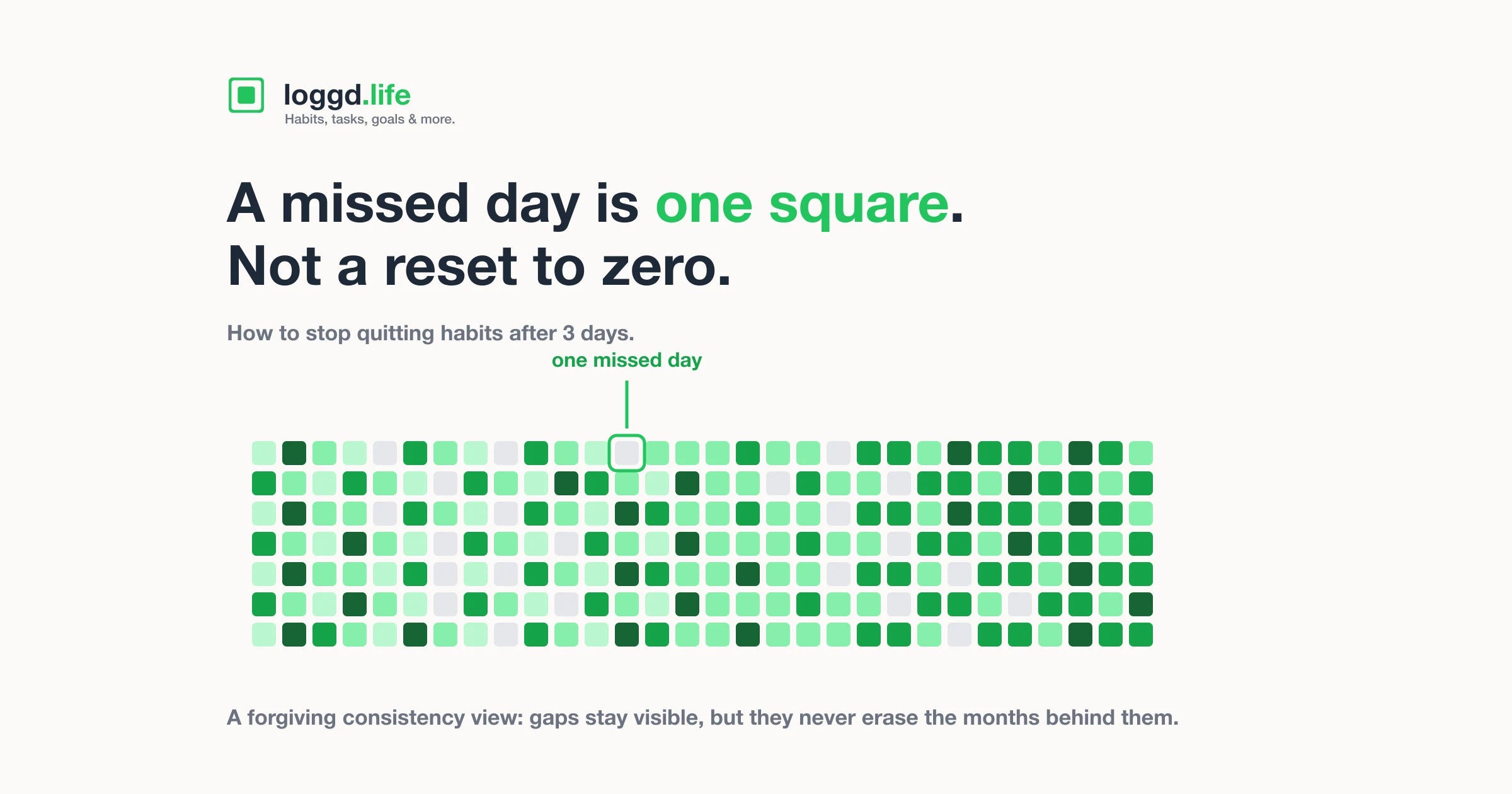
One related trap sits on the tracking side: if your tracker resets a streak to zero the first time you miss, the display undoes the whole point of a micro habit, which is that a missed day is cheap. That is why Loggd shows a contribution grid instead of a streak counter.
When a micro habit is the wrong tool
They are not a universal answer.
- When you need a specific outcome by a date. Two minutes a day of language practice will not pass an exam in March. Keep the behaviour alive with the micro habit, then schedule real blocks for the work.
- When you already have too much on. Adding seven tiny obligations to a failing schedule makes it worse. Subtract first.
- When the habit is genuinely all or nothing. Some things do not shrink. There is no two-minute version of a half marathon.
- When the small version is there to make you feel productive. Checking off "read one paragraph" for six months while telling yourself you are a reader is a way of not reading.
Small is not virtuous. It is just that most habits never survive long enough to become anything, and how long it takes to build a habit puts the research and our own numbers side by side on exactly that point.
Pick one habit. Cut it until it is embarrassing. Pin it to something you already do. Then leave it alone.
Last updated: December 2026.
Written by Eusebiu, the solo founder building Loggd in public. I build it in the evenings around contract work and a small daughter, which is why every habit I design has to survive an evening that disappears without warning. I post what the aggregate data keeps showing on Threads.
Track three tiny habits instead of ten ambitious ones. Loggd shows your consistency as a forgiving contribution grid, so a missed day stays one lighter square instead of resetting you to zero. Start free.