TL;DR. The failure percentages that open almost every article on this topic have no traceable source, so I am not going to repeat them. What can be said: Strava's analysis of its own users named the second Friday of January the point where new-year activity falls away, which describes fitness-app behaviour rather than human nature. Beyond that, the mechanics are the interesting part. January commitments die because they name an outcome instead of a behaviour, start at full volume, have no policy for a missed day, are designed by a rested version of you, and displace nothing. Each of those has a fix.
Search this question and you will get a wall of articles that all open the same way: a confident percentage, no link, and then eight hundred words of advice.
The percentages are the tell. The 80% that fail by February, the 92% figure, the 8% who succeed. They get passed between articles like a chain letter. Follow the citations and they either lead to another article with the same number, or to a study that the citing page never links, in a form nobody has produced.
I am not claiming the real number is higher or lower. I am saying nobody quoting it knows what it is, and neither do I.
That matters more than it sounds, because a fake number at the top buys credibility for everything underneath it. Once you have accepted "80% fail by February" you will accept whatever comes next, and what usually comes next is a listicle.
So here is the version without that trick. I build a habit tracker, I have aggregate data about what happens to habits people create, and I will tell you exactly where each figure comes from or admit I do not have one.
The one measurement that is actually real
Strava, the fitness app, publishes an analysis of its own user activity, and named the second Friday in January "Quitter's Day": the point where the surge of new-year activity drops off.
That is a real number from a real dataset, which is already more than the rest of this genre offers. Treat it carefully anyway.
It describes people who log workouts in a fitness app. That is not a random sample of humanity, it is a self-selected group of people motivated enough to install a tracker and press start. It also measures logging, not living: someone who kept running and stopped opening the app looks identical to someone who stopped running. And it says nothing at all about resolutions that are not exercise, which is most of them.
What it is good for is the shape. Whatever the true rate is, the drop-off is early. Weeks, not months. That matches what I see in habit data, and it is the single most useful fact in this article, because it tells you where to spend your design effort: the first fortnight, not the twelfth month.
What my own data says, and what it does not
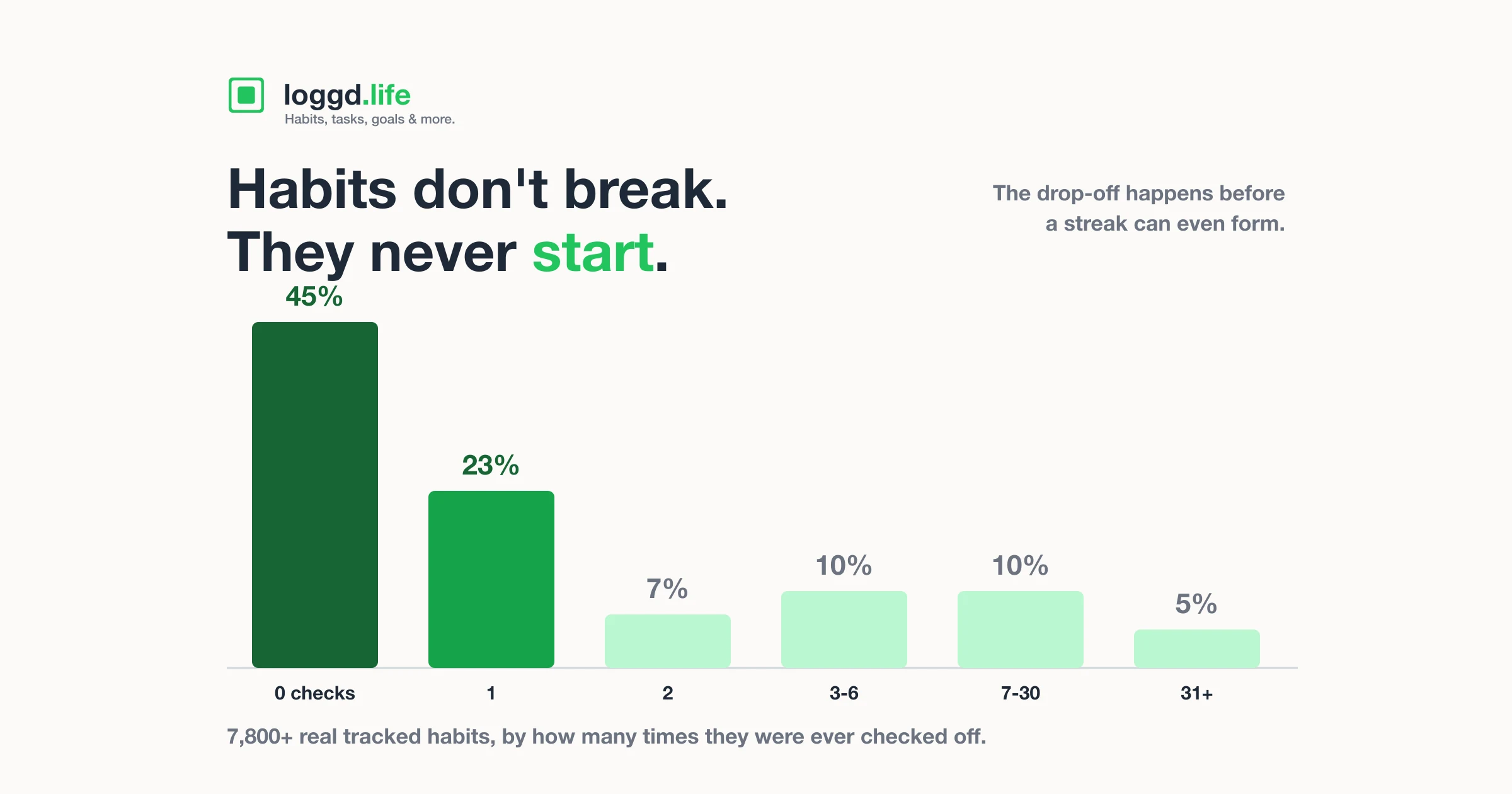
I can quote my own numbers because I published the method. Across 7,800+ habits and 4,200+ registered Loggd users, about 45% of tracked habits are never checked off once, and another 23% are checked exactly one time and never again. Only around 26% ever accumulate three or more check-ins. The full breakdown is in habits people quit fastest.
Roughly two in three habits die at or before the second check-in. The wall is not day three. It is check two.
Now the caveats, because this is a habit tracker's data and not a resolution study. These are people who chose to install a tracker, which over-represents the motivated. The figures cover the whole year, not January specifically. And a habit created in an app is not the same object as a resolution announced at a dinner table.
What carries across is the mechanism: most commitments do not break under pressure after building momentum. They never get far enough to have momentum to lose. Any explanation of January that assumes people fought hard and gradually faded is describing a minority.
Five reasons January commitments die
None of these are willpower. All of them are design.
1. It is an outcome, not a behaviour. "Get fit", "read more", "be more present", "save money". Every one of those is a result, and results cannot be done on a Tuesday. The first week of January is the only week where an outcome feels like a plan, because you have not yet had to work out what Wednesday evening actually requires.
Fix: write the version with a verb, a time and a place. Not "get fit" but "twenty minutes on the bike after I drop her at nursery". If you cannot name the time and the place, you have a wish.
2. It starts at full volume on day one. January 1 is the day you have the most rest, the most quiet and the least normal life you will have all year. Whatever you can do on January 1 is not a reliable guide to anything.
The published Loggd data is blunt about this: the size of a habit is decided at creation, by an optimistic version of you, and it is usually wrong. In that dataset "exercise 30 minutes" was tracked by 245 people and had an average longest streak of 0.9 days.
Fix: set the volume you could hold in the worst normal week of your year. Not the worst imaginable week. The worst ordinary one. You can always do more on a good day, and the good day is not the problem.
3. It has no miss policy. This is the big one. Almost nobody decides in advance what a missed day means, so the decision gets made on about January 9 by a tired person who is already embarrassed. That person reliably concludes that the run is ruined and the whole thing was fake.
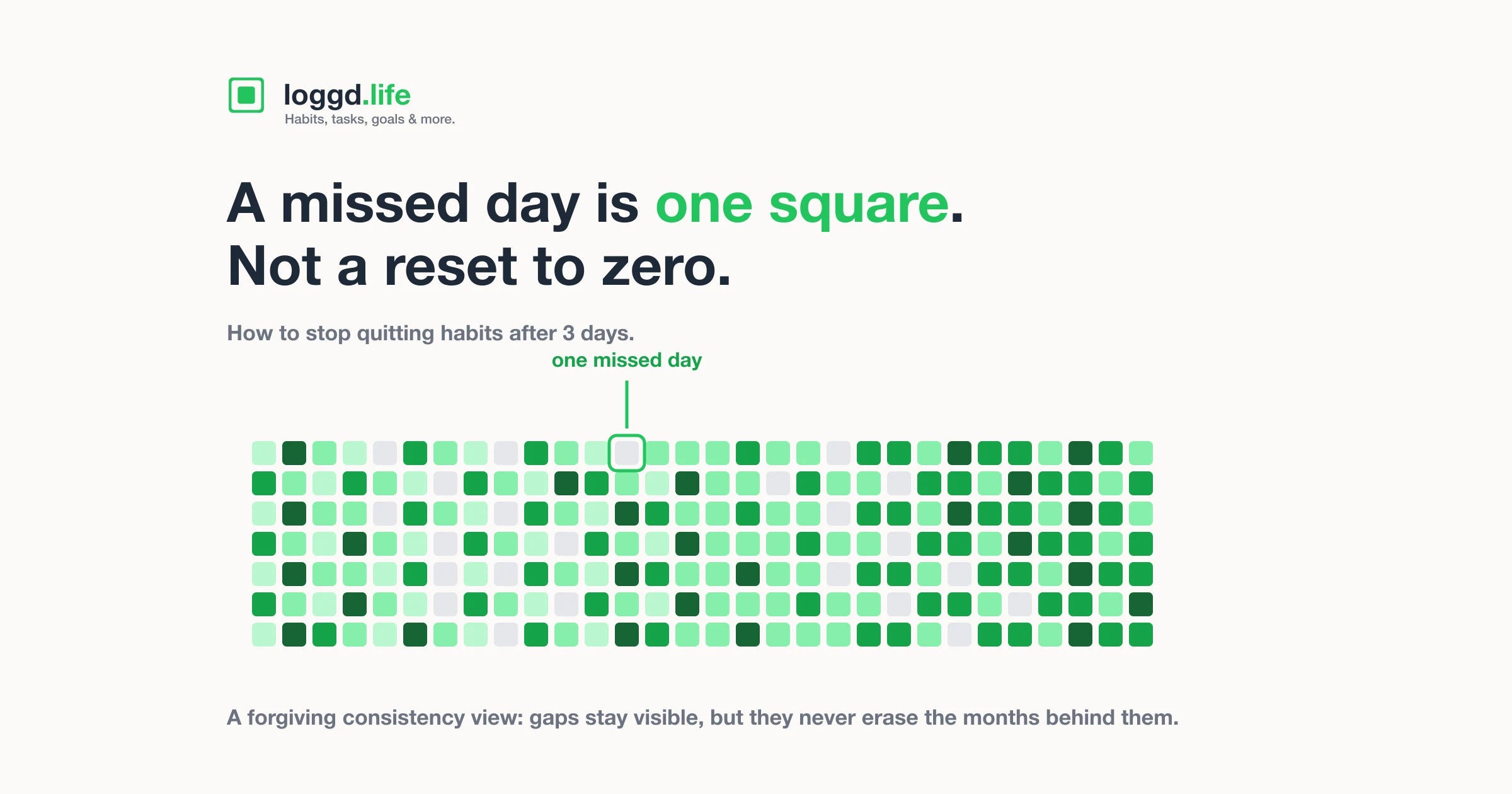
Psychologists call the spiral the abstinence-violation effect. Streak counters install it in software: 14, 15, 16, then zero, and the zero says that two weeks of work counted for nothing. It is exactly why Loggd shows a contribution grid instead of a streak counter, where a missed day is one lighter square instead of a reset.
Fix: write the policy in the same sentence as the commitment. A miss is one miss. Two in a row is the thing to prevent. How to stop quitting habits is the longer version of that rule.
4. It is designed by a rested person for a tired one. The January 1 version of you has slept in, has no deadlines, and feels genuinely capable of a 6am start. The person who has to execute it is back at work in a dark week with a backlog. They are not the same person, and only one of them was consulted.
Fix: design it in the state you will be in when you have to do it. If you would not commit to it on the worst Wednesday of last November, do not commit to it now.
5. Nothing was removed to make room. A new commitment needs an hour. Your week already had every hour allocated to something, including the parts you would rather not admit to. If you do not name what the hour comes out of, the answer gets decided for you, and it is usually the new thing that loses.
Fix: name the trade before you start. "This comes out of evening scrolling." "This comes out of the Sunday morning lie-in." A commitment with no named cost has not actually been made yet.
What to do instead
One thing. Not five. Five resolutions is a way of avoiding the discomfort of choosing, and it guarantees that a bad week takes out all of them at once.
Write it as a contract with a review date. The habit contract builder walks through three steps: state it as "I will [habit] at [time] in [location]", name one or two people who will hold you to it plus an agreed consequence if you do not, then sign it and pick a review date two weeks, thirty days, six weeks or ninety days out. You can print it or copy it as text, and it saves locally. The signature is theatre. The review date is the mechanism, because it converts an open-ended promise into something with a checkpoint you cannot quietly slide past.
Give it a trial window instead of a year. A year is unfalsifiable. Thirty days is a question you can answer. The 30-day challenge tracker has eight ready-made challenges plus a custom option, a duration of 21, 30, 66 or 100 days, a grid you tap each day, and a current and longest streak. One thing worth knowing before you plan around it: the challenge starts the day you create it, with no option to set a future start date. That is mildly annoying on December 27 and it is also the correct behaviour, because "I will start on the first" is where most of these die.
If you cannot resist a list, at least remove the pass/fail. The goal bingo card generator puts 24 goals plus a free centre on a 5x5 card you fill from a suggestion library or write yourself, then tick across the year. It is a list that cannot be failed, only partly completed, which is a friendlier shape for the sort of goal that is really a wish.
Or skip the list entirely. A theme costs nothing to keep and covers the small decisions a list never reaches: word of the year makes that case properly, including where it is the wrong choice.
If you already know this year went sideways
Before committing to anything for next year, it is worth knowing what actually happened in this one. Most people plan January against a memory of December. A two-hour annual review fixes that, and it usually changes what you would have committed to.
And if you are reading this having already broken something you started in January: one lapse is one lapse. The most useful thing I can tell you is that the rule is never miss twice, and that restarting in February means you are choosing the commitment rather than absorbing it from a calendar.
The date is not the problem. The design is.
Last updated: December 2026.
Written by Eusebiu, the solo founder building Loggd in public. I build it in the evenings around contract work and a small daughter, so my own January commitments have to survive a bad Tuesday or they do not survive at all. I publish the aggregate numbers as I find them, including the unflattering ones, on Threads.
Design for the bad week, not the first one. Loggd shows your consistency as a forgiving contribution grid, so a missed day in January stays one lighter square instead of resetting you to zero. Start free.