Short-term goal examples include finishing a project draft this week, saving a set amount in 30 days, or clearing one closet by Sunday. Choose a measurable finish line, set a deadline, and name the actions you will take this week.
Borrow one of the 30 examples below, then change its scope or deadline to fit an ordinary week. A goal names the result: clear the closet. An action is a step toward it: sort one shelf after dinner. Keeping the two separate makes it easier to see what you are aiming for and what to do next.
What Makes a Goal Short-Term?
A short-term goal is a near-term result with a clear endpoint. Today, this week, and the next 30, 60, or 90 days are useful planning windows, not universal cutoffs. The right deadline depends on the work involved and the time you have available.
The University of Minnesota Extension describes short-term goals as small, attainable steps toward a longer-term goal. For example, building a financial cushion is a longer-term direction; setting aside a planned amount over the next month is a short-term milestone on the way there.
The American Psychological Association says goals that are short-term, specific, and moderately challenging enhance motivation more than distant, general, overly challenging goals. The point is not that a near deadline alone makes a goal work. Specificity and a challenge that fits your circumstances matter, too.
15 Short-Term Goals for Work, School, Money, and Health
Use these as starting points. Change the target or timing to fit your workload, budget, and circumstances.
| Area | Goal and Deadline | First Action |
|---|---|---|
| Work and career | Revise three resume bullets by Friday | Open your resume and choose the bullets |
| Work and career | Send a project update every Friday for four weeks | Draft this Friday’s update |
| Work and career | Complete a practice presentation and request feedback within 14 days | Choose a topic and ask a coworker to review it |
| Students | Submit an essay outline by Thursday | Write the main question and three points |
| Students | Finish 120 assigned pages in 10 days | Check the page count and divide it across the days |
| Students | Complete and check 20 practice problems by Sunday | Gather the problems and mark the first five |
| Business | Interview three existing customers in 30 days | Choose three customers and draft an invitation |
| Business | Publish one revised service page within two weeks | List the edits the page needs |
| Business | Reconcile this month’s invoices by the fifth of next month | Collect the invoices and payment records |
| Finances | Record every purchase for seven days | Choose where you will record each purchase |
| Finances | Save a planned amount in 30 days, if the budget allows | Check your budget and choose a transfer date |
| Finances | Cancel one unused subscription before its next renewal | Find the renewal date and cancellation steps |
| Health and fitness | Walk for 10 minutes after lunch on four days this week | Choose four days and a suitable route |
| Health and fitness | Prepare lunch at home on three days next week | Pick three lunches and make a shopping list |
| Health and fitness | Complete 30 minutes of aerobic activity five days a week for four weeks | Choose days and activities that fit your ability |
The final health target is an example used in a peer-reviewed health-behavior article, not a personalized exercise prescription. Adapt activity to your abilities, and seek clinical guidance when a health condition affects what is appropriate.
For the spending goal, Consumer.gov recommends writing down what you spend each day. If you are working toward a reading deadline, use the reading goal calculator to turn the assigned page total into a daily target. The sinking fund planner can help divide a savings target into contributions that fit your schedule.
15 Personal Short-Term Goals, From Today to 90 Days
Choose from these personal short-term goals rather than treating all 15 as a challenge to complete. Pick a time frame that fits what you want to do and the room you have in your week.

| Time Frame | Personal Goal | Finish Line |
|---|---|---|
| Today | Call a relative | Complete a 10-minute call |
| Today | Clear one kitchen drawer | Remove unwanted items and put the remaining items in order |
| Today | Practice a hobby | Spend 15 minutes practicing |
| This week | Arrange a catch-up with a friend | Agree on a time and place |
| This week | Donate unused belongings | Fill one bag and set it aside for donation |
| This week | Compare destinations for a future trip | Write down three possible destinations |
| In 30 days | Finish a small craft project | Complete one chosen project |
| In 30 days | Keep a brief mood record | Record a check-in on 20 days; the free mood tracker can help you keep the entries together |
| In 30 days | Host a low-cost meal with friends | Serve one meal you planned within your budget |
| In 60 days | Organize family photos | Organize and back up one folder |
| In 60 days | Learn beginner language skills | Complete eight beginner lessons |
| In 60 days | Plan a weekend trip | Write down a route, lodging options, and a spending limit |
| In 90 days | Try a new hobby | Finish one beginner course |
| In 90 days | Stay connected with someone close | Hold six scheduled check-ins with a partner or close friend |
| In 90 days | Explore nearby places | Complete four local outings from a personal wish list |
Turn an Example Into a SMART Short-Term Goal
The CDC defines SMART as specific, measurable, achievable, relevant, and time bound. Use each word as a check: What result will I reach? How will I count or see it? Can I do it with my time and resources? Does it matter to me now? By when will I finish?
Copy and fill in this sentence:
By [date], I will [specific result], measured by [finish line], because [reason], using [available time or resources].
Then turn the goal into actions you can schedule this week. The examples show how a broad intention becomes a defined result and a short action plan.
| Vague Intention | SMART Goal | This Week's Actions |
|---|---|---|
| Get organized | Clear the hall closet by Sunday | Schedule two 20-minute sorting sessions and arrange a donation drop-off |
| Save more | Move a planned amount into savings within 30 days | Confirm that the weekly amount fits the budget and schedule the first transfer |
| Improve presentations | Deliver one five-minute practice presentation and collect feedback from a coworker by Friday | Outline it Tuesday and rehearse Thursday |
| Move more | Take a 10-minute walk after lunch on four days this week | Choose the days and identify a suitable route |
If you want help writing your own version with the same checks, use the SMART goal worksheet.
Choose the Goals That Fit Your Actual Week
Choose a goal by the behavior it asks of you and the space it has in your week. Start with one main goal. Add a second only after you have assigned time to the first goal’s actions.
Before you commit, check:
- Does this need attention soon?
- Can I name the next action?
- Can I fit that action into an ordinary week?
- What will I postpone to make room?
Jordan has a project deadline this week and wants to begin a hobby course. The project takes priority for now, while a brief walk can stay as a small supporting routine. If a goal feels too large, reduce its scope: organize one drawer instead of the whole kitchen.
Keep one active goal and put the remaining candidates on a later list.
Give Your Goal a Habit, a Task, and Focus Time
A goal becomes easier to act on when you connect its finish line to the next few actions. Use this sequence to build a plan you can follow through an ordinary week.
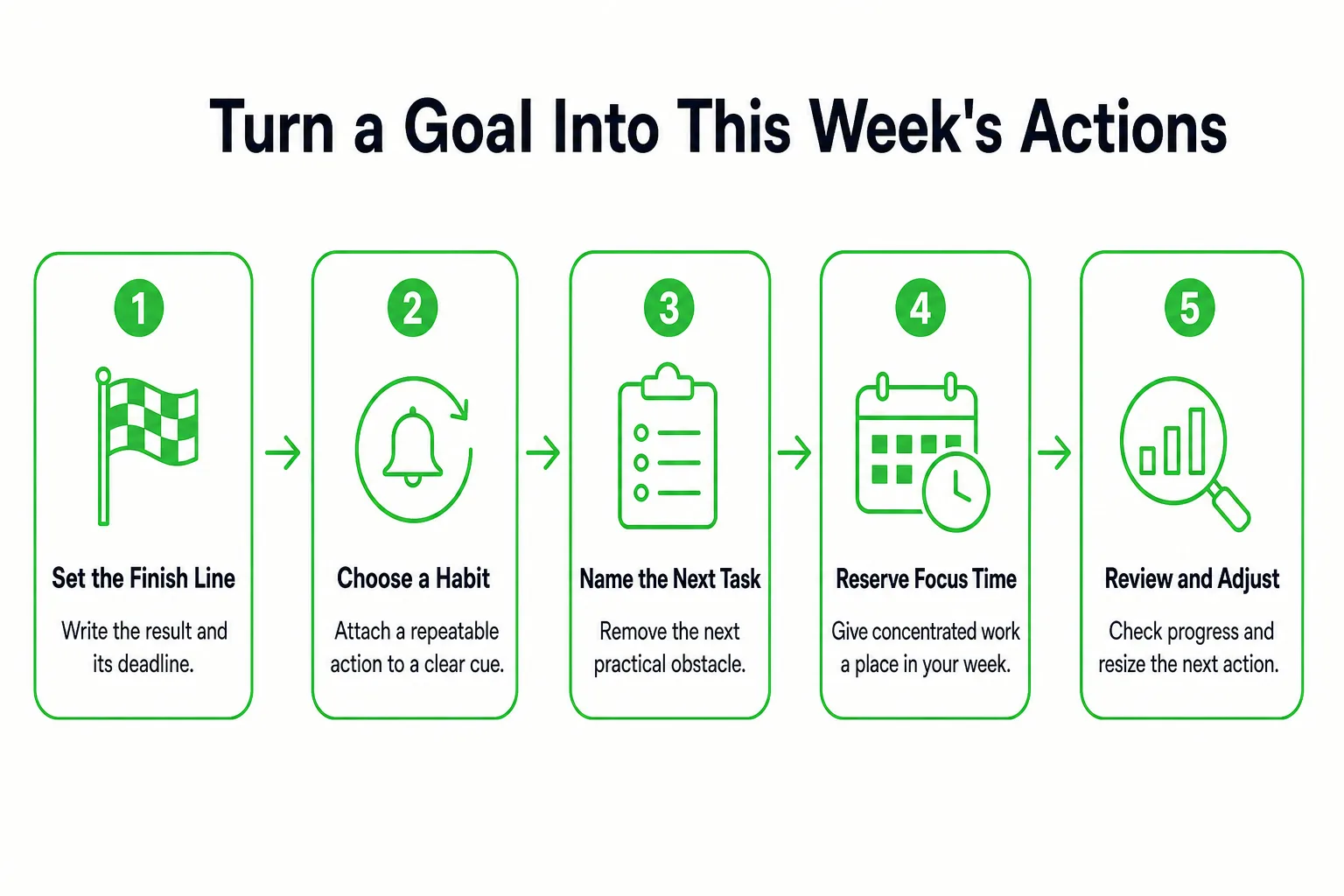
- Write the finish line and deadline somewhere you will review them. For example: finish a 120-page book in 30 days.
- Choose a repeatable supporting habit with a clear cue. Read four pages after breakfast; attaching a new action to an existing routine can make it easier to remember. See these habit stacking examples for other ways to pair actions.
- Identify the next one-off task that removes an obstacle. Get the book today, so it is ready when you sit down to read.
- Reserve a focus session for work that needs sustained attention. Set aside 20 minutes on Sunday for reading.
- Choose a review time and a smaller action for a disrupted day. Check your progress each Sunday. If you miss a morning, read two pages before bed, then redistribute any unfinished pages during your weekly review.
Four pages across 30 days covers 120 pages. The Sunday session gives you time to get ahead or catch up; it does not add extra pages to the daily calculation. Some goals need a recurring action, some need a sequence of tasks, and some benefit from both. Match the setup to the work.
Track the Finish Line and Review Each Week
Keep three details together: the deadline, your progress toward the finish line, and the next action. Checking off an action is not the same as completing the goal. Reading today counts as an action; reaching the final page completes the book goal.
Set aside a short time each week to compare your progress with the time remaining. Name the obstacle, then schedule the next action. If your list has too many actions, cut it down to the ones that move the goal forward. Schedule those before adding another goal, and replace vague wording with a result you can see.
For the book, if 40 pages remain with 10 days left, plan to read four pages a day. A goal countdown timer can keep the remaining time visible alongside your progress record.
Track Your Short-Term Goal With Loggd
You can keep the book goal and its supporting actions together in Loggd. Add finishing the book to Goals, add reading as a habit with a schedule that fits your week, and put getting the book on the task list. Use the focus timer for the Sunday reading session. Tasks and focus sessions connect with goals, so the work stays together.
Use the daily check-in to look at what happened and choose your next action. When you check off a day, it fills a grid of your last 365 days, giving you a view of your activity across the year. That grid shows activity over time; the book’s finish line is still reaching the final page.
Loggd is free on iPhone, Android, and the web, with no credit card needed. Choose one goal and add its next task.
Questions About Short-Term Goals
How Do I Explain My Short-Term Career Goals in an Interview?
Name a skill or result you can work toward soon, then connect it to the role. For example: “Over the next 60 days, I want to improve how I present project updates. I plan to lead one practice presentation each week and ask a teammate for feedback.” Keep the goal specific, realistic for the job, and focused on what you can do.
What Should I Do When I Miss a Goal Deadline?
First, work out what got in the way: the goal may have been too large, the time estimate too low, or the week unusually busy. Choose whether to reset the deadline, reduce the scope, or stop pursuing the goal. If it still matters, write a new finish line and schedule the next action. Treat the missed date as a prompt to adjust the plan, not as a reason to leave the goal undefined.
How Do I Set a Measurable Goal When the Result Depends on Other People?
Measure the part you control, such as sending a proposal by Friday, asking three customers for feedback, or requesting a meeting. Set a date to follow up, but do not make another person’s response the only measure of your progress. You can track both the action you take and the outcome you hope for, while keeping the finish line tied to your own next step.
Sources
- Healthy and fit on the go: Goal setting
- Pre-K to 12 Teaching Principle: Motivation
- Goal Setting and Action Planning for Health Behavior Change
- Making a Budget
- Design Training: Learning Objectives