TL;DR. The 90-minute cycle is genuinely established during sleep and much more speculative once you are awake. Kleitman proposed that the same rhythm continues through the day, and sixty years later that extension is still contested. Daytime energy fluctuations are real, but whether they run on a 90-minute clock is not settled. The good news is that the practical template survives the uncertainty: about 90 minutes of focused work followed by about 20 minutes of real recovery is a sensible shape for demanding work for reasons that need no biology at all. Track your energy for a week to find your own numbers, and stop treating the afternoon trough as something to caffeinate away.
Search for ultradian rhythms and you will get a hundred articles telling you that your body runs in strict 90-minute cycles and that fighting them is why you are tired.
The claim has a real scientific ancestor. It has also been stretched a long way past what that ancestor supports, and almost nobody says so, because "work in 90-minute blocks because a mid-century sleep researcher had an interesting hypothesis that is still disputed" is a harder sell.
I want to give you the honest version and then the useful version, because they are different and both matter.
Where the 90-minute cycle comes from
Nathaniel Kleitman is the reason sleep science exists as a field. He co-discovered REM sleep with Eugene Aserinsky in 1953, which is one of those findings that reorganised an entire discipline.
In the 1963 revised edition of his book Sleep and Wakefulness, he proposed the basic rest-activity cycle, or BRAC. The observation behind it was simple. During sleep, the brain cycles through stages on a roughly 90-minute loop, moving between deeper non-REM sleep and REM. Kleitman's hypothesis was that this cycle does not start at bedtime and stop at waking. It runs continuously, and while you are awake it shows up as a wave of alertness rising and falling on roughly the same schedule.
It is a beautiful idea. A single rhythm underlying both halves of your day.
The honest status of the evidence
Here is the part that gets skipped.
During sleep, the cycle is not in question. It is measurable, replicable and visible in any sleep lab. This part is textbook.
During waking hours, the picture is much weaker. Researchers have looked for a clean 90-minute alertness cycle in awake subjects since the 1970s, and the results have been inconsistent. Sceptical reviews appeared as early as the late 1970s, and later work by sleep researcher Leon Lack found weak or unclear evidence for a distinct 90-minute rhythm in daytime alertness. Where periodicity does show up, the periods vary widely between individuals and across measures, and they are easily swamped by whether you slept, ate, or just sat through a meeting.
What is well documented is that alertness fluctuates during the day. The disputed part is whether those fluctuations share a mechanism with the nightly sleep cycle and arrive on a predictable 90-minute schedule.
So when an article tells you that your brain switches modes every 90 minutes and you must obey, it is presenting a contested hypothesis as settled fact. I would rather give you the template with an accurate label on it.
Why the 90/20 template is still worth running
Now the useful version. The template works for reasons that do not depend on Kleitman being right.
It amortises warm-up cost. Demanding work has a setup phase where you load a structure into your head before producing anything. A 90-minute block pays that cost once for a long stretch of output. Four 25-minute blocks pay it four times.
It forces a real break. Twenty minutes is too long to spend refreshing an inbox and calling it recovery. The length itself pushes you toward standing up and leaving the desk, which is the part that actually restores attention.
It caps the day honestly. Three cycles is four and a half hours of genuinely focused work, more than most people manage. Ericsson's research on elite performers found they rarely exceeded about four hours of truly focused practice daily, in sessions of roughly an hour to ninety minutes. If people whose entire job is practising top out there, planning eight hours of deep work is fantasy scheduling.
It fits real fatigue. Whatever the underlying clock, most people can feel their attention degrade somewhere in the second hour of hard work. The template puts a break exactly where the degradation shows up.
None of that requires a biological rhythm. It requires only that focus is a depleting resource with a startup cost, which is uncontroversial.
The practical template
Focus: 80 to 100 minutes. Start at 90. One task, chosen before you begin, with the phone in another room.
Recovery: 15 to 25 minutes. Start at 20. Away from the screen. Movement if possible.
Cycles: two or three a day. Not five.
Placement: your best cycle goes on your hardest task. Not on email.
The rule I would most defend is the single-task one. A 90-minute block spent on four things is not a deep work session. It is task switching with a timer attached, and it feels worse than 25 focused minutes.
The ultradian rhythm timer runs this shape directly. Focus length is adjustable from 60 to 120 minutes and recovery from 10 to 30, so you can tune it once you know your own numbers, with auto-start if you want the cycles to roll. It also counts your cycles for the day and shows a gentle warning from the fourth one on, which is the feature I use most, because the fourth cycle is usually me being stubborn rather than productive.
If 90 minutes is more than your day can hold, that is common and fine. The pomodoro timer covers everything up to a 60-minute focus block, and the trade-offs between 25, 50 and 90 are laid out in how long a pomodoro should be. Ninety minutes is a tool for your two hardest sessions, not a standard unit for the whole day.
Finding your own cycle in a week
Since the general 90-minute claim is shaky, the useful move is to stop arguing about the population average and measure yourself. This takes about ten seconds, six or seven times a day.
- Log your energy hourly on a 1 to 10 scale. Do not overthink the number. First instinct is fine and more consistent than deliberation.
- Tag what you were doing. Meals, meetings, exercise, caffeine, commute. These usually explain more of the variance than any rhythm.
- Do it for at least five days, including one weekend day. Weekday patterns are heavily shaped by your calendar, which is worth seeing separately.
- Look for the shape, not the clock. You are trying to find your two or three best hours and your reliable trough, not to confirm a 90-minute period.
- Then move one thing. Take your hardest recurring task and shift it into a peak window. Leave everything else alone so you can tell whether it worked.
The energy level tracker is built exactly for this: hourly check-ins on a 1 to 10 scale, optional activity tags, a daily timeline, and a weekly patterns view that averages out your peak hours across days. Everything stays in your browser.
Most people are surprised by how stable the trough looks once a week of it sits side by side, and by how much of the pattern is explained by lunch, meetings and sleep rather than any internal wave.
The trough, and why caffeine is the expensive answer
Everyone has a period in the afternoon where quality drops. Most people respond by drinking something.
Caffeine works mainly by blocking adenosine, the molecule whose accumulation signals that you have been awake a long time. Blocking the signal does not clear the backlog. The tiredness is still accumulating behind the block, and when the caffeine clears you get it back, often with a sharper edge. Caffeine also hangs around for hours, which is why a coffee that felt necessary at four in the afternoon can quietly degrade the sleep that would have fixed the problem properly.
Run the arithmetic. A 20-minute break costs you 20 minutes, once, today. Push through the trough with caffeine instead and you get roughly an hour of adequate work, a duller evening, and a slightly worse night, which makes tomorrow's trough deeper. Do it four days running and you have built a small debt that costs a weekend to clear.
I am not telling you to quit coffee. I drink it. I am saying that using it to overwrite a trough is borrowing at a bad rate, and the break is the cheap option almost every time. The exception is real deadlines, where today genuinely matters more than tomorrow. Just spend tomorrow knowingly rather than every afternoon by default.
What to do with your trough instead
Do not try to make the low period productive in the same way as the peak. Give it work it can actually hold:
- Admin, expenses, inbox triage.
- Routine code: tests, small refactors, dependency bumps.
- Walking meetings or calls where you are mostly listening.
- Planning tomorrow, which needs judgement but not sustained load.
- An actual nap if your situation allows it.
The trough is not wasted. It is a different tool, and you should stop asking it to be a peak.
Making it survive past week one
The template is easy. Still running it in three weeks is the hard part, and it fails in the usual way: something urgent lands, the cycle gets skipped, and it quietly never comes back. The mechanics that prevent that are in how to stop quitting habits, and the one that matters most here is protecting the first block of the day, because it is the only one nobody else has a claim on yet.
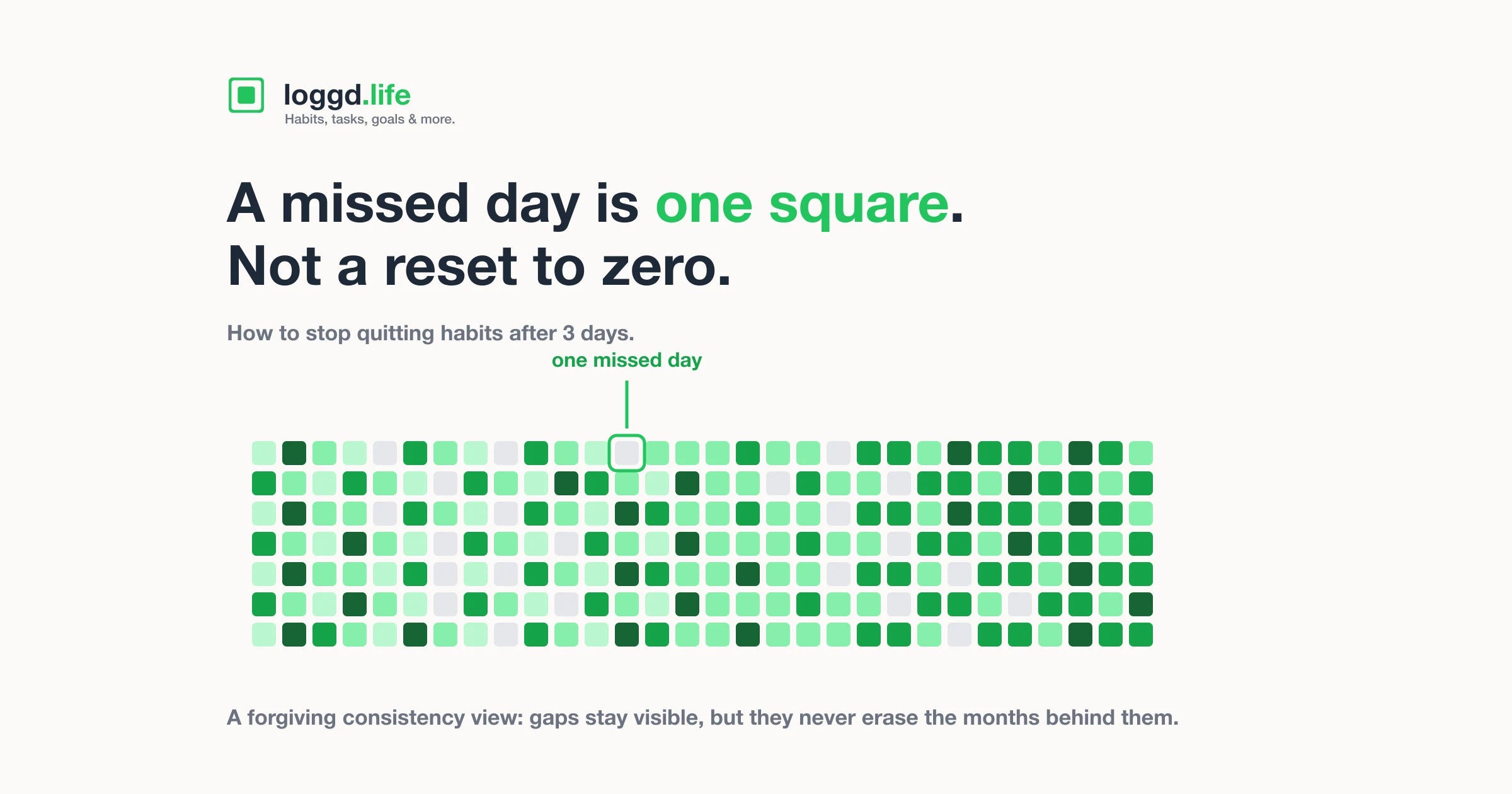
Looking at it weekly rather than daily helps too. A single missed cycle means nothing. Four skipped mornings in a row is a pattern telling you something about your calendar, and a weekly review is where that becomes visible early enough to fix.
What I would actually tell you
Ignore the number. Nobody has established that your body runs a 90-minute clock while you are awake, and anyone who says otherwise with confidence has not read the sceptical half of the literature.
What is true: focus depletes, restarting is expensive, and real breaks restore more than fake ones. The 90/20 template is a good shape for that, roughly two or three times a day, and a week of energy logging will tell you more about your own version of it than any study of a hundred undergraduates ever will.
Start with 90 and 20. Adjust to what you measure. Take the break.
Last updated: October 2026.
Written by Eusebiu, the solo founder building Loggd in public. I write code for clients during the day and build this in the evenings around a small daughter, so my own 90-minute blocks are more of an aspiration than a schedule. I share what the aggregate data keeps showing on Threads.
See your focus pattern over weeks, not days. Loggd tracks consistency as a forgiving contribution grid, so one skipped cycle stays one lighter square instead of resetting your progress. Start free.