TL;DR. Twenty five minutes is an arbitrary default that a student picked with a kitchen timer in the late 1980s. It stuck because it was good enough. The right interval depends on how long your task takes to warm up: 15 to 25 minutes for admin and anything you are avoiding, 50 minutes for work that needs a mental model loaded first, 90 minutes for the two or three genuinely demanding blocks in a day. All of that matters far less than starting at all. If you want an answer without the essay: use 50/10, adjust after a week.
Someone asks this in every productivity forum, roughly weekly. Is 25 minutes too short? Should I do 50/10? Is 90 minutes the real answer because of ultradian rhythms?
I build a focus timer, so I have read a lot of these threads. Almost all of them are people optimising an interval instead of running one.
The question is not stupid, though. The default is genuinely wrong for some work, and using the wrong one long enough will convince you that timers are not for you. So here is the honest version, including the part where the answer matters less than you would like.
Where 25 minutes actually came from
Francesco Cirillo was a university student in Italy in the late 1980s, struggling to study, and he bet himself he could concentrate for ten minutes. The timer he grabbed was a tomato-shaped kitchen timer. Pomodoro is Italian for tomato. That is the whole origin story.
He then experimented. Shorter intervals, longer intervals, different break lengths. He settled on 25 minutes because it was about the longest stretch he could hold before his attention started fraying, and because 25 plus a 5-minute break makes a tidy 30-minute unit that slots into a calendar and is easy to count.
No study. No lab. One person, one kitchen timer, a reasonable amount of self-experimentation.
That is not a criticism. Twenty five minutes is a genuinely good default: short enough that starting feels cheap, long enough to get something real done. Defaults chosen by someone who used the thing daily tend to be decent.
The mistake is treating a well-chosen default as a discovered constant. People sit through 25 minutes of deep work feeling the timer interrupt them at exactly the wrong moment, and conclude that they are bad at focusing.
The thing that actually decides your interval
Forget personality types and chronotypes for a moment. The variable that matters is warm-up cost: how long it takes you to get from sitting down to actually working.
Some tasks have almost none. Replying to messages, sorting a backlog, filing expenses, editing a paragraph you already wrote. You sit down and you are working within seconds.
Other tasks have a lot. Debugging something with several moving parts, writing an argument that has to hold together over 2,000 words, reading a paper in a field you barely know. You have to page a whole structure back into your head before you produce anything.
The research term nearest to this is attention residue, from Sophie Leroy's work: when you switch tasks, part of your attention stays with the previous one, and performance suffers until the residue clears. The practical consequence is simple. If your task takes ten minutes to warm up, a 25-minute block gives you fifteen minutes of real work and calls it a session. Do that four times and you have paid the warm-up cost four times for less than an hour of output.
So the rule is: the higher the warm-up cost, the longer the block should be. Everything else is detail.
The case for 25/5
Still the right default for more work than people admit.
- Tasks you can start cold.
- Anything with dread attached, where the entire problem is beginning.
- Fragmented days where a 50-minute uninterrupted window is a fantasy.
- Physical or repetitive work where fatigue arrives faster than boredom.
The underrated property of 25 minutes is that it is small enough to be honest about. "I will work on this for 25 minutes" is a promise you will keep. "I will work on this all afternoon" is a mood.
The case for 50/10
This is where I spend most of my own working time, and it is what I would pick for you if you told me nothing about your work.
Fifty minutes gives you roughly ten minutes of warm-up and forty of real work, which is a much better ratio than 25/5 offers on anything demanding. It also halves the number of transitions in a day, and transitions are where time quietly disappears.
The 50/10 pattern suits writing, coding, studying, design work, and anything where you keep a structure in your head. The developer focus timer defaults to exactly this split, with a task label and IDE-style dark themes if you want the version tuned for code.
You can run the same pattern on the standard pomodoro timer by dragging the focus slider to 50 and the short break to 10. Nothing about the tool assumes 25 except the starting position of a slider.
The case for 90/20
Ninety minutes is the interval with the most confident-sounding science behind it and the least reliable evidence, which is an unusual combination.
The claim comes from Nathaniel Kleitman's basic rest-activity cycle: a roughly 90-minute rhythm that is unambiguous during sleep and, Kleitman hypothesised, continues while you are awake. The waking half of that claim is much shakier than productivity blogs suggest, and researchers have been sceptical about it since the 1970s.
Here is the thing though: the template is useful whether or not the biology holds up. Ninety minutes of focus and twenty of genuine recovery is a sensible shape for demanding work, for reasons that need no rhythm at all. It amortises a large warm-up cost, it forces a real break rather than a token one, and three of them is a full day of serious cognitive work.
Two honest cautions. A 90-minute block is a big commitment, and big commitments are the ones you postpone. And most people get two or three good ones before quality drops, so making 90 minutes your standard unit means most blocks will be mediocre.
If you want to run this properly, the ultradian rhythm timer is built for it: focus lengths from 60 to 120 minutes, recovery from 10 to 30, and a daily cycle counter that warns you from the fourth block on. The regular pomodoro timer caps its focus slider at 60 minutes, so it will not take you there.
The case for going shorter than 25
Underrated, and the option most people skip because it feels like admitting defeat.
If you are stuck, overwhelmed, or looking at something you have been avoiding for three days, 25 minutes is too big an ask. Fifteen is not. Neither is ten. The point of a short block is not output, it is getting past the start, which is the only part that was ever hard.
This is also the standard recommendation for ADHD, where the barrier is almost always initiation rather than stamina. Shorter blocks mean more completions, and more completions mean more of the immediate feedback that makes the next one easier to begin. The ADHD focus timer starts at 15 minutes and adds visual progress, a task label, and body doubling ambience for exactly this reason.
Nobody has ever been harmed by finishing a block that was too easy.
A rough mapping
| Task | Interval | Why |
|---|---|---|
| Email, admin, expenses | 25/5 | No warm-up, boredom arrives before fatigue |
| A task you have avoided for days | 10 to 15 | Starting is the entire problem |
| Writing a draft you have outlined | 50/10 | Enough runway to hold the argument |
| Debugging something with many parts | 50/10 or 90/20 | Expensive to reload the model |
| Studying unfamiliar material | 50/10 | Warm-up cost is real, stamina is not infinite |
| The one hard problem of your week | 90/20 | Worth the setup, worth protecting |
| Anything after your fourth block | Stop | You are typing, not thinking |
Take it as a starting point, not a prescription.
The part nobody wants to hear
The gap between 25 and 50 minutes is small. The gap between doing a focus block and not doing one is enormous.
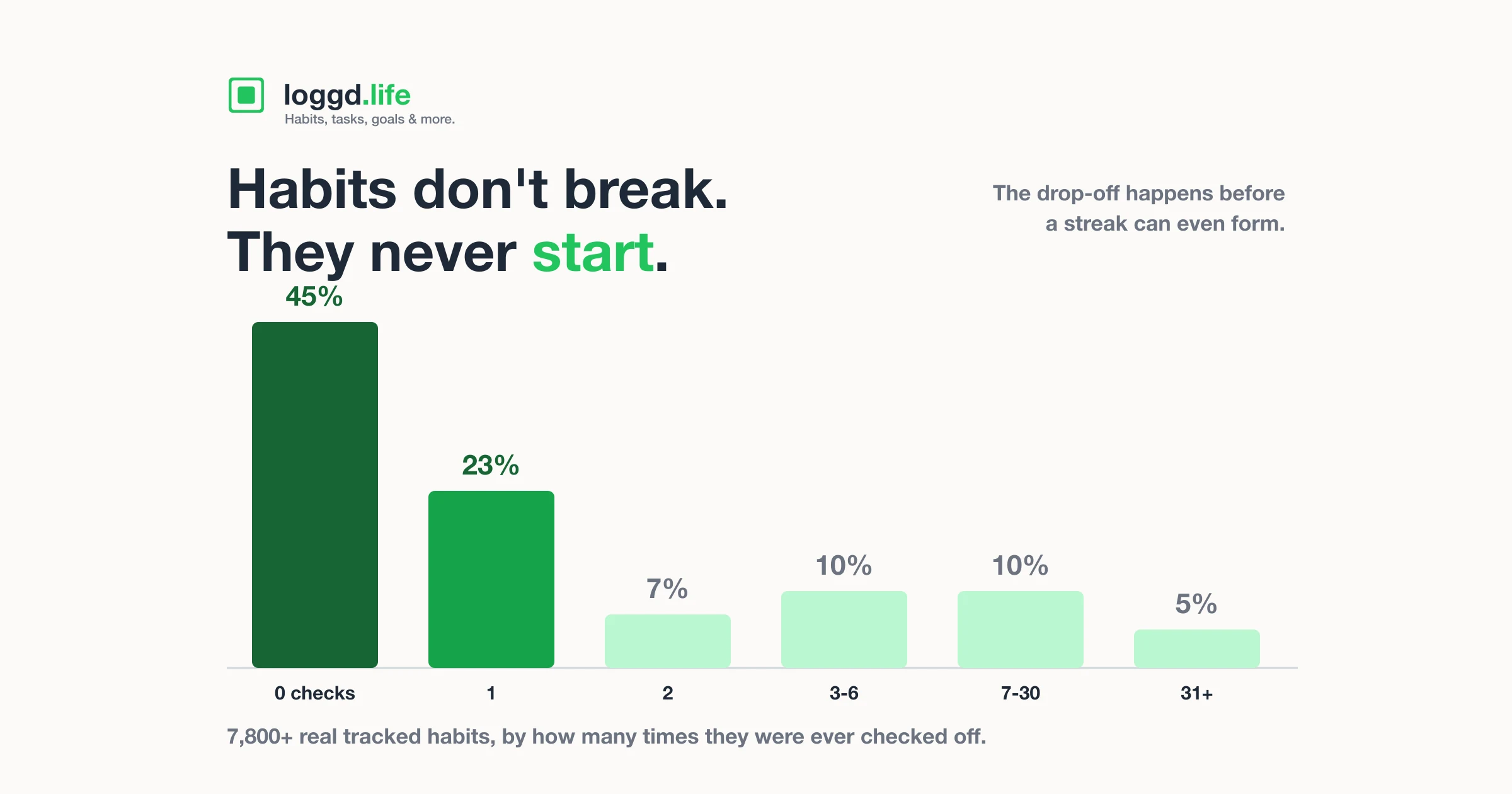
I am confident about that because of what the aggregate data on habits keeps showing. Across 7,800 tracked habits on this site, about 45% were never checked off even once, and another 23% were checked exactly one time and then never again. Roughly two in three died at or before the second check-in. That pattern is not about intensity or interval design. It is about the enormous difficulty of doing something a second time.
Focus sessions behave the same way. Nobody abandons a focus practice because they chose 25 over 50. They abandon it because on Tuesday it felt like a lot of setup and they had a meeting at eleven.
So if you are currently reading comparison articles instead of working, the interval is not your bottleneck.
How to find your own number in a week
Five days, minimal ceremony:
- Run 50/10 for the whole week on the work that matters most, so you have a fixed baseline.
- Note two things at the end of each block: did I finish it, and did I still have something left at the timer.
- If you abandoned blocks, go shorter. Drop to 35 or 25 and stop treating it as a downgrade.
- If you were consistently annoyed at being stopped, go longer. Try 70, then 90.
- If it varied by task, that is the correct answer and you are done. Use two intervals, one for shallow work and one for deep, and pick per task.
Most people land on two intervals. Almost nobody lands on one number that fits everything, which is the flaw in the original question.
Where the timer sits in the wider habit
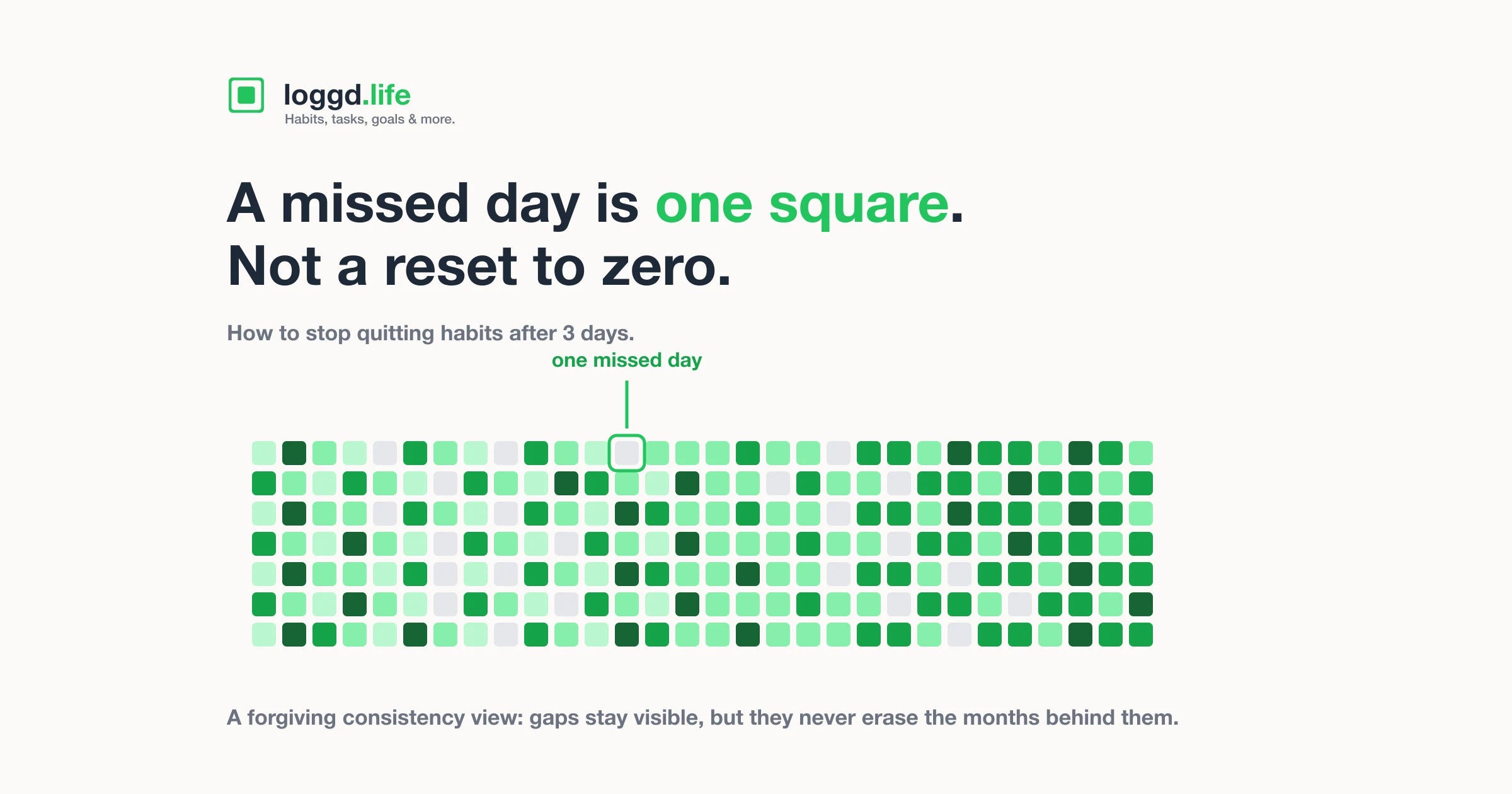
An interval is a small technical decision inside a bigger behavioural one: whether focus blocks survive a bad week. The mechanics that matter there are in how to stop quitting habits: make the entry cheap, never miss twice, and keep a record that shows a missed day as a missed day rather than a reset to zero.
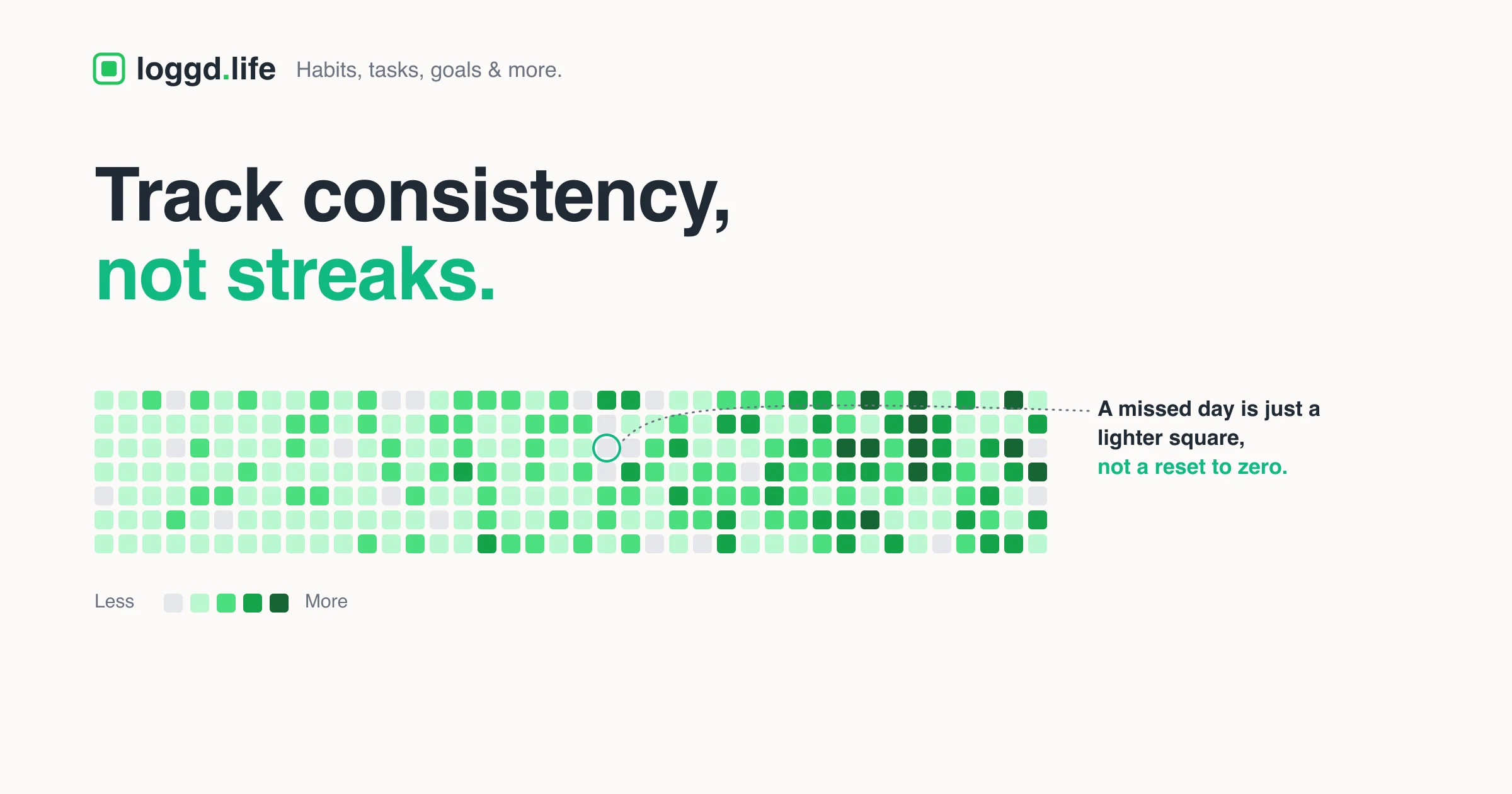
That last part is why I built Loggd's tracking around a contribution grid instead of a streak counter. A week with nine focus blocks instead of twelve is a good week. A counter reading zero because you skipped Thursday tells you something false, and people quit over false information all the time.
The short answer
Use 50/10. If you keep quitting early, go shorter until you finish one. If you keep resenting the bell, go longer.
And if you have read this far without starting a block, that was the actual finding.
Last updated: September 2026.
Written by Eusebiu, the solo founder building Loggd in public. I write code for clients during the day and build this in the evenings around a small daughter, so my focus blocks get interrupted by things no interval can plan for. I share what the aggregate data keeps showing on Threads.
Track focus sessions alongside everything else. Loggd shows your consistency as a forgiving contribution grid, so a lighter week stays a lighter week instead of resetting you to zero. Start free.