TL;DR. 75 Hard is a 75-day program with five fixed daily tasks and a rule that sends you back to day 1 if you miss any of them. It genuinely works for some people because the rules leave no room to negotiate. It is also the program dietitians and health outlets have flagged hardest: two workouts a day with no rest days is an injury risk for beginners, a gallon of water is more than many bodies need, and the restart rule punishes ordinary life. 75 Soft keeps the structure and drops the extremes. Pick the version you will still be doing on day 50, and talk to a doctor first if you are returning from injury, pregnant, or managing a condition.
Every January and every September, 75 Hard comes back around. Someone in your feed is on day 3. Nobody is on day 60.
I want to be fair to it, because the sneering reviews are as lazy as the hype. The program has a real mechanism and it works on real people. It also has design decisions that produce injuries and dropouts at scale, and the community around it tends to read both of those as personal weakness.
So here is the honest version: what it is, what it gets right, what the criticism actually says, and what to run instead if the strict version is not appropriate for you.
This is not medical advice. If you are returning from injury, pregnant, managing a health condition, or have any history of disordered eating, talk to a doctor before starting either version of this.
What 75 Hard actually is
Andy Frisella, an entrepreneur and supplement company owner, published 75 Hard in 2019. He is explicit that it is not a fitness program. He calls it a mental toughness program, and the fitness is a side effect.
Five tasks, every day, for 75 days:
- Two 45-minute workouts, one of which must be outdoors.
- Follow a diet of your choosing. No alcohol, no cheat meals.
- Drink one gallon of water.
- Read 10 pages of a nonfiction book.
- Take a daily progress photo.
Miss any one of them and you start over at day 1. Day 3, day 74, it does not matter. That rule is the reason people talk about it.
What it genuinely gets right
I think three things about the design are good, and I would defend them.
There is nothing left to decide. The single largest daily cost of most self-improvement plans is negotiation. Do I go today. Is 30 minutes enough. Does a beer count. 75 Hard answers all of it in advance. That removes an enormous amount of daily friction, and for people whose actual problem is decision fatigue rather than capability, it is a legitimate fix.
The outdoor workout is smarter than it looks. Forcing one session outside means daylight, weather, and a walk when you are wrecked. It is the least macho rule on the list and probably the most beneficial.
Reading 10 pages is small on purpose. It is the one rule sized correctly. Ten pages takes 12 minutes and can be done at 11:50pm in bed. Almost every other rule on the list should have been designed like this one.
There is also a fourth thing, which is harder to measure. Finishing 75 consecutive days of anything changes how you talk to yourself about difficulty. That effect is real and I am not going to pretend it is not.
Where the criticism is right
Now the part the promotional content skips.
Two workouts a day, zero rest days. This is the most flagged element and the criticism is straightforward. Recovery is where training adaptation happens, not an optional extra. A beginner going from sedentary to 90 minutes a day with no scheduled rest for 75 days is a textbook setup for overuse injury, and the rule structure actively discourages backing off, because backing off means starting over. Coaches and health outlets have made this point repeatedly since the program went viral.
A gallon of water. That is roughly 3.8 litres, meaningfully above typical guidance for an average adult, and it ignores body size, climate, activity level, and the fact that food supplies a real share of daily fluid. For most healthy people, drinking that much is mostly inconvenient. For people with kidney or heart conditions it is not merely inconvenient. Work out your own number with the water intake calculator rather than inheriting a figure chosen for a slogan.
The restart rule. This is the design decision I object to most, and not on softness grounds. It is simply bad at producing finishers. Deleting 40 days of real work because of one missed 10-page reading session teaches you that the 40 days were worthless, and that is factually wrong. Research on habit formation finds that a single missed occasion has almost no effect on long-term automaticity. The restart converts a small stumble into a total loss, which is precisely the condition under which people quit permanently instead of continuing imperfectly.
No cheat meals plus a daily progress photo. For most people this is fine. For anyone with a history of disordered eating it is a combination worth taking seriously, and the program offers no guidance on that at all.
The authorship. The program was written by a supplement company owner, not by a clinician, a physiologist, or a coach. That does not automatically make it wrong. It does mean the rules were chosen for memorability and virality rather than derived from anything, and you should treat them accordingly.
What the dropout pattern actually looks like
I build a habit tracker, so I get to see follow-through in aggregate rather than in testimonials, and the shape is consistent across every kind of commitment.
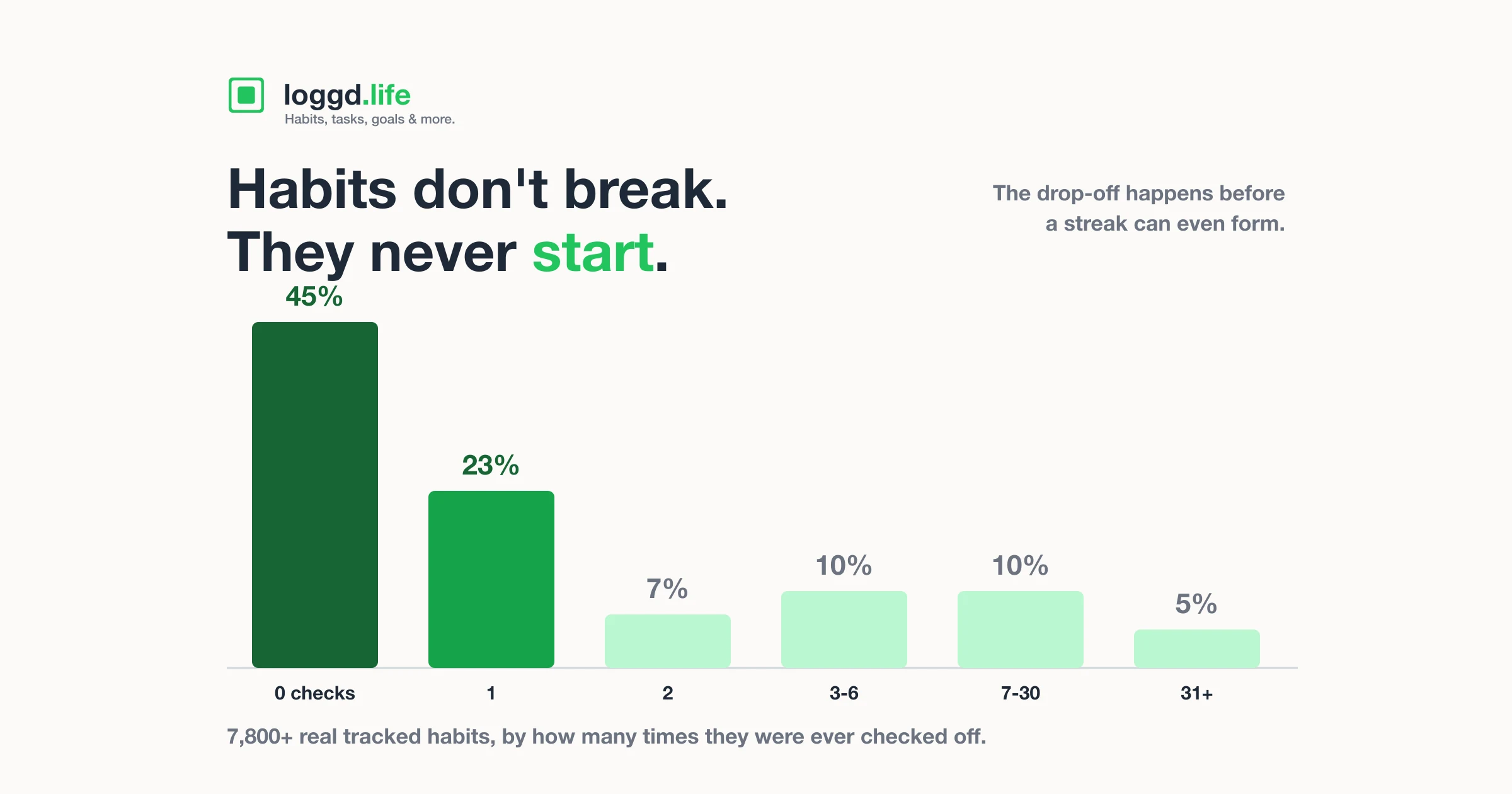
In Loggd's published data across 7,800 tracked habits, roughly 45% were never checked off a single time and another 23% were checked exactly once. Only about 26% ever reached three check-ins. The detail is in habits people quit fastest, and the pattern it describes is not specific to habit apps. It is what happens whenever intention meets an ordinary week.
Now apply that to a program with a hard reset. If most commitments break in the first few days under normal conditions, a rule that punishes the first break with total erasure is optimising against its own completion rate. The people who finish 75 Hard tend to be people who would have finished a structured 75 days anyway.
75 Soft: the same shape, different intensity
75 Soft appeared as a direct response to the injuries, burnout, and all-or-nothing spirals the original produced. It keeps the container and fixes the contents:
| 75 Hard | 75 Soft | |
|---|---|---|
| Training | Two 45-minute sessions, one outdoors | 45 minutes, one rest day per week |
| Diet | Strict, no alcohol, no cheat meals | Eat well, alcohol on social occasions |
| Water | 1 gallon | 2 litres |
| Reading | 10 pages nonfiction | 10 pages, any book |
| Photo | Daily, mandatory | None |
| Missing a day | Restart at day 1 | Mark it, continue |
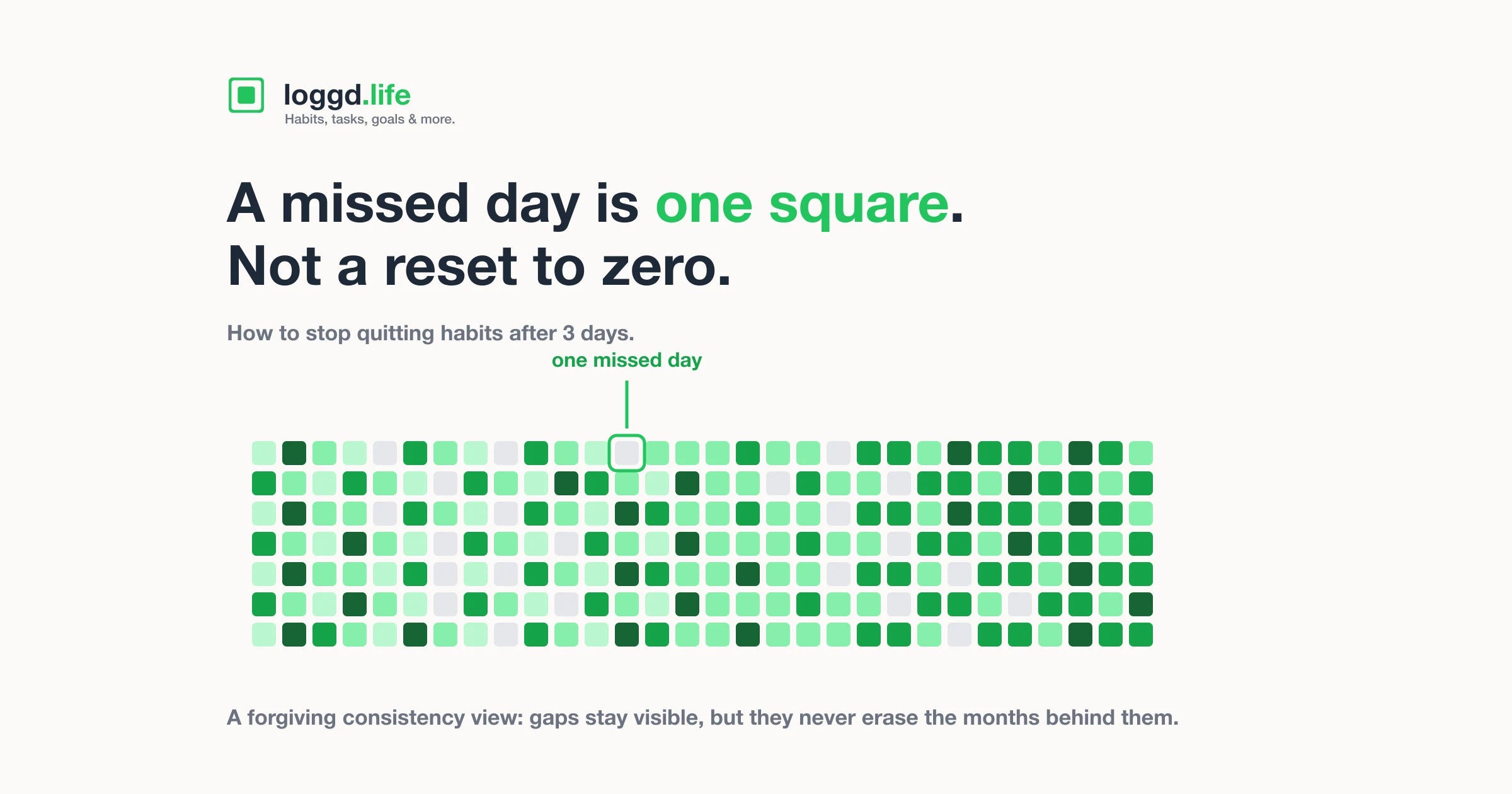
I want to be clear that this is not the participation-trophy version. The daily non-negotiable is intact, the count is intact, the visible record is intact. What changed is that the program now contains a rest day, which is a training principle rather than a concession, and that a bad Tuesday costs you a square instead of six weeks.
For anyone who has not trained consistently before, 75 Soft is the version far more likely to still be running in week six. That is the whole argument.
Which one should you actually pick
A short decision guide, no drama.
Choose 75 Hard if you already train four or more times a week, your joints and schedule can absorb a second daily session, you have somewhere to walk outdoors in winter, and the strictness is genuinely the appealing part rather than the frightening part.
Choose 75 Soft if you are starting from little or no training, you are managing a job with unpredictable hours or young kids, you have a history of injury, or you have already attempted the strict version and quit inside three weeks. The last one is not a knock. It is data.
Choose neither if the rules are mostly about how your body looks and the thought of missing a day produces something closer to dread than disappointment. A 30-day container with two or three rules is a healthier place to start, and the 30-day challenge tracker is built for exactly that.
How to run either version so it finishes
Five things that matter more than which rule set you picked.
Stack the easy tasks early. Read your 10 pages at breakfast. Get the outdoor session done at lunch before the weather and your willpower both turn. Tasks left for 9pm are the ones that end challenges.
Set the minimum version of every rule now. What does a travel day look like. What does a day with a sick child look like. Deciding this in week one is planning. Deciding it at 10pm on day 41 is improvisation, and improvisation loses.
Track it somewhere honest. A grid you can see beats a mental tally you can quietly edit. The 75 Hard tracker on this site runs both rule sets with a daily checklist and a 75-day grid, defaults to marking a miss and continuing, and keeps strict mode available if the classic reset is the whole point for you. Everything stays in your browser and the progress photo is a checkbox only, so no image is ever stored or uploaded.
Never miss twice. One missed day is noise. Two in a row is the start of a different pattern. This single rule matters more than anything in the official rule set, and it is the core of how to stop quitting habits after three days.
Decide what happens on day 76. Most people finish and immediately drift, because the challenge was doing the structural work rather than the habits. Pick the one or two rules you want to keep permanently and let the rest end. That is a successful outcome, not a relapse.
The part nobody puts in the caption
75 days is a long time. Something in your life will go sideways during it. A deadline, an illness, a family thing, weather that makes the outdoor workout genuinely unwise.
The measure of a program is what it does on those days. A program that answers "start over" has told you that circumstance is a moral failure. A program that answers "mark it and keep going" has told you the truth, which is that consistency is a rate, not a chain.
Pick the version you will still be running on day 50. Nobody is handing out prizes for the version that sounded harder on day 1.
Last updated: September 2026.
Written by Eusebiu, the solo founder building Loggd in public. I build the app around contract work and a small daughter, which is why I am unmoved by any plan that assumes 90 uninterrupted minutes a day. I share the aggregate numbers as I find them on Threads.
Track the 75 days without the all-or-nothing reset. Loggd shows consistency as a contribution grid, so a missed day stays one lighter square instead of erasing six weeks of work. Start free.