TL;DR. The winter arc is a 90-day block from October 1 to January 1 where you hold yourself to a short list of daily rules while the rest of the year winds down. It works because the deadline is real and the list is small. It fails when people turn it into a punishment schedule that cannot survive one bad Tuesday. Pick 3 to 6 rules you could keep on your worst day, write your miss policy before you need it, and track the whole thing somewhere that shows a missed day as one square rather than a reset to zero.
Every September the same clip circulates. Black and white gym footage, a voiceover about who you will be in January, a caption that says winter arc, no excuses. The comments fill with people saying they are in.
By mid-November most of those accounts are quiet again.
I am not sneering at them. I build a habit tracker, which means I get to watch this cycle in aggregate every year, and I have started my own badly designed versions of it more than once. The idea is genuinely good. The execution is usually a fantasy schedule written by a well-rested person on a Sunday.
This is the version that survives contact with a normal life.
What the winter arc actually is
A winter arc is a fixed block of time, traditionally October 1 to January 1, in which you commit to a small set of daily rules. That is the entire concept. The rest is aesthetics.
It is 92 days if you are counting. Everyone calls it 90.
Three things make the format work, and none of them are motivational.
The deadline is real. January 1 arrives whether you showed up or not. That converts a vague intention into a countable window with a scoreboard at the end.
The list is short. Choosing three to six rules forces you to decide what actually matters this season instead of attempting a whole-life overhaul. Most people who try to change nine things change zero.
The record is visible. Ninety days of marks in one grid is a different object than a vague sense of how the autumn went. It is also much harder to quietly abandon something you can see.
There is a fourth reason it is popular, and it is more honest than the fitness content admits: the arc ends right where resolution season begins. You do not spend January writing a list. You spend January already moving.
The grindset problem
The winter arc got absorbed into a corner of the internet that treats discomfort as the product. Cold showers as identity. 4am as a personality. The implication is that if the plan is not miserable, it does not count.
That framing is not just annoying, it is a design flaw. A plan built around maximum daily suffering has one guaranteed failure mode: the day you are ill, or your kid is up all night, or the deadline eats the evening. In a 92-day window there are five or six of those minimum.
Rules that only work on good days are not rules. They are a mood.
The whole skill here is picking commitments that hold on an ordinary bad Tuesday, then letting the good days take care of themselves.
Step 1: Set the window
Pick a start date and stop negotiating.
October 1 is the classic. It is also fine to start on October 14, or November 3, or today. A 60-day arc that exists beats a 90-day arc you are still planning. The counter is smaller and that is the only cost.
What matters is that the end is a date, not a feeling. "Until I look better" is not an arc, it is an open sentence. January 1 is an arc.
If you want the structure without the season, the same shape works at any length. The 30-day challenge tracker is the shorter version of this exact idea, and it is a sensible trial run if you have never finished a multi-week commitment before.
Step 2: Pick 3 to 6 rules that survive a bad Tuesday
This is where arcs are won and lost.
The standard menu is: train every day, read 10 pages, wake before 7am, no alcohol, a daily deep work block, cold showers, 10,000 steps, in bed by 11pm, no social media before noon. All reasonable. None mandatory.
Run every candidate rule through one test: could I do this on the worst realistic day of my week? Not the worst imaginable day. The worst normal one.
| The rule people write | The rule that survives |
|---|---|
| Train 60 minutes daily | Move for 20 minutes, any form |
| Wake at 5am | In bed by 11pm |
| Read 30 pages | Read 10 pages |
| Two hours of deep work | One protected 50-minute block |
| No sugar, ever | No alcohol on weeknights |
| Cold shower every morning | Cold finish, 30 seconds |
The left column is more impressive. The right column is the one still standing on December 12.
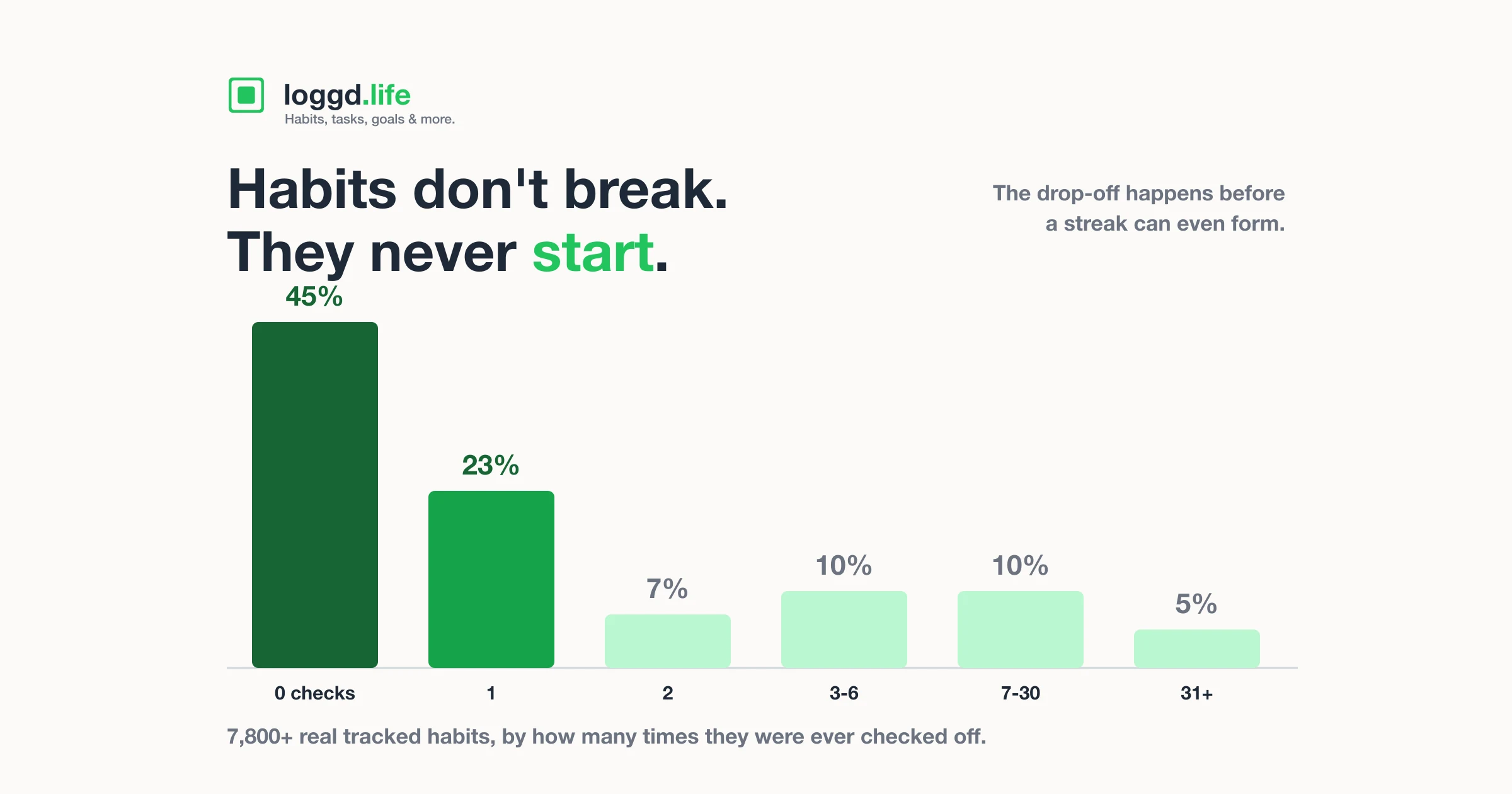
Three rules is a real arc. Six is the ceiling. Past that you are running an audit, and the daily overhead alone will kill it. The published Loggd data is blunt about ambition at setup time: across 7,800 tracked habits, around 45% were never checked off even once. The breakdown is in habits people quit fastest.
One more thing. Include at least one rule that is not about output. A daily walk, real meals, one screen-free evening, time with people you actually like. An arc that costs you your sleep and your relationships did not work, no matter what the December photo looks like.
Step 3: Write your miss policy before you need it
The winter arc has no official restart rule. That is a feature, and most people waste it by inventing one in their head at the worst possible moment.
So decide now, in writing, while you are calm:
- A missed day is one missed day. It is marked, it is honest, and the arc continues.
- A day where you kept four rules out of five is a partial, not a failure. Mark it as what it was.
- The only genuine threat is two misses in a row, which is the never-miss-twice rule from how to stop quitting habits. That is where an arc quietly becomes a memory.
The reason to write this down in week one is that you will not be reasonable in week seven. The version of you that misses a Thursday in mid-November is tired, slightly embarrassed, and extremely receptive to the idea that the whole thing is already ruined. Psychologists call that spiral the abstinence-violation effect. It is what happens when a system defines success as an unbroken line.
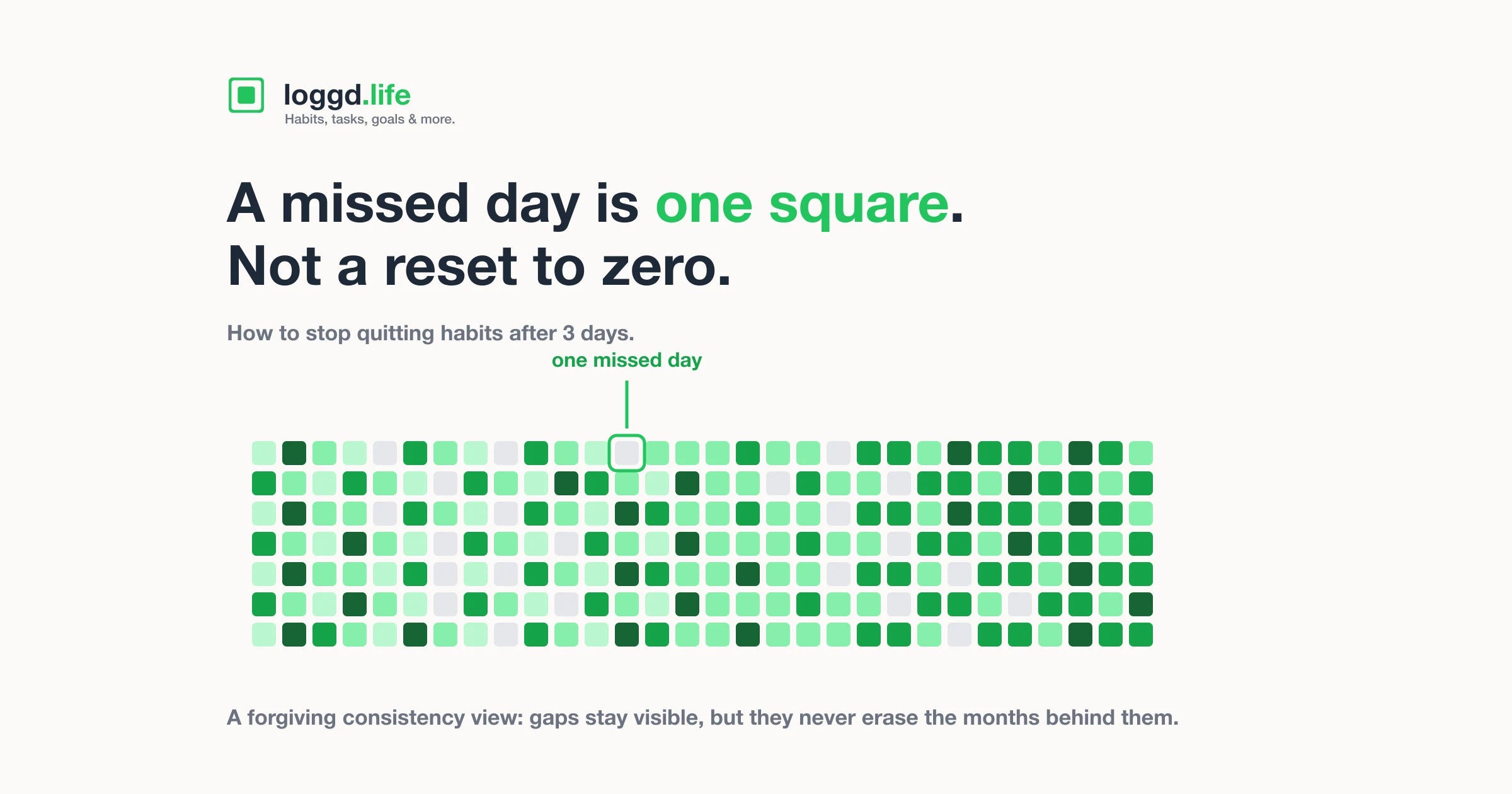
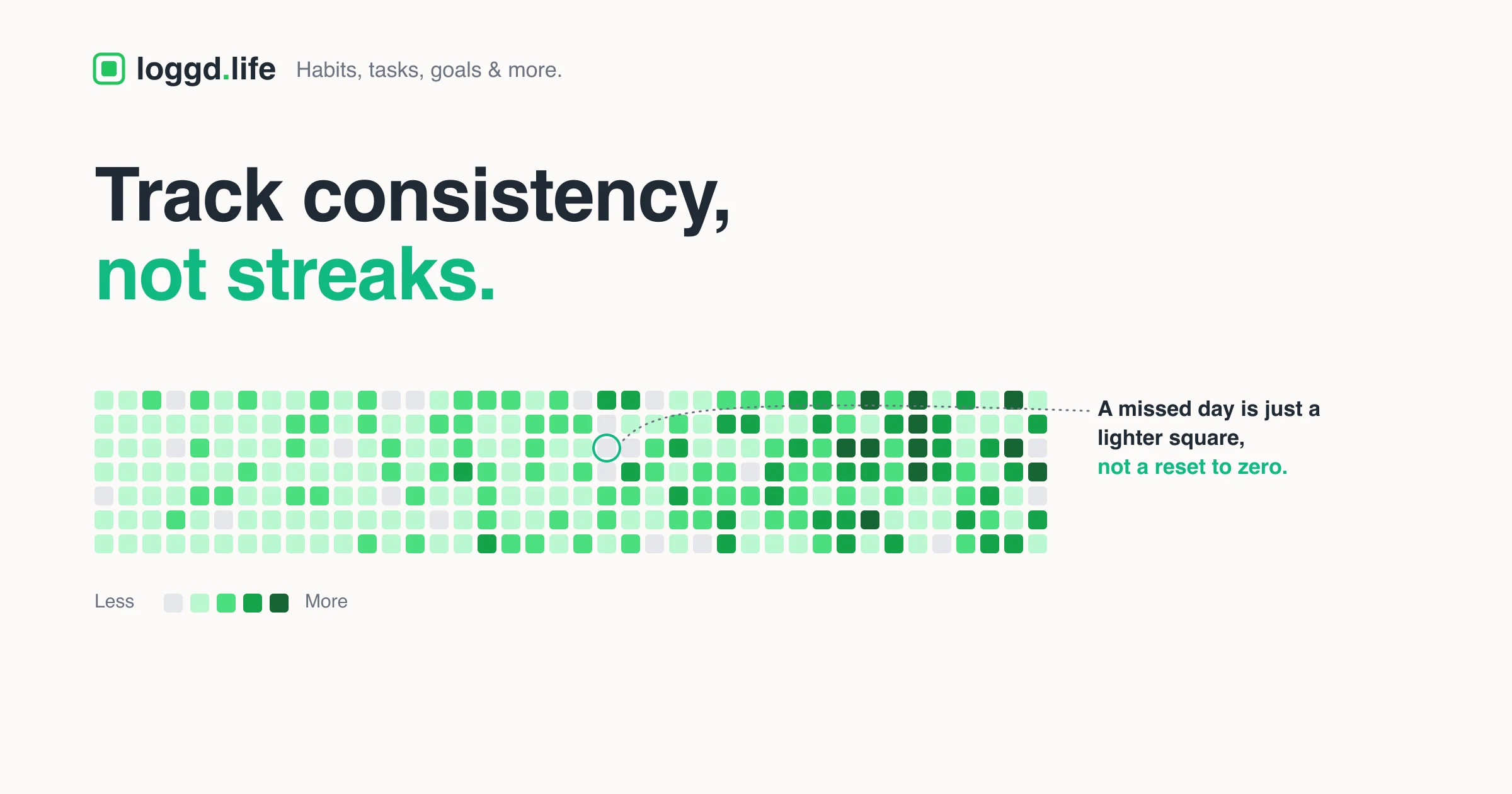
Which is why the display matters more than people expect. A streak counter that reads 31 and then reads 0 has told you that a month of work is worth nothing. A grid with one lighter square has told you the truth. I have written at length about why Loggd shows a contribution grid instead of a streak counter, and the winter arc is the single clearest case for it: 92 days is long enough that a perfect run is statistically unlikely and completely unnecessary.
Step 4: One check-in a week
Daily journaling about your arc is another rule you will drop. One check-in a week is enough, and it should take under two minutes.
Three questions:
- Which rule carried itself this week?
- Which one did I keep negotiating with?
- What is one change for next week?
The answer to question two usually means the rule is wrong, not that you are weak. A rule you renegotiate every day is badly sized. Shrink it and keep going. Changing a rule in week four is intelligent design. Changing it in week eleven because you are tired of it is quitting with extra steps, and you will know the difference.
The winter arc tracker has this as an optional weekly note next to the grid, so the review sits with the thing it is reviewing. Everything stays in your browser, no account needed.
What the 92 days actually feel like
Roughly, and from repeated experience:
Weeks 1 to 2. Easy and slightly smug. The rules feel light because novelty is doing the work. Do not add rules here. This is the trap.
Weeks 3 to 5. The novelty is gone and the weather turns. Nothing has gone wrong, it just stopped being interesting, which feels like something going wrong.
Weeks 6 to 8. Mid-November, the point where most arcs die. If you get a miss here, day 50 is exactly where "I will restart in January" sounds most reasonable. It is not. It is 40 days of progress thrown away for aesthetic reasons.
Weeks 9 to 11. Holidays, travel, other people's schedules. Your minimum version of each rule matters more than the full version. Decide what the travel-day version looks like now, not in an airport.
Week 12 to 13. The end is visible and the effort gets easy again. Finish the count.
How it ends
On January 1, look at the grid and count days kept, not days in a row. Then answer one question: which of these rules do I want to keep without a challenge wrapped around it?
Usually it is one, sometimes two. Those graduate into ordinary habits and stop needing a name. The rest served their purpose and can go. That is what a 90-day trial is for.
The failure mode to avoid is starting a new arc on January 2 because you cannot tolerate life without a countdown. If every season needs a challenge, the challenge is not the thing helping you.
When a winter arc is the wrong idea
- If you are already at your limit, an arc adds obligations to a schedule that is failing. Subtract first.
- If you have never finished a two-week commitment, 92 days is a poor first attempt. Run a 30-day version and finish it.
- If the rules are mostly about how your body looks and the whole thing feels compulsive, this format can go somewhere unpleasant fast.
- If you are picking rules to look disciplined, you will drop them the moment nobody is watching, around week three.
If you just want to know what your consistency has looked like so far before committing to anything, the habit streak calculator will tell you without any ceremony.
The winter arc is a good container: a deadline, a short list, a visible record. The 4am starts, the suffering as proof, the idea that a missed day means starting over, all of that is decoration, and most of it makes the thing more likely to fail.
Pick your rules. Keep them small enough to survive December. Count the days you kept, not the days in a row.
Last updated: September 2026.
Written by Eusebiu, the solo founder building Loggd in public. I build the app in the evenings around contract work and a small daughter who does not care about my arc, which is roughly the level of scheduling adversity I design for. I share what the aggregate data keeps showing on Threads.
Run your arc without the all-or-nothing pressure. Loggd shows your consistency as a forgiving contribution grid, so a missed day in November stays one lighter square instead of resetting you to zero. Start free.