A practical definition of bad habits is learned, repeated behaviors that harm you or repeatedly work against your health, relationships, responsibilities, or goals. The useful test is what the behavior costs you, not whether someone dislikes it.
The American Psychological Association describes a habit as a well-learned behavior or automatic sequence performed with little conscious intent. Calling a behavior “bad” describes its consequences, not your character. It does not mean every repeated behavior is harmful, or that one mistake defines a pattern. Start by identifying the response you repeat, checking what follows, and deciding whether that cost deserves your attention.
Identify the Repeated Response
Name an observable behavior, not a judgment about yourself. Write “checking messages during dinner,” rather than “being inconsiderate,” or “putting off the first task,” rather than “being lazy.” A specific description gives you something you can notice and assess.
Habits can be triggered by internal or external cues, such as a feeling or a familiar situation. When the behavior happens, notice what was going on just before it, what you did, and what you got from doing it right away. That payoff might be relief from an uncomfortable task, even if the delay creates a cost later.
To examine what happens before and after the response, use the explanation of the habit loop, cue, routine, and reward. Repetition does not mean you are completely unaware of what you are doing. If you are trying to understand the automatic part, read about when a habit becomes automatic.
Test the Cost Against Your Actual Life
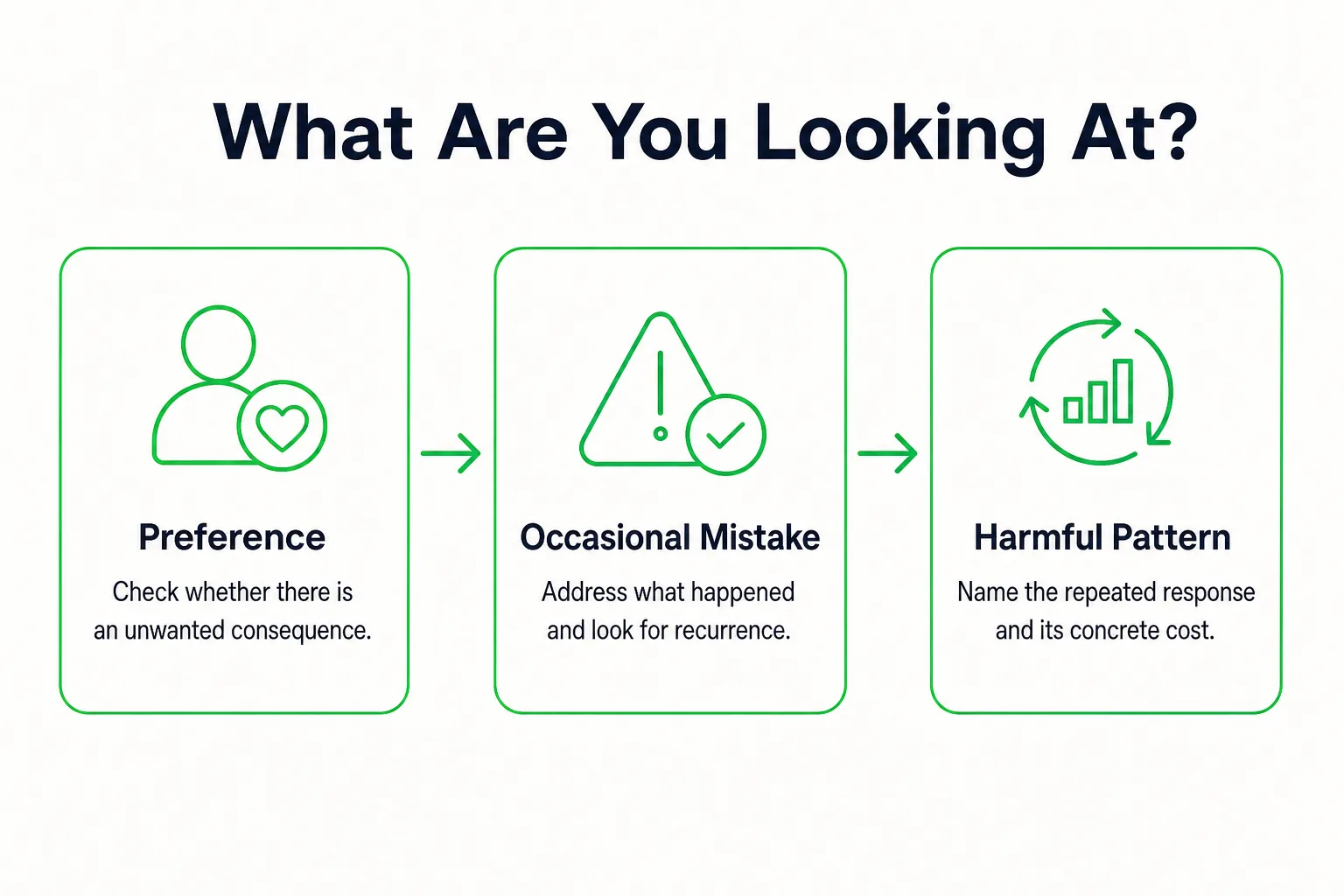
Use a concrete consequence to judge a habit, rather than an attractive idea of how your day should look. Ask:
- Does this response recur in a recognizable situation?
- What unwanted consequence follows?
- Does it interfere with something I value or need to do?
- Is that consequence substantial enough to address?
Look for something observable: a missed bedtime, an unfinished obligation, spending beyond the amount available, or repeatedly not listening during a conversation. Choosing an evening show after finishing your responsibilities can be a preference. Repeatedly watching past your intended bedtime and feeling too tired for the next day’s commitments gives you a concrete reason to reassess.
A one-time mistake calls for attention to what happened. A recurring response calls for attention to the pattern. If you are unsure, observe it for a short period. Record the situation, your response, and the consequence without assigning yourself a personality label. To notice repeated responses across an ordinary day, use the habit scorecard exercise.
 Loggd · by the makers of this blog
Track your habits, tasks and goals in one free app.
Every day you check off fills in a grid of your last 365 days, so you can see if you are getting better.


Free plan with no time limit. No credit card.


Sort the Consequences That Matter
Sort the consequences by what they affect in your life. The same response can touch more than one area, so focus on the cost that matters most to you.

| Area affected | Behavior to examine | Consequence to check |
|---|---|---|
| Health and energy | Smoking or repeatedly cutting sleep short | NIH includes smoking among potentially harmful routines. If you keep shortening sleep, notice whether you are repeatedly tired when you need to be alert. |
| Time and responsibilities | Opening social media whenever work becomes difficult | Do intended breaks repeatedly displace the task or delay a commitment? |
| Relationships | Checking your phone during a conversation or interrupting | Is your attention repeatedly pulled away from an interaction you want to take part in? |
| Goals | Leaving the next action unspecified, or using negative self-talk and then abandoning a planned action | What planned action gets displaced? |
A single phone check, a short night, or an unfinished task does not by itself establish a harmful pattern. Look at what happens repeatedly and what it costs you. If repeated purchases are part of the pattern, use the vice cost calculator to total the amount spent and make the financial consequence concrete.
Distinguish a Habit From Addiction or Compulsion
“Bad habit,” “negative habit,” and “harmful habit” are everyday ways to describe unwanted behavior. “Harmful” is clearest when you can name the specific consequence, such as losing sleep or missing an obligation. The label matters less than an accurate description of what is happening.
An ordinary learned response may be unhelpful in a particular situation, yet still feel manageable. Addiction is a more serious concern when someone has difficulty controlling substance use or a behavior despite harmful consequences. A compulsion can involve a repeated action or mental act that a person feels driven to perform, sometimes in response to distress or a rigid rule. These terms are not interchangeable, and frequency alone does not settle which one applies.
Pay attention to felt pressure, how much control you have, whether the behavior causes distress, and how it interferes with daily life. If the behavior feels uncontrollable, causes substantial distress, or creates a safety risk, seek qualified professional support. When asking for help, describe the behavior and its consequences rather than trying to diagnose yourself from a list.
Write Down the Pattern Worth Addressing
Finish this sentence: “When ___ happens, I tend to ___, and the consequence I want to change is ___.” For example: “When a task feels unclear, I tend to open social media, and the consequence I want to change is that my first work block passes without starting.”
Then choose a next move that fits what you found. Leave a harmless preference alone, observe an unclear pattern for a little longer, or address a recurring cost you can name. Once you have named the response and its cost, use the guide to breaking a bad habit to choose a replacement.