TL;DR. You cannot delete a behaviour that is still being cued and rewarded, which is why "just stop" fails. You can make it harder to start and send the reward down a different route. Find the actual cue, raise the friction around the specific object or app, decide the replacement in advance, and change the environment instead of arguing with yourself in the moment. Then track the absence: a counter of clean days works where a to-do list cannot, because with a bad habit the thing worth recording is that nothing happened. One slip is data. What turns it into a relapse is deciding it already has.
There is a particular flavour of self deception I know well. It is 11pm, I have decided this is the week I stop checking my phone in bed, and I am checking my phone in bed while feeling genuinely surprised about it.
Nothing about that moment involved a decision. There was a cue, the phone on the nightstand, and there was a reward, a few minutes of not being alone with my own thoughts. The resolution I had made that morning was not present in the room.
That is the thing worth understanding before any technique. A bad habit is not a character flaw you need to override. It is a loop that runs on its own, and you are trying to interrupt it with something that only works while you are paying attention.
Why "just stop" fails
A habit runs as a loop: a cue triggers the behaviour, the behaviour produces a reward, the reward makes the loop more likely next time. The habit loop guide covers the mechanics and where the different versions of the model disagree.
Deciding to quit changes exactly one part of that: it inserts resistance between the cue and the behaviour. Everything else stays intact. The cue still fires on schedule. The craving still arrives. The reward is still sitting there, available, one small action away.
So quitting by resolve means paying a tax every single time the cue fires, forever, out of a budget that runs low exactly when you need it most. Late evening. After a bad meeting. When the deadline slipped. Which is precisely when the habit fires hardest.
The inversion is this: you cannot subtract a behaviour, you can only make it expensive to start and give the reward another route.
Notice that both halves are environmental. Neither of them happens in the moment of temptation, which is the moment you are worst equipped to make decisions.
Step 1: Find the actual cue
Most people misidentify their own cue. They say "I snack when I am bored" when what actually happens is "I snack when I walk past the kitchen on the way back from the bathroom".
Watch yourself for three days without changing anything. Each time the habit fires, note four things: what time it was, where you were, what you were feeling, and what you had just finished doing.
Patterns show up fast, and they are usually more specific and more physical than the story you had. My phone habit was not about anxiety. It was about the phone being within arm's reach of the pillow.
The habit loop analyzer will walk you through this. Choose the "break a habit" mode and it takes you through five steps: name the habit, identify the cue from five trigger types (time of day, location, emotional state, the action just before, or other people), work out the craving underneath it from seven options including stress relief, stimulation, comfort, control and escape, then examine the response and the reward. It ends with strategy cards built from your own answers, using the four laws inverted: make it invisible, unattractive, difficult and unsatisfying. You can save several analyses, copy one out or download it as a text file, and none of it leaves your browser.
Step 2: Raise the friction
Shawn Achor's twenty-second rule is the most useful heuristic here: add about twenty seconds of effort to the start of a habit you want less of, and remove twenty seconds from the one you want more of. It is a rule of thumb from his book rather than a research finding, and it works far better than it has any right to.
The key is specificity. "Use my phone less" is not a friction change. These are:
- Phone charges in the hallway, not the bedroom.
- The app comes off the home screen, or off the phone, and lives in a browser you have to log into every time.
- Snacks go in an opaque box on a high shelf rather than the counter.
- The card comes out of the browser autofill.
- The TV remote lives in a drawer in another room.
Each of these adds ten to thirty seconds. That sounds trivial until you notice how many of your habits fire in a window smaller than that.
The general principle appears in a different form in how to stop doomscrolling, where the whole battle turns out to be fought at the point of unlocking rather than at the point of scrolling.
Step 3: Pick the replacement before you need it
The craving does not go away when you refuse the behaviour. It sits there looking for the nearest available option, and the nearest available option is the thing you just quit.
So decide, in advance and in writing, what happens when the cue fires. The analyzer produces exactly this line: when I feel the urge to X, I will Y instead.
Two rules for choosing Y.
It has to serve the same need. If the cigarette was really about getting away from the desk for five minutes, then the replacement is a walk outside, not a breathing exercise at the same desk. Match the reward, not the behaviour.
It has to be available where the cue happens. A replacement you cannot do in the actual moment is not a plan, it is a wish.
Write it down while you are calm. Nothing designed mid-urge is any good.
Step 4: Change the environment, not the argument
The single highest-leverage move is usually to make the cue impossible rather than resistible.
Delete the account rather than resolving to use it less. Leave the card at home rather than deciding not to spend. Take a different route home rather than walking past the shop with willpower engaged. If you can remove the cue entirely, you never have to win the argument, because the argument never starts.
This feels like cheating to a lot of people, as though the honourable version is to face temptation daily and defeat it. That framing costs people years. The person who deleted the app is not weaker than the person white-knuckling it. They are just finished.
Track the absence, not the action
Here is where breaking a habit needs different tools from building one, and where most trackers fall down.
With a good habit, you record that something happened. With a bad one, the thing worth recording is that nothing happened, and a to-do list cannot represent nothing. What you need is a count of clean days, running on its own, that you look at rather than update.
The quit counter does exactly this. Pick a preset (smoking, vaping, alcohol, sugar, caffeine, social media, gambling, junk food) or enter your own, set your quit date, and it counts days, hours, minutes and seconds since. Add a daily cost and it works out what you have not spent. Each counter gets a milestone list for its habit type, with a general list as the fallback, so there is something ahead of you rather than only behind. You can run several counters at once, and everything stays in your browser.
How much a slip actually costs is measurable, and it is worth knowing before you decide your own policy: the odds of ever picking a habit back up fall fastest between the first missed day and the second, then keep sliding for every day after.
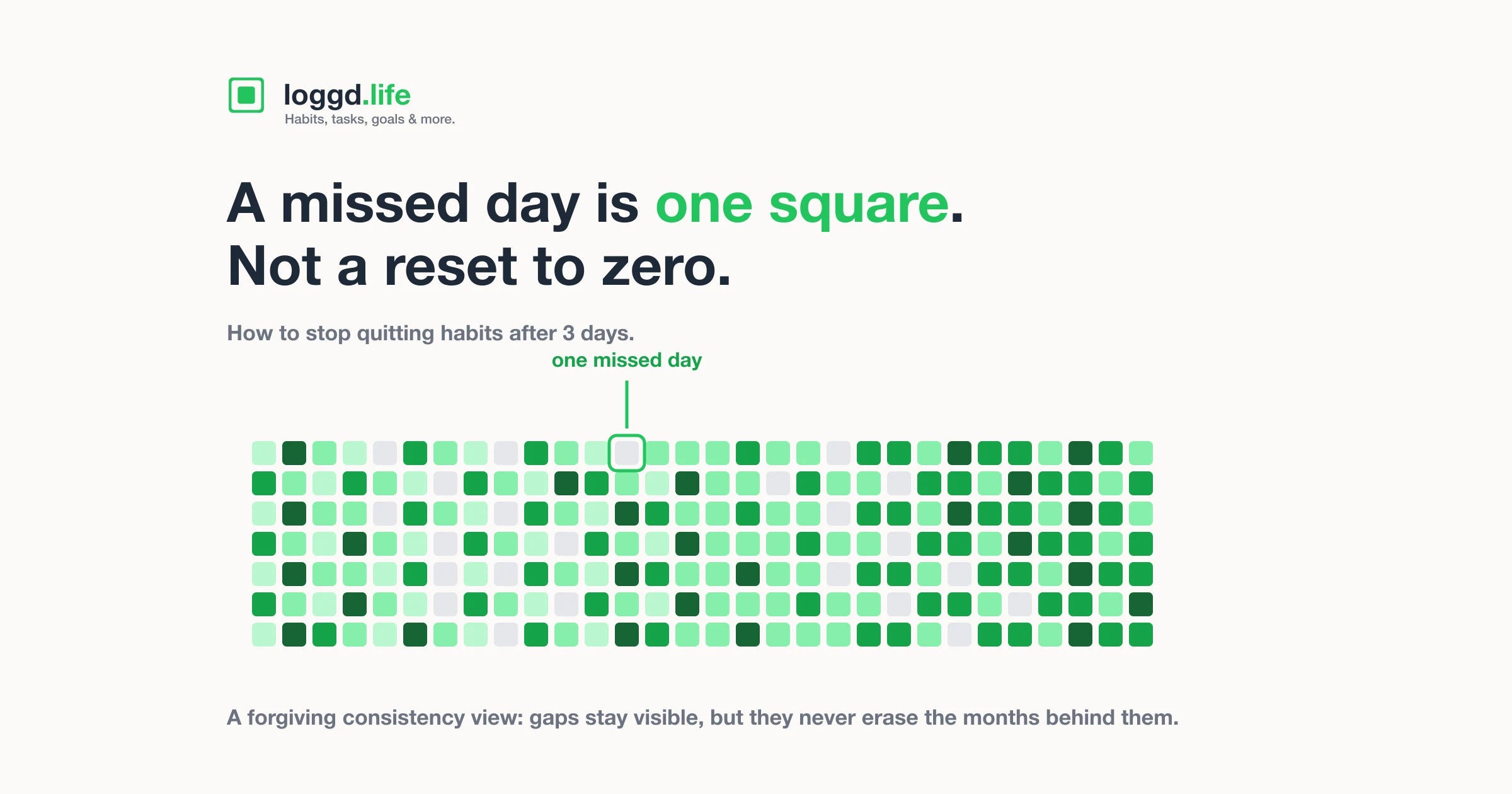
The design detail that matters most is what happens when you slip. The counter offers two options: log the slip and keep counting, or reset to today. That is a deliberate choice rather than an oversight, and I would take the first one almost every time. A number that drops to zero tells you the previous month was worth nothing, which is false, and it is the same failure mode we designed the main app around when we chose a contribution grid instead of a streak counter.
Worth pairing with one more thing: track the replacement as a normal habit too. Counting clean days tells you what you avoided. Tracking the walk, or the glass of water, or the ten minutes with a book tells you what filled the space, and that is the part that determines whether this holds.
Lapse versus relapse
A lapse is one instance. A relapse is a return to the pattern. The distance between them is almost entirely interpretation.
Psychologists call the mechanism the abstinence-violation effect. After a slip, if you read it as proof that you have failed and the run is ruined, the sensible next move looks like abandoning the attempt altogether. If you read it as one instance, the next occasion is simply a fresh decision. The slip itself does not decide which one happens. You do, usually within about an hour of it, while feeling embarrassed and looking for a reason to stop trying.
So write the rule down before you need it, in week one, while you are calm:
- One slip is one slip. It gets logged, honestly, and the count continues.
- Two in a row is the actual warning sign, which is the never-miss-twice principle from how to stop quitting habits applied in reverse.
- A slip is information about the cue. Where were you, what had just happened, what had you not planned for? That answer is worth more than the guilt.
Where this stops being enough
Everything above is about habits. Substance dependence is a different problem.
If you are dealing with alcohol, nicotine, drugs or gambling, especially where withdrawal, health or finances are involved, that belongs with a doctor or a specialist service rather than a browser tool. Friction and replacement and a day counter are decent supports alongside real treatment. They are not treatment, and I am not qualified to tell you otherwise. The quit counter includes those categories because people find it useful to see the days, not because a counter is a plan.
For ordinary bad habits, the whole method fits in four lines. Find the cue. Make starting expensive. Decide the replacement while you are calm. Count the clean days and let one slip be one slip.
And if you want to know when it stops feeling like effort, the same mechanics run in reverse for building: when a habit becomes automatic covers what actually moves that timeline.
Last updated: December 2026.
Written by Eusebiu, the solo founder building Loggd in public. I build it in the evenings around contract work and a small daughter, and the phone-in-bed habit above took three attempts and a hallway charger, not resolve. I post what the aggregate data keeps showing on Threads.
Count what you avoided and what replaced it. Loggd tracks the replacement habit on a forgiving contribution grid, so one slip stays a single lighter square instead of resetting you to zero. Start free.