TL;DR. Automaticity is a spectrum, not a switch. A behaviour becomes automatic when it starts running without a deliberation step, and you usually notice it by catching yourself already doing it. The most-cited study, Lally and colleagues at University College London, reported 66 days as the headline number with a range of 18 to 254 across 96 people, which means the spread is the finding and the middle number is close to useless on its own. Four things move where you land: how complex the behaviour is, how stable and specific the cue is, whether your context stays put, and how often you actually repeat it rather than intend to.
I noticed it on a Tuesday, standing in the kitchen with a glass of water in my hand, having no memory of deciding to fill it.
That is what it feels like. Not a milestone, not a badge, no moment of arrival. Just a small absence where the deliberation used to be.
I had been tracking that habit for about seven weeks. If you had asked me in week three whether it was working, I would have said no, because in week three it still cost me something every single day.
What automaticity actually means
The technical meaning is narrower than the everyday one, and the distinction is the whole article.
A behaviour is automatic to the extent that it starts without conscious deliberation. The cue arrives and the action follows, with no weighing up, no decision, no small negotiation. Researchers who study this treat it as a matter of degree, measured by things like how little thought the behaviour needs, how naturally it begins, and how strange it feels to skip it.
Note the word degree. There is no day on which a habit becomes automatic, which is why the popular framing of the question does the damage it does. People expect a threshold, feel effort on day 30, and conclude it did not work.
What is really happening is that the behaviour gets gradually cheaper to run. Less deliberation, less negotiation, less friction, until one day you look down and there is a glass of water in your hand.
A habit is not a thing you get. It is a cost that keeps falling.
Worth naming the limit of that, though: falling cost is exactly what you want for showing up, and exactly what you do not want for getting better at something. Improvement needs the effort kept deliberately high, which is a different practice with different rules. That is deliberate practice, and it is the opposite end of the same dial.
What the research actually supports
The number everyone quotes comes from one study: Lally, van Jaarsveld, Potts and Wardle, who at University College London followed 96 people for 12 weeks as each tried to make one new daily behaviour stick, rating how automatic it felt along the way.
The headline was 66 days. The finding was the spread: 18 to 254 days, with some participants not fully automating inside the study window at all. One missed day did not meaningfully harm the process.
Three caveats belong with that, and I would rather state them than sell the number. The study is small. It ran for 12 weeks while some of the estimates extend far past that. And participants chose their own habits, which were mostly simple eating, drinking and activity behaviours rather than the ambitious things people usually mean.
What it genuinely establishes is direction, not destiny: this takes longer than the folklore says, it varies enormously between people, and a slip is not a reset.
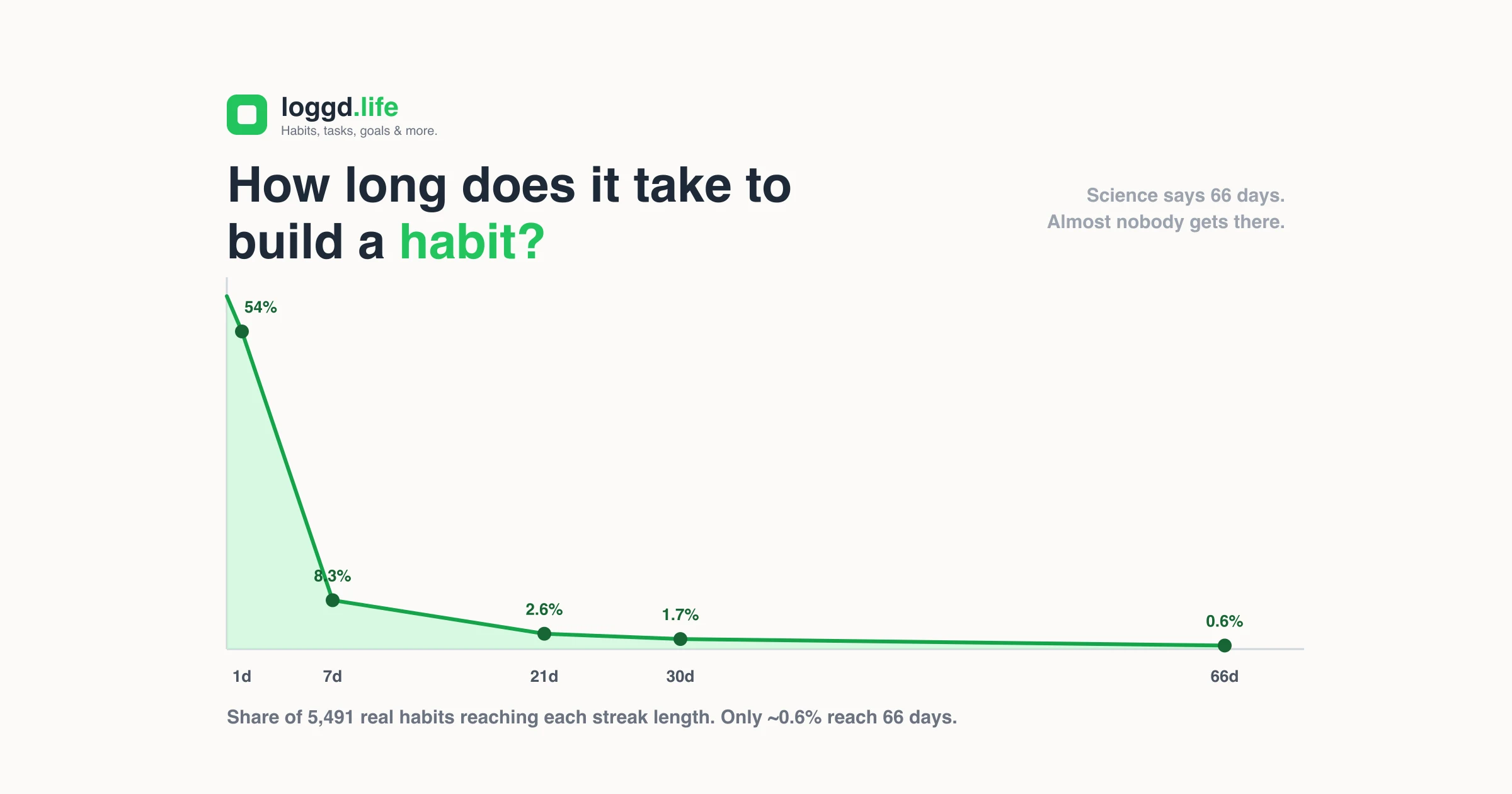
For what happens to real habits against that timeline, our own numbers are in how long it takes to build a habit, and they are blunt. Across thousands of tracked habits, reaching a 66-day streak was a sub-1% event, not because 66 days is hard to sustain but because almost nothing survives week one. That post owns the timing data. This one is about what the finish line feels like when you actually approach it.
Four things that move the number
This is the part worth your attention, because unlike the number itself, all four are things you control.
How complex the behaviour is. One action with one step automates fastest. "Drink a glass of water after I get up" has a single component. "Do a 40-minute strength session" is a chain of a dozen decisions, and every link in the chain needs its own repetitions. If you want the earliest possible automaticity, shrink the behaviour until it is one move. There is a list of fifty of those in micro habit examples.
How stable and specific the cue is. This is the biggest lever and the one most people leave loose. "In the morning" is not a cue, it is a region. "After I put the kettle on" is a cue, because it happens once, at a fixed point, triggered by something you already do without thinking. A vague cue means you supply the trigger yourself every day, which is exactly the deliberation you were trying to remove. The habit stacking guide covers how to pick one.
Whether your context holds still. Habits are attached to contexts, not to intentions. Holidays, moving house, a new job, a changed commute, a baby: each can delete the moment your habit was pinned to, and the behaviour goes with it. This is not weakness, it is the mechanism working as designed. Plan a travel version of every habit before you travel.
How often you actually repeat it. Not how often you intend to. Daily repetition compounds faster than four times a week, and four times a week that actually happens beats a daily plan you keep half of. Be honest about the frequency you will really hit, then design for that one.
What to expect on the way there
Roughly, and from doing this repeatedly on myself and watching the aggregate shape of it.
Week two. It still costs something every day, and the novelty that carried week one is gone. This is where most people conclude it is not working. It is working. It is just that nothing has changed yet, and nothing changing is what week two looks like.
Week six. The behaviour starts happening on ordinary days without a push, and still needs a push on bad ones. You will have missed a day or two by now. This is the point where the difference between people is not discipline, it is whether a missed day was treated as information or as a verdict.
Month three. Some days it runs entirely on its own. Skipping starts to feel slightly wrong. This is usually where people stop tracking, which is fine, though I would keep it a few weeks longer than feels necessary, because the first genuine disruption to your routine is the real test.
None of those are promises. They are the shape of the curve, not a schedule.
What the calculator on this site does
The habit formation calculator asks four things: the category of habit (physical, mental, social, nutritional, professional or creative), how complex it is (simple, moderate or complex), how often you will repeat it (daily down to three times a week), and whether you have tried it before. You can add a name and a start date.
It returns a minimum, an average and a maximum in days, placed on the 18 to 254 day spectrum from the study with the 21-day myth marked on it for contrast. With a start date it also projects the three dates, counts your elapsed days, and labels the phase you are in, from Initiation through to Formed.
Now the honest part, which the tool's own research panel also states: the base numbers per category and the multipliers are our calibration to fit inside the range the study observed. The study does not report a separate figure for nutritional versus creative habits. So the output is a structured expectation, not a measurement, and it is built on one small study of 96 people. Use it to stop yourself quitting on day 22 because you expected to be finished. Do not use it as a prediction about you.
If you want to know what your consistency has actually looked like rather than what it should look like, the habit streak calculator will tell you without any modelling at all.
How you will know
Three signs, in the order they usually arrive.
- You catch yourself already doing it, with no memory of starting.
- Skipping it feels mildly wrong, the way leaving without your keys does.
- The reminder becomes annoying rather than necessary.
And one thing that is not a sign: enjoying it. Plenty of automatic habits are things I do not enjoy. Automaticity is about the absence of a decision, not the presence of a good feeling.
The practical consequence of all this is simple. Since there is no finish line, the only thing that matters is whether the behaviour is still in your week, which means the tracking should survive a missed day rather than punish it. That is why Loggd shows a contribution grid instead of a streak counter: a gap is one lighter square in a year of squares, which is roughly what the research says a single missed day is actually worth.
Last updated: December 2026.
Written by Eusebiu, the solo founder building Loggd in public. I build it in the evenings around contract work and a small daughter, so most of my own habits have been rebuilt at least twice after a context change I did not plan for. I post what the aggregate data keeps showing on Threads.
Track the repetitions, not the deadline. Loggd shows your consistency as a forgiving contribution grid, so a missed day in week six stays one lighter square instead of resetting you to zero. Start free.