TL;DR. The evidence for focus sounds is real but thin, and the effects are modest. Two things hold up reasonably well: steady sound masks unpredictable sound, which genuinely helps in shared spaces, and intelligible speech reliably damages language-heavy work. The famous coffee-shop creativity finding exists but is narrower than the internet implies. Individual variation is huge, and for some people doing some tasks, silence simply wins. The most defensible use of a soundscape is as a start ritual: a cue that says work begins now, which is a much lower bar than a performance enhancer.
I built an ambient sound mixer for this site. So take what follows with the appropriate suspicion, and note that I am about to spend most of it arguing that the effect is smaller than you have been told.
The genre of article this replaces usually opens with "studies show that brown noise increases focus by 30%" and links to nothing. There is no such study. What exists is a scattered literature with mixed results, small samples, and effect sizes that would not survive a confident headline.
That does not make sound useless. It makes the reasons to use it different from the ones you have been sold.
What actually holds up
1. Masking is the strongest effect, and it is not about your brain
The most reliable benefit of background sound has nothing to do with cognitive enhancement. Steady sound raises the noise floor so that intermittent sounds no longer stick out. A conversation two desks away, a door, a phone buzzing in another room: these are disruptive largely because they are unpredictable, and unpredictable sound is far worse for concentration than constant sound at the same volume.
If you work in a shared space, a household with other people, or a cafe you did not choose, masking is the entire argument and it is enough on its own. If you work alone in a quiet room, this benefit does not apply to you, which is a large part of why the advice feels wrong to so many people.
2. Speech reliably hurts language-heavy work
This is the finding I would bet money on. Intelligible speech in the background degrades reading comprehension, writing quality, and tasks that involve holding things in order. The effect appears even when people say they are not paying attention to the sound, and even when they believe it is helping. The rough mechanism is that language processing is not fully optional, so words in your ears compete with words on your screen.
The practical rules are unglamorous:
- Writing, editing, reading, coding with heavy naming decisions: no lyrics, no podcasts, no TV in the room.
- Data entry, sketching, repetitive tasks, physical work: lyrics are fine and may genuinely help with tedium.
Instrumental music sits in between. It does not carry the speech problem, but complex or unfamiliar music still competes for attention. Familiar and repetitive tends to work better than interesting, which is precisely why lofi took over the study-music market.
3. The creativity finding is real and smaller than you think
You have seen the claim that a moderate level of ambient noise makes people more creative. It comes from published research comparing a quiet room, a moderately noisy environment roughly the level of a busy cafe, and a loud one. The moderate condition produced better performance on abstract and creative idea generation.
I want to be precise about what that does and does not mean. It was measured on short creative tasks under lab conditions. It says nothing about sustained concentration on hard analytical work, and the effect was moderate rather than dramatic. Somewhere between the paper and your feed it turned into "work from a coffee shop to be more productive", which the study never claimed.
Fair reading: if you are generating ideas, try cafe ambience. If you are executing something precise, do not assume it transfers.
What does not hold up
Binaural beats. The claim that specific frequency differences reliably drive brainwaves into a focus state is popular and poorly supported. Studies are small, results conflict, and the more dramatic claims have not replicated well. If it works for you, it is very likely working as a placebo and a start cue, both of which are legitimate. Just do not pay for a subscription over the neuroscience.
Specific noise colours having distinct cognitive effects. White, pink and brown differ in how their energy is distributed across frequencies, which is a real acoustic distinction and a real comfort distinction. Brown noise is easier on the ears over hours. That is a preference finding, not a performance one. Nothing supports the idea that brown noise does something to attention that pink noise does not.
Any specific percentage improvement. Whenever you see a precise number attached to focus audio, it is either from a single small study being over-extended, or invented outright. The honest summary is "modest, inconsistent, and highly individual", which is unmarketable and true.
The variation problem
Here is the finding that should shape your behaviour more than any individual result: the differences between people are larger than the differences between conditions.
Personality research on background music found that it impaired performance far more for introverts than extraverts on the same tasks. Work on noise and attention suggests the same sound can help someone who struggles to concentrate and mildly hurt someone who does not. Add task type, familiarity, and how tired you are, and any population average washes out to nearly nothing at the individual level.
Which means most articles on this topic, again including this one, cannot tell you what will work for you. They can only tell you what is worth testing and what is not.
The honest case for silence
Some people do their best work in silence, and the internet is bad at saying so because silence is not a product.
If your room is already quiet and your work is language-heavy, silence is very likely your best option. Adding sound in that situation is adding a variable to a system that was already working. There is also a subtler cost: if you become dependent on a particular soundscape, you have made your ability to concentrate conditional on having headphones, which is an unnecessary fragility.
My own pattern, for what it is worth: silence for writing prose, brown noise plus rain for debugging, cafe ambience when I have no idea what to do next. That is not evidence, it is one person's preference, which is exactly the point.
Matching sound to task
The practical part. Roughly:
| Task | Try | Avoid |
|---|---|---|
| Writing, editing, reading | Silence, or steady noise at low volume | Lyrics, podcasts, speech |
| Coding a familiar codebase | Brown or pink noise, rain, instrumental | Anything with words in it |
| Debugging something hard | Silence or minimal steady noise | Novelty of any kind |
| Brainstorming, early ideas | Cafe ambience, moderate volume | Total silence if you feel stuck |
| Admin, data entry, inbox | Whatever you enjoy, lyrics included | Nothing much |
| Open-plan office, noisy home | Masking noise, volume just above the room | Music you love enough to notice |
One rule cuts across all of it: volume just high enough to mask, no higher. Loud audio is its own cognitive load, and hours of it is a hearing risk you get nothing for.
The best reason to use sound is a cue, not a boost
This is the argument I actually believe.
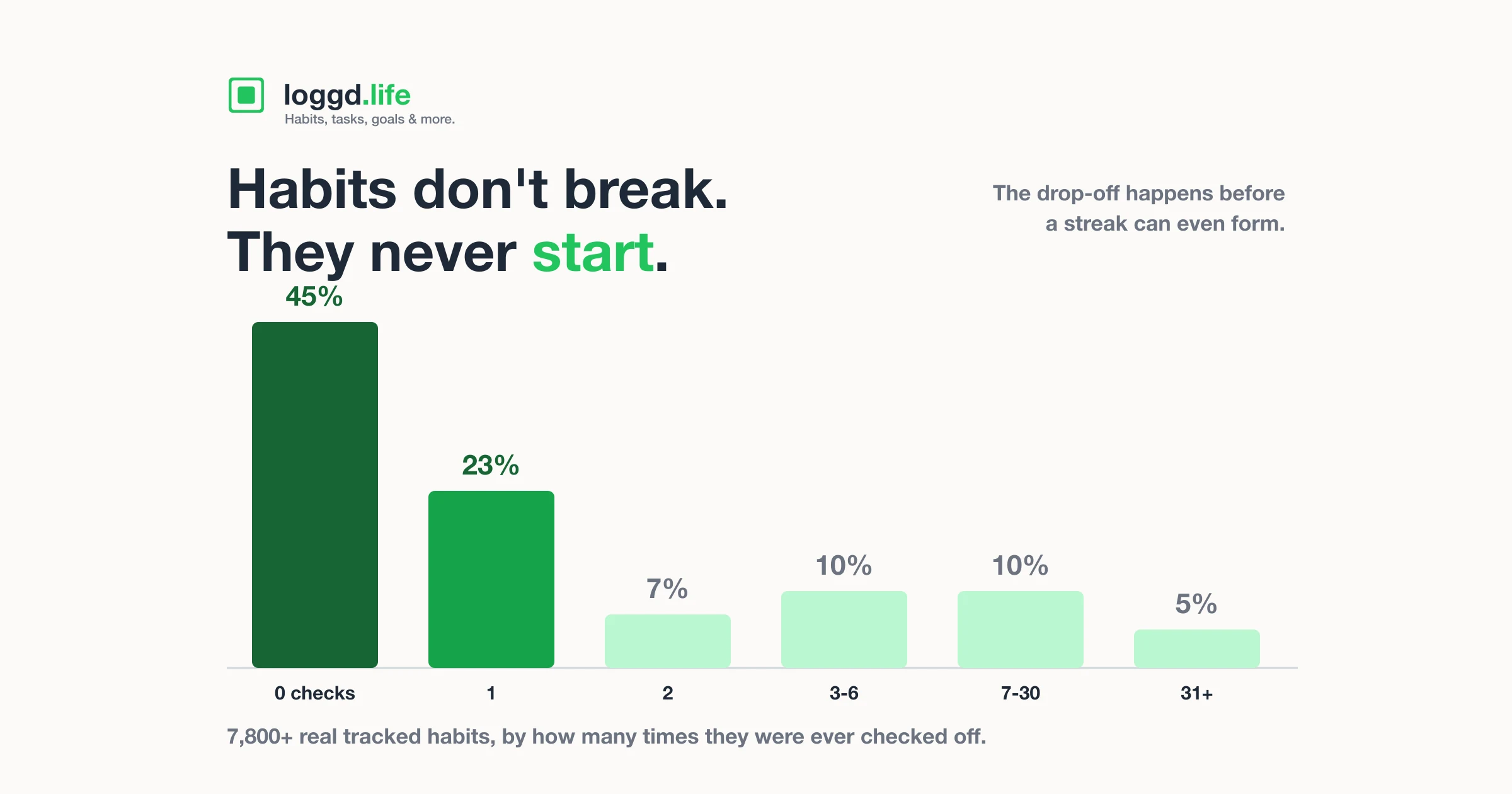
Starting is the hard part. Across 7,800 tracked habits on this site, about 45% were never checked off even once, and roughly two in three died at or before the second check-in. The failure is almost never intensity. It is initiation.
A consistent sound is one of the cheapest initiation cues available. Headphones on, same mix, timer starts. Do that fifty times and the sound stops being audio and becomes a signal your brain has learned. That is the same cue-and-routine mechanism described in how to stop quitting habits, and it does not require the audio to improve your cognition by a single percent. It only has to reliably mark a boundary.
Judged as a performance enhancer, focus sounds are unimpressive. Judged as a ritual that gets you into the chair, they are excellent, and the second job is worth more than the first.
How to test this properly on yourself
One week, one task type, minimal effort:
- Pick one recurring task you do most days: writing, studying, one category of work.
- Alternate conditions by day. Sound on Monday, off Tuesday, on Wednesday, and so on. Do not alternate within a day, you will fool yourself.
- Keep the block length fixed so you are comparing like with like. A 50/10 pomodoro is a reasonable unit.
- Score two things after each block, out of five: how easy it was to start, and how much you got done.
- Read the starting score first. If sound only improves initiation, that is still a win and a real one.
Most people find a clear preference within a week, and it is usually more task-specific than they expected.
The tools
The focus sound mixer has fifteen sounds across nature, environment and noise categories, each with its own volume slider, plus a master volume and six presets including Deep Focus, Coffee Shop and Nature Escape. You can save a mix to your browser and set a fade-out timer.
Two things about it worth knowing. Everything is generated in your browser with the Web Audio API rather than streamed, so it works offline and uses effectively no data. And there are no lyrics, no tracks and no playlists anywhere in it, which sidesteps the one failure mode the evidence is clearest about.
If you want the sound and the timing in one place, the pomodoro timer has ambient sound built in alongside the interval, with a fullscreen mode for when the screen itself is the distraction. For code specifically, the developer focus timer runs a 50/10 default with a task label, so the audio and the session boundary arrive together.
All of it stays in your browser. Nothing is sent anywhere.
The summary I would give a friend
Use sound if you work around other people, because masking is real. Kill the lyrics for anything involving language. Try cafe noise when you are generating ideas and silence when you are executing. Keep the volume low. Do not believe any number you see attached to this topic, and run your own week before you decide.
And if the honest result is that you focus best in silence, that is a finding, not a failure.
Last updated: September 2026.
Written by Eusebiu, the solo founder building Loggd in public. I write code for clients during the day and build this in the evenings, usually with rain and brown noise going, which I am fully aware proves nothing. I share what the aggregate data keeps showing on Threads.
Keep a record of the focus sessions you actually run. Loggd shows consistency as a forgiving contribution grid rather than a streak that resets, so a quieter week reads as a quieter week. Start free.