TL;DR. A no-spend challenge only works if the rules exist in writing before day one. Four decisions: how long it runs, what is banned outright, which essentials are allowed as named exceptions, and where the unspent money goes. Settle the awkward cases in advance rather than at the till, watch for the four standard loopholes (stocking up the day before, "it was a gift", subscriptions renewing mid-challenge, the blowout afterwards), and track it as a run of days rather than as a budget.
A no-spend challenge is a fixed period where you buy nothing outside a list of agreed essentials. That is the whole idea, and it is a good one, because it does something a budget cannot: it removes the decision entirely for a while, and shows you what you were actually spending on autopilot.
It also fails in extremely predictable ways. Almost all of them come from the same cause, which is starting before the rules exist.
I am not a financial adviser. I build a habit tracker in the evenings, and what follows is about the mechanics of keeping a rule for a month, not about what to do with your money.
Decision 1: how long
Seven days for a first attempt. Thirty if you have finished one before.
A week is enough to surface your triggers (the 4pm shop, the Friday takeaway, the bored scroll through an app) and short enough that you will actually reach the end. Finishing a small one is worth more than abandoning a big one, for the same reason a finished 30-day challenge of any kind is worth more than three ambitious ones you quit.
Thirty days is the honest test, because a month contains a pay cycle, the bills, several weekends and at least one social event nobody warned you about. That is where the rules get stressed.
Also pick a start date rather than defaulting to the first of the month. There is nothing special about the first, and waiting for it costs you up to four weeks.
Decision 2: what is banned
Write the banned list as categories, not as a feeling. "Being sensible" is not a rule. These are:
- Takeaway, delivery, and food or drink bought outside the house
- Clothes, shoes and accessories
- Books, games, gadgets, apps
- Homeware and decor
- Beauty and grooming products you do not need this month
- Anything that arrives because an app suggested it
Your list will differ, and it should. The right list is built from your own last three months of transactions, not from someone else's blog. Look at where the money actually went and ban those categories. Banning things you never buy is theatre.
Decision 3: the exceptions, in writing
This is the decision people skip, and it is the one that decides everything.
The standard allowed list is rent and bills, groceries, medical costs, transport to work, and childcare. Start there and then write the awkward cases down, because the awkward cases are what end challenges:
- A birthday inside the window. Allowed, up to an amount you write now.
- A friend's dinner you were invited to. Allowed, a set number of times. Isolation is not the goal.
- Something genuinely breaks. Allowed if it is genuinely broken, which is a word you will be tempted to stretch.
- Petrol, medication, school costs. Allowed, obviously, and worth writing anyway so there is no debate.
- Groceries. Allowed, but constrained: one shop a week, from a list. A supermarket trip that acquires a magazine and a bottle of wine is discretionary spending in a grocery costume.
The rule for writing exceptions is that a stranger should be able to read your list and rule on any purchase without asking you a question. If they would need to ask, the exception is not written yet.
Decision 4: where the money goes
Unassigned savings get spent. Usually in the week after the challenge ends.
So decide the destination before day one, and move the money deliberately rather than leaving it sitting in your current account looking like normal balance. A separate account, a specific debt, a named goal. If you want the money to have a job, the sinking fund planner exists for exactly that: goals, target dates and the monthly contribution each one needs.
This is also the difference between a no-spend challenge that changes something and a no-spend challenge that was a month of mild discomfort followed by an identical bank balance.
The four loopholes
Every one of these is common enough to be predictable, so name them now.
Stocking up the day before. A trolley full of snacks and a large order placed on day zero is not a no-spend challenge, it is a deferred one. If you would not have bought it that week anyway, it belongs inside the window.
"It was a gift." Money spent on you is still money spent, and asking for things during the challenge is how people finish a spotless month having acquired everything they wanted. Someone else's card does not reset the rule.
Subscriptions that renew mid-challenge. The most useful loophole to close, because these are the purchases you already stopped noticing. List every renewal date that falls inside your window before day one, decide which ones survive, and cancel the rest during the challenge rather than promising yourself you will do it after.
The blowout at the end. The single most common way a no-spend month nets to zero. Day 31 arrives with a mental list of everything you deferred, and the list gets bought in one evening. The defence is to write that list as you go and re-read it on day 31: most of it will have stopped being interesting, which is the actual result of the experiment.
Why this works better as a streak than as a budget
A budget asks how much. A no-spend challenge asks a yes or no question once a day, which is a far easier question to answer honestly and a far harder one to fudge.
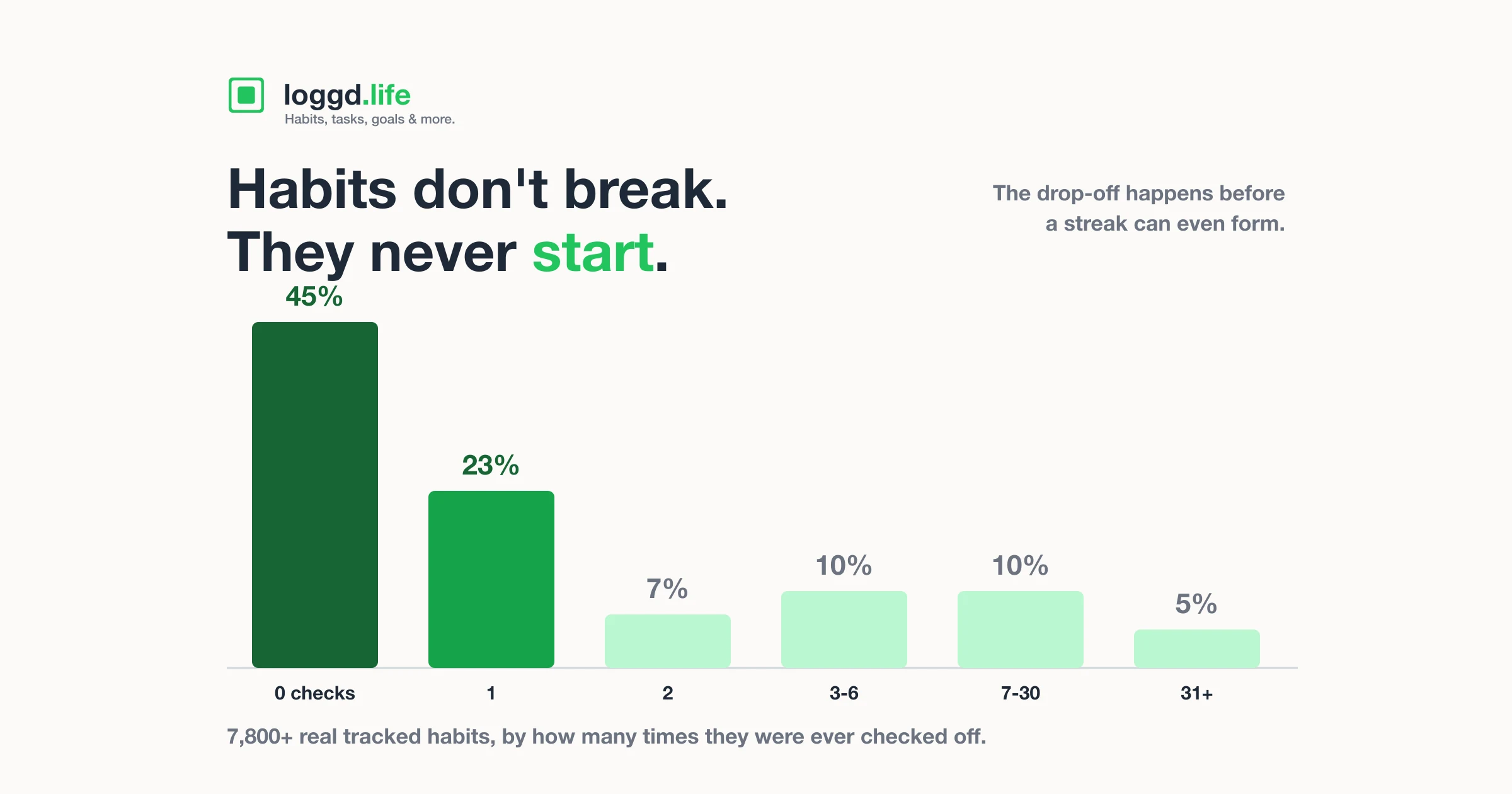
That also means it behaves like any other daily habit, including the failure mode. The published Loggd data on tracked habits is unkind about all-or-nothing framing: across 7,800 habits, about 45% were never checked off once and another 23% were checked exactly once, which I broke down in habits people quit fastest. Rules that only survive perfection do not survive.
So count the no-spend days you kept, not the unbroken run. One spend day on day eleven does not make the other twenty-nine worth nothing. This is the same argument for showing consistency as a grid rather than a streak counter that resets to zero, which I made properly in contribution grid versus streaks.
A 30-day template
Copy this, change the parts that are wrong for you, and write it down somewhere you will see it.
- Duration: 30 days, starting on a date I picked, not the first available excuse.
- Mode: essentials allowed.
- Banned: takeaway and delivery, coffee out, clothes, gadgets, homeware, anything an app suggested.
- Allowed: rent and bills, one weekly grocery shop from a list, medical, transport to work, childcare.
- Written exceptions: one birthday gift up to a set amount, two social meals out, replacing anything that genuinely breaks.
- Renewals inside the window: listed by date, each one marked keep or cancel.
- Destination: the money moves to one named place, the same week.
- Miss policy: a spend day is one day, logged with the trigger. Two in a row is the only signal worth reacting to.
Tracking it
The no-spend challenge tracker is free and runs entirely in your browser. You pick 7, 14, 21 or 30 days or a custom length, set a start date, and choose between allowing essentials or a strict version with none. In the standard mode you toggle which of five categories do not count against you: bills, groceries, medical, transportation and childcare.
From there it is a calendar. Each day is marked no-spend or spent, and a spend day takes an amount, a category and a note, which is where the trigger goes. There is a separate log for purchases you avoided, and those amounts add up into a running total saved alongside your success rate, current streak and longest streak. Past challenges are kept as history.
Two honest limits: the exception categories are the five fixed ones, so your written list of awkward cases has to live in a note beside it, and the totals are formatted in dollars regardless of what you actually spend.
If a month goes well and you want the longer sibling, a no-buy year is the same idea stretched out, with a rules card instead of a calendar grid: the no-buy year builder covers that. And if the thing you are really fighting is the moment of purchase rather than the month, the impulse purchase pause attacks it from the other end.
The rules are the whole product here. Write them, then start.
Last updated: November 2026.
Written by Eusebiu, the solo founder building Loggd in public. I build it in the evenings around contract work and a small daughter, so my own version of this has a very generous exceptions list and a very short banned one. I share what the aggregate data keeps showing on Threads.
Count the days you kept. Loggd records daily rules as a forgiving contribution grid, so one spend day stays a lighter square instead of wiping out the month. Start free.