TL;DR. A 30-day challenge works when it is one action you can answer yes or no to at 11pm, small enough to survive your worst normal day, and run one at a time. Below are around 100 ideas across eight areas of life, split into easy, medium and hard. Start in the easy tier if you have never finished one. Write your miss policy before day one, expect the first weekend and the second week to be where it wobbles, and on day 30 keep one thing and drop the rest.
I built the challenge tracker on this site, which means I get to watch what people do with it. The most common pattern is someone opening the create screen, looking at the empty name field, and closing the tab.
Choosing the challenge is the part nobody helps with. So here is the list I wish had existed: around 100 ideas, all written the same way, as one thing you either did today or did not.
The test every idea has to pass
At 11pm, tired, you should be able to answer a single question: did I do it, yes or no.
If you have to interpret, the challenge is written wrong. "Eat healthier" fails that test. "No food after 8pm" passes it. "Be more present" fails. "Phone stays in another room during dinner" passes.
Vague challenges do not collapse because you lack discipline. They collapse because there is never a moment where you get to say you did it.
Four rules before you pick
Binary, always. See above. Every idea below is phrased so that the answer is yes or no.
One at a time. Two challenges do not cost twice as much, they cost considerably more, because the expensive part is the daily decision load rather than the minutes. The second one is also the excuse: once you have missed one of the two, the whole day reads as failed.
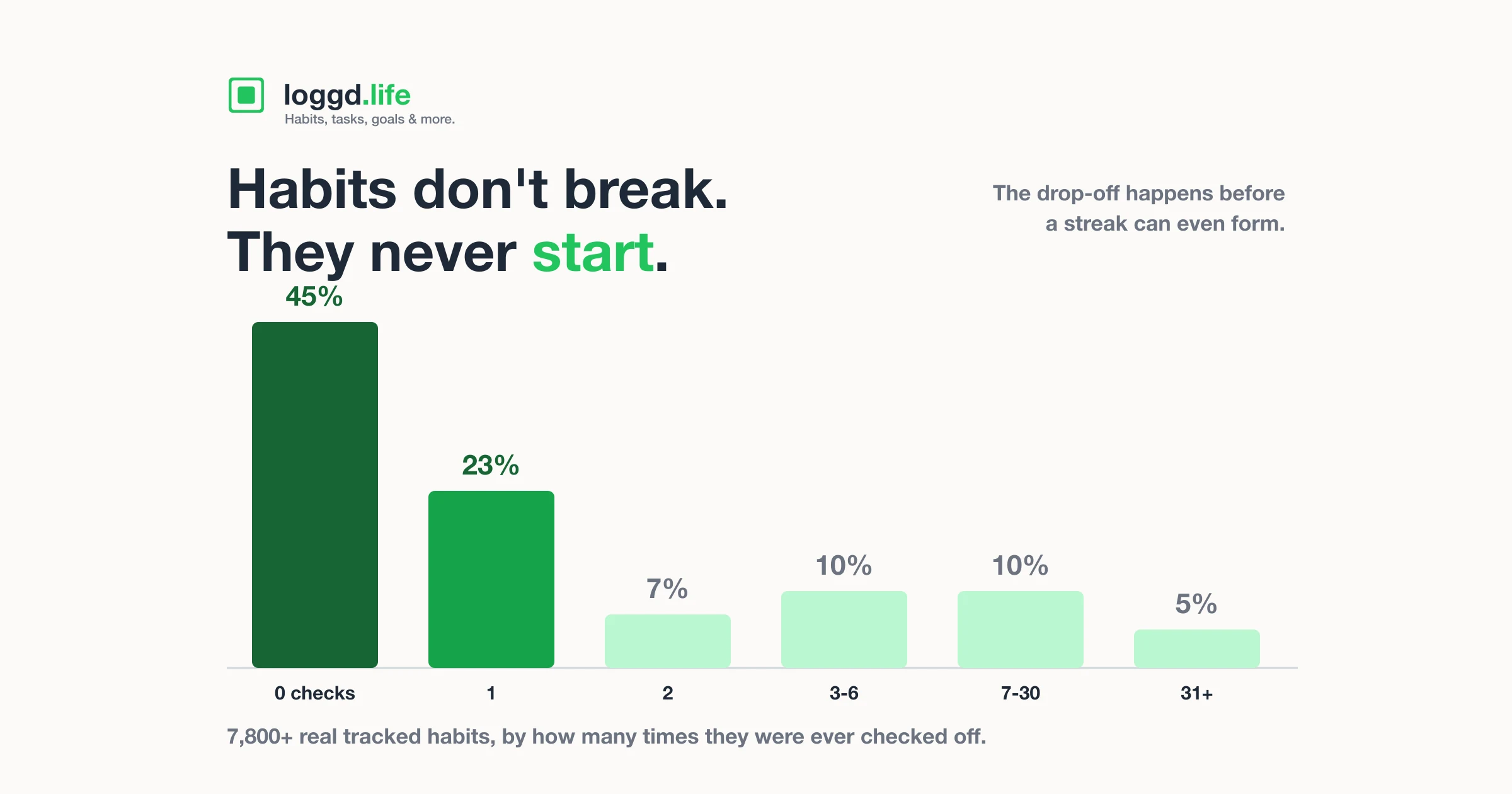
Size it for your worst normal day. Not your worst imaginable day, the ordinary bad one where work overran and someone at home is ill. The published Loggd figures are blunt about what optimism at setup time does: across 7,800 tracked habits, about 45% were never checked off even once and another 23% were checked exactly once. The full breakdown is in habits people quit fastest.
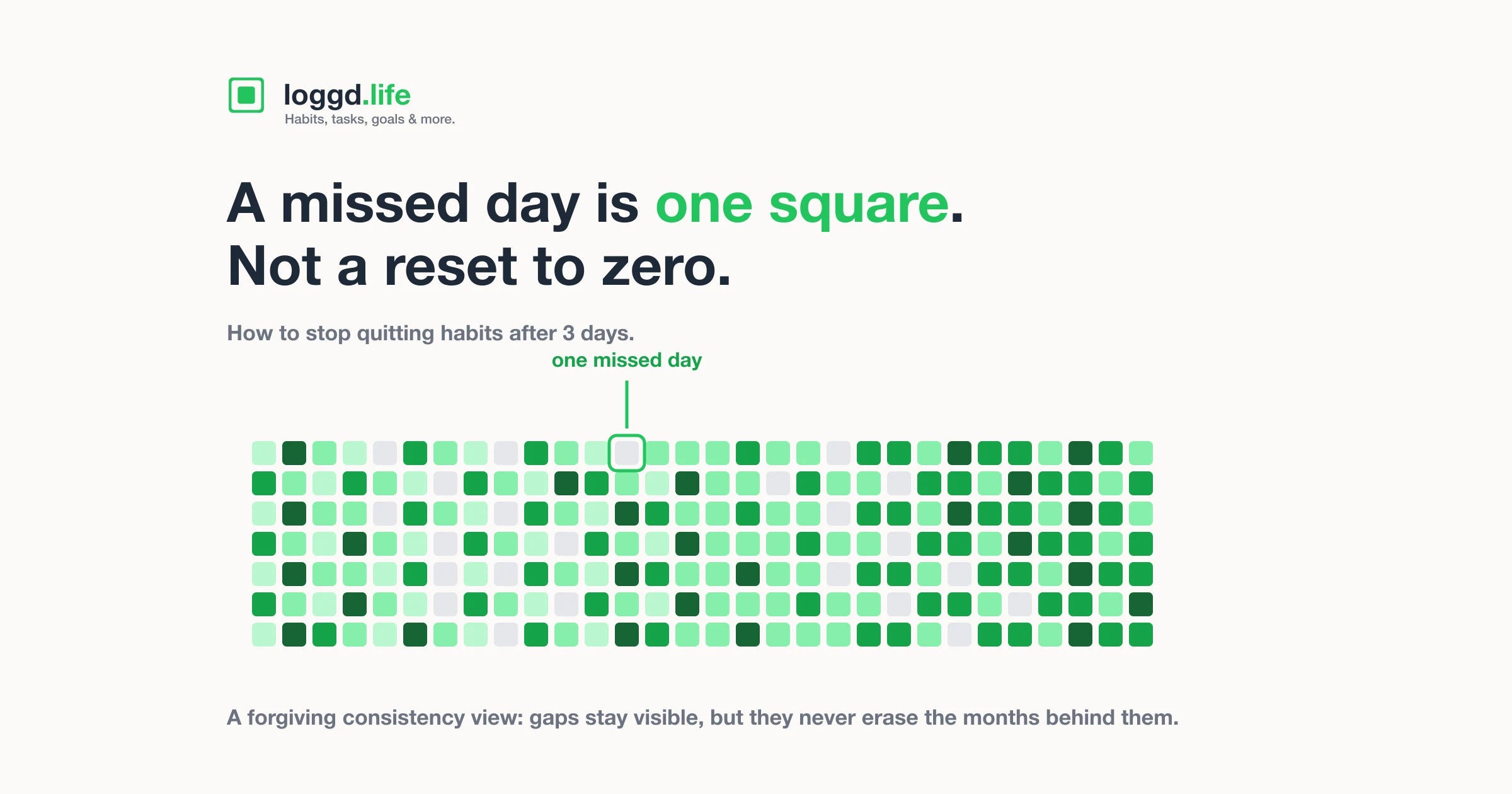
Decide the miss policy on day zero. Write it down while you are calm, because you will not be calm in week two. A miss is one square. The only pattern that genuinely ends a challenge is missing twice in a row, which is the rule I keep coming back to in how to stop quitting habits.
The three tiers
Easy. Under fifteen minutes, no equipment, no planning. Possible in a hotel room, a hospital waiting room, or the ninety minutes you have left at the end of a bad day. If you have never finished a month-long commitment, everything you pick should come from here.
Medium. Fifteen to forty-five minutes, or a small logistical cost: a trip, a purchase, a schedule change.
Hard. A real dent in the day, or an abstinence rule that touches your social life. These photograph well and get abandoned in week two.
Fitness and movement
Easy: ten pushups before your shower · a ten minute walk after lunch · twenty bodyweight squats while the kettle boils · five minutes of stretching before bed.
Medium: 8,000 steps · thirty minutes of movement, any kind · stairs instead of the lift, every time · a twenty minute run.
Hard: a full gym session · train twice a day · one hundred pushups spread across the day · a cold finish to every shower.
Money
Easy: log every purchase the same day · no coffee bought out · check your balance once, at the same time each day · move a fixed small amount into savings.
Medium: a no-spend day · cook every meal at home · review one subscription a day · list one unused item for sale.
Hard: no discretionary spending at all · nothing bought as food or drink outside the house · no online orders · no card taps, cash only.
If the money tier is the one that appeals, there is a purpose-built version of it: the no-spend challenge tracker handles the "did I spend today" question with allowed exceptions, so essentials do not break the run.
Mind and mood
Easy: write three things that went well · five minutes of breathing before you open the laptop · name your mood in one word · get daylight within an hour of waking.
Medium: ten minutes of meditation · one written page · one worry written down and given a slot later · a day without complaining out loud.
Hard: twenty minutes of meditation · a cold shower · no alcohol · a full hour outdoors.
Creative
Easy: one photo taken deliberately · one sentence written · one sketch, any size · one line of a song or a poem.
Medium: 500 words · thirty minutes on an instrument · one small finished drawing · one page of a story, comic or design.
Hard: 1,000 words · one finished piece posted publicly · an hour of practice with a metronome · one cold email or pitch sent.
Home
Easy: make the bed · empty the sink before bed · bin or donate one item · a ten minute tidy on a timer.
Medium: clear one drawer, shelf or surface properly · all dishes done before bed, no exceptions · one room reset to zero · laundry never left in the machine overnight.
Hard: thirty minutes of decluttering · one deep-clean task from a written list · nothing enters the house without something leaving · kitchen and inbox both empty before bed.
Social
Easy: one message to someone you have not spoken to this week · one specific thank you · one real question asked and actually listened to · no phones at the table.
Medium: a ten minute call with a friend or a parent · one offer of help nobody asked for · one meal eaten with another person · one handwritten note.
Hard: meet someone in person · have one conversation you have been avoiding · no phone between six and bedtime · introduce yourself to one stranger.
Digital
Easy: no phone for the first thirty minutes awake · phone charges outside the bedroom · notifications off for one named app · no screens during meals.
Medium: no social media before noon · screen time under a number you set, checked at bedtime · one app deleted for the month · no phone in the bathroom.
Hard: no social media at all · no streaming · phone in greyscale · a screen-free evening, every evening.
Learning
Easy: ten pages read · ten minutes on a language app · one flashcard set reviewed · one article read to the end rather than skimmed.
Medium: thirty minutes of focused study · one coding exercise solved · twenty minutes of deliberate practice on your weakest thing · one idea written down in your own words.
Hard: an hour of study before work · a chapter a day · two hours of practice · teach one thing you learned to somebody else.
Where challenges die
Two places, reliably.
The first weekend. Weekday challenges are propped up by a routine that disappears on Saturday. The gym trip attached to the commute has no commute. Decide now what the weekend version looks like, and let it be smaller.
The second week. The novelty has gone and the end is still far away. Nothing has actually gone wrong, it has just stopped being interesting, which feels almost identical. This is where people add rules to make it exciting again, or restart from day one after a single miss. Do neither. Keep the size honest and let it be boring.
About the "30 days to a habit" idea
Thirty days is a good container. It is not a scientific threshold.
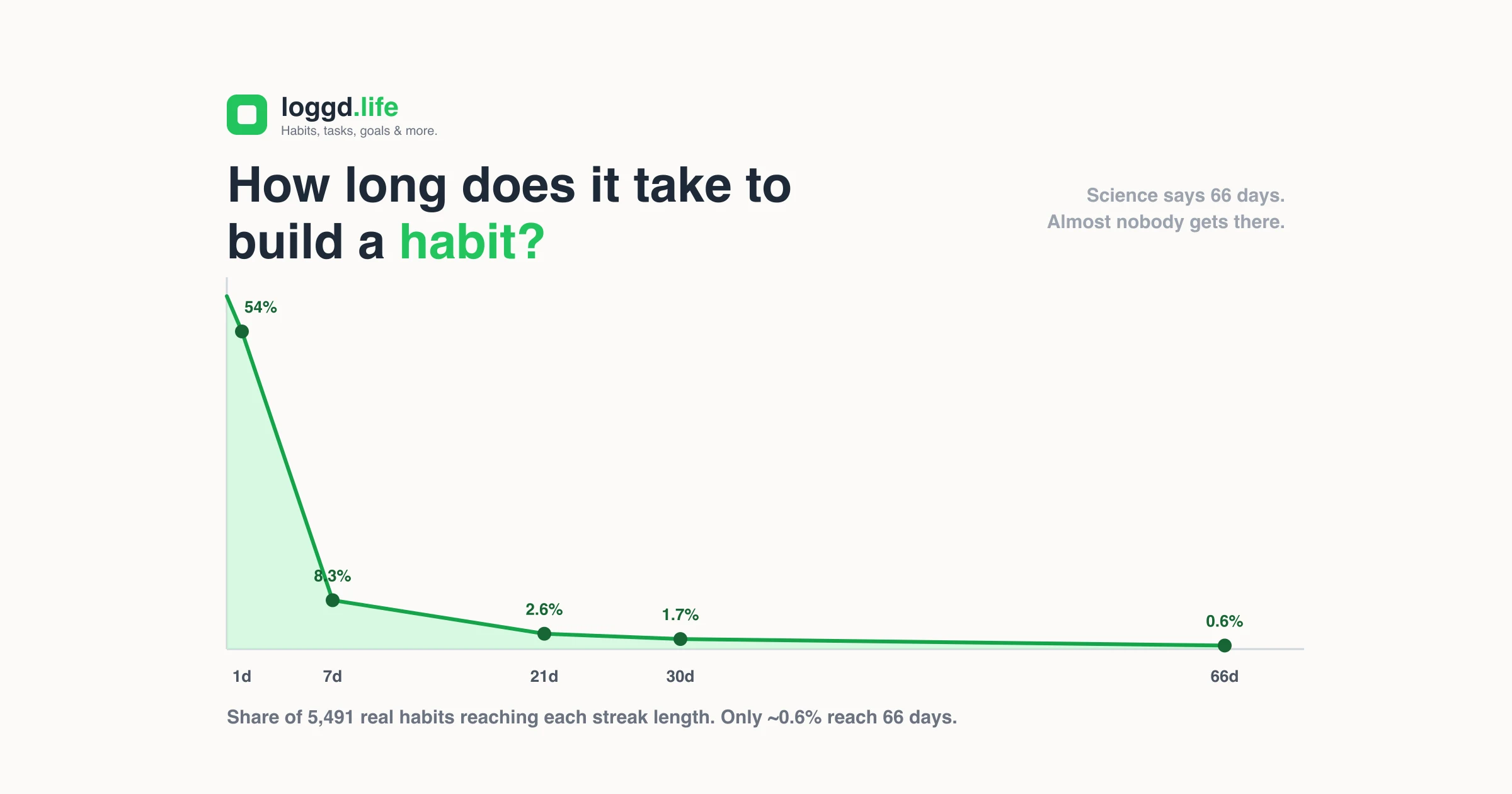
The number in circulation is 21 days, and it traces back to Maxwell Maltz, a plastic surgeon who wrote in 1960 that his patients took a minimum of about 21 days to get used to a change. That was a note about adjusting to a new face after surgery, not a finding about building behaviours, and decades of repetition flattened it into a law. The research figure people cite instead is a median closer to 66 days with an enormous spread. I have already set that against real tracking data in how long it takes to build a habit, so I will not re-argue it here.
Pick 30 because a month is a unit you can hold in your head. Nothing clicks on day 31.
Day 30
Count the days you kept, not the days in a row. Then answer one question: which of these do I want to keep without a challenge wrapped around it?
Usually it is one. That one graduates into an ordinary habit and stops needing a name. The rest were an experiment, and experiments are allowed to end. If you want the longer version of the same shape afterwards, the winter arc is the same rules stretched over ninety days.
Tracking it
The 30-day challenge tracker is the free version of this. It ships eight ready-made challenges plus a custom option, four lengths (21, 30, 66 or 100 days), and a numbered grid of days you tap to mark complete. Future days are locked, so you cannot tick tomorrow in advance. It shows your current streak, your best streak, and how many days you still have to check off, and it produces a downloadable certificate image when you finish. Everything lives in your browser, with no account.
The one thing it will not do is choose for you. That part is above.
Last updated: November 2026.
Written by Eusebiu, the solo founder building Loggd in public. I build it in the evenings around contract work and a small daughter, which is why my own challenges live almost entirely in the easy tier and why I stopped being embarrassed about that. I share what the aggregate data keeps showing on Threads.
Keep the one that survived the month. Loggd tracks it as a forgiving contribution grid, so a missed day stays one lighter square instead of resetting you to zero. Start free.