A weekly cleaning planner gives each household chore a place in your week. Use the free Monday-to-Sunday template below, then adjust the tasks to fit your rooms, available time, and energy.
The routine has three parts: a short daily reset, one scheduled weekly chore, and an occasional deeper task. Copy the planner onto paper or into a planning tool you already use, then move tasks around before you start. The sample spreads work across the week, but your home may need a different pace. You’ll also have a plan for uneven workloads and missed days, so one disrupted evening does not have to derail the whole routine.
Sort Chores Into Daily, Weekly, and Occasional Work
Use a simple rule to decide where a chore belongs: handle mess tied to an activity after that activity, schedule repeating household upkeep weekly, and put less frequent detail work on an occasional list.
A daily cleaning schedule can start small: do the dishes, wipe food-preparation mess, return loose items to their places, and address spills when they happen. Treat these as starting points, not a fixed standard for every household. The CDC recommends cleaning high-touch surfaces regularly and other surfaces when visibly dirty, so a weekly slot is for planning routine upkeep, not a reason to leave visible dirt until that day.
Food-preparation cleanup has its own timing. The FDA advises washing cutting boards, dishes, utensils, and countertops with hot, soapy water after working with each food item. That is different from an evening kitchen reset, which might mean putting away clean dishes, wiping the table, and clearing the sink.
Put repeating jobs such as bathrooms, floors, bedding, and laundry on the weekly list. Save cabinet interiors, baseboards, and other detail work for an occasional list you can rotate through when time allows. For example, clean the food-preparation counter after cooking; put cabinet fronts on the rotating detail list.
Make the daily reset easier to remember by attaching it to something you already do, such as clearing the kitchen after dinner. If you need help choosing a cue, try the habit-stacking guide.
Build Your Room-by-Room Cleaning Checklist
Walk through your home and keep only the rooms and tasks that apply. Leave food-preparation cleanup in the daily reset above, so it does not get counted twice.
Kitchen
- Clean the sink and stovetop.
- Wipe appliance exteriors.
- Clean the floor.
- Check the refrigerator.
Bathroom
- Clean the toilet.
- Clean the sink and other surfaces.
- Clean the shower or tub as needed.
- Clean the floor.
The American Academy of Pediatrics recommends weekly cleaning and disinfecting of the toilet, sink, and other bathroom surfaces. Follow cleaning-product labels, and never mix cleaning products.
Bedroom
- Wash sheets and pillowcases.
- Put clothing away.
- Dust accessible surfaces.
- Vacuum.
The American Academy of Pediatrics recommends washing sheets and pillowcases every week.
Living Areas and Entryway
- Return items to their places.
- Clear clutter from the floor.
- Damp-dust suitable surfaces.
- Clean floors.
The EPA recommends vacuuming carpets and furniture weekly or more often. For dusting, the EPA says a dampened dust cloth helps keep settled dust from returning to the air.
Keep decluttering bounded: return misplaced items, gather items to donate, and remove rubbish before cleaning surfaces.
Laundry
- Gather clothing and linens.
- Wash a load.
- Dry it.
- Fold it.
- Put it away.
A laundry task is not finished when the washer stops. Count gathering, folding, and putting clothes away as part of the job, but keep machine-running time separate from hands-on work. Choose a laundry schedule that fits your household, such as one clothing day and a separate bedding day.
Measure Chores Before You Fill the Week
-
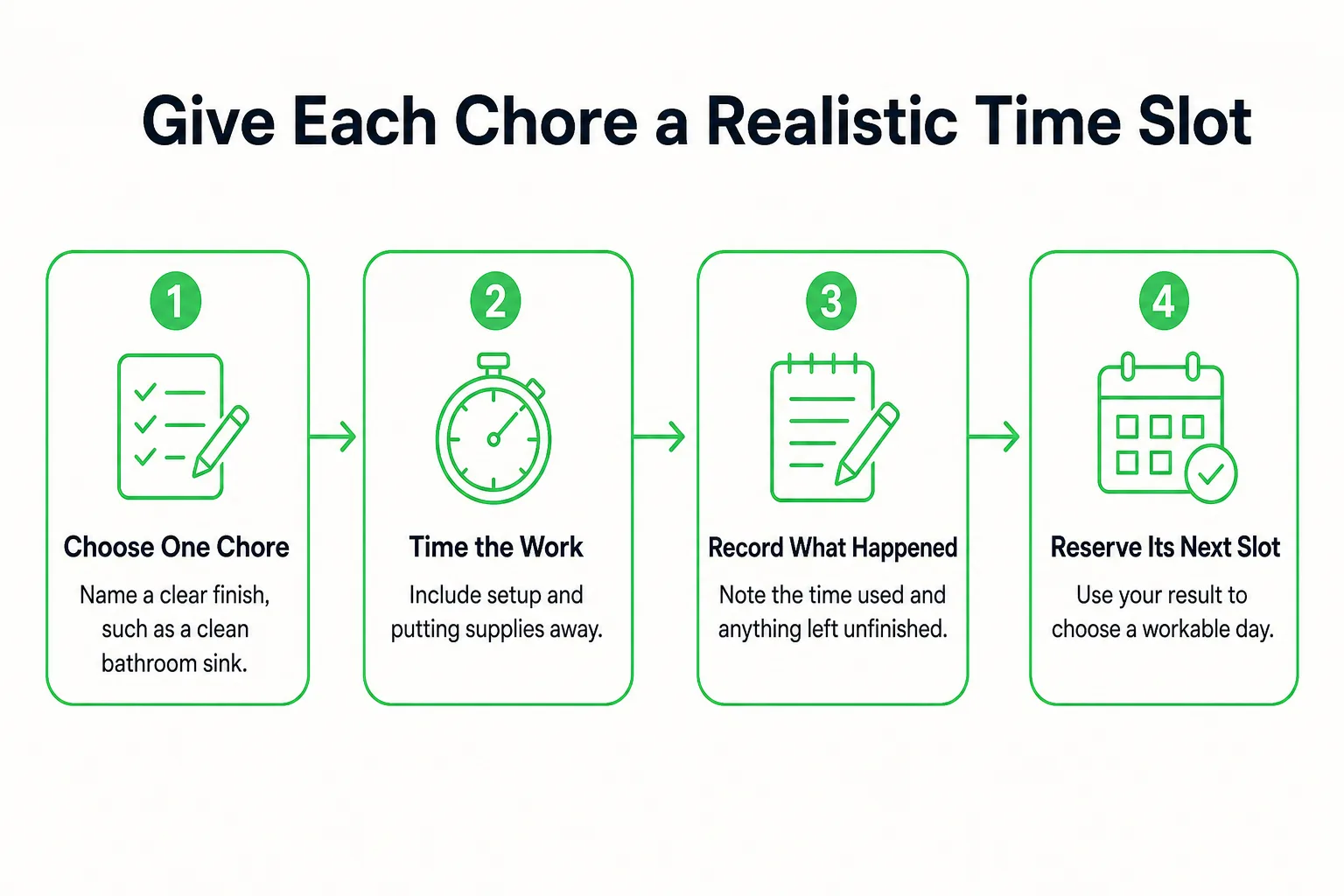
Choose one clearly bounded chore. “Clean the bathroom” is too broad to time well. “Clean the bathroom sink and toilet” gives you a finish line.
-
Time the hands-on work. Allow 10 minutes to clean the sink and toilet, then record how long it actually takes. Use the free stopwatch to measure a chore before deciding where it belongs in your week.
-
Record what remains. Include gathering supplies, setting up, putting equipment away, and any laundry handling. Keep washer and dryer running time separate from active cleaning time; you do not need to reserve the whole cycle as a cleaning block.
-
Reserve a realistic slot for the next time you do the chore. A 10- or 15-minute focus session can suit a defined outcome, such as wiping the sink and cleaning the faucet. When the timer ends, stop and reassess. Finish the task, or make a clear note of what remains, rather than quietly expanding the block.
If a chore will not fit, divide it into smaller jobs. Split whole-house floors into areas, or clean bathroom fixtures separately from the shower. Each part should be specific enough to finish or deliberately pause.
Copy This Monday-to-Sunday Cleaning Planner
Use this as a starting schedule. Copy the table into a document or onto paper, then print it if that suits you. The short daily reset is separate from the main blocks below: handle dishes, food-preparation mess, loose items, and spills as they come up.
| Day | Main Cleaning Block | Starting Time Allowance | Done |
|---|---|---|---|
| Monday | Bathroom fixtures | 15 minutes | [ ] |
| Tuesday | Dust and vacuum living areas | 20 minutes | [ ] |
| Wednesday | Clothing laundry, hands-on work | 15 minutes | [ ] |
| Thursday | Kitchen surfaces and floor, plus refrigerator check | 20 minutes | [ ] |
| Friday | Bedding and bedroom floor, hands-on work | 20 minutes | [ ] |
| Saturday | One rotating detail task | 15 minutes | [ ] |
| Sunday | Catch-up or rest, plus planner check | 10 minutes | [ ] |
These are starting time budgets, not fixed estimates. Replace them with the times you record for your own chores. Laundry machine cycles sit outside the hands-on allowance. The FDA recommends checking refrigerator expiration and use-by dates once a week.
Rebalance the table around the week you actually have. First mark evenings when you are unavailable. Then move the largest chore to a day with room, and split any task that exceeds its slot. If Tuesday is busy, move vacuuming to Saturday and skip that week's optional detail task instead of squeezing both in.
Use the ideal week template to see which days can hold housework. Use the time-blocking planner to reserve a specific cleaning session around existing commitments. Keep Sunday as spare capacity for catch-up or rest, not another full cleaning block by default. Move at least one row now if the sample conflicts with your actual week.
Make a Fallback Plan for Busy or Low-Energy Days
A cleaning routine works better when it names a specific action, makes room for missed days, and fits an ordinary week. Give each important chore a full version and a smaller version, so a difficult day does not have to become an all-or-nothing choice.
For a low-energy day, use this fallback checklist:
- Handle food mess and the dishes needed next.
- Remove rubbish that needs attention.
- Clear one usable surface.
- Choose one necessary next action.
Allow five minutes to get started, or choose a smaller defined action if that is what the day allows. The outcome matters more than completing the original time block. Cleaning the sink and putting away the dishes you need can be a useful finish for today.
When several chores are missed, triage them in order: handle immediate mess first, reschedule necessary unfinished work into the next available slot, and drop or defer optional detail work. If you missed Tuesday's vacuuming, move it to Saturday in place of cabinet fronts instead of adding it to Wednesday's laundry. Mark the missed chore honestly rather than checking it off for the sake of a streak.
If the same cleaning slot repeatedly falls at a low-energy time, use the energy-management protocol to reconsider its timing.
Rotate Monthly Cleaning Without Filling Every Weekend
Connect your monthly cleaning schedule to the weekly planner by using Saturday’s optional slot for one occasional task. That keeps detail work from turning every weekend into another full cleaning day. Choose tasks based on how your home is used, what looks dirty, and the care instructions for the surface or item.
A compact deep cleaning checklist might include:
- Empty a small section of a cabinet, wipe it, let it dry, and put items back.
- Clean accessible baseboards.
- Dust reachable vents.
- Clean an appropriate section of a window.
- Sort one storage shelf.
Treat these as options to inspect and schedule, not chores that all need to happen every month. For example, rotate one task through the Saturday slot: week one, a kitchen cabinet section; week two, a bathroom detail; week three, a bedroom storage shelf; week four, an entryway or living-area detail. Adjust the sequence to suit your home.
Give each task a small finish. Replace “deep-clean the kitchen” with “empty, wipe, dry, and refill one cabinet.” For decluttering, choose one drawer or shelf, return items that belong elsewhere, set aside donations, and clear the space before wiping it.
If necessary weekly work needs the time, let the detail task give up its slot. Follow care instructions for larger appliance maintenance and specialized cleaning instead of adding unverified procedures to your rotation.
Use Missed Chores to Improve Next Week
Spend a few minutes on Sunday reviewing your checklist or other records. Look at what you finished and what remained unfinished more than once. The aim is to improve the schedule, not to judge the week.
Ask three questions:
- Which chore moved more than once?
- Which task took longer than its time slot?
- Which day had too much assigned to it?
Use the answer to make one practical change. Move a chore that repeatedly lands at a bad time, split a task that does not fit its slot, or reconsider how often an optional task appears. If bedding remains unfinished on Friday across several weeks, move it to a day when you can also dry and remake the bed.
A checked box records that you marked a task done; it does not tell you what condition the room is in. Add a short completion note when it helps, such as “bathroom sink and toilet cleaned.” Then change one scheduling choice for the coming week, so you can see whether that adjustment fits better.
If cleaning is part of a broader Sunday reset, add this check to the weekly reset planner.
Build Your Weekly Cleaning Routine With Loggd
Loggd brings habits, tasks, goals, and focus time into one app. It is free on iPhone, Android, and the web, with no credit card needed. Set it up to reflect the cleaning plan you have made, then review the work yourself each week.
- Create a habit for a short repeating action, such as an evening kitchen reset. Use flexible habit schedules to choose the days that suit your household.
- Add weekly cleaning jobs and occasional detail work to the task list. Use priorities to separate necessary cleanup from optional detail work, and tags such as “kitchen” or “bathroom” to group tasks. During your weekly review, choose a day for each task that is coming up.
- Use the focus timer for bounded sessions, such as the 10- or 15-minute blocks you planned earlier. If you set a home-care goal, tasks and focus sessions can connect with that goal.
- Use the daily check-in to look at what happened. Each day you check off fills the grid of your last 365 days, so you can see the year at a glance. The app also includes points, 100 levels, streaks, badges, and a leaderboard as game elements.
- At the end of the week, compare the planned chores with what you finished. Reschedule necessary work, change an overloaded day, and leave optional detail work for a week with room.
Keep the first setup small: one daily cleaning habit, the week’s scheduled cleaning tasks, and a short focus session. The goal is a plan you can use and adjust, not a list that keeps growing.
Weekly Cleaning Planner Questions
Is a Digital Cleaning Planner Better Than a Printable Checklist?
A digital planner is useful when you want to move chores as your week changes or keep the plan on a phone. A printable checklist is easy to see at home and mark by hand. Choose the format you will check and update; either can hold the same weekly cleaning schedule.
How Can I Share This Cleaning Planner With Other People at Home?
Copy the table and checklist into a place everyone at home can see, or print a copy for a shared spot. Agree on who handles each task and how you will mark it done. If plans change, update the shared copy so two people do not assume the other has taken care of the same chore.
How Should I Adapt the Planner for a Small Apartment?
Keep only the rooms and chores that apply, then combine tasks that fit into one short session. For example, clean the bathroom and kitchen floors in the same block if that works for your layout and available time. Use the rotating detail slot for one small area, such as a shelf or cabinet section, and leave out tasks you do not need that week.
Sources
- When and How to Clean and Disinfect a Facility | Water, Sanitation, and Environmentally Related Hygiene (WASH)
- Food Safety at Home
- Keep Your Home Healthy: Room-by-Room Cleaning Tips to Prevent Infections
- Sources of Indoor Particulate Matter (PM)
- Cleaning (Food Safety for Moms-to-Be)