
Personal objectives for work are specific improvements you want to make in how you do your job. Examples include sending clearer project updates, meeting agreed deadlines, improving reporting accuracy, and preparing to lead a small project. A useful objective connects an improvement to work you actually do, a visible measure, and a review date. Writing the objective is only the start. You also need to make room for the actions it requires in an ordinary week, alongside your other responsibilities. The examples in this guide can be adapted for your current job, a performance review, an employee development plan, or an interview. Choose an improvement you can practice and track, then agree on what progress should look like.
What Counts as a Personal Objective at Work?
A personal work objective is a specific change you want to make in your contribution, skills, or working behavior. “Personal” means you own the improvement. It does not mean the objective has to concern your private life.
A performance goal focuses on work you are responsible for, such as completing assigned reports accurately. A development goal focuses on building a skill, such as learning to present those reports clearly. One objective can support both: clearer presentations may strengthen your skills while helping your team understand the reports.
A work objective can also be one step toward a broader career aspiration. You might want to move into project leadership over time; a near-term objective could be to coordinate one small deliverable and gather feedback on how you handled it.
“Become a better communicator” leaves the action unclear. “Send a decision-focused project update every Friday for eight weeks” names work you can do and gives you a point to review. If you are setting objectives outside work, personal goal-setting examples cover a broader range of life goals.
Step 1: Choose One Objective for This Quarter
Start with one main improvement objective for this quarter, alongside your ordinary job responsibilities. Add another only if its recurring actions fit your calendar without displacing the first. A short list can help you focus on the work that matters now.
Write down three things: where work currently gets stuck, feedback you have received, and responsibilities coming up soon. Turn each into a possible objective. This keeps you from choosing an attractive skill that has no clear use in your current work.
Connect the choice to real priorities. Federal workplace guidance from the Office of Personnel Management says individual objectives should connect to organizational priorities. Check what matters to your own team, too. Then ask:
- Does this help with an important responsibility?
- Can I influence the result?
- Can I practice the needed behavior during an ordinary week?
For example, Jordan has a project that depends on clear handoffs. Colleagues need to know who owns each next action. Jordan chooses to improve handoffs rather than learn an unrelated tool, because the improvement supports work already underway.
If two options still seem equally useful, compare them against a relevant strength, a recurring obstacle, and an upcoming opportunity with the personal SWOT analysis. Choose the objective with the clearest connection to your current work and the most realistic weekly practice.
Before you commit, put the first review date and recurring practice time on your calendar. If you cannot find time for the actions, adjust the objective now. Available time is part of the choice.
Step 2: Adapt These Six Everyday Work Objectives
Use these six objectives as starting points. Adjust the timelines and targets to fit your responsibilities and current baseline. The measures are evidence to discuss, not extra goals you need to take on all at once.
| Work priority | Objective to adapt | Evidence to record |
|---|---|---|
| Communication | For the next eight weeks, send a Friday project update that names progress, blockers, and decisions needed. | Dated updates and clarification requests that follow them. |
| Time management | For the next six weeks, hold Monday and Thursday planning sessions and finish each week’s agreed priority task by its deadline. | Planning sessions and the completion date of the priority task. |
| Accuracy | Use the Office of Personnel Management’s example to reduce reporting errors by 25% over six months. | Record your starting error rate, and use the same definition of an error throughout. |
| Collaboration | For the next eight weeks, confirm the owner, due date, and next action before handing off each assigned deliverable. | Completed handoffs and any work returned because essential information was missing. |
| Skill development | Within eight weeks, learn the spreadsheet functions needed for the monthly report and use them to produce a report my reviewer can verify. | Completed practice and the reviewed report. |
| Security awareness | Complete the security training assigned to my role by its due date and use the approved checklist for the next relevant work task. | Training completion and use of the relevant workplace process. |
NIST describes awareness training as foundational cybersecurity or privacy training for personnel. For the objective, focus on completing the training your role requires and following your workplace’s process in the relevant task.
Short-term objectives like these can build communication skills, time management, professional development, or employee performance. Choose the one that fits your current work best. You do not need to pursue all six at the same time.
Four More Objectives for Your Level of Responsibility
The next four examples fit different levels of responsibility. Adapt the deliverable and evidence to your role; the underlying structure can work across administrative, customer-facing, technical, and operations work.
| Role or responsibility | Objective to adapt | Evidence to record |
|---|---|---|
| 7. Early-career employee | Within six weeks, complete one recurring work task using the team checklist, then review the finished work with my supervisor. | The deliverable, checklist, and feedback on the next skill to practice. |
| 8. Experienced specialist | Within ten weeks, document one recurring process, test the instructions with a colleague, and revise any unclear steps. | The process document, test notes, and revisions. |
| 9. First-time manager | For the next eight weeks, delegate one suitable recurring responsibility with an agreed owner, outcome, and check-in date. | The delegation agreement, check-ins, and completed work. |
| 10. Employee preparing to lead | Within twelve weeks, coordinate a small cross-functional deliverable with agreed owners, milestones, and a closing review. | The agreed milestones, completed deliverable, and feedback from participants. |
To adapt an example, change the deliverable to match your work and choose evidence you can actually collect. An administrative employee might document an intake process; a technical employee might test a procedure; someone in customer service might review a handoff. Keep the objective tied to work you can influence.
Leadership practice and promotion are separate questions. You can build evidence by coordinating a project or delegating a responsibility without making the objective depend on a promotion decision. Before committing, check that you have permission to take on the work, enough time for it, and access to the colleagues or resources it requires.
Step 3: Agree on the Objective for Your Review
Once you have chosen an objective, make it usable in a performance review or employee development plan. Write down the work involved, your starting point, the intended result, the evidence you will collect, the review date, and any support you need. That gives you and your manager something concrete to discuss.
Use SMART objectives as a quick check: Is the objective specific, measurable, feasible, relevant to your work, and tied to a timeframe? Apply each question to the objective you chose. If the measure or deadline is unclear, agree on it before treating the objective as settled.
For example, replace “improve presentations” with: “Prepare and deliver my next assigned project update by the agreed date, using our shared outline, then review the feedback with my manager.” The revised version names a work product, an action, and a way to learn from the result.
Agree on what successful work looks like. The EEOC emphasizes clear expectations and fair performance standards. Ask who owns the measurement, how often you will check it, and what happens if the project changes or required support is unavailable.
If a disability-related barrier affects the work, a reasonable accommodation can change the workplace or work practices to help a person perform job duties. Discuss the support you need through your workplace process.
Before the review conversation, gather examples of completed projects and useful lessons. The year-in-review tool can help you organize that reflection.
Step 4: Give the Objective Three Weekly Behaviors
A work objective should change what goes on your calendar and task list. Otherwise, it can stay a good intention without giving you a clear next move. Use small decision rules to make the action easy to repeat. For a communication objective, decide what you will collect, when you will draft, and when you will send the update.
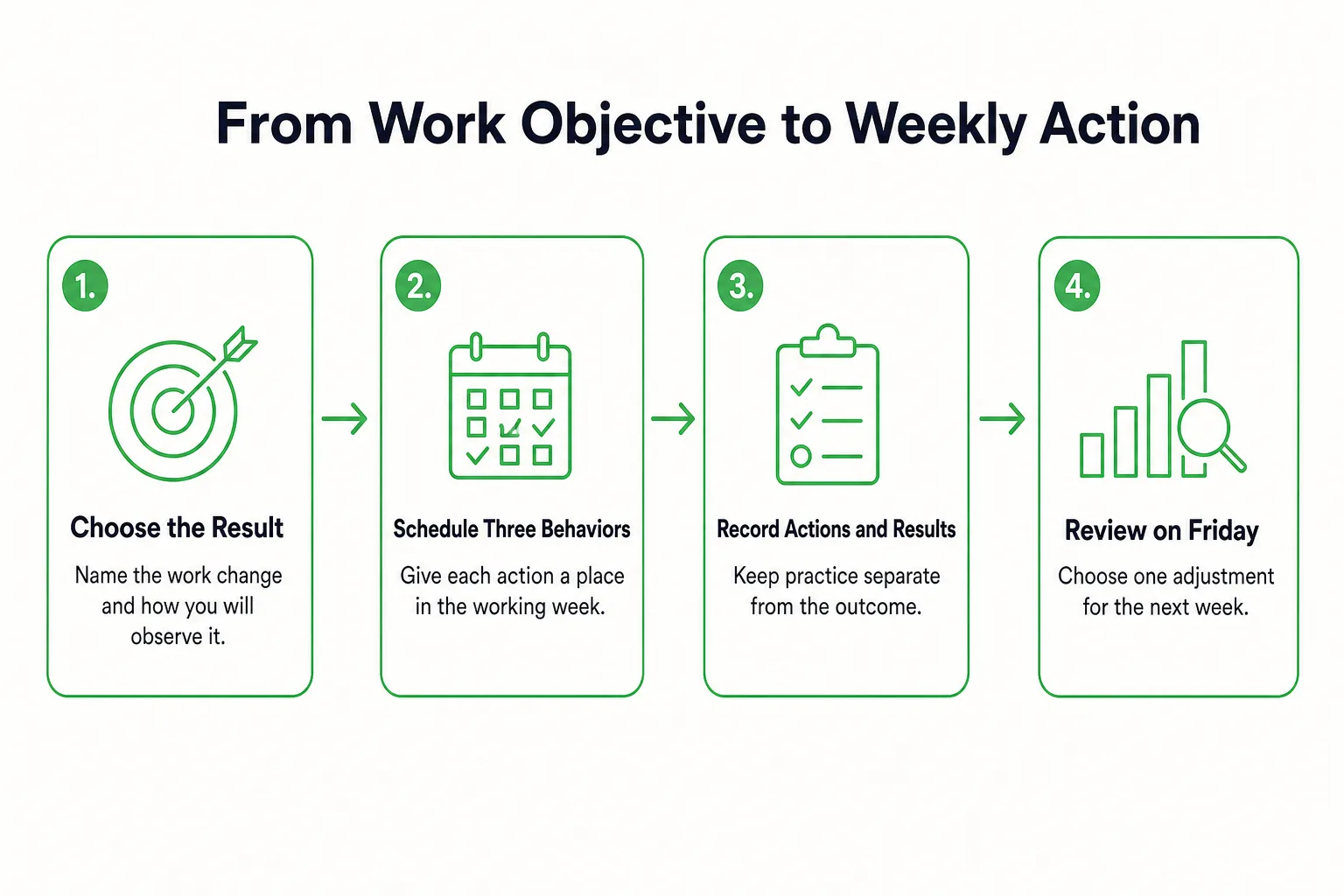
Take this objective: over eight weeks, make project updates easier to act on and reduce questions about who owns the next step. First, look at recent updates to set a starting point. If your last two updates led to six clarification requests about ownership or next steps, you could discuss a target of three or fewer with your manager. Those figures are an example for this situation, not a general benchmark.
Use exactly three weekly behaviors:
- Tuesday: Collect decisions made, current blockers, and the person responsible for each next step.
- Thursday: Draft the update using four prompts: progress, owner, next step, and request. If you need protected time to write it, a focus timer can structure the work session.
- Friday: Send the update, then record follow-up questions about ownership or next steps.
The Tuesday, Thursday, and Friday actions are leading behaviors: they show whether you practiced the work you control. Clarification requests are an outcome measure: they offer a signal about whether the update is becoming easier to use. Do not judge communication quality by message volume alone. A question may point to an unclear update, or it may be a necessary discussion about changing work.
Keep a brief weekly note with three parts: action completed, result observed, and one adjustment. For instance: “Collected owners Tuesday; sent the update Friday; two people asked who would approve the next step; name the approver in the next update.” If no update was due that week, note that context instead of marking an action as missed.
Use a simple decision rule: if the same question appears again, revise the part of the next update that should have answered it before adding detail elsewhere. On Friday, compare the actions you took with the result you saw, then choose one adjustment for next week. That is enough tracking to keep the objective visible without creating a second job.
Step 5: Reset an Objective That Falls Behind
When an objective falls behind, reset the next action instead of abandoning the wider career goal. Use this sequence to find a workable restart:
- Name what slipped. Identify the specific action that did not happen, such as drafting Thursday’s project update.
- Check the cause. Was the action too large, was there no protected time, or did progress depend on a person or resource that was unavailable?
- Reduce or change the next action. If drafting the full update feels too large, prepare the outline first. If the week is crowded, reserve time before accepting more optional work. If you are waiting for a decision or access, ask the person responsible for what you need.
- Agree on any changed expectation. If the project, support, outcome target, or deadline has changed, discuss the measure with your manager. Do not quietly move the target and treat it as unchanged.
- Choose a restart date. Put the next useful action on a specific day and time.
For example, if the Thursday draft keeps slipping, prepare its three headings right after Tuesday’s project meeting. Fill in the details later, once you have the owners and next steps. If even that first action feels too large, choose a small starting behavior from these micro-habit examples and attach it to an existing work routine.
A restart does not mean catching up on every missed session. Keep the broader aim, adjust the immediate scope or schedule, and name the next action and when it will happen.
How to Explain Your Objective in an Interview
A Short Answer Structure
Use this ready-to-say template to explain an interview goal in under 30 seconds:
My current objective is [relevant improvement]. I’m working on it by [specific action]. I’ll measure progress through [evidence] and review it by [deadline].
For example: “My current objective is to make project updates clearer. I’m using a consistent format for progress, owners, and next steps. Over the next eight weeks, I’ll review the questions those updates generate with my manager and revise the format where people need more clarity.”
If You Are Seeking Your First Role
You can describe a development goal without implying that you have already done the work in a job. For example: “My objective is to become confident with the reporting tools this role uses. I’m practicing with sample tasks and checking the output against a checklist. My next milestone is completing a full practice report within six weeks.”
Choose an objective that connects to the job description, but keep it accurate to your current experience. Practice the answer aloud and trim background before removing the action, evidence, or deadline. A planned result is a goal, not an achievement.
Track Your Personal Work Objectives With Loggd
You can track the communication objective in Loggd by keeping the intended result and the weekly work together. Put the result, such as clearer project updates over eight weeks, in goals. Add the recurring practice as habits with a schedule that fits your workweek, then create one-off tasks for the next draft and Friday review.
Use priorities and tags to distinguish the next useful task from work that can wait. Connect the tasks and focus sessions to the goal so you can see how the practice relates to the result. When it is time to draft, use the focus timer to set aside a work session. The daily check-in gives you a place to note progress or a practical obstacle.
For a technical objective that includes coding practice, the developer focus timer offers a browser-based way to time a work session. Loggd’s browser tools need no signup and save privately on your device. That statement applies to the browser tools, not to the app.
The 365-day grid makes checked-off days visible, so you can see when you followed through on the habit. You still need to record the agreed outcome evidence, such as clarification requests about ownership or next steps. Points, levels, streaks, and badges recognize completed work; they do not replace the measure you agreed to use.
Loggd is free on iPhone, Android, and the web, with no credit card needed. Keep confidential work details in approved workplace systems. In your personal tracker, use a general task name and the measure you agreed to track.
Set up one goal, its three weekly behaviors, the next task, and a date to review the result. That gives the objective a place in your week and a point when you will check what changed.
Questions About Personal Work Objectives
What Are Some Career Aspirations Beyond My Current Role?
Career aspirations can include becoming a specialist, moving into management, or working toward a role in another function. Choose one that fits your interests and the opportunities available to you, then identify a near-term skill or responsibility that would help you move toward it.
What Are Good Professional Goals for 2026 If My Responsibilities Are Changing?
Start with the work you expect to take on, then choose a goal you can practice and review within your current responsibilities. For example, if you are taking on more cross-team work, you might aim to agree on an owner, milestone, and next action for each deliverable you coordinate, then review the handoffs after eight weeks.
Can I Keep a Personal Development Objective Private From My Employer?
Some development objectives may be personal, but if an objective concerns your work performance, expectations, or access to workplace support, discuss the relevant parts with your manager or the appropriate workplace contact. Keep private reflections separate from work records, and share only the information needed to agree on the objective and how it will be assessed.
Sources
- Performance Management Roadmap
- awareness training - Glossary
- Applying Performance and Conduct Standards to Employees with Disabilities
- Prohibited Employment Policies/Practices