
Wheel of Life categories are the life areas you rate to see where you feel satisfied and where you want change. Start with career, finances, health, relationships, personal growth, recreation, and your surroundings, then adjust the labels to fit your life.
The Wheel of Life assessment turns those ratings into a visual snapshot, then helps you choose what to work on. The aim is to pick useful categories, assess how things feel now, and turn one priority into work that fits the coming week. If you want the mechanics before choosing your categories, read how the Wheel of Life assessment works.
Start With These Wheel of Life Categories
Use these eight common life areas as a starting point. Rate your own satisfaction, not how impressive an area looks from the outside.
| Category | What to Include | A Question to Ask Yourself |
|---|---|---|
| Career and business | Meaningful work, business responsibilities, workload, and how work fits your life | Do I find my work satisfying, and is my workload manageable? |
| Finances | Routine bills, spending choices, savings, and room to handle unexpected costs | Can I manage regular expenses and feel some financial breathing room? |
| Health and wellness | Energy, sleep, movement, emotional well-being, and care that supports you | Do I have the energy and access to care I need right now? |
| Family and friends | Support, shared time, and the quality of relationships with family and friends | Do these relationships feel supportive and connected? |
| Romance | Intimacy, connection, and the relationship you want, if romance is part of your life | Am I satisfied with the intimacy and connection in this area? |
| Personal growth | Learning, skills, reflection, and experiences that help you develop | Am I learning something that matters to me? |
| Fun and recreation | Hobbies, play, rest, and enjoyable time that is not another obligation | Do I make room for things I enjoy? |
| Physical environment | Home, workspaces, and other surroundings that affect comfort and daily life | Are my surroundings usable and comfortable for the way I live? |
The University of Wyoming describes occupational wellness as personal satisfaction and enrichment through work. Keep that separate from status or promotions: a person can advance and still feel dissatisfied with the work itself.
The Consumer Financial Protection Bureau includes control over routine finances and the capacity to absorb a financial shock in financial well-being. If irregular bills are the problem behind your finance score, use the sinking funds guide to plan for those expenses.
The CDC’s definition of social connection includes relationship functions and quality, not just how often you see people. And the University of Wyoming includes social, natural, and built surroundings in environmental wellness, so this category can cover more than tidiness. Treat the table as a starting set and adapt it. For health, assess how you feel and what support you need; this exercise is not a diagnosis.
Choose Categories That Match Your Actual Life
Start with eight categories and adjust to roughly six to ten. Fewer can hide differences that matter, while more mean extra definitions and more to review. Choose a number you can rate thoughtfully and revisit without turning the exercise into a project of its own.
The University of Florida’s Health Wheel uses eight areas, including emotional and spiritual health. Those labels can help you notice parts of your life your first list misses. For example, separate parenting from friendships when caregiving needs its own attention. Add spirituality if meaning or faith matters to you, creativity if making things matters beyond work, or community if belonging and participation deserve a separate decision.
Combine categories when you would give them the same score for the same reason. Split them when the difference would change what you do next. Keep romance optional, and define relationships around your actual circumstances rather than forcing your life into a standard label. If you cannot tell which life areas need attention, use the life audit guide to gather concrete examples before choosing your labels.
Rate Your Satisfaction With Clear Anchors
- Define what belongs in each category. Keep the definition brief so you rate the same things next time.
- Think about the past month, not one unusually good or difficult day.
- Rate your satisfaction from 1 to 10. A 1 means deeply dissatisfied, a 5 means mixed, and a 10 means very satisfied with this area as it currently fits your life.
- Write one sentence explaining each rating, using your circumstances and needs rather than comparing your life with someone else’s. Keep observable facts, such as how often you exercised, separate from your satisfaction with them.
- Describe what a one-point improvement would look like. Choose a change you could recognize in ordinary life.
Use the Wheel of Life assessment if its ten life areas fit your situation. For another ten-area scoring format, try the Level 10 Life template. If you use customized categories, keep your labels and ratings on paper or in a note.
Turn One Category Into a Weekly Action Plan
Choose one category by asking three questions: Does it matter now? Can an action this week help? Would that action support another life area too? Do not automatically choose the lowest score; choose the area where a useful next step is clearest.
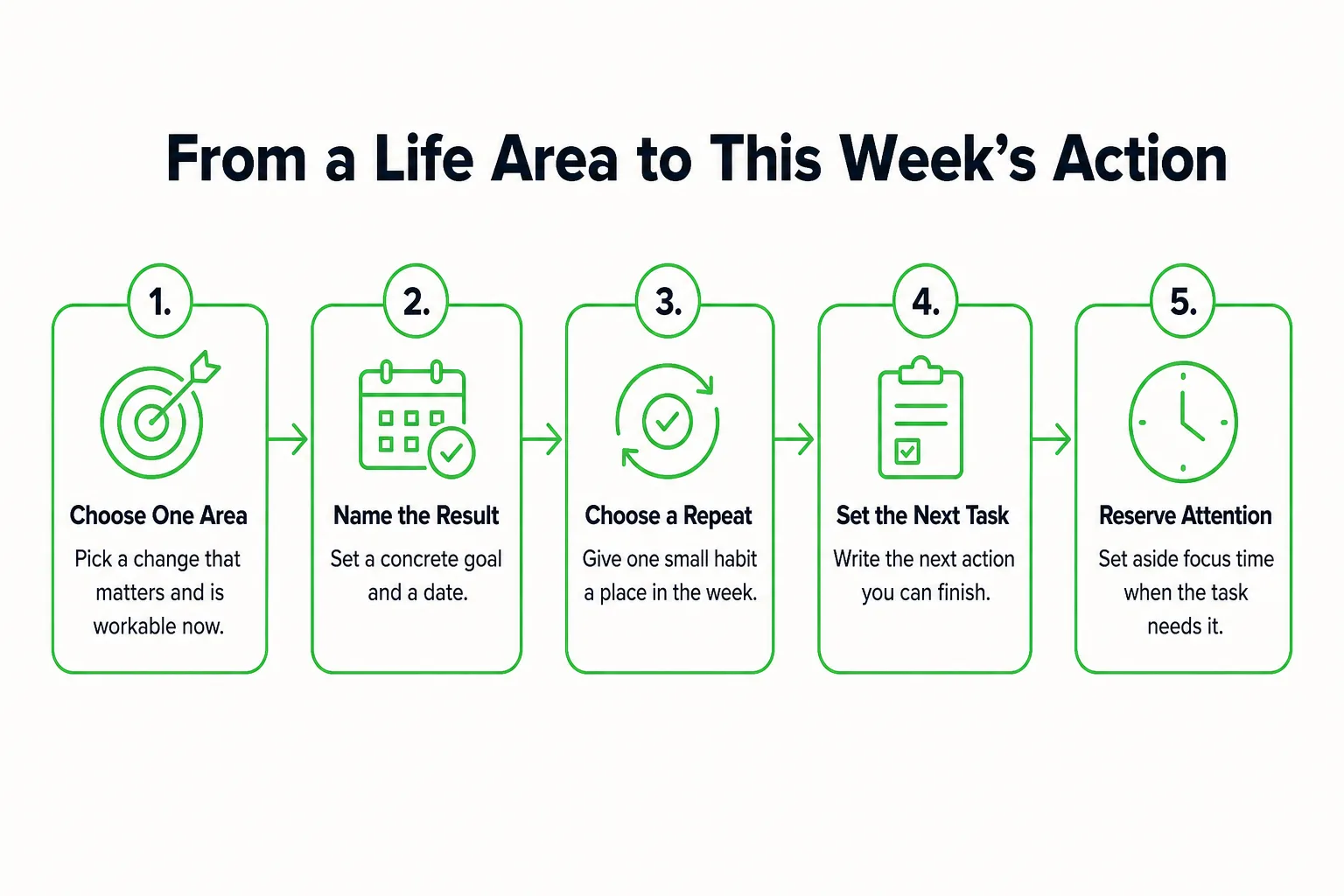
A useful category changes a decision in your ordinary week. Luis rates recreation a 4 because every evening becomes catch-up work. He wants to try four enjoyable activities over the next month, so he chooses one activity to arrange this week and protects a Saturday hour for it.
Copy this plan and fill it in:
- Category: Recreation
- Current Satisfaction and Reason: 4. Every evening becomes catch-up work.
- Goal and Date: Try four enjoyable activities over the next month. Review on: __________
- Weekly Habit: Protect one Saturday hour for an enjoyable activity.
- Next One-Off Task: Choose and arrange this week’s activity.
- Focus Session: Spend 15 minutes on Thursday making the arrangements.
- Busy-Week Minimum: Take a 20-minute walk with my camera.
- Review Date: __________
A goal names the result Luis wants. His weekly habit repeats, while choosing and arranging one activity is a task to finish once. The focus session reserves attention for making those arrangements. If the week gets crowded, the minimum gives him a smaller version of the action to do. Put the first action into the coming week before changing another category.
Set a Boundary When Life Areas Compete
The University of Florida notes that wellness categories can overlap, even when assessed separately. For example, accepting more work could improve career satisfaction while taking time away from sleep, relationships, or recreation.
Pair an improvement with a decision rule that protects what matters elsewhere. You might accept one additional project only if it fits within your existing work hours. Before you schedule it, name what time or commitment will change, which other category could lose out, and the boundary that will protect it. If the change affects shared responsibilities, agree on it with the other person before making the schedule.
Useful balance means making a deliberate allocation for the season you are in. It does not require every score to be equal.
Review Weekly and Compare Scores Monthly
Spend five minutes each week reviewing the action you chose. Ask what happened, what got in the way, and whether the next step should be smaller or scheduled differently. If you keep missing the action, adjust it so it fits the week you actually have.
Once a month, repeat your Wheel of Life assessment. Keep the same category definitions, 1-to-10 anchors, and past-month window so you can make a useful comparison. Save the date, each score, and a short note about what shaped it.
Treat a score change as a reason to look closer, not as proof of a lasting shift. Compare the explanations and circumstances across several assessments before drawing that conclusion. For example, a demanding work deadline may lower your recreation score this month; note when you expect your schedule to ease. If you split or rename a category, begin a fresh comparison under its new definition.
If you complete the action repeatedly but your satisfaction does not rise, reassess the action. It may be time to choose a different step or revisit what the category means to you.
Put Your Wheel of Life Priorities Into Loggd
Keep your category ratings and assessment notes on paper or in a note. In Loggd, carry over the actions from your recreation plan: create the goal of trying four enjoyable activities over the month, then add the Saturday hour as a recurring habit using a schedule that fits. Put this week’s activity arrangement on the task list, adding a tag or priority if that helps you find it.
Set a 15-minute focus session for Thursday to make the arrangements. Loggd connects tasks and focus sessions with goals, so the work stays together. Use the daily check-in to note how the action fits your day, including when the week makes it hard to follow the plan.
As you check off completed actions, they fill a grid of your last 365 days, giving you a visible record of daily progress. Keep that record separate from your satisfaction review: completed actions show what you did, while your next Wheel of Life assessment asks how satisfied you feel.
Use Loggd to track the goal, habit, and next task together. Loggd is free on iPhone, Android, and the web, with no credit card needed.
Wheel of Life Categories FAQ
What are 12 areas of life I can use for a Wheel of Life?
You could use career, finances, health, family, friends, romance, parenting, personal growth, spirituality, creativity, community, and fun and recreation. Treat these as a starting point, not a required list: combine areas that lead to the same rating and action, or separate them when they need different attention.
How is a Wheel of Life different from a wellness wheel?
Both are self-assessment tools that divide life into areas, invite you to reflect, and make the results visible. A Wheel of Life usually focuses on your satisfaction across the areas you choose, while a wellness wheel may use dimensions such as emotional and spiritual health. The labels vary by framework, so choose the one that helps you decide what to do next.
Can I complete a Wheel of Life without a life coach?
Yes. Choose categories, rate your satisfaction, and write down what each score means to you. Then select one area and turn it into a specific action for the coming week. A coach can offer guidance, but you can complete the assessment on your own.