
These five ways to achieve your goals turn an intention into work you can do: choose a clear target, set weekly milestones, schedule the next action, track progress, and adjust your plan. The examples below show how habits, daily tasks, and focus time fit together.
Each method answers a practical question: what counts as finished, what happens this week, what happens today, what progress is visible, and what needs to change. We’ll follow one goal throughout: publishing four edited writing samples in an online portfolio within 90 days. You’ll also get a way to respond when a day goes off plan, without assuming that steady effort guarantees a particular result.
Choose a Clear Goal That Fits Your Available Time
Start with the reason behind the goal. Wanting evidence of your writing ability for job applications gives portfolio work a clearer purpose than wanting to be more productive. A useful goal makes it easier to decide what deserves your time when other options compete for it.
Run a quick SMART check before you commit:
- Specific: What will you produce?
- Measurable: What will show that it is finished?
- Achievable: Can the work fit your actual schedule?
- Relevant: Why does it matter to you?
- Time-bound: By when will it be done?
For the portfolio example, the target is: “Publish four edited 600-word writing samples on a portfolio page within 90 days.” Finished means each sample is edited, accessible on the page, and ready to share. Indiana University of Pennsylvania’s guidance favors challenging but attainable goals. Use that as a reason to check the workload, not as a promise about what this particular plan will achieve.
Before setting the deadline, look at an ordinary week in your calendar. The writing plan reserves three 30-minute work sessions per week and a five-minute weekday check-in. If those blocks do not fit, change the pace or the target before you start.
Start with one main goal. Keep essential maintenance commitments, such as regular responsibilities, in view. Add another active goal only when its work fits into named time slots without displacing the first. Use the SMART goal worksheet to turn a vague aim into a target with a deadline and a clear finish line.
Copy and fill in this line:
By [date], I will finish [deliverable], measured by [finish condition], because [reason].
Give Each Week a Finish Line
Work backward from the final deliverable to the steps that need to be ready first. “First draft complete” is an outcome you can inspect. “Work on writing” describes an activity, but it does not tell you what will exist when the work is done. The CDC recommends breaking objectives into smaller tasks with their own deadlines.
Weekly milestones make a larger goal easier to check. You can see whether a draft, revision, or published page exists, rather than relying on a general sense of effort. Indiana University of Pennsylvania describes objectives as smaller accomplishments that move you toward a larger goal.
For the portfolio, the sequence might be to choose briefs, draft a sample, revise it, collect feedback, and publish the finished set. Write one visible finish condition for the current week, such as “four sample briefs chosen.” Then note any dependency. If revision requires feedback from a reviewer, decide when you will ask and when you need the response.
Leave buffer time near the deadline for feedback or corrections. Check intermediate milestones as you go instead of watching only the final date. Use the goal countdown timer to keep the next milestone date visible while you plan the work needed before it.
Should This Action Be a Habit, a Task, or Focus Time?
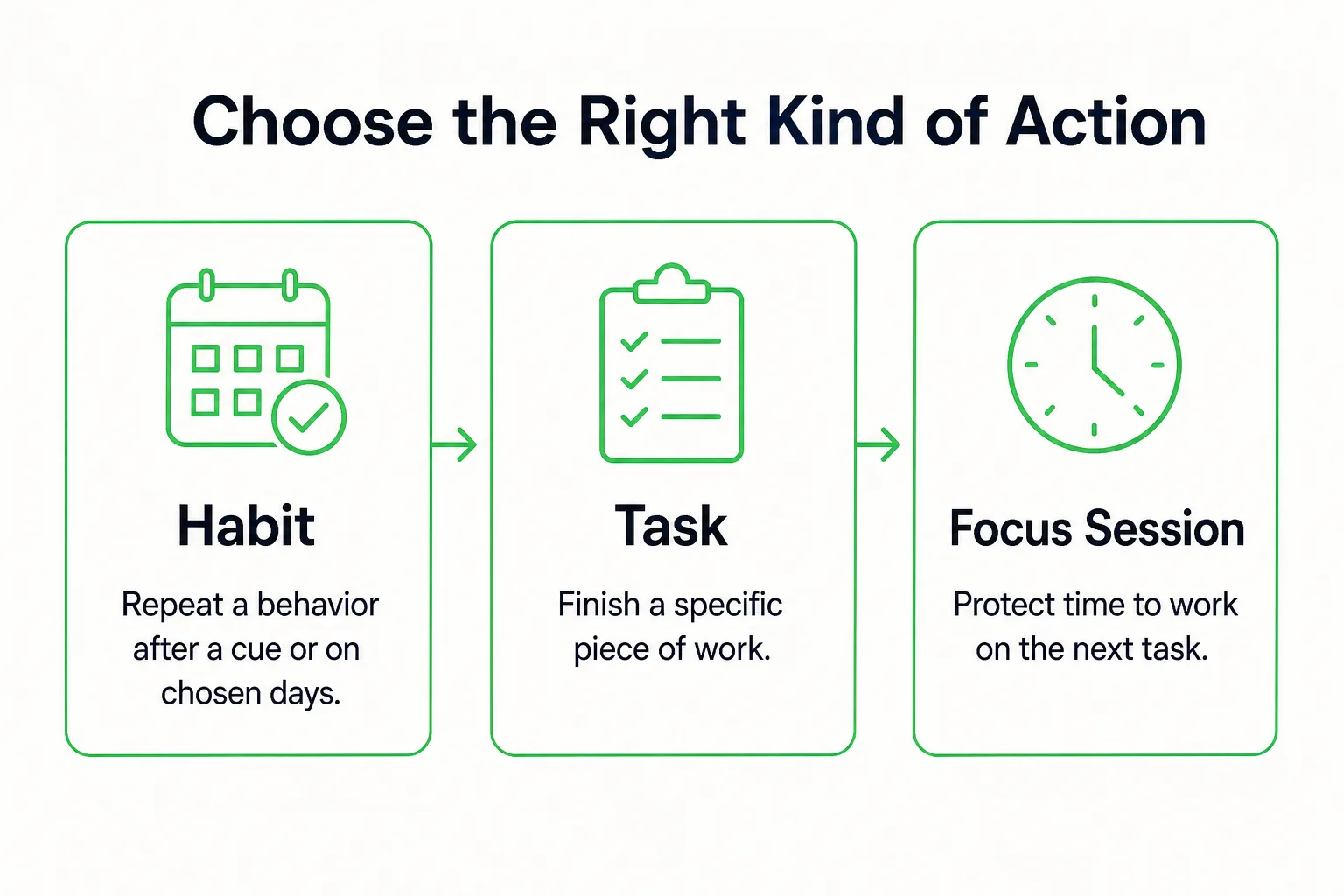
Before you schedule the work, decide what kind of action it is. Use a habit for a behavior you repeat, a task for something with a finish line, and a focus session for a protected block of time. They can work together: “Draft the opening paragraph” is a task, and a 30-minute session is the time reserved to do it.
| Type | Purpose | Finish condition | Writing-goal example |
|---|---|---|---|
| Habit | Repeat a small behavior on a schedule | You do the behavior on its scheduled day | After lunch on weekdays, spend five minutes choosing the next portfolio action. |
| Task | Produce a specific result | The deliverable exists, even if it takes more than one session | Write a 600-word first draft. |
| Focus session | Protect time to work without switching tasks | The work interval happened; inspect its output separately | Tuesday, 12:30 to 1:00 p.m.: draft the first section. |
For a habit, choose a cue that already belongs to your day. Copy this line and fill it in: “After [existing event], I will [small repeatable behavior].” Set the schedule around your actual workdays. If your weekdays vary, choose the days you can realistically keep rather than forcing the same routine every day.
Keep the records useful. A habit checkoff, a completed task, and a finished timer may all describe the same piece of work from different angles. Treat them as different information about one effort, not three independent achievements.
Put the Next Useful Action on Today's Schedule
Use this short sequence to turn the current milestone into a calendar entry:

- Check this week’s milestone and name what must exist by the end of the week.
- Choose the action that most directly creates that result.
- Write a finish condition you can see or check.
- Reserve a realistic work block for it.
If the milestone is a complete draft, drafting comes before adjusting the portfolio’s colors. The design may matter later, but it does not create this week’s draft. Make the priority match the finish line.
A useful daily entry is: “Tuesday, 12:30 to 1:00 p.m.: write the opening 200 words of sample one.” It names the work, the amount, and the time. Before you place it, check fixed obligations and your likely energy. An open space on the calendar is not automatically usable time if you need it for a commute, meal, or recovery.
Keep goal work separate from maintenance tasks. Returning a necessary message may belong on today’s list, but it does not have to become the main action for your goal. Choose one goal-moving priority first, then add smaller tasks if time remains. If urgent requests keep displacing that action, use these Eisenhower Matrix examples to separate what needs attention now from what deserves a protected slot.
Make the next action small enough to begin when its block starts. “Open the brief and draft the first paragraph” is easier to enter than “work on the portfolio.”
Make Progress Visible and Accountability Specific
Record both the actions you complete and the deliverables you finish. For the portfolio, you might note completed drafting sessions and edited samples ready to publish. Action records show whether planned work happened; deliverables show whether the goal is moving toward completion.
Those records point to different adjustments. If three focus sessions happened but there is no usable draft, inspect the task: perhaps the brief is unclear or the session needs a smaller target. If a session was missed because of a calendar conflict, the work may be fine; the time slot needs to change.
Visible evidence can help you see what you have done, name the next action, and get feedback on the actual work. Keep streaks in proportion. Ask what work a streak represents, and check milestone progress alongside it. A string of checkoffs is not the same thing as a finished sample.
Make accountability a clear agreement with another person: “On Friday, I will send Jordan the draft and ask which paragraph needs the most work.” That gives you a date, a deliverable, and a specific request. If sharing the work is unsuitable, keep a private weekly record of what you finished and what you will do next.
Use this step to capture evidence and arrange feedback. The weekly review is where you use that evidence to change the plan.
Review the Evidence and Adjust Next Week
At the end of each day, take two minutes to record what happened, note the next unfinished action, and check where it could fit tomorrow. A short close helps you start with a clear next step instead of reconstructing the plan from memory.
Set aside 15 minutes once a week to review your completed work, missed actions, and current milestone. Use this checklist:
- What finished this week?
- Which action moved the goal forward?
- What did I miss?
- What got in the way?
- What needs to change in the plan?
- What will count as next week’s finish line?
If you repeatedly miss a drafting session scheduled at lunch because meetings take that time, move it to a genuinely open slot. Copying the same session into the same conflict does not solve the problem. In its behavior-change guidance, NIDDK recommends tracking changes, reviewing progress, and revising the approach after setbacks. Apply that review pattern to your plan: use what happened to decide what to do next.
Change the action when the goal still fits but the current plan does not. If your available capacity no longer supports the goal’s scope or timing, revisit those too. Keep the target, milestones, and review notes together in a copyable goal-setting sheet if you prefer a written record.
Put the next review on your calendar, then choose next week’s main deliverable.
When a Day Falls Apart, Reschedule, Reduce, or Replace
Give a commitment a fallback action before you need it. When a day goes off plan, choose deliberately: reschedule, reduce, or replace the action.
Reschedule when the work still fits but its original time is gone. Move a missed drafting session to a named opening, such as Friday at 2 p.m., rather than adding it to an undated backlog.
Reduce when you have less capacity but can still do a useful part. Replace a planned 30-minute editing block with five minutes revising one paragraph. In health-behavior guidance, the U.S. Office of Disease Prevention and Health Promotion says small, manageable steps improve self-efficacy. Revising a paragraph is a practical smaller action for this writing example, not a tested writing intervention.
Replace when the planned action is blocked. If feedback has not arrived, format a finished sample or draft questions for the reviewer instead of waiting. Choose work that still supports the same milestone.
Whichever option you choose, connect it to the milestone you are trying to finish. If you need ideas for a repeatable fallback, adapt one of these two-minute micro habits to the action your goal requires.
Do not automatically double tomorrow’s workload. Check the time you actually have, then move, shrink, or remove the work on purpose.
A Complete 90-Day Example: Four Published Writing Samples
Renee wants finished writing to share with prospective clients. Her goal is to publish four edited 600-word writing samples on a portfolio page within 90 days. For this example, she has three 30-minute focus sessions each week and a five-minute weekday check-in after lunch. Adjust the scope, pace, and session length to fit your own work and calendar.
| Week or period | Finished output | Next action |
|---|---|---|
| 1 | Four briefs chosen; a place for drafts created | Outline sample one |
| 2 | Rough draft of sample one | Edit sample one |
| 3 | Sample one edited | Draft sample two |
| 4 | Rough draft of sample two | Edit sample two |
| 5 | Sample two edited | Draft sample three |
| 6 | Rough draft of sample three | Edit sample three |
| 7 | Sample three edited | Draft sample four |
| 8 | Rough draft of sample four | Edit sample four |
| 9 | Sample four edited | Gather feedback on the set |
| 10 | Feedback gathered | Make final revisions |
| 11 | Final revisions complete | Publish and check the portfolio |
| 12 | Portfolio published and checked | Fix any remaining issues |
| Days 85-90 | Time held for delayed feedback and corrections | Make needed corrections and confirm the page is ready to share |
In week two, her weekday check-in is the habit, the 600-word draft is the task, and the three protected 30-minute blocks are focus sessions. Monday’s five-minute check-in selects the outline. Tuesday’s session drafts the first 200 words. Wednesday’s session is displaced by a meeting, so Renee moves it to an open 30-minute slot on Friday. Thursday’s session adds the final 200 words, and Friday’s moved session adds the middle 200. At Friday’s check-in, she confirms that the rough draft exists and records the next editing task.
The move changes the timing, not the finish line. Renee still has the same rough-draft milestone for the week. At her weekly review, she records whether the draft exists, which sessions happened, why one moved, and whether the next milestone still fits. If feedback or a correction runs late, the final six days give her room to address it without pretending the work has already been done.
Keep Your Goal Actions Together With Loggd
Put the goal and its next actions in one place. In Loggd, add the 90-day target under goals, then enter each milestone deliverable as a task. Use priorities and tags to distinguish the next action from work that can wait. Tasks and focus sessions connect with goals, so you can see how a scheduled block relates to the result you want.
Add the weekday check-in as a habit, with a schedule that matches your actual workdays. Use the focus timer for the protected drafting blocks. Keep the habit small: it is a prompt to choose the next portfolio action, not a substitute for writing the sample.
Use the daily check-in to record progress. Each daily checkoff fills a space in the grid of your last 365 days, giving you a year-at-a-glance view of activity. The grid shows checkoffs, not whether a finished deliverable exists, so inspect the actual draft or published page at your weekly review.
Points, streaks, and badges can make returning to the work more engaging. Keep the finished sample as the milestone you are checking, and use gamification as an extra cue to come back to your plan. If you want a visual board for the milestones, use our goal bingo card generator to give each finished deliverable its own square.
Loggd is free on iPhone, Android, and the web, with no credit card needed. Start by adding the goal you already chose, then enter its next deliverable and schedule a time to work on it.
Questions About Choosing and Finishing Goals
What are some personal goals students can set for their education?
Choose a result a student can check, such as finishing a research paper by a set date, completing a study guide for an upcoming exam, or reading a course assignment each weekday. Break the result into weekly milestones, then schedule the next study task around classes, work, and other commitments. A useful goal fits the student’s actual week, not an imagined one.
What are some good life goals to have?
Good life goals connect to something you value and describe a change you can recognize in daily life. Examples include building a regular exercise routine, saving for a specific expense, developing a skill, or making more time for family. Choose one main goal first, define what finished means, and check that its actions fit the time you have.
What should I do after I achieve a goal?
Confirm what you completed, note what helped, and decide whether the goal needs a next stage or can be put aside. If you want to continue, set a fresh target with a new finish line rather than extending the old one by default. Then choose the next action and put it on your calendar.