Examples of goals include completing a course, saving for a planned expense, walking regularly, and spending more time with family. To make any of them usable, add a first action, a way to track it, and a date to review your progress.
The ideas below cover everyday life, work, career development, school, health, money, relationships, and personal growth. Borrow one example and adjust its target to your circumstances. The outcome and the action that supports it belong together: “save for a planned expense” gives you a finish line, while a weekly transfer gives you something to do next. You’ll find copy-ready wording and smaller starting versions throughout. Treat the library as a place to choose from, not a list you need to complete.
Step 1: Find a Goal You Can Use
A useful goal names a result you want and gives you a first move toward it. The 24 examples below are grouped by area, with a smaller starting version for days when the full target does not fit. Copy a row and change its amount, date, or frequency to suit your week.

University of Minnesota Extension defines SMART goals as specific, measurable, attainable, relevant, and time-bound. Use that as a quick reading aid: look for a clear result, a way to see progress, and a time frame that makes sense for you.
Everyday Life
| Goal to Copy | First Action | Track | Smaller Start |
|---|---|---|---|
| Clear one kitchen counter by Sunday. | Sort for 10 minutes after dinner. | Cleared sections. | Clear one tray. |
| Prepare lunch at home three weekdays a week for four weeks. | Choose two lunches and make a grocery list. | Lunches prepared. | Prepare one lunch weekly. |
| Establish a Sunday household reset for four weeks. | Schedule 15 minutes to review appointments and supplies. | Resets completed. | Check tomorrow’s appointments. |
Work
| Goal to Copy | First Action | Track | Smaller Start |
|---|---|---|---|
| Send the weekly project update by Thursday afternoon for the next month. | Reserve a 15-minute Thursday drafting block. | Updates sent on time. | Write three status bullets. |
| Finish a reusable checklist for one recurring task within two weeks. | List the steps during the next attempt. | Draft, test, and revision milestones. | Document the first three steps. |
| Send meeting decisions and assigned next actions within one workday for four weeks. | Reserve 10 minutes after each meeting. | Meetings with notes sent. | Do this for one recurring meeting. |
Career Development
Professional goals can concern skills, promotions, earnings, or a career change. Keep the target focused on what you can do, even when the eventual outcome depends on other people.
| Goal to Copy | First Action | Track | Smaller Start |
|---|---|---|---|
| Finish one relevant course module each week for six weeks. | Schedule a 25-minute learning session. | Modules finished. | Finish one lesson weekly. |
| Complete one portfolio sample within six weeks. | Choose the sample and draft its outline. | Outline, draft, and revision. | Make a one-page sample. |
| Hold two career conversations over the next month. | Send one specific invitation this week. | Invitations sent and conversations completed, separately. | Ask one question by email. |
School
| Goal to Copy | First Action | Track | Smaller Start |
|---|---|---|---|
| Raise my GPA from 2.8 to 3.2 by the end of the academic year. | Identify the lowest-performing course and schedule two 25-minute study blocks this week. | Assignment scores and term GPA, separately. | Do one study block and ask the instructor one question. |
| Submit the next four assignments one day early. | Add personal deadlines to your calendar. | Submissions made before those deadlines. | Submit the next assignment early. |
| Complete a five-minute closed-book review after three classes each week for four weeks. | Reserve the first session after class. | Reviews completed. | Complete one review weekly. |
Health and Wellness
Choose movement and food actions that fit your abilities and any medical guidance you follow.
| Goal to Copy | First Action | Track | Smaller Start |
|---|---|---|---|
| Walk for 10 minutes after lunch on three days each week for four weeks. | Choose the days and set out your shoes. | Walks completed. | Walk for five minutes once this week. |
| Keep a consistent bedtime window on four nights each week for two weeks. | Choose the window and set a wind-down reminder. | Nights within the window. | Try it on two nights. |
| Prepare one vegetable side for three dinners each week for four weeks. | Add one affordable option to your grocery list. | Dinners with a prepared side. | Make one side for one dinner. |
Money
| Goal to Copy | First Action | Track | Smaller Start |
|---|---|---|---|
| Save for a planned expense over 12 weeks. | Review your budget before scheduling a weekly transfer. | Amount set aside. | Choose an amount that fits after essential expenses. |
| Record discretionary purchases for 14 days. | Make a two-minute entry each evening. | Days recorded and total spending. | Record one spending category. |
| Review recurring charges and make keep-or-cancel decisions by month-end. | Open your latest account statement. | Charges reviewed and decisions completed. | Review one charge. |
Relationships and Family
| Goal to Copy | First Action | Track | Smaller Start |
|---|---|---|---|
| Have one phone-free meal together each week for a month. | Agree on a day. | Meals shared. | Have a 10-minute conversation. |
| Contact a friend once a week for four weeks. | Choose a person and send a message. | Outreach made, not whether the person responds. | Send one message this month. |
| Share a household planning conversation each Sunday for four weeks. | Agree on a 15-minute time slot. | Conversations held and decisions made. | Resolve one scheduling question. |
Personal Growth
| Goal to Copy | First Action | Track | Smaller Start |
|---|---|---|---|
| Read one chosen book over four weeks. | Schedule a 10-minute reading block. | Pages read and book finished. | Read for five minutes twice weekly. |
| Practice a chosen hobby for 15 minutes twice a week for six weeks. | Prepare materials and book the first session. | Sessions and one finished piece. | Practice for five minutes weekly. |
| Write a three-sentence reflection on three evenings each week for a month. | Choose a cue and leave a notebook nearby. | Entries completed. | Write one sentence once weekly. |
For more detail on adapting an individual example, use the personal goal-setting examples.
Step 2: Choose What Fits Your Week
Start with one main goal and one lighter supporting goal. That is a practical way to keep your week manageable, not a rule about how many goals you can pursue.
A useful goal needs a decision you can carry out during an ordinary week. A course, an exercise routine, and a household project might all matter, but each could compete for the same evening. Choose the one whose next action has a real place in your schedule.
Use this checklist to decide:
- Identify the need that feels most pressing.
- Name the time or money the goal requires.
- Check next week’s actual commitments.
- Choose the goal whose next action fits the space you have.
- Ask: What changes if I finish this?
- Ask: What time or money will I use?
- Ask: What will I postpone to make room?
For students, the APA says short-term, specific, moderately challenging goals support motivation more than distant, general, overly challenging ones. That finding supports choosing a manageable academic target; it does not settle how many goals to choose in every area of life.
Keep appealing ideas on a later list with a date to review them. That lets you return to a goal without turning every good idea into an active commitment. Write down your chosen outcome, available time, and review date on the goal-setting sheet.
Step 3: Make the Starting Version Fit Your Limits
Use the Smaller Start column to bring a goal within your current schedule, budget, and energy. Keep the smaller action connected to the result you want, so it still moves the goal forward.
If time is tight, shorten the session. If money is tight, start with an action that costs nothing, such as reviewing your budget before setting a savings target. If motivation is low, prepare what you need ahead of time and choose a clear cue, such as starting after breakfast.
For example, suppose you want to finish one relevant course module each week for six weeks, but weekday study is unavailable. Make the starting version one short lesson on Saturday. Try that for two Saturdays, then review whether you can add another session. Keep the target small enough to fit before you expand it.
Savings targets need a date that matches the amount you can afford. If a weekly transfer does not fit your budget, choose a smaller transfer and rewrite the goal with a later completion date. Do not keep a deadline that depends on money you cannot set aside after essential expenses.
For a relationship goal, scale your own invitation or outreach. You can send one message or suggest a short conversation, but you cannot set another person’s response as your measure of success.
A reduced ongoing target is different from a fallback action for an unusually difficult day. You might plan one lesson each Saturday, with five minutes of reading as a fallback when the day goes badly. If the first action still feels too large, borrow a starting action from these two-minute habit examples.
Step 4: Put the First Action on Your Schedule
A goal is the result you want. For a portfolio sample, the goal might be to finish one sample within six weeks. Choosing its topic is a one-off task. Practicing the relevant skill can be a recurring habit. Drafting the sample can happen in a timed focus session.
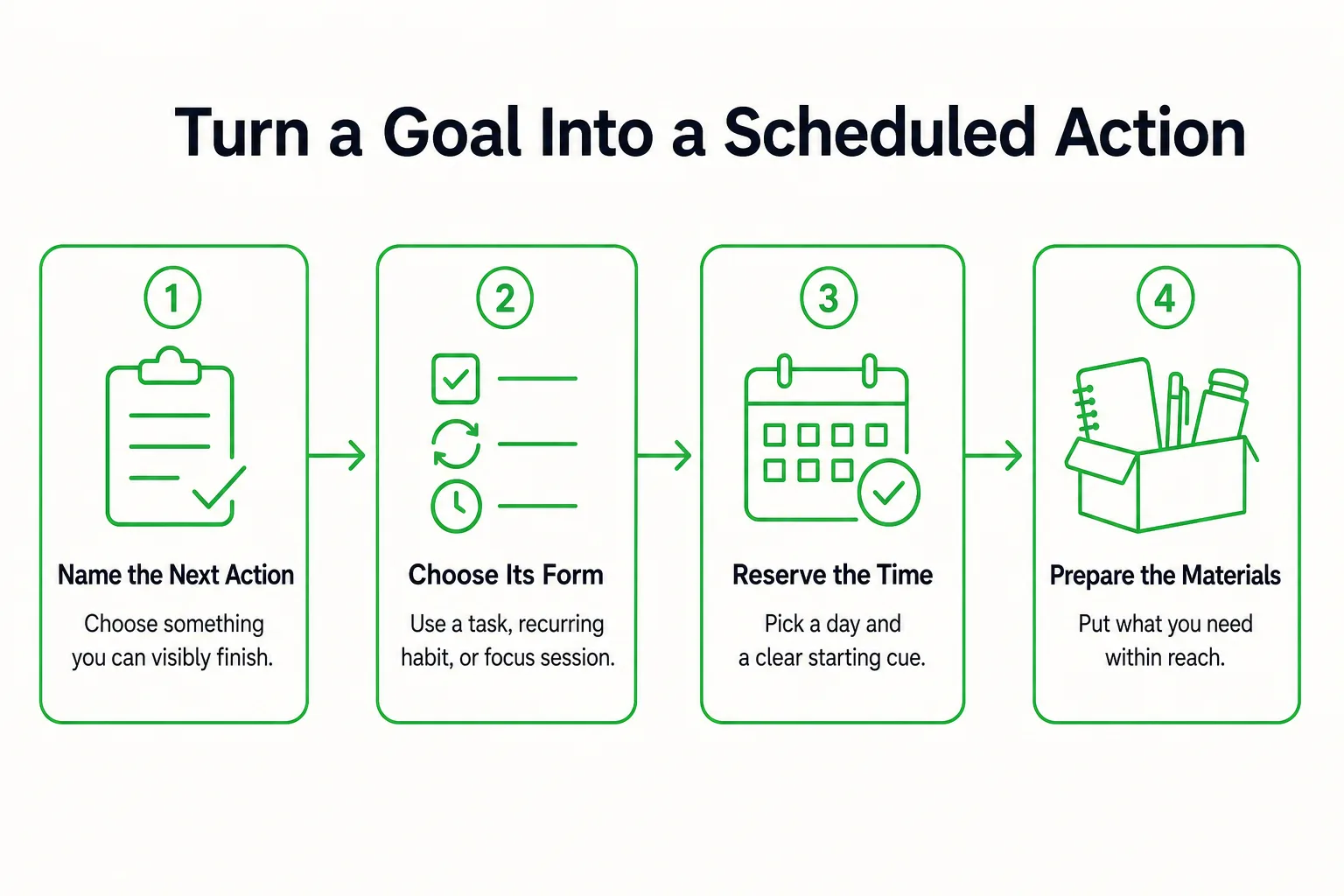
- Name the next visible action. Choose something you can start and finish, such as outlining the sample. An NIH example changes “read papers on chemotaxis” to reading three review papers on chemotaxis. The bounded version gives a session a recognizable finish.
- Choose a task or recurring schedule. Add a one-off task if the action only needs to happen once, or set a recurring time for practice you want to repeat. If an existing routine would make the action easier to remember, use the habit-stacking examples to choose a cue.
- Reserve the first session. An NIH researcher describes breaking large goals into tasks lasting 30 minutes to four hours. Choose a shorter starting session if that is what you can schedule. Put the day and time on your calendar.
- Prepare what the session needs. Use this sentence to make the plan concrete: “On [day], after [existing event], I will [specific action] for [time] using [materials].” For example: “On Saturday, after breakfast, I will outline my portfolio sample for 20 minutes using my project brief and a blank document.” Open the document before you start, then draft three headings: Problem, Approach, and Result.
Step 5: Track the Measure That Matches the Goal
The result you want and the action that supports it may need different measures. Choose one primary measure of progress and, when it helps, one measure of the supporting action. A finished portfolio sample, for instance, can be tracked by milestones, while the practice sessions that help you make it can be tracked by frequency or duration.
| Measure | Use It When | Example | Review Question |
|---|---|---|---|
| Outcome | You want a defined result. | Save for a planned expense. | How much remains, and does the current contribution fit the deadline? |
| Frequency | You repeat an action. | Walk three times each week. | How many planned opportunities did I complete? |
| Duration | You practice for a set amount of time. | Practice a hobby for two 15-minute sessions. | How much time did I complete, and what did I practice? |
| Milestone | You are completing a project in stages. | Finish the portfolio outline, draft, and revision. | Which stage is complete, and what is blocking the next one? |
Daily checkmarks alone do not tell you whether a project is finished. An outcome measure alone does not tell you what action to take today. Pair the two when needed: track portfolio milestones as the main progress measure and scheduled drafting sessions as supporting activity.
For savings, make a weekly contribution for 12 weeks toward the planned expense. If you miss a week, calculate the amount left and choose a date that fits the remaining contributions. A streak can show consistency, but it is not the savings balance. For a goal with a fixed deadline, the goal countdown timer can show the time remaining while you track the actual work separately.
Step 6: Adjust After Missed Days
Start with the next scheduled opportunity. Before changing your goal, look at what prevented the last attempt. One missed session may call for nothing more than returning to the plan. A repeated problem may mean the plan needs to change.
- One interruption: Resume at the next planned session.
- The same time slot keeps failing: Move the action to a time you can protect.
- The action feels too large: Reduce its size or frequency, then review the smaller target.
- The reason for the goal has changed: Replace it with a more relevant goal or close it.
Jordan planned to study during two weekday evenings, but missed both sessions. The issue was the unreliable evening slot, not a lack of progress or commitment. Jordan moves one short lesson to Saturday morning and checks after two weeks whether that schedule works.
If a missed action affects a deadline, choose deliberately: extend the date, narrow the result, or make time by changing another commitment. Keep the original record and note the change. That way, a later review can show what you tried and what you adjusted. Restarting a streak does not erase money saved, lessons completed, drafts finished, or other progress already made.
At the end of the week, ask: “What got done, what got in the way, and what will I change before the next session?”
Turn Your Chosen Goal Into Daily Work With Loggd
Use the portfolio sample from your goal list as the thread connecting your plan to your daily work. In Loggd, set up the portfolio sample as a goal, then add the next one-off task, such as choosing its topic, to the task list. Choose a flexible schedule for related skill practice, and use the focus timer for a drafting session. Tasks and focus sessions connect with goals, keeping that work together.
Keep the project’s milestones visible: outline, draft, and revision. Checking off daily activity fills Loggd’s grid of your last 365 days, giving you a year-at-a-glance view of your activity. That record can sit alongside the milestones, but checkmarks show activity, not proof that the finished sample meets your aim.
Use the daily check-in to notice whether the next scheduled action still fits your day. Then make the weekly decision yourself: keep the plan, adjust it, or choose a different next step. The point is to keep the goal connected to work you can actually do.
Loggd is free on iPhone, Android, and the web, with no credit card needed. If you want a separate card of finishable milestones, create one with the goal bingo card generator. This browser tool needs no signup and saves privately on your device.
Enter one goal and schedule its first session.
Questions About Choosing Goals
What are five good goals in life if I want one balanced starting set?
Choose goals that matter in different parts of your life and fit the week you have. For example: walk for 10 minutes after lunch twice a week, save each week for a planned expense, have one phone-free meal with someone close to you each week, read for 10 minutes twice a week, and complete one useful work or school task before its deadline. Treat these as options, not a set you need to take on all at once.
What are good work goals for a 2026 performance evaluation?
Choose goals that describe a result you can influence and a measure you can review. Examples include sending a weekly project update by Thursday afternoon, completing a reusable checklist for a recurring task, or sending meeting decisions and next actions within one workday. Add a deadline and a review measure that match your role, and agree on expectations with your manager where needed.
How can I write an annual goal when my priorities may change?
Set an outcome and an initial review date, then plan the next action you can take now. Review the goal regularly and update its target or date if your circumstances change. Keep a note of what changed so the record reflects both the original plan and the decision you made.
Sources
- Getting started with woodland stewardship
- How to Set Professional Goals for Yourself (With 11 Examples)
- Academic Goals Examples
- Motivation
- Using SMART Goals to Make Scientific Progress