
An annual progress review checks what you achieved, what got in the way, and what deserves your time next year. Set aside 70 minutes to review your records, make decisions about unfinished goals, and write an action plan.
For a personal or professional review, look at goals, habits, daily routines, completed work, and development needs. An academic review may also assess degree requirements, research, and dissertation progress. If you are completing a university review, follow your program’s form and deadlines.
Use a notebook or document, along with records you already have, such as calendar entries and task lists. The five timed steps below are designed to fit in one sitting; adjust the pace if you need more time.
Gather Evidence of Your Progress
Set aside 10 minutes to collect evidence before deciding how the year went. Gather the goals you started with, calendar entries, completed tasks, work samples, habit records, and relevant feedback.
For each objective, note the result you intended, what actually happened, and the evidence you can point to. Keep completed milestones separate from work still underway. Include achievements that were not on your original list, too, such as finishing an unexpected project or developing a skill your changing responsibilities required.
If records are missing, write down what you can verify and mark the rest as uncertain. Avoid filling gaps by reconstructing precise totals from memory. The point is to see what the evidence supports, not to make the year look neater than it was.
Use the year in review generator if you want a place to work through your personal annual reflection. As you gather your notes, ask: What did you finish? What changed because of your work? Which original objectives became less relevant?
Check What Your Ordinary Week Allowed
Spend 15 minutes checking the conditions behind your results. Review your routines, workload, energy, and unfinished commitments rather than treating every missed goal as the same problem. Habit records can help you identify what is working and what needs to change.

For each habit, compare the occasions you completed it with the occasions you intended to practice. Use the schedule you chose, such as three walks a week, rather than assuming every habit should happen daily. Then ask when you had usable time, which commitments competed for it, which tasks repeatedly carried over, and when your energy matched the work.
Check what may have been behind an unfinished goal. Was there available time but no action? Was the target larger than the time you had? Were too many commitments competing? Or did the same obstacle in your working method keep getting in the way? These checks help you choose a response; habit records alone do not establish why something happened.
Plan for the week you usually have. Choose a workable time, a smaller fallback action, and a restart point after a missed day. Finally, ask what training, feedback, tools, or practical support would address the obstacle you found.
Continue, Stop, Revise, or Replace Each Goal
Spend 10 minutes giving each unfinished goal one decision and a short reason based on the evidence you gathered. Choose continue, stop, revise, or replace. Choose goals that are personally driven rather than based on others' expectations.
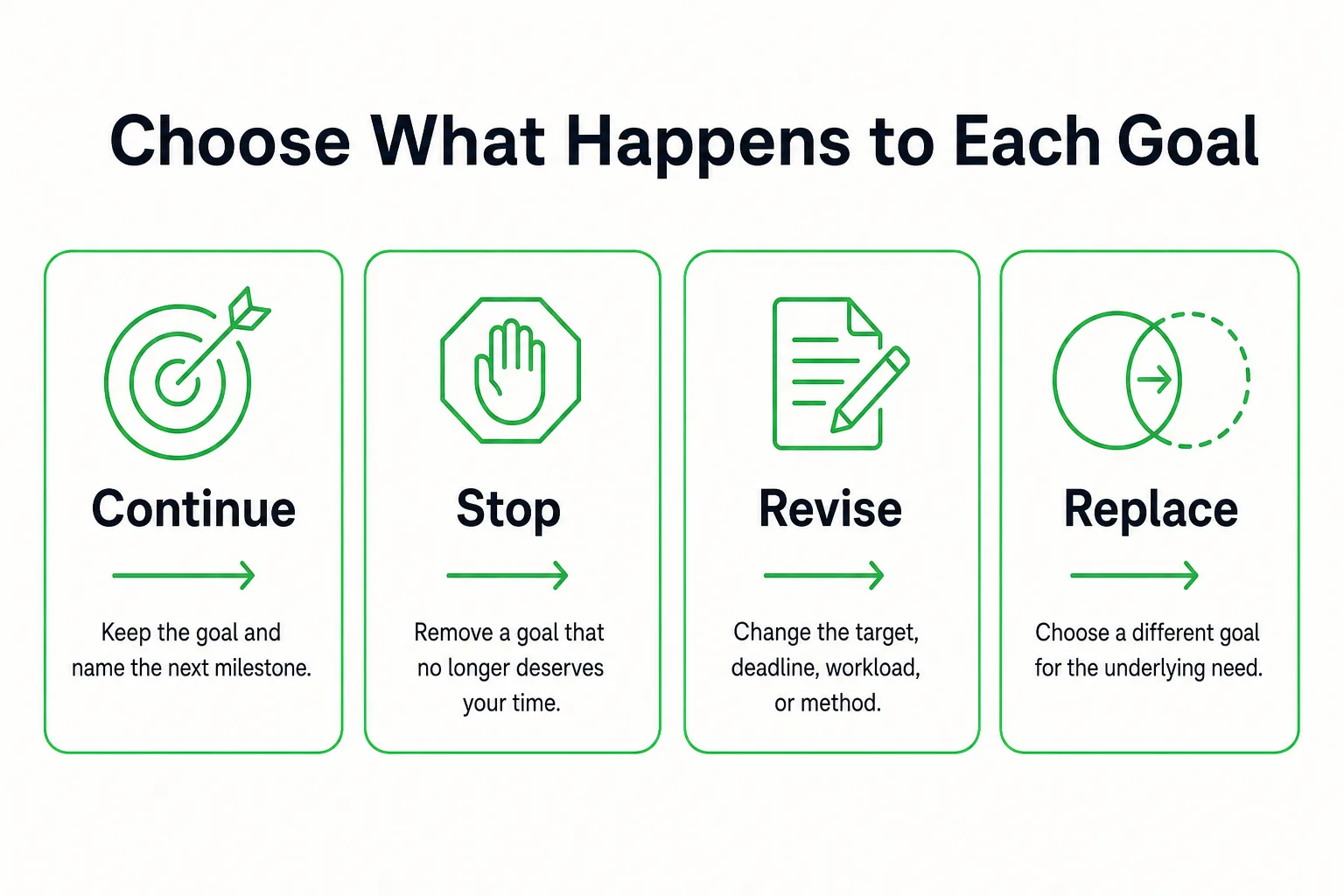
- Continue when the outcome still matters and the approach fits your available time. Name the next milestone.
- Stop when the outcome no longer deserves space in your plan. Remove its remaining tasks and recurring reminders.
- Revise when the outcome matters but the target, deadline, workload, or method needs to change. State the change instead of writing “try harder.”
- Replace when the underlying need remains but a different objective would serve it better. For example, replace attending every networking event with arranging one relevant professional conversation each month.
Before adding a revised or replacement goal, decide what will leave your schedule. Keep a short list of active goals instead of carrying every old commitment forward.
Turn Your Decision Into a Next-Year Action
Spend 20 minutes turning each active goal into a plan. Name the outcome, how you will measure it, its deadline, the first action, and where it fits in your week. Make the objective specific, measurable, achievable, relevant, and time-bound.
Say your goal was to improve your portfolio by publishing four case studies. Your records show one published piece and two unfinished drafts, and your calendar has room for one 30-minute session each week. Revise the scope: publish one of those unfinished case studies by March 31.
Set three milestones:
- Outline the case study by January 31.
- Complete a draft by February 28.
- Publish it by March 31.
Schedule a 30-minute session each Tuesday. Your first action is to select the draft and outline its headings. If you miss a session, resume the next Tuesday. If missed sessions keep recurring, adjust the scope or deadline to fit the time you have. For a timed work block, follow the focus timer setup guide to prepare your next session.
Write Your Progress Report and Set a Check-In
Spend 15 minutes turning your notes into a short progress report. Write five plain paragraphs: achievements and evidence; missed milestones and obstacles; lessons and development needs; decisions about goals; and next actions with review dates.
For a work review, add the support or feedback you need from a manager or collaborator. Share the report before a meeting if that would help, and ask what needs correcting, which priority should come first, and what support you can agree on. For a private review, keep the same structure and record the decisions yourself. Sharing the report is optional.
Frequent progress checks are associated with a greater chance of reaching a goal. Set a brief weekly appointment to inspect your next action and any obstacles. Use the weekly review checklist to give that appointment a structure. If unfinished commitments need a fuller review, follow the GTD weekly review guide.
Put the first action and your next check-in on your calendar.
Annual Progress Review Questions
What Is the Difference Between an Annual Review and a Progress Review?
An annual review looks back over a year to assess achievements, habits, workload, and lessons, then sets priorities for the year ahead. A progress review checks how work is moving toward specific goals or milestones; it can happen at any point in the year, not just at year-end. In practice, an annual progress review combines both: it examines what happened and uses that evidence to decide what to do next.
Sources
- Graduate College Bulletin - Program Annual Review of Student Progress
- 3 Steps to Building a Healthy Habit
- SMART Goals for the New Year
- Frequently Monitoring Progress Toward Goals Increases Chance of Success