
The most useful personal why statement examples connect something you do with a difference you want to make. For example: “To make complicated ideas clear so people can make informed choices.” You can borrow that structure without borrowing someone else’s purpose: choose a contribution that feels like yours, then name the impact you hope it has.
Below are examples for six life roles, a short exercise to draft your own sentence, and a way to practice it in ordinary choices. CUNY’s management text describes personal mission and vision statements as a way for job seekers to identify their core values and beliefs.
Personal Why Statement Examples for Six Life Roles
Your contribution is the action you bring. Your impact is the difference you hope that action makes. These examples pair the two; use them to find wording that fits your own life, not to copy a role’s sentence as a label.

| Life role | Personal why statement | Contribution | Impact |
|---|---|---|---|
| Student | To ask thoughtful questions and share what I learn so difficult subjects feel more approachable. | Questioning and sharing | More approachable learning |
| Parent | To offer steady attention and honest guidance so my children feel supported as they become independent. | Attention and guidance | Supported independence |
| Career changer | To turn my experience into practical help so people facing unfamiliar work can move forward with confidence. | Practical help | Confidence with unfamiliar work |
| Creator | To tell honest stories so people feel less alone in experiences they struggle to explain. | Honest storytelling | Recognition and connection |
| Manager | To make expectations clear and remove obstacles so people can do work they are proud of. | Clarity and support | Work people value |
| Health-focused person | To care for my strength and energy so I can take part in the people and activities that matter to me. | Caring for physical capacity | Participation in daily life |
A life role is an entry point, not a promise to keep one sentence forever. Select the contribution and impact that feel true in your circumstances; your why can change as your responsibilities and priorities change.
Check Whether Your Sentence Explains Why
A why statement explains an action you bring and its intended impact. Check whether your sentence does that, or whether it only names an achievement, responsibility, quality, or picture of the future.
| Starting sentence | What it names | Why-focused rewrite |
|---|---|---|
| Become a manager | A goal or achievement | To make work clearer and more supportive so others can contribute with confidence. |
| Prepare weekly reports | A job responsibility | To make information understandable so people can make informed decisions. |
| Integrity | A value | To speak honestly so others can make choices with reliable information. |
A goal names something you want to reach; a why describes the contribution and impact behind your choices. In everyday use, a personal mission often means what you commit to doing, while a personal vision often describes a future you hope to help create. People use these terms in overlapping ways, so focus on what the sentence helps you understand or choose.
For graduate applications, Berkeley describes a statement of purpose as covering preparation, academic interests, and future career goals. That kind of statement serves an application, while a personal why can guide choices across your life.
Find Your Why in Three Specific Experiences
Start with memories, not an ideal description of yourself. A CUNY exercise starts with four or five recent personal successes before looking for common themes. Use these three prompts as a practical way to gather your own examples.
- Think of a time you helped someone through a difficulty.
- Recall a time you felt absorbed in useful work.
- Remember something worthwhile you did without recognition.
Copy this worksheet and fill it in for each moment:
Moment 1: Helping someone through a difficulty
What happened: ___. What I did: ___. Who or what benefited: ___. What mattered to me: ___
Moment 2: Absorbed in useful work
What happened: ___. What I did: ___. Who or what benefited: ___. What mattered to me: ___
Moment 3: Worthwhile work without recognition
Context: ___. My response: ___. Who benefited: ___. What mattered to me: ___
Berkeley’s application-writing guidance recommends supporting conclusions with specific instances. A concrete memory gives your draft something to refer back to, instead of relying on a broad claim about who you are.
Circle actions and effects that repeat. Look for verbs such as “explained,” “listened,” “organized,” or “repaired” instead of a broad word like “empowered.” Then use this fill-in-the-blank formula: To [contribution] so [intended impact]. For example: “To explain unfamiliar processes so people can take their next step.” Read your sentence aloud and remove wording that adds no meaning. Keep one contribution and one impact. If you are stuck on what you contribute, use the personal SWOT worksheet to name strengths you can connect to an actual memory.
Turn Your Why Into a Week You Can Practice
A why becomes useful when it changes an ordinary decision. Take the manager’s statement: “To make expectations clear and remove obstacles so people can do work they are proud of.” Here is one way to put it into a real week.
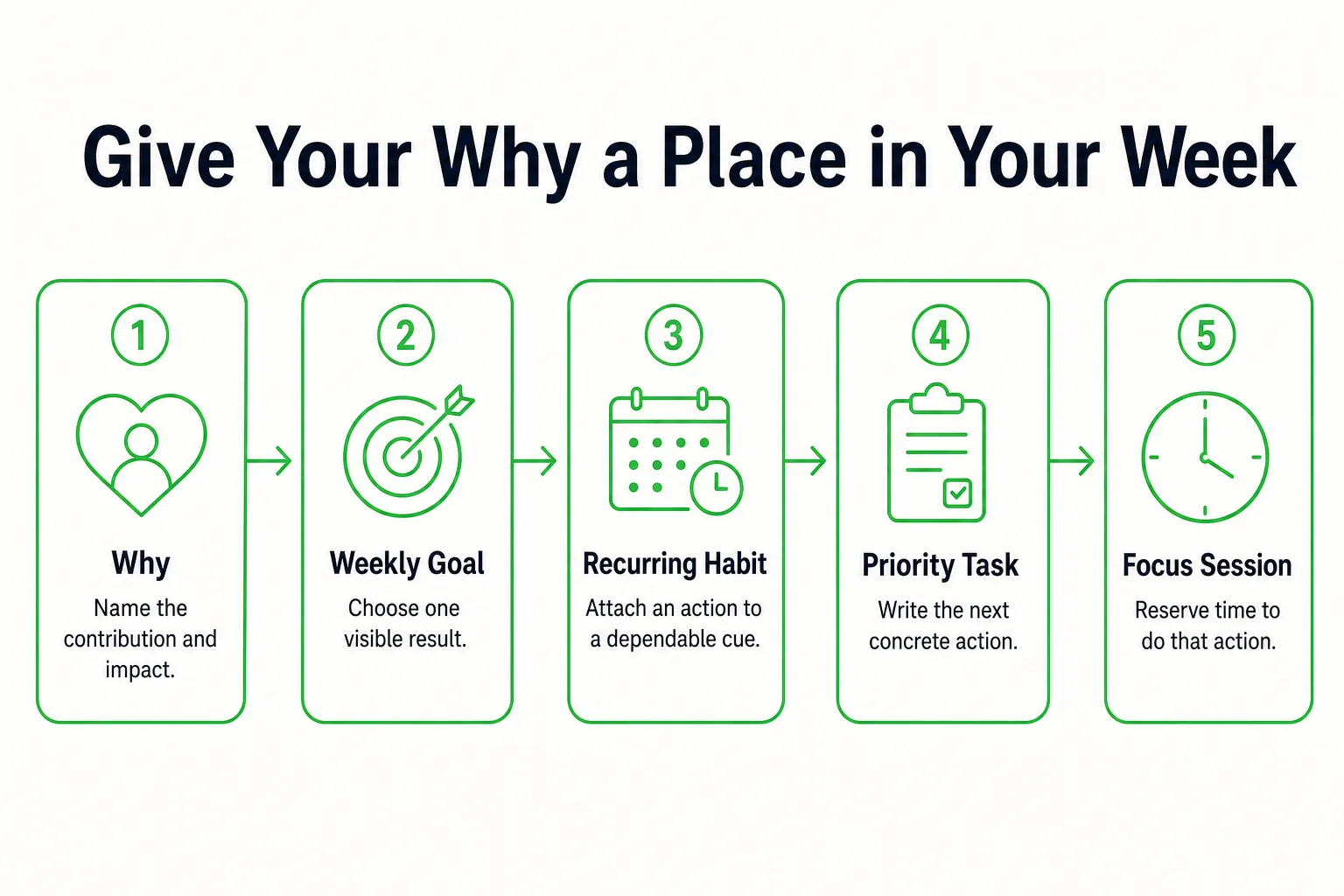
- Set a weekly goal: Make the handoff for one shared project clearer. The visible result is a short checklist, agreed on with the teammate who will use it.
- Choose a recurring habit: After Monday planning, ask, “Which unclear expectation needs attention this week?” If Monday planning gets missed, ask the question at the next workday’s planning session.
- Name a priority task: Draft the checklist and ask the teammate to flag missing information.
- Reserve focus time: Set aside 20 minutes to draft the checklist. By the end of the session, produce a first version with the project steps, owner for each step, and any information the next person needs.
Berkeley advises applicants to demonstrate traits through examples; use that same question here: what action would make your sentence visible? This is an application of writing advice, not a research finding about purpose. If you need help defining the visible result, browse personal goal-setting examples. If you need a dependable cue for the recurring action, see these habit-stacking examples.
Test and Refine Your Why Over 30 Days
Treat 30 days as a practical review window, not a deadline for discovering a final purpose. On day 1, write your current statement. At the end of each week, note one choice that aligned with it or conflicted with it. On day 30, review the wording against those notes.
For each note, record the situation, the choice you made, and how the statement helped or failed to help. The aim is to see whether the wording gives you useful direction, not to count completed actions as a measure of your worth.
Use this checklist when the sentence does not fit:
- Too broad: Replace “make the world better” with a contribution and a person or situation you can picture.
- Negative: Replace “stop being unreliable” with an action, such as following through on clear commitments, then name who benefits.
- Vague: Replace “be my best self” with an observable verb and an intended effect.
- Disconnected from daily choices: Test the sentence against a real decision about time, attention, or responsibility. Revise wording that gives you no direction.
At day 30, keep language your notes support. Adjust wording that repeatedly misses your everyday life, then choose the next action you want to practice. If your sentence describes only work while important commitments sit elsewhere, use the Wheel of Life assessment to identify an overlooked area before revising.
Put Your Personal Why Into Practice With Loggd
Use the manager example to carry your statement into a working week: “To make expectations clear and remove obstacles so people can do work they are proud of.” Start by deciding what that looks like on one shared project. If you want help shaping the wording first, try the personal mission statement builder, a free browser tool that needs no signup and saves privately on your device.
- In Loggd, create a weekly goal to make the project handoff clearer. Define the result as a short checklist agreed with the teammate who will use it.
- Add a recurring habit: after Monday planning, ask which unclear expectation needs attention this week. Give it a flexible schedule that fits your workweek.
- Add “Draft the handoff checklist and ask my teammate to flag missing information” to your task list. Set its priority so it has a clear place among your other work.
- Set aside a 20-minute focus session to draft the checklist. The session should produce a first version your teammate can review, not a finished process for every project.
- Use the daily check-in to consider whether your work reflected the contribution in your statement. Tasks and focus sessions connect with goals, but the statement itself remains your guide for choosing what to do.
Daily checkoffs fill a grid of your last 365 days, giving you a view of recorded activity, not a score for purpose or meaning. If you only need a browser timer for the drafting session, use the free stopwatch. Loggd is free on iPhone, Android, and the web, with no credit card needed.
Personal Why Statement Questions
What are some examples of personal vision statements?
A personal vision statement describes a future you hope to help create. For example: “A community where people can find clear, practical support when they need it.” Your why can explain how you contribute to that future, such as by making useful information easier to understand.
Can I have more than one personal why statement?
You can write different statements for different parts of your life, such as family, health, or work. Start with the one that helps you make a current decision, then see whether it also fits your other commitments. If the statements point in different directions, that can be a reason to revisit what matters most right now.
Should my personal why statement stay private or be shared?
Either choice can work. Keep it private while you are drafting if that helps you write honestly, or share it with someone who can give useful feedback. If you share it, explain the contribution and impact you mean so the wording is not left to guesswork.
Personal Why Statement Questions
What are some examples of personal vision statements?
Use a vision statement as a test for your why: the why should show how your choices support the future you want to help create.
Can I have more than one personal why statement?
A statement becomes useful when it helps you choose between competing commitments. Read it against your calendar and notice which choices it clarifies.
Should my personal why statement stay private or be shared?
After drafting, read the statement aloud and remove any phrase you would not use in ordinary conversation. The clearest version is usually easier to remember and apply.