
A personal energy tracker records how energized you feel so you can choose when to tackle demanding work and when to handle lighter tasks. Start with a free energy tracker, a consistent morning-and-evening check-in, and a weekly review that changes your schedule.
This tracks your personal energy, not the electricity your home uses. The useful result is a decision about today's work, not a score to maximize. Fatigue means weariness, tiredness, or lack of energy; a tracker is a way to notice patterns, not a health assessment. Use the free energy level tracker to begin recording your observations, then follow the check-in routine below.
Choose an Energy Tracker You Can Use Comfortably
Choose a Method That Fits
If you want to understand personal energy and productivity without a wearable, start with manual tracking. You can record what you notice and add context instead of relying on a device’s calculated score.
| Approach | What you record or receive | What you can use it for | Privacy checks |
|---|---|---|---|
| Paper energy journal | Your own energy ratings and notes | Compare how you feel with your day’s tasks and routines | Consider where you keep the journal and who can access it |
| Manual digital tracking | Your own entries in a browser tool or account-based app | Review entries over time and add context alongside ratings | Check where entries are stored, who they may be shared with, and how to delete them |
| Health-device-based tracking | Measurements and calculated scores, depending on the device | Review the signals that device collects alongside your own observations | Check permissions, data sharing, storage, and deletion controls |
Our free browser tools require no signup and save privately on your device. That storage description applies to those tools, not to the Loggd app. Before entering sensitive notes in any app, check its storage, sharing, and deletion controls, along with the permissions it requests.
One study found a disconnect between wearable metrics and people’s own understanding of their energy, particularly during travel, illness, or menstrual-cycle changes. That finding comes from that study; it is a reason to keep your own context in view, not a claim about every device or user. Choose a method that leaves room for a brief note, so a calculated score does not have to explain how you feel.
Use the Same Morning and Evening Check-In
Make Morning and Evening Check-Ins
Use the same simple routine each day. It should take about a minute, and you can do it without a wearable or a complicated setup.

- Attach the morning check-in to a cue you already have, such as finishing breakfast.
- Record the fields in the template below. In the morning, note the previous night’s sleep and the workload you expect that day.
- Repeat the check-in in the evening. Record the workload the day actually required.
- Add a short context note if something unusual happened, such as a late meeting or a disrupted night.
Copy this template for each check-in:
Date and time:
Energy (1 to 5):
Mood (one word):
Sleep duration and how rested I feel:
Planned workload (morning) or actual workload (evening):
One context note:
Use the same energy scale every time: 1 means depleted, 3 means steady, and 5 means energized. Keep mood separate. A pleasant day with little energy is different from a day when both mood and energy feel low.
For example: “Morning: 4, calm, about 7 hours, rested, proposal plus meetings.” “Evening: 2, frustrated, workload heavier than planned, meeting ran late.” These are useful entries, not evidence that any one circumstance caused a particular energy level.
If you want to locate useful work periods more precisely, add a brief rating before a demanding task. Keep the regular morning and evening entries as your baseline.
Match Task Demands to the Energy You Have
Start with the work that matters most today, then match it to the energy you have. A small plan you can adjust is more useful than assigning every task to an ideal hour.
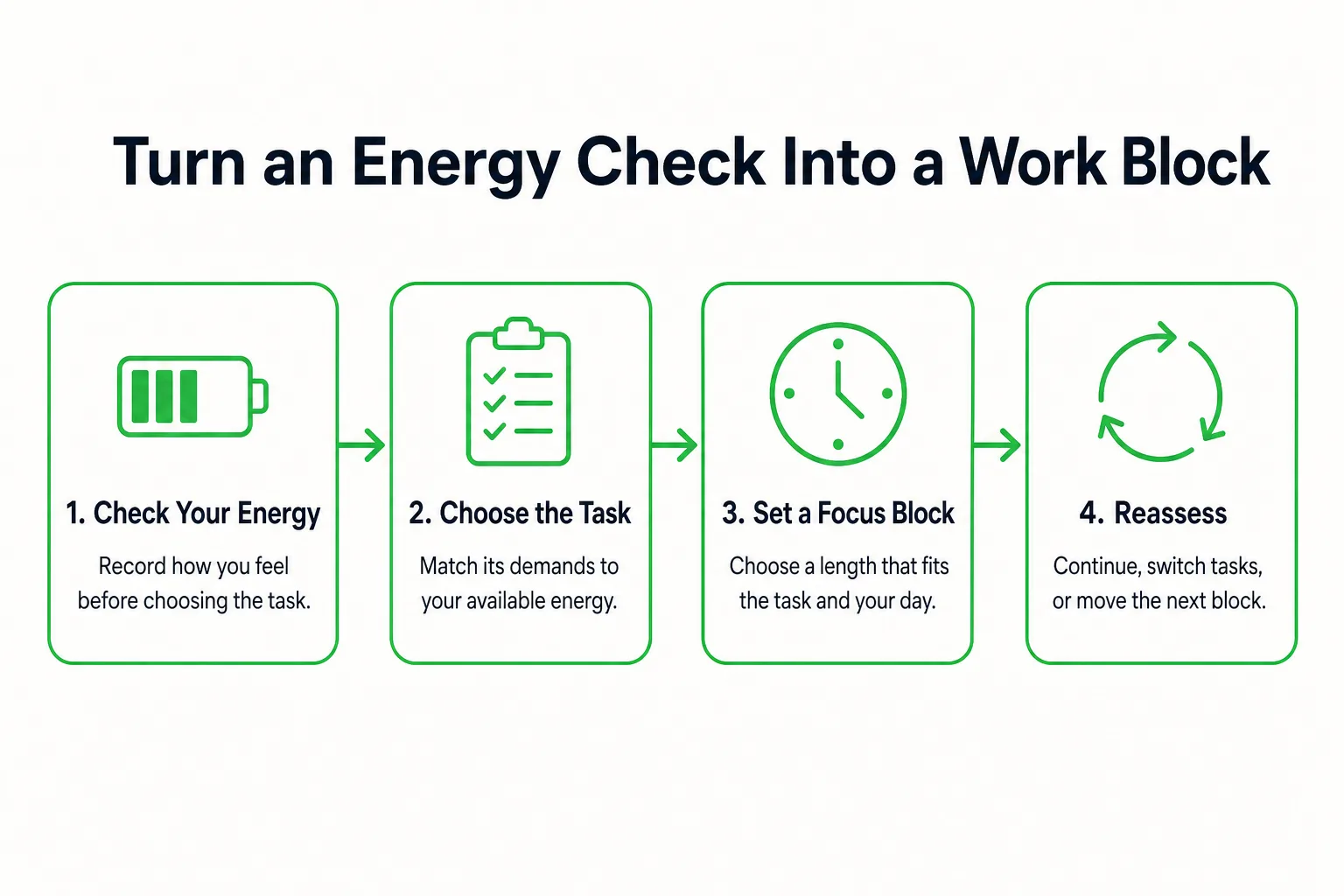
- Choose the day's essential outcome. Name what needs to be finished or moved forward.
- Separate demanding work from routine work. Drafting a proposal or making a difficult decision takes more concentration than filing receipts or confirming appointments.
- Reserve a likely higher-energy window for the demanding task. Use your own check-ins to choose the time, rather than assuming a certain hour is best.
- Reassess just before you begin. If your energy is lower than expected, reduce the first step or move the full task to another available window.
Nina's check-ins lead to this plan for one day. The times and energy levels are her observations, not universal peak hours.
| Time | Observed energy | Task and priority | Focus block |
|---|---|---|---|
| 9 a.m. | 4 | Draft proposal, high priority | 45 minutes |
| 1 p.m. | 3 | Revise proposal, medium priority | 25 minutes |
| 4 p.m. | 2 | File receipts, low priority | 15 minutes |
If Nina checks in before the 9 a.m. session and finds her energy is 2 rather than 4, she can outline the proposal for 15 minutes, then move the full drafting block to another available window. If the draft has a deadline, she should keep that commitment visible while adjusting the plan, rather than postponing it indefinitely.
Use a focus timer to give the chosen work period a clear boundary, then check how you feel and what you completed. The right block is one you can use for the task at hand. To test scheduling changes against your actual calendar, follow the one-week energy management protocol.
Check What Changed Before Adding Another Habit
When energy drops, first check whether your plan asked for more time and attention than the day could give. A useful commitment names a behavior and fits an ordinary day. For example, three hours of planned focused work cannot fit into a day with only one open hour. Reduce or renegotiate the work before adding another self-improvement task.
Use this checklist before changing your habits:
- Compare the work you planned with the time you actually had.
- Notice whether meetings or interruptions took up more of the day than usual.
- Compare your sleep and recovery notes with days when you felt more rested.
- Look for circumstances that show up repeatedly instead of explaining a plan with one low score.
Feeling sleepy and feeling depleted are not the same thing: MedlinePlus separates the need to sleep from low energy and motivation. Nearly three in four U.S. adults reported tiredness or exhaustion on some days during the prior three months, but that context does not explain any one person's experience. If repeated notes point to short sleep, the sleep debt calculator can help you review your sleep-duration estimates, not determine the cause of fatigue.
Persistent, unexplained, or worsening fatigue deserves a conversation with a healthcare professional.
Turn Your Weekly Notes Into Three Decisions
At the end of each week, read your entries together rather than reacting to one difficult day. Then find a circumstance that repeats and check whether another factor, such as workload or sleep, could also fit the pattern. A repeated association can suggest a scheduling experiment, but it does not establish what caused the energy change.
For example, Nina notices that late meetings coincide with unfinished proposal drafting. She chooses three changes to test next week:
- Habit: Before stopping each day, prepare tomorrow's first task.
- Schedule: Protect an available morning block for proposal drafting.
- Goal: Complete a proposal draft by Friday. If the full drafting block is unavailable, write the next paragraph outline as a smaller fallback.
Keep the habit narrow if you are tempted to change several routines at once. This guidance on how many habits to track can help you choose a manageable number. When you review the plan, consider completed work alongside energy scores. A three-line done list offers a brief way to record those outcomes.
Copy this three-line review for next week:
Habit I will test: ___.
Schedule change: ___.
Realistic goal and fallback: ___
At your next review, keep the experiment if it worked, adjust it if it partly fit, or replace it if it did not suit your week.
Put Energy-Aware Plans Into Practice With Loggd
Use your energy journal or browser tracker to notice patterns, then bring the decisions you want to act on into Loggd. Keep the energy observations in the tracker you chose; use Loggd to organize the habits, tasks, goals, and focus time that follow from them.
For Nina, the goal is to finish a proposal draft by Friday. She can set it up this way:
- Add the weekly goal: Complete proposal draft by Friday.
- Create the next drafting task, mark it high priority, and add a tag such as
proposal. - Schedule the preparation habit on the days she chooses: before stopping, identify tomorrow’s first task.
- Reserve the next available writing window and use the focus timer for that block.
- Use the daily check-in as a cue to review how the day went and what work remains.
Tasks and focus sessions connect with goals, so Nina can keep the drafting work attached to the proposal outcome. If a meeting disrupts the planned block, she can choose the next available window or use her smaller fallback, rather than losing sight of the goal.
Loggd’s grid shows checked-off activity across the last 365 days. It gives you a view of what you completed, while your energy observations remain in the tracker where you recorded them. Loggd is free on iPhone, Android, and the web, with no credit card needed. Set up your next week's habits, tasks, goals, and focus time in Loggd.
Energy Tracker Questions
Should I Track My Energy on Weekends?
Yes, if weekend routines matter to the patterns you want to understand. Use the same check-in fields, but note differences such as a later wake-up, fewer meetings, or a busy family day. If weekends are not relevant to your current planning question, you can track weekdays and add a weekend when you want to compare.
What Should I Do if I Forget an Energy Check-In?
Record it later only if you can remember the details with reasonable confidence, and mark it as a later entry. Otherwise, leave it blank and resume at the next planned check-in. A missing entry is more useful than a guessed score that could blur the pattern.
Can I Compare My Energy Score With Someone Else's?
Use your score to compare your own days, not to rank yourself against another person. A 3 is only meaningful when you apply the same scale consistently and include context such as sleep, workload, and interruptions. Another person’s score reflects their own scale and circumstances.
Sources
- Fatigue
- Design for Dis/Ability: A Crip Inquiry into Personal Energy Tracking
- How Common is Fatigue Among U.S. Adults?