
In goal vs objective planning, use the goal for your broad aim and the objective for a milestone that moves it forward. Write the aim first, then give the milestone a measure and a deadline.
This distinction helps you decide what belongs in annual planning, a weekly priority list, and today's tasks. An annual goal might describe a direction you want your life or work to take. A weekly objective gives you a nearer target to check, while a task tells you what to do next.
Take the broad intention of exercising more. It points toward a change you want, but it does not yet tell you what to put on this week's calendar or how to review your progress. Turning it into an objective gives you a more useful checkpoint. You can make that change without losing sight of the larger aim.
Give Your Objective a Measure and a Deadline
Start with a long-term aim, then choose a nearer target that would show progress toward it. Treat a milestone as a checkpoint on the way, not as a competing aim. The planning role matters more than the label: a goal can also be a proficiency target within a specified period. In this guide, use goal for the broad aim and objective for the checkable target.
Make the objective easier to use by asking five editing questions. Is it specific about what you will do or reach? Measurable, so you can tell what happened? Achievable with the time and resources you have? Relevant to the aim? Time-bound, with a date or period for review? These are the common SMART criteria, a way to shape a target, not a promise that it will succeed.
For example, “Read more regularly” could become “Read 10 pages each weekday for four weeks.” Before committing, check that the workload fits the time you actually have. If your target is finishing a book by a date, use the reading goal calculator to work out the daily page count.
Keep the benchmark separate from the target. A benchmark is your starting value or comparison point, such as how many pages you read in a typical week now. The target is the value you intend to reach. Knowing both makes progress easier to interpret.
Identify What Each Statement Does
A sentence can contain more than one planning role. Use the question it answers and its place in your plan to classify it, rather than relying on a particular verb.
| Planning term | Question it answers | Clue in the wording |
|---|---|---|
| Goal | What direction matters? | A broad aim or end state |
| Objective | What target is due when? | A result with a value and deadline |
| Outcome | What actually happened? | An observed result, recorded after action |
| Strategy | What approach will I use? | A way of pursuing the target |
| Tactic | What concrete move puts that approach into practice? | A specific or repeated action |
| KPI | Which key metric will I track? | The selected measure used to monitor progress |
KPI means key performance indicator. The metric is the measurement; the objective supplies the value you want and the deadline for it. An objective is intended. An outcome is observed, so the two can differ.
Consider “Walk three times a week to become more active.” “Become more active” is the goal; walking three times a week is the objective. The walk itself can be a repeated tactic, while a task is a bounded action to complete, such as putting one walk on your calendar. Label each statement by the role it plays in your plan.
Build the Full Chain for a Daily Habit
- Goal: Make regular movement part of an ordinary week.
- Objective: Complete 12 walks of 20 minutes each over four weeks, aiming for Monday, Wednesday, and Friday.
- Strategy: Reserve the lunch window for walking.
- Tactic: Put the next Monday walk on your calendar and leave your walking shoes by the door.
- KPI: Track completed walks per week, with three as the planned weekly target.
- Outcome: At the four-week review, suppose your record shows 10 completed walks against 12 planned. Ten is the observed outcome; 12 was the objective. The count tells you how often you walked, not whether your fitness changed.
A workable commitment describes what you will do, suits a normal week, and includes a plan for getting back on track after a missed day. If you miss a walk, take the next scheduled slot. If the same conflict keeps recurring, reconsider whether lunch is the right window. In Loggd, you can use a flexible habit schedule for the planned walking days.

Choose the Next Action in a Busy Workweek
For clearer project handoffs, set this week's objective: confirm an owner and next-step date for five open requests by Friday. “Send five emails” describes an action, not the intended result here. An email may help, but the handoff is confirmed only when ownership and a next step are clear.
Use a strategy of resolving unclear requests before accepting new ones. Today's next action is to draft a clarification message for the oldest unresolved request. Break the objective into smaller tasks with their own deadlines, and set a Thursday follow-up so Friday is a review point, not the first reminder.
Track confirmed handoffs and check the count on Friday. If a reply from someone else is still needed, record your follow-up separately from the confirmation that remains pending. For another workplace priority, adapt an example from personal objectives for work.
Diagnose an Unmet Target Before Replacing It
When an objective is unmet, diagnose the cause before replacing it. Ask these questions in order:
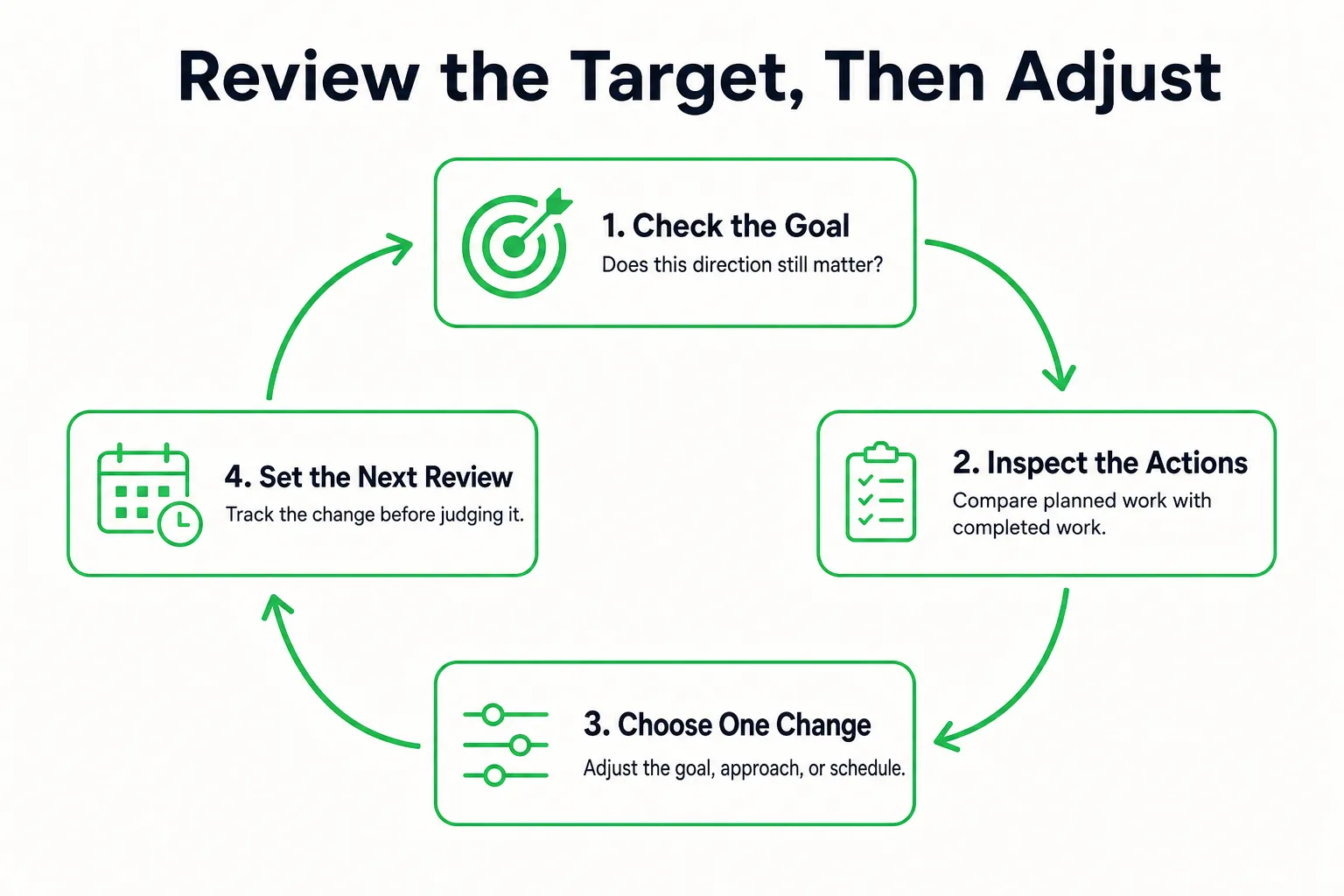
- Does the goal still matter? If the priority has changed, revise the goal.
- Did the planned actions happen? If execution was incomplete, adjust the schedule or make the tasks smaller.
- If the actions happened, did the approach produce the intended result? If not, test a different strategy.
A thin record may not show which cause mattered. In that case, choose one change and track it through the next review, rather than changing several things at once. Plan for interruptions and how to return to progress, so a missed day or delayed task has a next step.
One goal can have several objectives. Keep the active set small enough that each objective has a real time slot and a review date. Check a daily habit briefly, review a work target on Friday, and use year-end to decide which objectives still serve the goal.
Sources
- Goal Setting - Center for Scholarly Communication
- APA Dictionary of Psychology
- SMART Framework | Youth Advisory Councils
- Healthy and fit on the go: Goal setting