
A human values test helps you name the priorities you want your everyday choices to reflect. Start with our free core values quiz, then use the Schwartz framework to make sense of the priorities you identify.
The quiz is a reflection tool, not a Schwartz-scored assessment. It is free to use online, needs no signup, and saves your answers privately on your device. This guide will help you consider what your results mean and turn them into one weekly goal, three repeatable habits, and specific daily actions.
The point is not to collect impressive labels. It is to make a few everyday choices easier to see and act on.
Before You Take the Test, Look at Your Choices
Take a few minutes to think about what matters in the ordinary version of your life. Use these steps before answering an assessment.
- Recall a choice that left you satisfied, even if it took effort. What made it feel worthwhile?
- Think of a frustrating compromise. What did you have to set aside, and why did that bother you?
- Name something you would protect during a busy week. Consider what you would make time for even when other demands compete.
- Ask yourself what you would still care about without praise, what you have accepted a cost to protect, and what keeps appearing in different situations.
A value is a lasting motivation, not every preference or aspiration. Wanting a new notebook may be a temporary preference; caring about learning could be the value behind it. Prestige expected by your family is a social expectation, while wishing you seemed confident is a desired personality trait. Each may matter, but none automatically tells you what you value.
Answer assessment questions with your recent, ordinary choices in mind, rather than the person you hope to become. In psychology, tests use standardized instruments to measure behavior or mental attributes. The Short Schwartz’s Value Survey had its reliability and validity examined in four studies, so when choosing an assessment, look for the named questionnaire and an explanation of how it is scored. If you cannot find the right word for a motivation, browse the core values list for more precise language, then return to your examples.
The 10 Schwartz Values in Everyday Life
The Schwartz Theory of Basic Values gives you a vocabulary for the motivations behind choices. The same action can express different values: taking on a challenging project might reflect achievement, stimulation, or both. Look at the reason behind the action, not only what you did.

| Value type | What matters | Everyday example |
|---|---|---|
| Self-direction | Independent thought and choice | Choosing how to solve a work problem |
| Stimulation | Novelty and challenge | Trying an unfamiliar activity |
| Hedonism | Pleasure and enjoyment | Making time to enjoy a favorite meal |
| Achievement | Demonstrating competence against standards | Finishing a demanding professional qualification |
| Power | Status, influence, or control over resources | Seeking authority over a project budget |
| Security | Safety and stability | Keeping a dependable household routine |
| Conformity | Restraint to meet social expectations and avoid harming or upsetting others | Following shared quiet hours |
| Tradition | Respect for inherited customs and beliefs | Keeping a meaningful family observance |
| Benevolence | Caring for people close to you | Helping a friend through a difficult week |
| Universalism | Concern for people broadly and for nature | Supporting accessible public spaces |
The phrase “10 universal values” refers to broad value types. It does not mean you should give all ten equal priority. Your own value priorities are the useful starting point.
Read Your Results as Priorities, Not Grades
Start with the assessment’s own scoring instructions. Then compare your leading value priorities with the choices you recalled before taking it. A high result points to a priority within that assessment; it is not a grade for your character or a percentage of your personality. Compare yourself with other people only if the assessment’s scoring instructions say that comparison is meaningful.
Schwartz’s refined theory organizes 19 values by compatible and conflicting motivations, including whether they focus more on the individual or the social world, and on self-protection or growth. The broad framework is not the same thing as any one test. For example, the revised Portrait Values Questionnaire was designed as a 57-item assessment of the refined 19-value model. An evaluation of that questionnaire covered 49 cultural groups, 53,472 participants, and 32 language versions. Those findings describe that questionnaire’s research, not the results of every online quiz.
Write one behavior beside each of your leading values that supports the result. If a value surprises you, find a recent situation where it might have mattered before accepting or dismissing the label. If two results are close, ask which one should guide a specific decision this week. You do not need to declare one the permanent winner.
When Two Values Compete, Set a Boundary
A value becomes useful when it changes a small decision. Choose a decision rule that fits an ordinary week, rather than a good-sounding statement with no action attached.
Name the two values in conflict, then name the choice in front of you. Decide what minimum commitment you will protect for one value, and give the other a bounded action. That lets both matter without pretending you can give them equal time in every moment.
Nina has a proposal to finish and a coworker asking for help. Achievement matters in completing the proposal; benevolence matters in responding to her coworker. She blocks 25 minutes for the proposal, then offers 15 minutes to help with one defined question. Her rule is: “When an optional request interrupts my proposal block, I offer a specific time after the block.” The boundary protects focused work, while the offer gives her a concrete way to help.
The same method can guide a security-versus-stimulation career choice. Keep current commitments in place while you schedule one conversation with someone in a different role or set aside time for a small learning project. You can explore a new direction without making an immediate, high-stakes change.
For a conflict you face now, write one rule that names the action, its boundary, and when you will reconsider it. For example: “I’ll work on the report for 25 minutes before taking nonurgent requests, then review the arrangement Friday.”
Build One Weekly Goal and Three Daily Habits
Use Nina’s proposal to turn values into a plan you can act on this week. Keep the goal specific, and make the habits small enough to repeat.
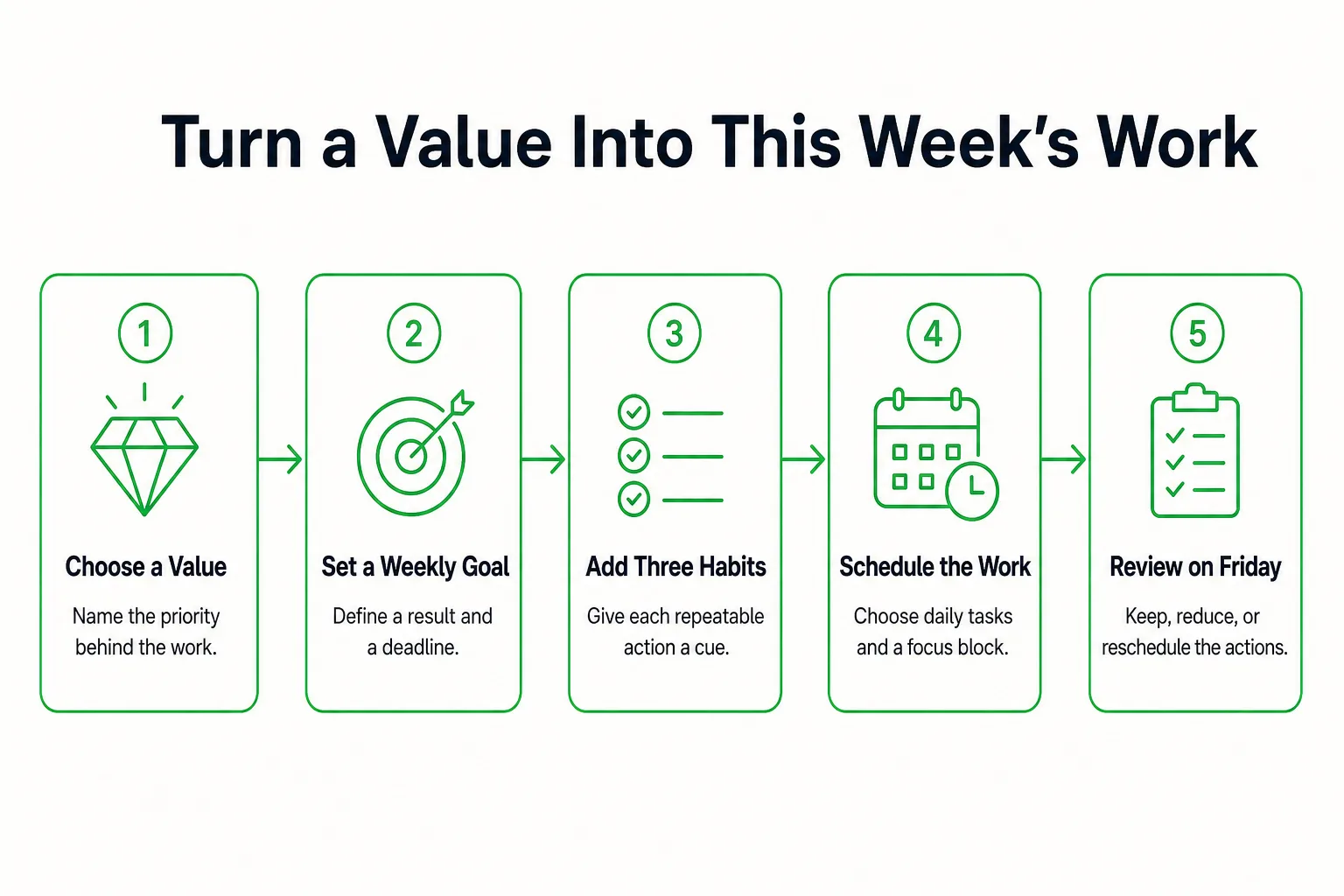
- Value: Achievement, shown by completing the proposal. Benevolence, shown by setting a clear time to help coworkers rather than abandoning the proposal block.
- Weekly result: Send a one-page proposal by Friday at 3 p.m.
- Three repeatable habits: At the start of work, choose the next proposal action. After lunch, work on it for 25 minutes. Before finishing work, record the next action.
- Daily tasks: Monday, draft the headings. Tuesday, compare two options. Wednesday, write the recommendation. Thursday, edit the page. Friday, send it by 3 p.m. These are one-off tasks with a finish point; the habits are behaviors Nina repeats as cues arrive.
- Focus time: Protect the 25-minute after-lunch block for the next proposal task. If coworkers make optional requests during it, offer a specific time after the block.
- Review: On Friday, note what got done, which value the actions expressed, and what to reduce or reschedule after any missed days. Make the next plan fit the week you actually have.
Copy this template and fill it in before the week starts:
- Value or values:
- Weekly result:
- Deadline:
- Habit 1, cue and action:
- Habit 2, cue and action:
- Habit 3, cue and action:
- Next task:
- Focus block, time and duration:
- Friday review, result and next adjustment:
If you want help attaching an action to an existing morning cue, use the morning routine builder.
Put Your Values Into Practice With Loggd
Once you have chosen a weekly goal, you can organize its actions in Loggd. This is a way to track the plan you made; it does not administer or score a Schwartz assessment.
Create the weekly proposal goal, then add the one-off tasks: draft the headings, compare two options, write the recommendation, edit, and send. Give each task a priority and tag, and connect it to the proposal goal so the steps stay together. Add the three repeatable behaviors as habits with flexible schedules: choose the next action at the start of work, work on the proposal after lunch, and record the next action before finishing.
Use the focus timer for the protected 25-minute proposal block and connect that session to the goal. A daily check-in gives you a place to reflect on the choices you made, including whether you kept the boundary for helping coworkers. On Friday, compare the completed work with the value you meant to express, then choose the next week’s actions.
Each checkoff fills a grid of your last 365 days. Treat that grid as a view of recorded activity, not a verdict on whether your choices matched your values. The weekly reflection is where you consider what the activity meant. Loggd is free on iPhone, Android, and the web, with no credit card needed.
Human Values Test Questions
How accurate is a human values test?
Accuracy depends on the specific questionnaire, its scoring instructions, and how carefully you answer. In psychology, tests can use standardized instruments to measure behavior or mental attributes, but a result is still a prompt for reflection, not a complete account of you. Look for the named questionnaire and an explanation of how its scores should be interpreted.
What is the difference between human values, personal values, and core values?
Human values usually refers to broad motivations that can be described in a framework such as Schwartz’s. Personal values are the priorities that matter to you in your own life; core values usually means the few priorities you choose to use as guides. People use these labels in overlapping ways, so pay attention to what a particular test means by them.
Can my values change over time or in different situations?
Your priorities can shift as your circumstances and responsibilities change, and different situations can bring different values to the foreground. A result is a snapshot of how you answered, not a permanent label. If a score surprises you, compare it with recent choices and check again when your life or priorities have changed.
Sources
- APA Dictionary of Psychology
- Measuring values with the Short Schwartz's Value Survey
- Refining the theory of basic individual values
- Measuring the Refined Theory of Individual Values in 49 Cultural Groups: Psychometrics of the Revised Portrait Value Questionnaire