
The difference between goals and objectives is their level of detail: a goal names the result you want, while an objective sets a specific outcome or behavior you can measure. Use the goal to choose your direction and the objective to decide what progress will look like by a deadline.
The American Psychological Association’s strategic plan treats goals as high-level descriptions and objectives as more specific components of each goal. A long-term goal and a short-term objective can sit in the same plan, but duration alone does not decide which is which. A goal can have a deadline, and an objective can extend over a longer period.
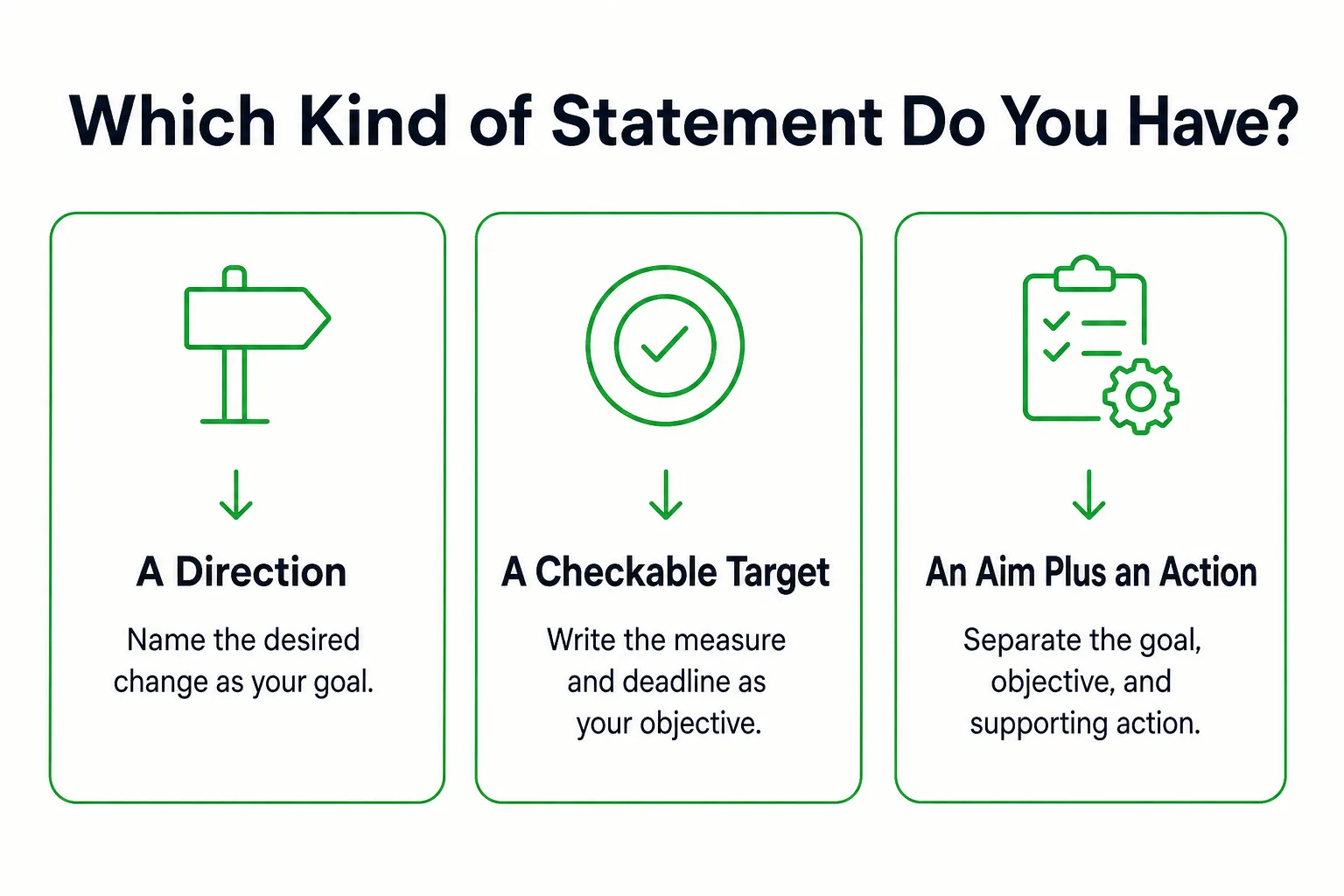
To sort a statement, identify the change you want, the evidence that would show progress, and the action you’ll take. If one sentence contains all three, separate them. That gives you a direction, a checkable target, and a practical next step.
Split Statements That Mix an Aim With an Action
Use this quick test when a statement seems to be both a goal and an objective:
- Underline the desired change.
- Circle anything countable or observable.
- Separate the action you’ll use to produce the change.
Take “Get more active by walking after lunch.” The desired change is making movement part of your ordinary week. The measurable objective is to walk for 20 minutes on four days each week for the next four weeks. Walking after lunch is the supporting habit: it names when you’ll act, not the result you want to measure.
Try the same test at work. In “Improve reporting by building a checklist,” improving report accuracy is the goal, and building the checklist is a task. An objective could be to have no more than one correction in each of the next four weekly reports. The correction count makes the target checkable.
When a direction is joined to an action, split the statement so the result, target, and action each have a clear role. If you need a target you can practice writing, adapt one of these short-term goal examples.
Make the Objective Measurable and Relevant
A SMART objective is specific, measurable, achievable, relevant, and time-bound. Apply those criteria to the walking target: it names the behavior and duration, sets a weekly count, fits a defined four-week period, and should be realistic for your schedule. A reusable sentence is: “By [date], I will [observable result or behavior], measured by [record or evidence], to support [goal].”
Keep the target distinct from the progress measure. Four walks per week is the target; a weekly count is the measure you’ll check. A milestone marks a checkpoint toward a larger result, such as reviewing the walk count at the end of each week.
A useful target has to change a decision. Relevance asks whether hitting the number would actually advance the goal. For report accuracy, counting completed checklists would be weak if errors stayed the same. Measure corrections instead. Use the SMART goal worksheet to work through your target and deadline. If you need to see how much time remains before a milestone, use the goal countdown timer.
Choose Only the Objectives Your Goal Needs
Start with one objective for a goal. Add another only if the first leaves an essential part of success unmeasured. For report accuracy, one objective may be enough. If timely delivery matters too, give it a separate deadline-based objective instead of folding both requirements into a vague target.
Name the weekly time or resources each objective will take. If two objectives compete for the same available time, decide which comes first or reduce their scope. For annual planning, a broad yearly goal can have a current monthly objective; choose later targets when you review your progress. Put your goal and its selected objectives together on a goal-setting sheet.
Keep Weekly Actions Below the Objective
Use a simple working hierarchy: the goal is the desired change; the objective is the target; a strategy is the approach; a tactic is a specific method; a task is a finishable action; and a habit is a repeated behavior. The labels can vary across settings, so focus on the role each item plays in your plan.

For reporting, the goal might be to improve accuracy, with the objective of meeting the correction target. Standardizing review is a strategy; using a pre-send checklist is a tactic; creating the checklist is a task; checking each report before sending is a habit. A measurable habit can also serve as an objective when the repeated behavior itself is what you want to establish.
Schedule the next action, not the whole objective on Tuesday’s task list. In Loggd, connect the supporting tasks and focus sessions with your goal so the work stays together. When you need to reserve time for the next action, use this guide to timeboxing and time blocking.
Review the Target and the Change It Produced
Suppose the first April report needed four corrections. The objective is no more than one correction in each of the final two April reports. At review, the counts are one correction in the first report and two in the second. The objective is partially achieved: one of the two required reports met the threshold. If both had at most one correction, it would be achieved.
Compare that with “make reports better by April 30.” Without a defined meaning of better or recorded evidence, you cannot check the result. Mark this objective poorly defined, then rewrite it before the next period with a clear target and a way to measure it.
Check relevance separately from completion. Even if the correction target was met, revise it if reports still lack information needed for decisions. Keep accuracy as a maintenance measure, then choose a new objective tied to the missing information. During an annual review, compare the original target, deadline, and evidence before choosing the next objective. If the target still matters but execution stalled, choose a next action from these practical ways to follow through on a goal.