
Use these career goal and objective examples to turn a broad aim into a measurable work plan. Start with the career move you want, then choose objectives, weekly actions, and evidence that will show your progress.
A career goal names a direction. An objective states a result and deadline. An action is the work you schedule toward that result. Setting a career goal means choosing a professional direction and the steps toward it.
The six plans below cover common career moves, from starting out to developing a specialist skill. Choose the situation closest to your next step, then adapt the targets to your role, time, and available support. If those terms still blur together, use our goal versus objective explanation before writing your plan.
Step 1: Choose the Career Move You Want
Complete this sentence: “By this time next year, I want to be ready to ___, with ___ as evidence.” Your answer might be entering a field, taking on broader responsibility, changing fields, returning to work, or managing a team.
Keep the outcome separate from the evidence you can create. A promotion or job offer depends on another decision-maker. You can still prepare for that outcome by completing relevant projects, demonstrating skills, or building a work sample. Focus your plan on those actions and evidence, while treating the final decision as an outcome you do not control.
Then choose the kind of work that fits your next move. Performance objectives improve how you handle your current responsibilities. Development objectives help prepare you for a different or broader responsibility. Performance objectives can describe observable skills and behaviors that support effective work. For example, improving how you document project decisions could support your current work and show readiness for a larger project.
Name one professional strength you can build on and one capability the next role requires. If you are unsure why you want this move, use the personal why statement examples to put a reason behind the career move you are considering.
Step 2: Adapt One of These Six Career Plans
Use the targets in this table as starting points, not fixed benchmarks. Adjust each one to fit your role, schedule, and access to support.
| Career situation and goal | Objective | Weekly action | Progress measure | Deadline |
|---|---|---|---|---|
| Starting a career: enter a chosen field | Prepare two relevant work samples and submit 12 tailored applications | Reserve two work blocks for samples and applications | Count completed samples and submitted applications; record interview invitations separately | Eight weeks |
| Seeking promotion: demonstrate readiness for a broader role | Agree on readiness criteria with your manager by week two and complete a scoped cross-team project by week 12 | Spend one block on the project and request feedback at milestones | Track accepted deliverables and evidence against the agreed criteria | Criteria by week two; project by week 12 |
| Changing fields: move into a target field | Complete three informational conversations and one role-relevant sample project | Send two focused outreach messages until conversations are booked, and reserve a project block | Track conversations completed, questions answered, and project milestones | Ten weeks |
| Returning to work: become ready to apply for a defined role | Refresh one required skill, prepare one current work sample, and submit six suitable applications | Schedule two 45-minute blocks | Record sample completion, applications, and responses | Eight weeks |
| Becoming a manager: demonstrate leadership readiness | Agree on a supported opportunity to coordinate a four-week project, then complete a handoff and feedback review | Hold a short weekly project check-in | Record milestone delivery, unresolved blockers, and feedback on coordination | Handoff and review by week eight |
| Advancing through a specialist skill: qualify for more complex assignments | Complete four practice tasks and one applied work sample | Schedule two 30-minute practice sessions and request feedback at agreed milestones | Track practice sessions, completed tasks, and revisions to the sample | 12 weeks |
For a career-change plan, give each new conversation a specific outcome you want help achieving, such as understanding the work samples a target role requires. A conversation can help you learn about a field or clarify what to prepare; it does not replace the sample or other evidence in your plan.
Before using an objective, substitute your own role, project scope, available time, and agreed quality standard. For instance, define what “accepted” means for a project with your manager, or identify which role requirements your work sample should address. Keep the measures distinct: applications sent are not the same as invitations received, and practice tasks completed are not the same as demonstrated skill.
Step 3: Keep Only Objectives You Can Schedule
Start with three objectives: one result you can demonstrate, one capability to develop, and one relationship or opportunity to pursue. Add a fourth or fifth only when you can give each a realistic place in your week. The point is to choose work you can actually schedule, not to make the plan look complete.
A career objective needs a decision rule you can use on an ordinary workday. Name what gets time, what counts as complete, and what you will do after a missed session. For example, if you have three 45-minute blocks each week, assign one to an applied project, one to skill practice, and one to outreach or applications. When a task needs more than one block, continue it in the next scheduled session rather than adding unplanned hours.
Before you commit, check your available time, access to feedback, required tools, and permissions. Check the skills, resources, effort, and commitment the objective requires before accepting the deadline. Then write each objective as an outcome, evidence of completion, and deadline. For a work sample, that might mean a finished sample that addresses specified role requirements and has received feedback against those requirements by a set date. Use the SMART goal worksheet to turn your chosen career result into a measurable objective.
Choose a response for a missed session in advance: move the block to another available slot that week, or reduce the next deliverable’s scope and update the deadline. A missed block is a reason to adjust the plan, not to discard an objective that still matters.
Step 4: Track Weekly Actions and Career Evidence
For each objective, track both the work underway and the result it is meant to produce. In a job search, applications submitted show activity; interview invitations are a separate outcome. For skill development, practice sessions show time spent, while a completed sample assessed against role requirements shows what you can demonstrate. For a project, milestones show progress, while accepted deliverables and feedback show how the work was received.

If improvement is the objective, record a baseline before you begin. That might be an initial work sample, an existing skill assessment, or the first project checkpoint. If you have no baseline, use the first sample or checkpoint as your starting reference. Compare later evidence with that reference, and note what changed.
Pair every weekly count with a quality check. Count an application after you have tailored it to the role requirements, not when you have only found a listing. Count a practice task after you have reviewed and revised the work, not just after a timer ends. This keeps activity measures useful without treating them as proof of job readiness or eligibility for a new role.
Set up the next week in four moves: choose the next deliverable, book a work block, identify who can help, and create a place to save evidence. An action plan can name the tasks, who can help, and when the work should happen. If your next career step depends on a specific skill, use the deliberate practice examples to shape a focused practice session. In Loggd, connect your career tasks and focus sessions with the goal they support.
Keep evidence in a dated folder: work samples, feedback, project notes, and application records. Store confidential employer material only in a location your workplace has approved. A short record is enough if it lets you find what you did, when you did it, and what evidence resulted.
Step 5: Decide What to Continue, Revise, or Replace
Set aside ten minutes each week to record completed actions, inspect the latest evidence, identify a blocker, and schedule the next deliverable. Once a month, spend 20 minutes asking three questions: Does this objective still support the career direction I chose? Does the work fit the time I have? Does the evidence point to a capability gap or an approach worth keeping?
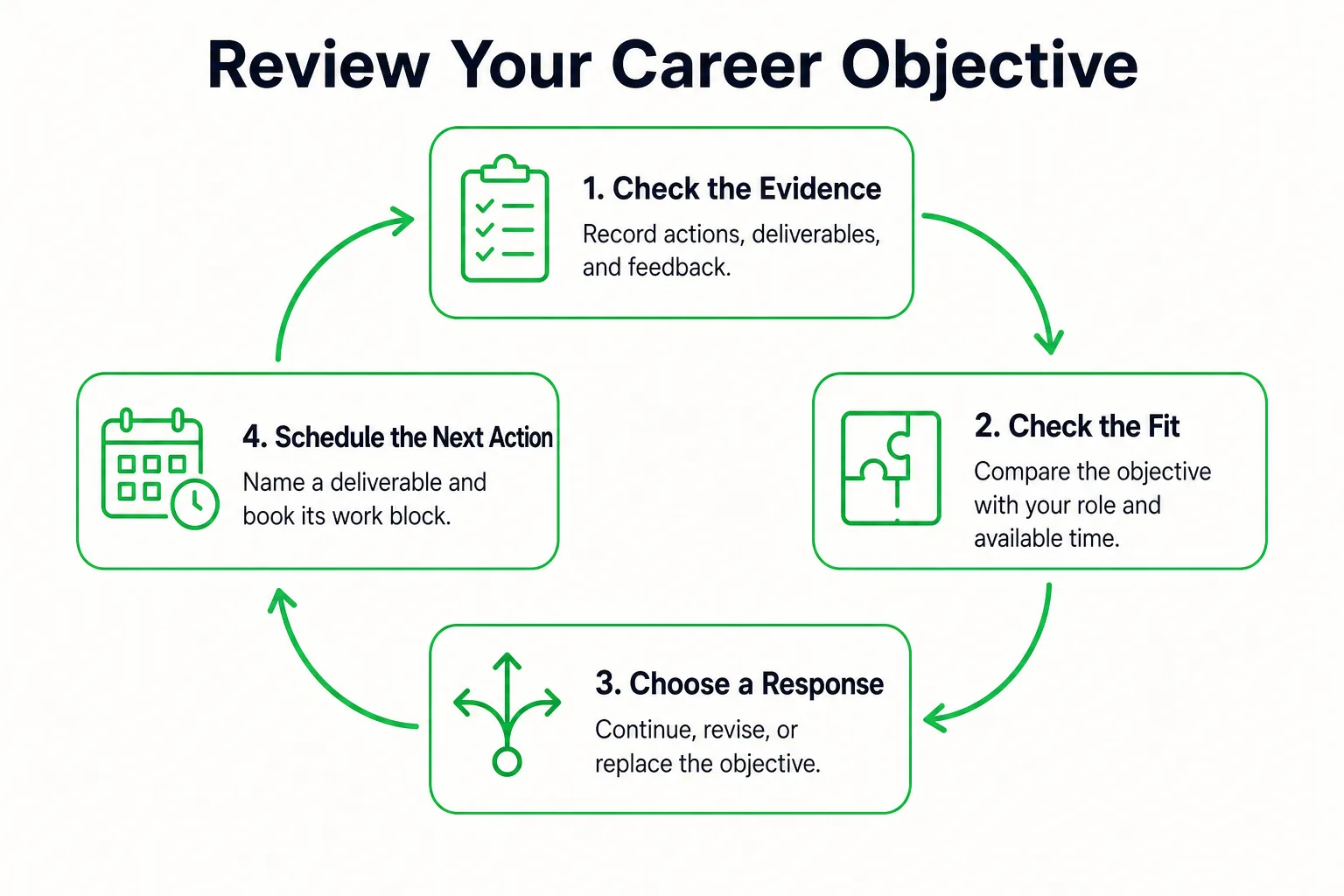
Use the answers to make a clear choice. Continue when the objective remains relevant and the scheduled work is producing the evidence you intended. Revise the scope, support, or timing when the objective still matters but the current plan is not workable. Replace it when the target role or the capability it requires has changed.
For example, if you have sent applications but received no invitations, inspect the role fit, application materials, and feedback available to you before raising the weekly target. More submissions may not address the issue. If you are completing practice sessions but still have no finished sample, make the next open-ended practice block a defined deliverable, such as a draft that addresses one stated role requirement.
Write a brief decision note with the date, what changed, why it changed, and when you will review it again. This gives you a record of how the plan has adapted without requiring a long report. If progress depends on someone else’s decision or input, name the person or decision you need, set a follow-up date, and choose useful work you can do in the meantime. For instance, while waiting for feedback on a project milestone, you could prepare the next draft or document the questions you need answered.
Keep the review focused on the next useful decision. A plan can stay in place, change to fit your actual week, or give way to a career direction that has shifted.
Step 6: Turn Your Progress Into a Year-End Review
Start the year-end review with the career objective you chose, not with a guess about what someone else will decide. Suppose your goal was to become ready for broader project responsibility. That gives you something you can work toward and assess, while keeping any promotion decision separate.
Set three objectives for that goal:
- Agree on readiness criteria with your manager by January 31.
- Finish a scoped cross-team project by June 30, with its deliverables accepted against those criteria.
- Complete two supported project handoffs by September 30 and collect feedback on each.
Put the work into your week. Reserve a 45-minute block for the project, keep a decision log, and request feedback at the milestones you agreed on. Track completed milestones separately from accepted work: time spent records effort, while accepted deliverables show what was completed to the agreed standard.
At year’s end, compare each objective with its deadline and evidence. Suppose the project’s deliverables were accepted on June 28, and one of the two handoffs was complete by September 30. Record the January criteria as met, the project objective as met, and the handoff objective as partially met. Keep those results separate from the actual promotion decision. Your evidence can show readiness for broader responsibility; it cannot make the decision on your behalf.
A completed review passage might read:
I agreed on readiness criteria in January and completed the cross-team project on June 28. I completed one of the two planned handoffs by September 30. My evidence includes the accepted deliverables, decision log, and handoff feedback. My next objective is to complete the remaining handoff by January 31 and review readiness for broader responsibility with my manager.
Adapt this passage to your own record. Name the original objective, report the result against its deadline, and point to the evidence that supports your assessment. Then state the next career decision. If the evidence shows a remaining skill gap, name it and make it part of the next objective, with a clear action and deadline.
Choose the objective you will carry forward, then schedule its first work block. Put the objective on a goal-setting sheet with its evidence, deadline, and first action.
Sources
- Setting Career Goals
- Performance Management
- Make Targeted Connections
- Student Career Action: Get Prepared