TL;DR. A dopamine menu is a pre-written list of activities you actually enjoy, sorted like a restaurant menu by how long each takes: roughly five-minute appetizers, fifteen-minute sides, thirty-plus-minute entrees, and desserts you eat sparingly. It works because choosing from a written list is much cheaper than inventing options while depleted. The name is a metaphor, not a mechanism. You are not dosing dopamine, you are pre-deciding what counts as a good use of a break while you still have the judgement to decide well.
It is 9pm. The work is done, the kid is asleep, and there is an hour before I should be too.
I know exactly what I want from that hour: to feel like a person again. And every single time, I stand in the kitchen with no idea what would achieve that, so I open my phone, and forty minutes later I go to bed slightly worse than when I started.
The problem was never willpower. It was trying to make a decision at the precise moment I had nothing left to make decisions with. A dopamine menu fixes that, and the fix is almost embarrassingly low-tech: write the list earlier.
The menu framing
The concept was popularised by the YouTube channel How to ADHD and has spread across ADHD and wellness communities in dozens of variants. The structure that stuck is the restaurant menu, because a menu solves the exact problem you have at 9pm: it presents a short set of options at the moment of choosing, so you never have to invent dinner from an empty mind.
The dopamine menu builder ships four courses.
Appetizers, around five minutes. Fast resets between tasks. Step outside and look at the sky. Stretch. Make a proper drink. Put on one song. Not meant to change your day, only to interrupt it.
Sides, around fifteen minutes. Things that pair with something else rather than replacing it. A walk round the block, music while you tidy, a podcast during the washing up.
Entrees, thirty minutes or more. Your actual leisure. Cooking something real, exercise, a hobby project, a chapter of a book you like rather than one you are supposed to like.
Desserts, use sparingly. The indulgent ones. Scrolling, streaming, games, whatever your default already is.
Some versions add a fifth course, often called specials, for rare or expensive treats: a day trip, a concert, a whole afternoon with nothing scheduled. The builder does not ship that course, but you can add them as custom entrees. What matters is that the list sorts by time, because time is the constraint you are working with when you consult it.
The builder starts you with over fifty preloaded activities across the four courses, and you add, remove, and edit from there. Each item carries an energy tag, low, medium, or high, and a location tag, home, outside, or anywhere. That combination is what makes the list usable at the moment of need, because the real question is never "what do I enjoy?" It is "what do I enjoy that fits twenty minutes, at home, on almost no energy?"
Why the pre-written list beats deciding in the moment
Here is the mechanism, and it has nothing to do with brain chemistry.
Generating options is expensive. Choosing between presented options is cheap. Those are different tasks with very different costs, and the moment you most need a break is reliably the moment you have least capacity for the expensive one.
So the default wins. The default is whatever requires zero generation: the app that opens itself, the feed that never runs out. It is not more rewarding than a walk. It is the only option that does not require you to think of it.
A menu moves the thinking to a moment when thinking is cheap. You write the list on a Saturday morning with coffee, when you have opinions about what a good evening looks like. You read it on a Wednesday night, when you do not. Same logic as a laid-out gym kit: decide once while capable, execute many times while depleted. Which is also why it has to live somewhere you will open, because a menu composed in your head is indistinguishable at 9pm from no menu at all.
The honest neuroscience note
I want to be straight about this, because most articles on the topic are not.
The name is a useful metaphor, not a mechanism.
Dopamine is a real neurotransmitter genuinely involved in motivation and reward prediction. That is roughly where the accurate part ends. You are not dosing dopamine when you go for a walk, and nobody can tell you how many units a bath delivers versus a phone call. The popular framing, in which activities are little syringes of a chemical you administer in the right order, is not how any of this works, and the same overreach powers the "dopamine detox" trend the menu often gets paired with.
What you are actually doing is simpler and, I think, more defensible: pre-deciding which activities are worth your time while you still have the judgement to decide well.
That reframing matters practically, not just pedantically. If you believe you are dosing a chemical, you will chase intensity and feel like a failure when a five-minute appetizer does not deliver a hit. If you believe you are removing a decision, you will build a list that is easy to read, easy to reach, and honest about what you enjoy. The second version survives.
Keep the metaphor anyway. Courses, portions, desserts eaten sparingly, all of it makes the structure memorable and slightly funny, which is more than most self-management frameworks manage. Just do not let the name make a scientific claim on your behalf.
The ADHD part
The concept came out of the ADHD community and that is still where the most practical writing about it lives. Community organisations like CHADD and magazines like ADDitude have long covered externalising decisions, reducing the number of choices made in the moment, and building environmental supports rather than relying on recall and willpower. A dopamine menu is a small, homemade version of that family of strategies.
Why it lands well there is not mysterious. Unstructured downtime is the hard case: knowing you want a break, wanting it to be a good one, and being unable to convert that into a specific action. The usual result is defaulting to the highest-stimulation, lowest-effort option available and feeling worse afterwards. A written menu changes the task from generation to selection, which is a real reduction in effort at the exact point where effort is scarce.
Two things plainly.
First, this is not treatment. It is a self-organisation tool, in the same family as a shopping list. Nothing here diagnoses anything, and it is no substitute for care from a clinician who knows your situation. If you are wondering whether the pattern above is worth raising with someone, raise it with someone.
Second, build the menu for your worst day, not your best. Most people write an aspirational list on a good afternoon: pottery, journalling, a long run. Then it gets read on the day where standing up is an achievement, and none of it applies.
Building one that survives contact with a Wednesday
Some practical notes, from building the tool and from using it badly first.
Write for low energy. Every course needs a couple of low-energy, at-home options, which is what the energy tags are for. If your appetizers all involve leaving the house, the menu fails on the day it is most needed.
Steal, then edit. The preloaded activities are a starting point, not a prescription. Delete anything that does not sound like you, because a list full of items you would never pick teaches you to stop trusting it.
Use the randomizer when choosing is the problem. The builder has a "what should I do?" picker that selects for you based on time and energy. It sounds like a gimmick. On the evenings where deciding is the obstacle, handing the choice to a coin flip is the entire win.
Rate things afterwards. You can score each activity from one to five stars once you have tried it, and this is the part I underestimated. What you assume will restore you and what actually does are different lists. After a few weeks the ratings quietly rewrite your menu for you.
Keep desserts on the menu. Do not build a virtuous list pretending you will never scroll again. You will, and a menu that lies to you gets abandoned. Listing scrolling as a dessert keeps it available while making the choice deliberate, which is a far lower bar than abstinence and a far higher success rate.
Everything stays in your browser, no account, nothing uploaded, which for a document containing your honest list of comforts seems like the right default.
Where it fails
Three failure modes, so you can spot them early.
The menu you never open. By far the most common. A list written once and never consulted is a craft project. Pin it, screenshot it to your lock screen, leave the tab open. It only works at the moment of the decision.
The all-dessert menu. If every item is passive consumption you have not built a menu, you have written down what you already do. The point of the courses is contrast.
Treating it as a productivity system. A dopamine menu is not there to make your breaks efficient or to earn your rest. The moment it acquires targets and streaks it becomes another obligation, which is the thing it was supposed to relieve.
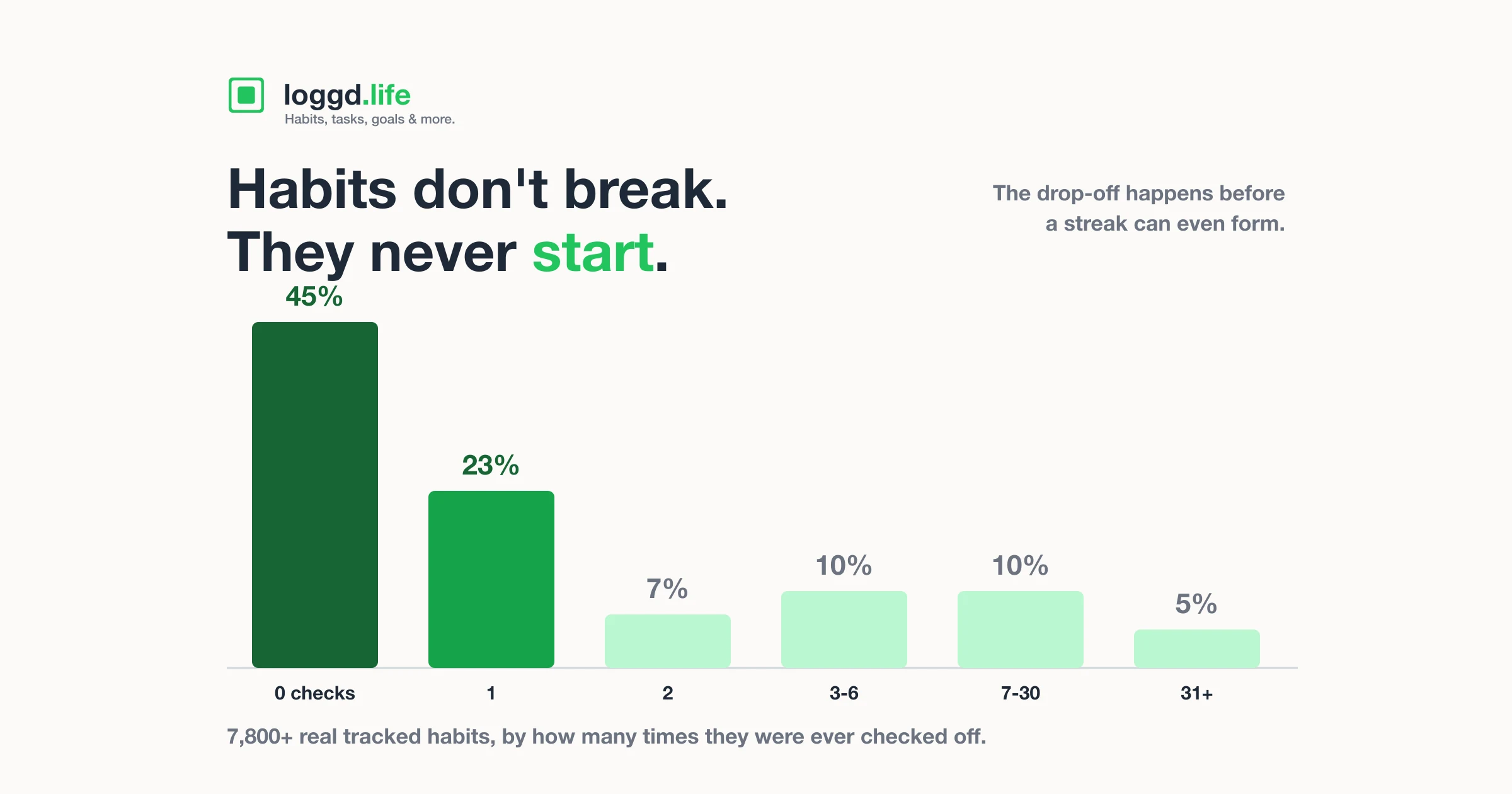
I will admit the tension in my own position on that last one. I build a habit tracker, so my instinct is to turn everything into a tracked routine. My own published data argues against it here: across the habits people set up in Loggd, around 45% were never checked off even once and roughly two in three died at or before the second check-in, which is the subject of habits people quit fastest. Adding "use dopamine menu daily" as a tracked habit is the fastest way to kill it.
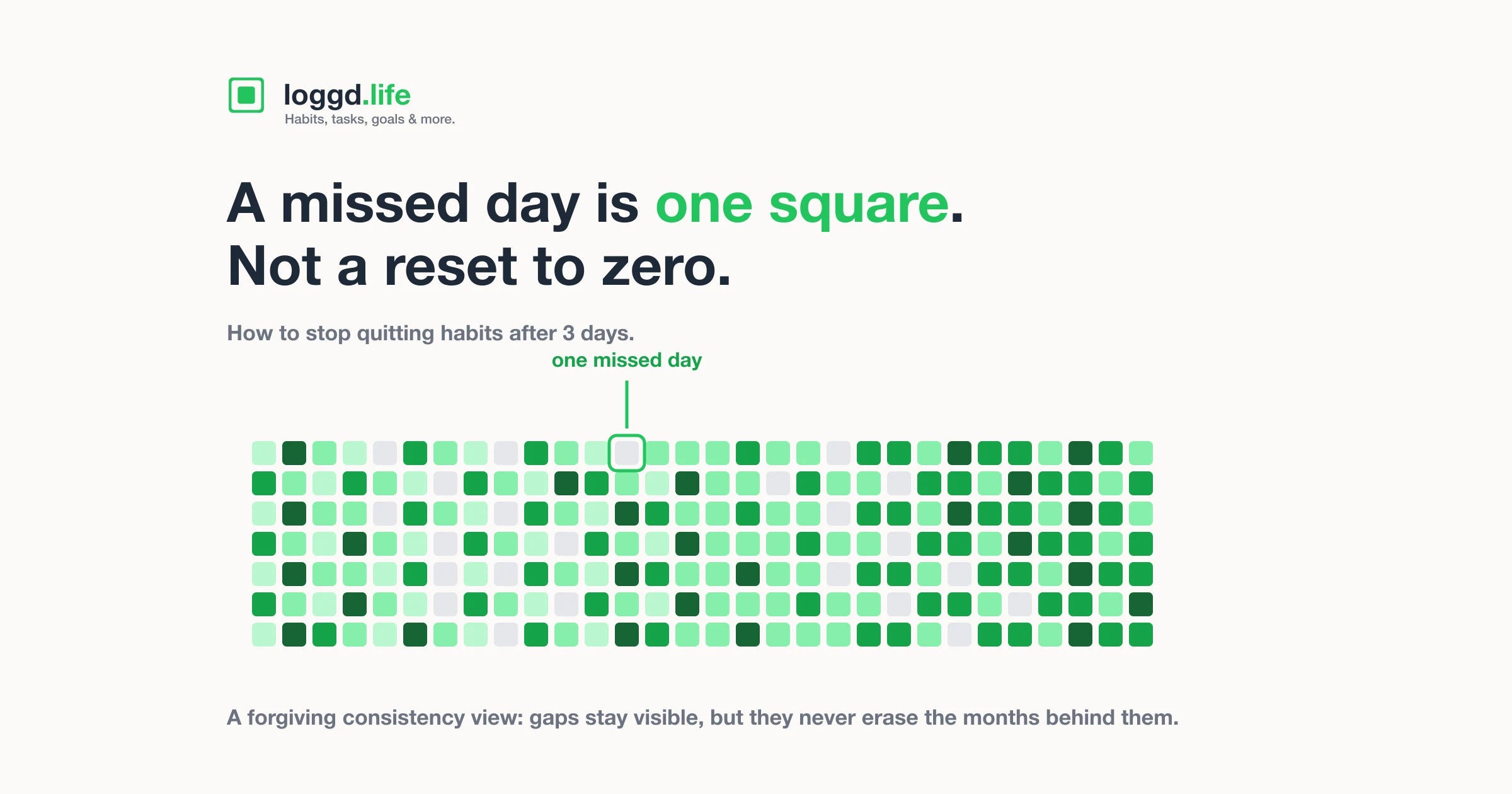
If something on the menu genuinely earns a place in your routine, track that specific thing and let the menu stay a menu. The never-miss-twice framing in how to stop quitting habits suits it better than any streak counter.
Two tools pair with this one. The mood tracker is a one-click daily log, the cheapest way to notice whether entree evenings read differently from dessert evenings. The self-care assessment rates six dimensions and points at the neglected ones, a decent prompt for what your menu is missing.
Write the list on a good day. Read it on a bad one. That is the whole method.
Last updated: October 2026.
Written by Eusebiu, the solo founder building Loggd in public. I build it in the evenings around contract work and a small daughter, so my own menu is heavy on the five-minute options and light on anything requiring a free afternoon. I share what the aggregate data keeps showing on Threads.
Track the one that earned it. If something off your menu is worth keeping, Loggd records it as a forgiving contribution grid, so a skipped evening stays one lighter square. Start free.