Long-term goals are outcomes you work toward over several years, such as changing careers, building savings, or learning a language. To choose yours, compare what matters to you with the time, money, and energy you can commit in an ordinary week.
You may have several ambitions that all sound worthwhile. You do not have to give one up just because you cannot work on all of them now. Keep the ambitions on a later list, but reserve regular time for the one you can actively fund with your attention and resources.
The point is to leave with a priority that fits your life, a realistic weekly commitment, and dates to check whether the goal still belongs. Your plans can change as your responsibilities and priorities do.
What Counts as a Long-Term Goal?
A long-term goal names a future outcome. Annual goals describe progress you want to make toward it this year. Short-term milestones and weekly actions spell out what to do next.
Say you want to move into a different field within three years. Your annual goal might be to complete an introductory course this year. A first milestone could be finishing its first module this month. This week, you could reserve two study sessions to begin that work. Each level connects a broad outcome to something you can act on now.
An outcome is different from an ongoing practice that supports it. Learning to hold a conversation in another language is an outcome. Practicing regularly is a behavior that can help you move toward it. You might continue the practice after reaching the outcome, but decide that separately.
The useful goal timeline depends on the work involved, its prerequisites, your resources, and your responsibilities. Choose a planning horizon that helps you make the next decisions, then revisit it when you know more. A deadline gives you a point to plan toward; it does not, by itself, show that the outcome is achievable. If you need to distinguish an outcome from a measurable objective, see the goals and objectives distinction.
Which Changes Would Matter in Your Life?
Write down changes you would still want if nobody else saw the result. Core values become more useful for goal planning when they point to choices: more time with family, greater financial flexibility, useful work, health, curiosity, or independence. Think about what you want your days to make room for, not just what would look impressive from the outside.
Use these areas as prompts, not a checklist you have to complete:
- Career and professional goals: Move into a chosen field, develop a specialist skill, or prepare for greater responsibility. What work would you like to do more of? A promotion is one option, not the automatic answer.
- Financial goals: Build a defined savings reserve or plan for a major purchase. What would having that money set aside make possible?
- Health and fitness goals: Develop an activity practice you can sustain or prepare for an event that suits you. What kind of movement or activity would fit your life?
- Personal development: Build language ability or make sustained creative work. Which skill or practice feels worth the time it takes?
- Relationships: Make dependable shared time possible. Which relationship would benefit from more protected time together?
- Wider life goals: Take on a community commitment or consider a change in living arrangements. What would that change support in your day-to-day life?
Shortlist three ambitions. For each one, finish this sentence: “This matters because it would let me ___.” Your answer can help you see whether the goal connects to something you care about, or mainly to a title or outcome that sounds appealing.
If a work-related direction is on your shortlist, explore career goals and objectives with practical plans for more options.
 Loggd · by the makers of this blog
Set a goal and track it every day.
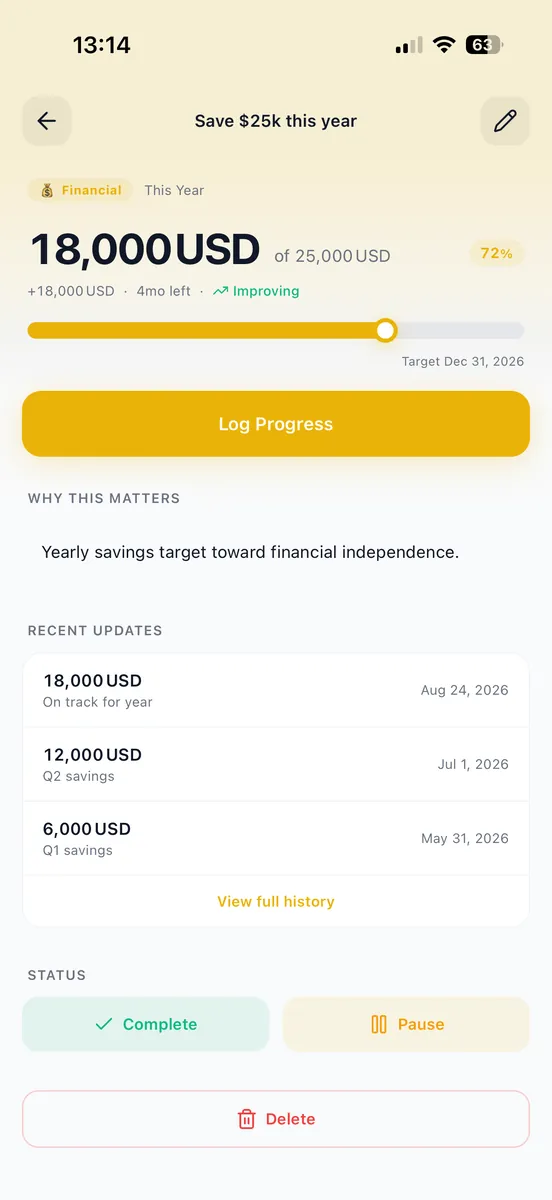
In the free Loggd app a goal has a target, a deadline and milestones, next to the daily habits that move it.


Free plan with no time limit. No credit card.



How Much Goal Work Fits Your Ordinary Week?
Start with your actual calendar, not an ideal week. Mark work, commuting, caregiving, household tasks, sleep, time with other people, and rest before you assign any hours to goals. Then look for usable blocks. A half hour after a draining day may be enough to prepare for a study session, but not enough for focused learning.

Say you find six discretionary hours in a normal week. Keep two hours unassigned for interruptions and recovery. That leaves four hours for planned goal work. Now estimate the weekly effort for your three ambitions:
- Career learning: three hours
- Language learning: two hours
- Family-history project: two hours
Together, those commitments require seven hours, but your available capacity is four. Choose the three-hour career goal for now and leave the remaining hour flexible. Keep the language and family-history ambitions on a later-review list, without assigning sessions your calendar cannot hold. In this example, one active growth goal fits the week.
Check money and energy separately. For each goal, note what it will cost, whether that spending fits after your obligations, and which sessions need your best concentration. If a goal requires a future cash amount, use the sinking fund planner to translate its target and deadline into a contribution you can compare with your budget.
The right number of active goals is the set whose recurring work fits your real capacity. Recheck that fit when your responsibilities or available time change.
How Do You Choose Between Competing Ambitions?
A useful goal priority tells you which commitment gets your available time when two worthwhile ambitions compete. Carry the same three options forward: career learning, language learning, and a family-history project. Adjust the details to match your own situation.
| Possible change | Weekly hours | Dependencies or timing | Commitment displaced |
|---|---|---|---|
| Career learning: complete a course that addresses a skill gap for a role you want | 3 | Enrollment closes on a date you have checked | Two hours of language learning, plus one flexible hour |
| Language learning: reach a conversation target you set for yourself | 2 | The target matters to you, but no current deadline affects your choice | Two hours of the family-history project, plus one flexible hour |
| Family history: record relatives’ memories and organize them | 2 | Interviews depend on coordinating times with relatives | Two hours of language learning, plus one flexible hour |
Use a short decision process rather than trying to make every ambition urgent. First, remove any option that does not fit your available time, money, or energy right now. Next, look for a real timing dependency: a checked enrollment deadline or a chance to arrange interviews that may not be available later. Then compare what the remaining outcomes would mean to you. Finally, name what you would give up to make your choice fit.
Choose career learning now if the enrollment window matters and the three hours fit. Choose family history if coordinating conversations is the time-sensitive priority. Choose language learning if the other goals have no current reason to displace it. None of these is a permanent verdict on the other ambitions.
Write your decision plainly: “For this review period, I am choosing ___ over ___ because ___.” Give each postponed goal a date to reconsider or a trigger, such as the course ending. Keep the ambition on your list, but leave it out of the weekly schedule until that review.
What Exactly Are You Committing To?
Once you choose a priority, give it four details: a time horizon, an observable success measure, a first milestone, and a recurring weekly commitment. Specific goals direct activity more effectively than vague goals. Specificity changes your next decision: instead of wondering what it means to “get ready” for a new role, you can decide which role requirements to check this month and which learning session to do next.
For a career goal, you might set a three-year horizon to meet the requirements for a chosen role. The first milestone is to compare actual role requirements this month, and the weekly commitment is three hours for learning work that addresses a gap. Track completed requirements and applications as things you control. Receiving an offer is a separate, external outcome.
Other ambitions can be written just as clearly, if you choose one of them instead. For a planned expense, a goal could be to save a set amount over two years. First confirm that the amount fits your budget and open or designate a savings account; then review spending for 15 minutes each week and contribute monthly if that amount works after your obligations.
For personal development, you could aim to hold a 20-minute conversation in the language you are learning within two years. Your first milestone might be completing an introductory learning unit in eight weeks, with two hours of practice each week. For a relationship goal, you could aim to establish a shared monthly outing over the next two years. Start by agreeing on the next three dates, then reserve a brief weekly planning slot and the outing itself.
Use the version that matches your chosen priority; these are alternatives, not commitments to stack together. Keep the target, first milestone, and review date together on a goal setting sheet, so you can find them when you plan the coming week.
Which Milestones Belong in This Year's Plan?
Work backward from the outcome you chose. Identify what must happen first, then decide which part belongs in the coming year. You do not need to map every step across several years before beginning. Small, attainable steps create opportunities to experience success along the way, and the next step can become clearer as you learn more about the work.
For the three-year career goal, start by confirming what the roles you would consider actually require. Then select learning that addresses a real gap, complete the first course, and produce a work sample that demonstrates the skill you chose to develop. These are possible stages, not a fixed calendar: later steps depend on what you find and how much time the work takes.
For the coming year, name the next milestone and the work that leads to it. Keep later milestones provisional until you have checked the prerequisites and the time available. A four-to-eight-week first milestone can be useful if it has a visible completion test. For example, compare requirements from roles you would genuinely consider, then select a course that fits your weekly capacity. You will know this milestone is complete when you have a short comparison and a specific course choice.
Give the milestone a target date and a review question, such as, “Does this course address a skill gap I found?” If it requires more weekly time than you allowed, choose a different course or extend the timeline before adding sessions. If you need help choosing a manageable first milestone, see short-term goals you can start.
Where Will the Weekly Work Actually Go?
A milestone needs a place in the week, not just a place in your notes. Turn the career-learning commitment of three hours into two 75-minute study blocks and one 30-minute preparation and review block. Put them around work, caregiving, shared time, and rest you have already protected.
Give each appointment a clear starting task. One study block could begin with opening the next lesson and taking notes on one concept. The other could begin with practicing an exercise from that lesson. Use the shorter block to prepare materials, review what you learned, and choose the next session’s starting task.
Keep recurring habits separate from one-off tasks. Weekly study is a recurring action; enrolling in the course and submitting an assignment are tasks with a completion point. For help deciding how to divide a study appointment into focused work and breaks, read how to choose a focus-session length.
Record both the action and the evidence of progress. A checked-off study session shows that you made time for the work. A completed module or usable work sample shows movement toward the milestone. The two records answer different questions, so do not treat a timer or a streak as proof that the outcome is complete.
Plan for interruptions and how to resume. If you miss a session, use a backup slot you selected in advance if it is still open. If it is not, return at the next scheduled session without doubling the workload. For a disrupted week, use a lower-capacity version, such as preparing the next exercise for 15 minutes. If that reduced schedule continues, adjust the milestone date at your next review.
Protect the boundary around the goal. If the sessions repeatedly consume sleep, shared time, or time needed for essential responsibilities, reduce the commitment or extend the timeline. At a brief weekly review, note what happened, choose the next session tasks, and check that the appointments still fit the week ahead.
At Your Yearly Review, Keep, Change, Pause, or Drop?
Schedule a yearly review when you choose the goal, with shorter milestone check-ins during the year. Bring the reason you started, completed milestones, the weekly work you actually did, the costs involved, and your current responsibilities. Use the questions below in order. Your answer determines what happens to the goal’s time in the next review period.
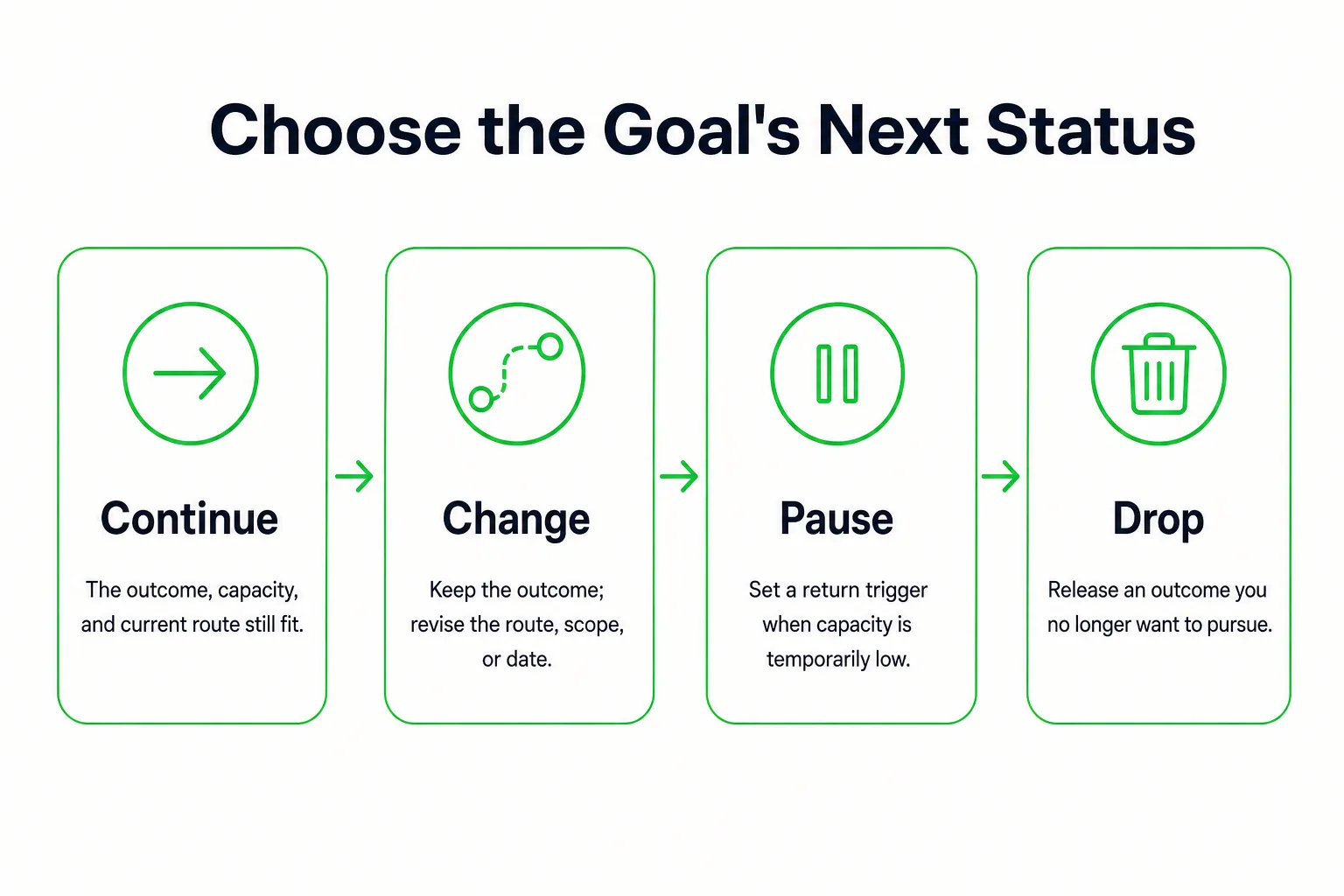
- Do I still want the outcome, knowing what pursuing it involves? If not, drop the goal and release its future appointments. Keep useful work or learning you have already done, but do not continue only because you have already invested time.
- If I still want it, is the goal complete? If it is, close it. Then decide whether a supporting behavior should continue as maintenance, or whether it has served its purpose. For example, finishing a course may complete a learning milestone without requiring the same study schedule to continue.
- If it is unfinished, does it fit my current capacity? If a temporary responsibility or resource constraint leaves no room for meaningful work, pause the goal. Set a return trigger, such as the end of a defined caregiving period, or a date to reconsider it. Remove its recurring sessions while it is paused.
- If it still fits, is the current route moving the milestone forward? Continue when the method and commitment remain suitable. Change the method, scope, or timeline when your experience shows they need adjusting.
For the career example, continue if the course fits the three-hour commitment and addresses the skill gap you identified. Change course if its content does not address that gap. Pause during a defined period of caregiving if the available time is temporarily spoken for. Drop the goal if the target role no longer represents work you want to do.
Separate actions you can control from outcomes other people decide. If you finish the learning milestones but applications receive no response, inspect whether the roles fit your experience and whether your application materials show the relevant work. Adding more courses is only one possible response, not an automatic requirement.
Finish by writing down the decision and its reason, the next milestone or return condition, and the next review date. Remove obsolete recurring tasks if you pause or drop the goal. A major change in health, responsibilities, work, or finances can bring this review forward; you do not have to wait for the annual date.