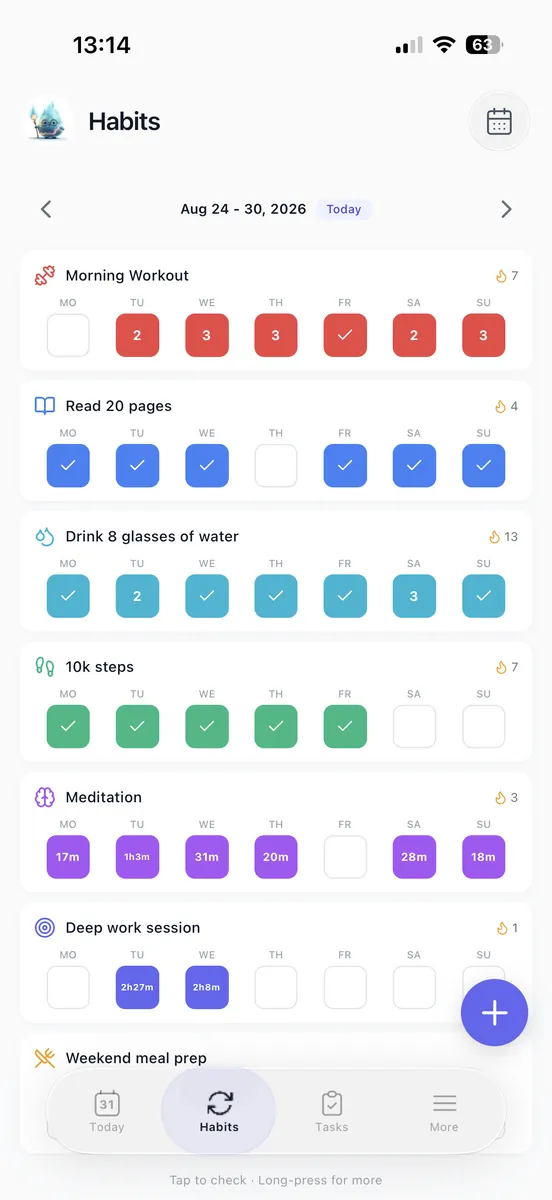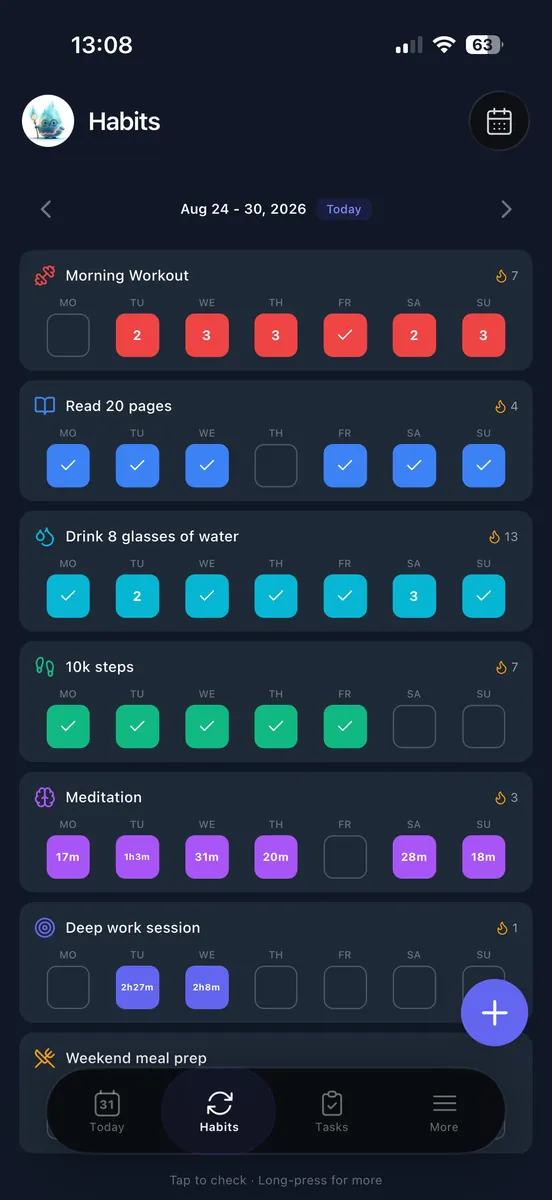
Useful habit tracker examples pair a clear action with a schedule and a place to record what happened. Copy one of the weekly examples below, choose three habits, and mark completed, partial, missed, and unscheduled days separately.
You’ll find seven examples: three completed weekly trackers, two paper layouts, a restart example, and a review example. Start with three rows. If you already track four or five useful habits, choose the three you most want to examine this week instead of adding more. For help deciding how much to track, see how to choose a manageable number of habits.
Weekly Trackers for Three Different Schedules
Use this legend in each table: ✓ means the stated action was completed; P means some was done, but less than the stated minimum; × means a scheduled action was missed; · means it was not scheduled.
1. A Student Week
These rows combine study preparation with money awareness. The evening bag check makes tomorrow’s classes easier to prepare for, while logging purchases gives you a record of spending.
| Habit | Mon | Tue | Wed | Thu | Fri | Sat | Sun |
|---|---|---|---|---|---|---|---|
| Recall course material for 10 minutes, Monday, Wednesday, and Friday | ✓ | · | P | · | ✓ | · | · |
| Pack a bag for the next day, Sunday through Thursday | ✓ | × | ✓ | ✓ | · | · | ✓ |
| Log purchases each evening | ✓ | ✓ | × | ✓ | P | ✓ | ✓ |
For recall, P means stopping before 10 minutes. For purchase logging, P means entering only some purchases. Each row has its own schedule, so an empty-looking day can be correctly marked · when the action was not scheduled.
2. A Busy-Adult Week
This set makes room for a short walk, a quick evening home reset, and attention to unplanned spending. Before Monday, define what counts as a planned purchase, such as groceries on your list; necessities still belong in the budget. If you want to record purchase decisions in more detail, use the no-spend challenge tracker.
| Habit | Mon | Tue | Wed | Thu | Fri | Sat | Sun |
|---|---|---|---|---|---|---|---|
| Walk for five minutes, Tuesday, Thursday, and Saturday | · | ✓ | · | × | · | ✓ | · |
| Clear the kitchen counter each evening | ✓ | P | ✓ | × | ✓ | ✓ | ✓ |
| Buy no unplanned extras, Monday, Wednesday, and Friday | ✓ | · | × | · | ✓ | · | · |
A walk is one possible health row. The CDC illustrates a specific food goal: eat a side salad with dinner on Mondays, Wednesdays, and Fridays. You could substitute that for a row if it matters more to you, keeping the set at three.
3. A Professional Workweek
These rows balance work focus with room for relationships. The priority is a morning cue before email; the focus block is a separate work session, and the thoughtful message gives a personal connection a place in the week.
| Habit | Mon | Tue | Wed | Thu | Fri | Sat | Sun |
|---|---|---|---|---|---|---|---|
| Write the day’s priority before opening email on weekdays | ✓ | ✓ | × | ✓ | ✓ | · | · |
| Complete a 20-minute focus block on weekdays | ✓ | P | ✓ | × | ✓ | · | · |
| Send a thoughtful message to a friend on Wednesday and Sunday | · | · | ✓ | · | · | · | × |
P on Tuesday means some focus work happened, but it did not reach 20 minutes. Swap a row when another behavior matters more, such as preparing tomorrow’s lunch or writing one sentence of gratitude. Keep the set the same size.
Paper Layouts and How to Choose Your Format
4. A Calendar Habit Tracker
Write one action and its scheduled days above a monthly calendar, then mark each applicable date box with the shared legend. This layout suits one habit whose dates matter, such as a walk scheduled for Tuesdays and Thursdays. The calendar makes those dates easy to see, though it has less room for several habits.
5. A Circle Habit Tracker
Divide a circle into dated segments and use one ring per habit. Leave enough space in each segment for a mark. This can fit naturally in a bullet journal and gives the month a visual shape, but drawing takes setup time and leaves limited room for notes.
| Format | Choose It When | Tradeoff |
|---|---|---|
| Calendar | One action has visible dates | Limited space for several habits |
| Table | You want several habits side by side | Needs a wider page |
| Circle | You want a visual journal layout | More drawing, less writing room |
| Printable | You want a reusable paper layout | Requires printing and physical storage |
| Digital | You want to check in on a phone or computer | Requires access to a device |
Printable and digital describe how you use a tracker; a printable can be laid out as a calendar, table, or circle. For a ready-made paper layout, try the printable habit tracker generator, then check your print options when saving a habit tracker PDF. If access to a device is your deciding factor, compare free habit tracker apps.
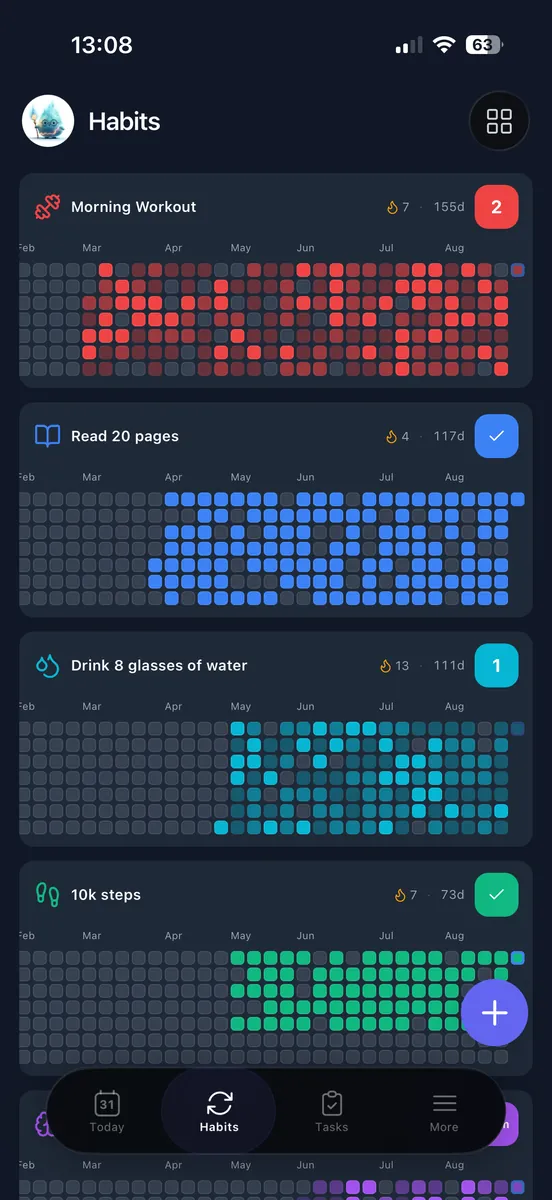
 Loggd · by the makers of this blog
Track your habits, tasks and goals in one free app.
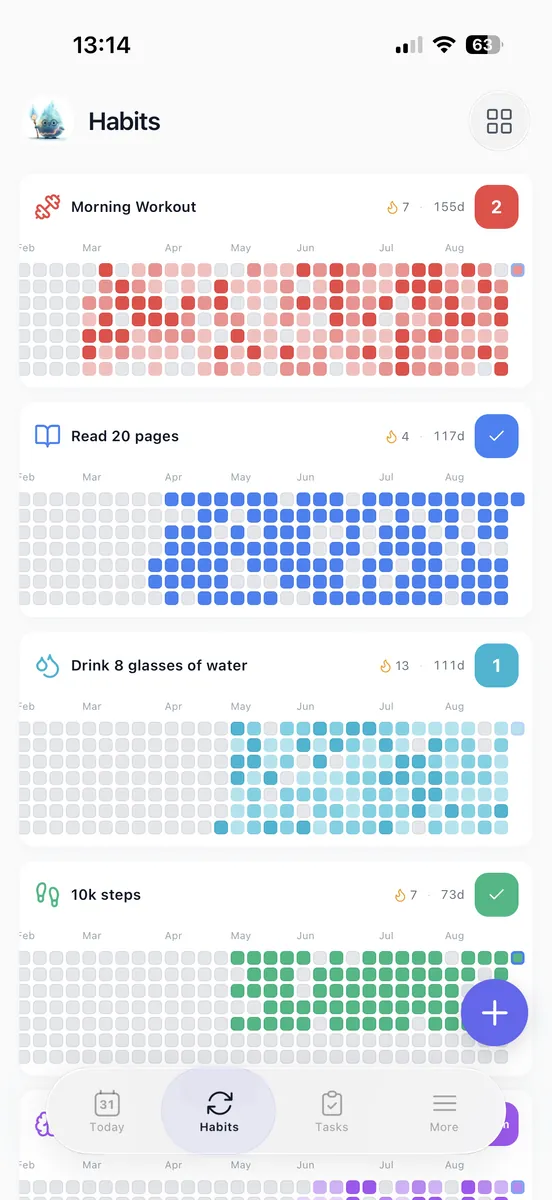
Every day you check off fills in a grid of your last 365 days, so you can see if you are getting better.


Free plan with no time limit. No credit card.


Use Missed Days and Reviews to Choose What Comes Next
A tracker should still work after a disruption, and its marks should help you decide what to do when the page fills.
6. A Restart After Missed Days
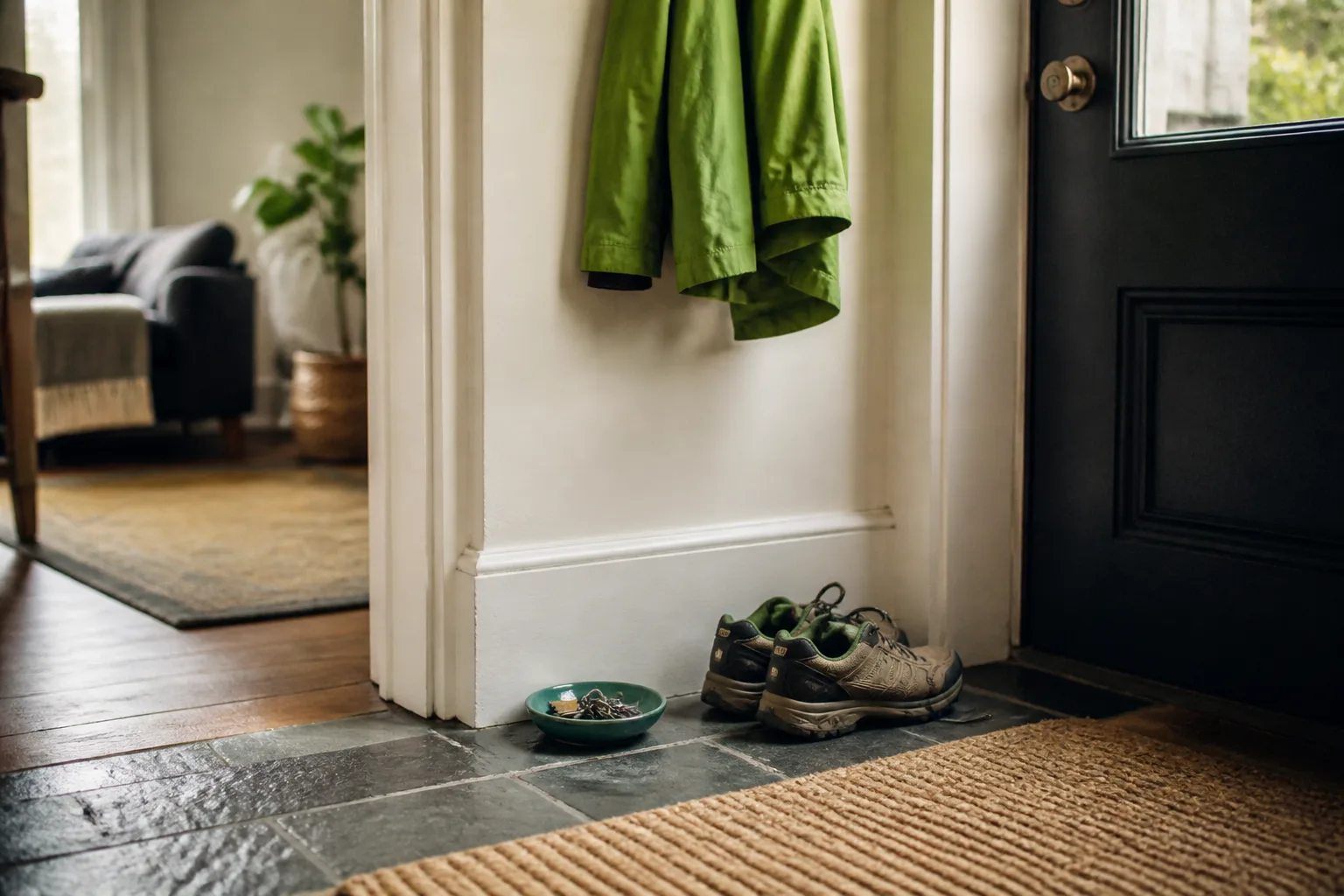
A useful habit row names what you will do, fits an ordinary week, and gives you a way back after missed days. Say your workweek focus block is scheduled Monday through Friday. You complete Monday, do part of Tuesday's 20-minute block, miss Wednesday and Thursday, then return Friday. Record ✓, P, ×, ×, ✓. P means you did some focus work but stopped before 20 minutes; keep that threshold as written for the week.
After a three-day gap, fill only the entries you can recall. Mark days you cannot remember with ?, not ✓, P, or ×, then resume on the next scheduled day. Keep P for a partial action you know happened. University of Minnesota Extension recommends planning how to return after interruptions. If the current action feels too large, choose a smaller replacement from micro habit examples and use it in place of the current row, not as another habit.
7. A Monthly Review That Leads to a Decision
Once a week is complete, use its marks to make a practical adjustment. In the busy-adult example, keep the five-minute walk on Tuesday, Thursday, and Saturday. Move the kitchen reset to immediately after dinner, when it may fit the evening better. Stop tracking bag packing once a dedicated check-in no longer helps; stopping the row does not require stopping the behavior.
At the end of each month, ask: Which scheduled actions did I complete? What repeatedly got in the way? Which row should I keep, change, or stop? For a yearly review, scan those dated monthly decisions and note which habits stayed useful through schedule changes. A guide to contribution grids and streaks can help you look across the year without treating one broken streak as the whole record. Date one change for the coming week.