Examples of long-term objectives include building an emergency fund in 12 months, completing a professional certificate within two years, or finishing a planned home update within five years. To make an objective useful, give it a measurable outcome, a deadline, milestone dates, and a weekly action you can fit into your life.
Treat the examples below as starting points. Replace the amounts, scope, and dates with figures and deadlines that fit your circumstances. “Improve my career” names a direction; “complete three portfolio projects by next June” gives you something to check. If you are unsure whether your wording names a direction or a result, use this goals-and-objectives test. Start with the result you want to finish.
Start With an Objective That Has a Clear Finish
Use checkpoints to make progress visible before the deadline. Each example ends in something you can verify, rather than an outcome controlled by someone else.
-
Career development: Within 18 months, build a portfolio of three completed projects relevant to the role you want. By month 1, choose a skill to demonstrate and write briefs for the projects. Finish the first by month 6, the second by month 12, and the third by month 18. Ask for feedback after each, then use it to guide the next project. For role-specific adaptations, see these career development plans. Your objective is the portfolio, not a promise of a hiring decision.
-
Financial planning: Set aside a chosen emergency-fund target within 12 months by saving a consistent amount each month. Check for one-quarter of the target by month 3 and one-half by month 6. An emergency fund is money reserved for unexpected expenses. First, review essential expenses and required debt payments, then set a monthly contribution that fits after them. Adjust the target or timeline if that contribution does not fit your budget.
-
Education and learning: Finish a chosen course and two applied projects within 12 months. Select the course by month 1, finish its first half by month 4, complete the coursework by month 8, and finish both projects by month 12. Choose one skill from the course and turn each study session into practice with these deliberate practice examples.
-
Home and lifestyle: Make a spare room usable as a workspace within 18 months. By month 2, agree on the work to be done and a spending cap. Clear the room by month 4, finish repairs by month 12, and install essential furniture by month 18. Write down what “usable” means for you, such as a clear work surface, lighting, and storage for the items you need.
-
Travel and experiences: Take a five-day trip within two years while staying under a spending cap you set now. By month 3, choose a destination and estimate the full cost, including transportation, lodging, meals, and local travel. Check your savings against that estimate at month 12. By month 21, arrange time off and make bookings that fit your budget and availability.
Each objective has a finish line you can assess yourself. That makes it easier to see what is complete, what remains, and whether the plan still fits.
Define Objectives That Need a Regular Routine
Some objectives have a finish line that includes repeating an action for a set period. Give the routine checkpoints, too, so you can adjust it before the final review.

-
Health and fitness: By month 12, establish a weekly walking routine that includes 150 minutes of moderate activity, and record completion through the final eight weeks. In month 1, review a manageable starting amount; review the schedule again in months 3 and 6. Adults doing at least 150 minutes of moderate aerobic activity weekly can receive substantial health benefits. Adapt activity to your health, and ask a clinician what is suitable if a condition or symptoms affect exercise.
-
Personal development: Over one year, read six books on a chosen subject and write a short note on how you might apply each one. Choose your first book now, finish two by month 4, four by month 8, and six by month 12. Start with two 15-minute reading sessions each week, then check whether that pace supports the books you chose.
-
Relationships and family: By year-end, complete nine monthly shared activities, starting in month 4. Agree on a format and budget during month 1, try an activity in months 2 and 3, and review at months 6 and 9 whether the plan still suits the people involved. Track the shared commitment, not a score for closeness.
-
Business and leadership: Over 12 months, establish a monthly project review and complete three improvements identified through it. Set the review agenda by month 1, then finish one improvement by months 4, 8, and 12. Record the changes completed rather than assuming that revenue or morale will rise.
-
Community and contribution: Complete 12 volunteer shifts over the next year. Choose a suitable opportunity by month 1, complete three shifts by month 4 and seven by month 8, then finish the remaining shifts by month 12. Check the actual shift length before committing so the schedule fits your availability.
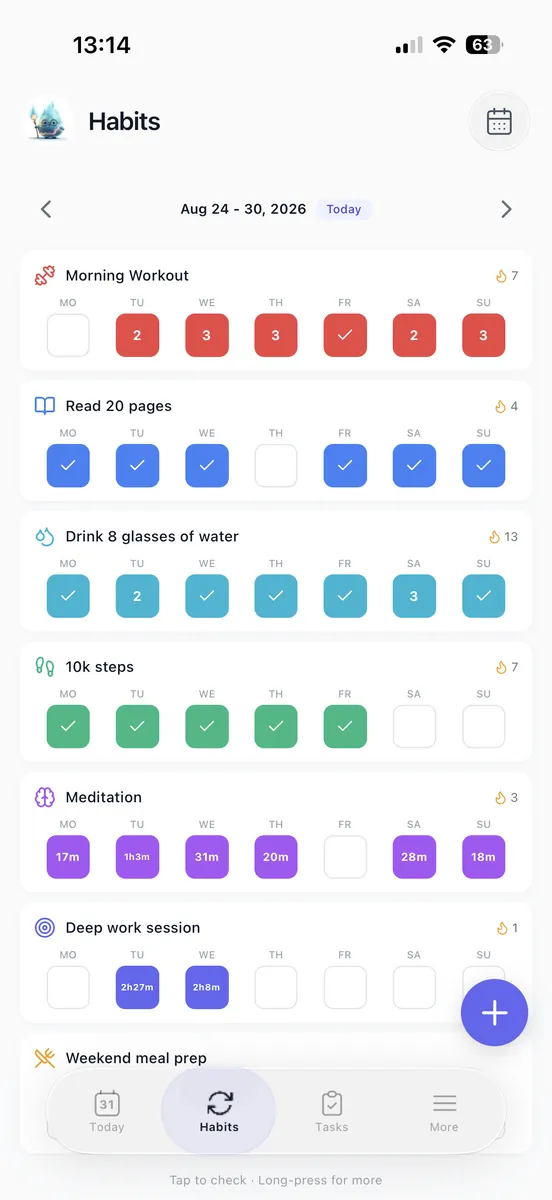
To record repeatable actions separately from the result they support, adapt these habit tracker examples.
 Loggd · by the makers of this blog
Track your habits, tasks and goals in one free app.
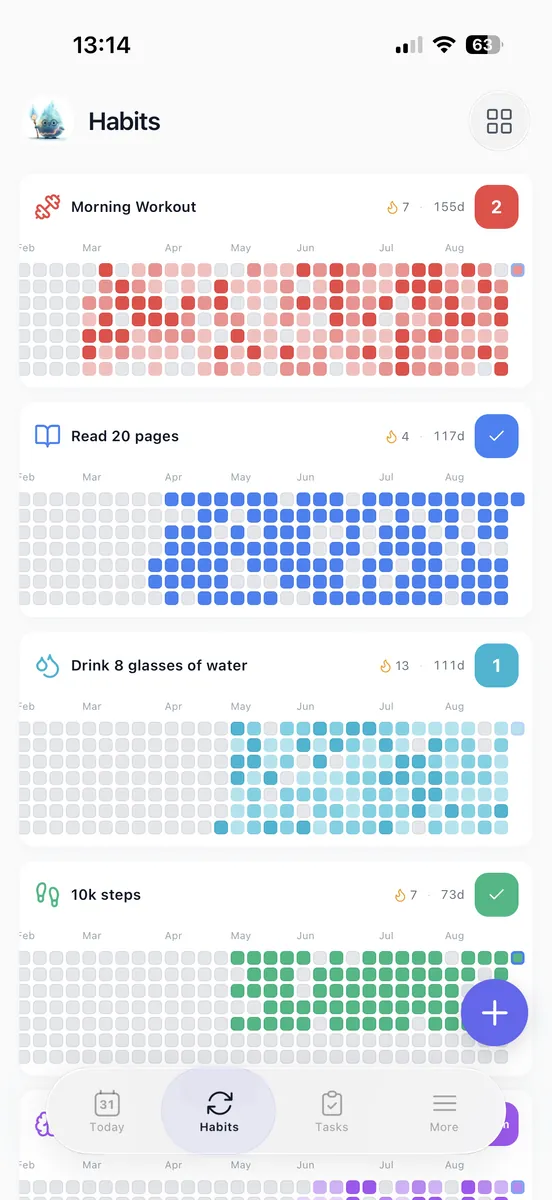
Every day you check off fills in a grid of your last 365 days, so you can see if you are getting better.


Free plan with no time limit. No credit card.


Choose a One-Year, Three-Year, or Five-Year Horizon
The useful time horizon depends on the scope of the work, the time and money you can commit, and what needs to happen first. Check those constraints before assigning a deadline. A large ambition does not automatically need a five-year plan.
| Time horizon | Adaptable objective | Interim checkpoints | Check before choosing it |
|---|---|---|---|
| One year | Complete an introductory course and one applied project. | Choose the course in month 1, finish the coursework by month 8, and complete the project by month 12. | Does the weekly study time fit, and can you cover the course costs? |
| Three years | Complete a selected certificate and three applied projects. | Confirm prerequisites in month 3, complete the first project in year 1, check certificate progress in year 2, and finish in year 3. | What are the program’s actual requirements and schedule? |
| Five years | Build the skills and project experience to complete a defined end-to-end project independently. | Agree on the final acceptance checklist in year 1, complete component projects by year 3, and deliver the full project by year 5. | Will you have access to practice, equipment, and feedback? |
These are alternative scopes, not steps in a required sequence or a forecast of how long skill development takes. Keep later years broad, but make the next three months concrete: name the work, schedule time for it, and choose a checkpoint. At your annual review, revisit the long-range scope against your actual progress and circumstances.
Pick What Fits Your Ordinary Week
Choose an objective whose next action fits your ordinary week, and decide what you will do when that week goes wrong. For each candidate, write down the time and cash it needs next month, any genuine deadline, and what it depends on. A preferred finish date is not the same as a deadline with a real consequence.
Then ask which objective needs attention now, which supports a commitment you already have, and which can wait without a meaningful cost. Choose the active objective based on those answers, not on how impressive it sounds. Do not assign the same hour to several plans.
For example, if you have two 30-minute blocks available each week, a course that needs three hours weekly requires a different schedule, a smaller scope, or a later start. Start with one demanding objective alongside routines you already maintain. Add another only when you have assigned it its own time and resources.
If a disrupted week knocks out your planned sessions, use a fallback such as one 15-minute practice session. Then check whether the deadline still fits; reducing the weekly action does not preserve the original date by itself.
Before you begin, check:
- Time is reserved in your week.
- The cost is accounted for.
- The first action is chosen.
- A fallback for a missed week is named.
- Other objectives are on a waiting list.
Work Backward From the Deadline to This Week
Work backward from a result you can check, not a broad intention. Use this sentence to set the objective: “By [date], I will complete [observable result], with [milestone] finished by [date], supported by [weekly action].” Then follow the sequence below.
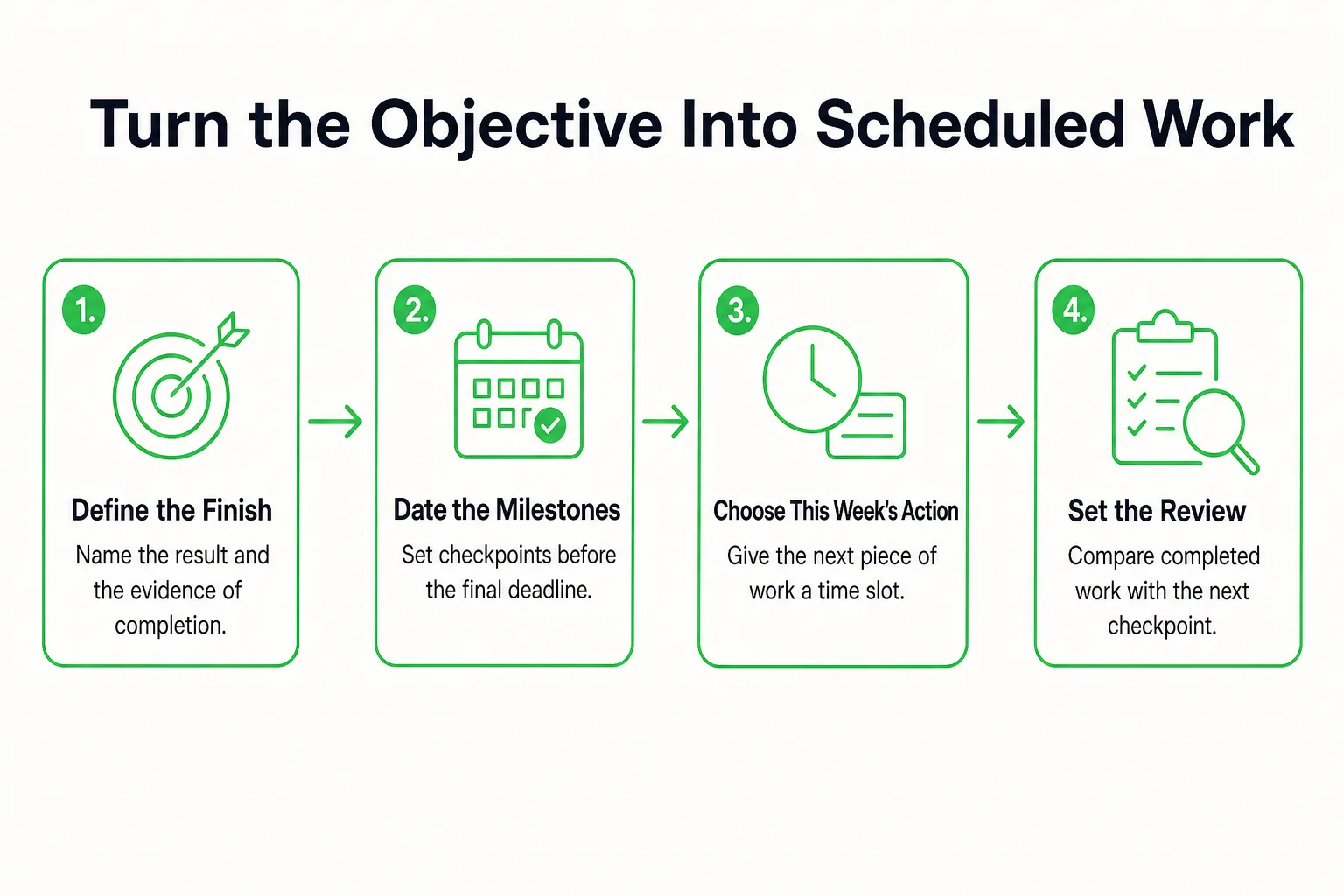
- Define the finish line. For a 12-month course-and-project objective, completion means finished coursework plus a working project that meets a written checklist. Make the checklist specific enough to inspect, such as listing the functions or components the project must include.
- Choose milestone dates. Choose the course by the end of month 1, finish half of it by month 4, complete the coursework by month 8, produce a first project version by month 10, and finish revisions by month 12.
- Identify the work for the next milestone. If the first milestone is selecting a course, check prerequisites and compare its schedule with your available time. For a later project milestone, name the component you will build or revise.
- Schedule a weekly action. In the first week, check the prerequisites, inspect the course schedule, and reserve two 30-minute study sessions. At the first monthly review, compare the workload with those available sessions. Adjust the scope or deadline if the fit is poor.
- Set the first review date. Put a short check-in on your calendar for the end of the first month. Adapt the next milestone into smaller targets with these short-term goal examples.
The sequence is: finish line → dated milestones → next milestone’s work → scheduled action → review. Log both the study session and the module or project component completed. The session records an action; the module or component records progress. Neither one, on its own, proves learning or guarantees the finish line. Use Loggd to keep the tasks, focus sessions, and goal in one place so the planned work stays together.
Review, Revise, or Pause the Objective
Set a five-minute weekly check to keep the next action visible, a monthly review to compare results with milestones, and an annual review to decide whether the objective still deserves your time and money. These are practical checkpoints, not a test of discipline.
At the weekly check, ask: What did I complete? What blocked the next action? What is scheduled next? At the monthly review, compare the work you finished with the milestone date. Enthusiasm can change from week to week; the dated result gives you something concrete to assess.
Choose what to do next:
- Continue when the plan still fits your available time, money, and commitments.
- Revise the action when your current approach is not producing the work the next milestone requires.
- Revise the scope or deadline when your capacity or circumstances change.
- Pause when a more pressing commitment needs the time or money the objective requires.
For example, if your study time drops from two hours to one hour a week, check the remaining coursework and project work against the time you have. Choose a later deadline or a smaller project if that is what the new schedule can support. Do not keep planning two hours you no longer have.
When you pause, record the last completed milestone, the next action, and a date to reconsider the objective. Remove its recurring work from your current schedule so it does not sit there as overdue. A pause does not have to become a promise to resume.
At your annual review, decide whether the objective still serves a current priority. If it no longer does, remove it from your active plans. Keep any useful work or skills for later without carrying the old commitment forward. If the objective still matters but its actions remain vague, use these practical ways to connect goals with daily work.
Now choose: keep the next milestone, change it, or give the objective a dated pause.
Sources
- An essential guide to building an emergency fund
- Increase the proportion of adults who do enough aerobic physical activity for substantial health benefits, PA-02